SSC GD 2026 Notification: A Golden Opportunity for 25,487 Constable, Rifleman & Sepoy Posts
The SSC has officially released the notification for “GD Constable / Rifleman / Sepoy 2026” recruitment — opening doors for a massive intake of candidates across India.
A total of 25,487 vacancies have been announced under this drive, making it one of the biggest recruitment campaigns for paramilitary / allied forces this year.
These posts include:
- General-Duty (GD) Constable (for male/female)
- Rifleman (GD) (for certain forces)
- Sepoy (GD) (for certain forces)
The recruitment is for multiple central forces / agencies, including Border Security Force (BSF), Central Industrial Security Force (CISF), Central Reserve Police Force (CRPF), Indo-Tibetan Border Police (ITBP), Sashastra Seema Bal (SSB), Assam Rifles (AR — for Rifleman/GD), Secretariat Security Force (SSF), and in some cases other authorised organizations — depending on vacancy allocation.
For many young aspirants, especially class 10 pass candidates, this represents an attractive and reachable opportunity to join central armed forces or paramilitary — a stable, respected government job with a clear career pathway.
Why This Recruitment Matters — The Big Picture
• Huge Number of Vacancies
With more than 25 thousand posts (25,487), the 2026 drive is among the largest in recent years under SSC GD. For candidates across India — rural or urban, from small towns to metros — the volume itself expands chances of selection.
• Low Educational Barrier: 10th Pass Eligible
The minimum educational qualification is matriculation (Class 10) or equivalent from a recognised board — making this accessible to a wide segment of youth.
Young aspirants who may have discontinued formal education or enrolled only up to 10th standard now have a credible pathway to a government career.
• Promises of Government Job Stability, Respect & Career Growth
Constable / Rifleman / Sepoy positions in forces like BSF, CISF, CRPF, ITBP etc. come with job security, allowances, pension/retirement benefits (as per service norms), and structured career progression over time — offering more than just an initial salary.
For many, this may be the first step in a long-term career in India’s security or paramilitary services.
• National-level Opportunity — For All States & Regions
Because vacancies cover multiple forces across India, candidates from every state (including from Kerala, like you) can apply — provided they meet the eligibility criteria.
This nationwide nature democratizes access, allowing youth from less represented or remote regions equal opportunity.
SSC GD 2026: Important Dates & Application Window
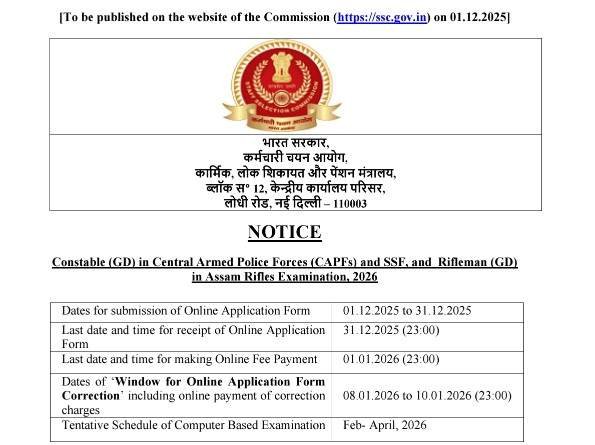
Below are the key timelines for the recruitment cycle (as per the 2026 notification).
| Event | Date / Period |
|---|---|
| Notification release & application start date | 1 December 2025 |
| Last date to submit online application | 31 December 2025 (up to 11:00 PM) |
| Last date to pay application fee (if applicable) | 1 January 2026 |
| Correction window (if any mistakes in form) | 8 – 10 January 2026 |
| Tentative examination period (Computer-based) | February – April 2026 |
Important Note: Applicants must not wait until the last moment to apply to avoid server overload or technical glitches. Fill the form early after verifying eligibility.
Who Is Eligible? — Eligibility Criteria
Educational Qualification
- Must have passed Class 10 (Matriculation) or equivalent from a recognised board/university by the specified cut-off date.
- Those still appearing in Class 10 exams (i.e. results not declared) are not eligible.
Age Limit
- General Age: 18 to 23 years as on 1 January 2026.
- Age relaxations are applicable for reserved categories per government norms (e.g. SC/ST, OBC, Ex-Servicemen, etc.).
Citizenship / Nationality
- Must be a citizen of India (or meet specific domicile / residence criteria for certain posts, if mentioned).
Physical & Medical Standards
Given the nature of the job — in paramilitary / security forces — there are mandatory physical standards and fitness tests (PST, PET), followed by medical examination.
Details:
- Height (minimum): Male – generally 170 cm; Female – generally 157 cm.
- Chest (for males): Unexpanded 80 cm with at least 5 cm expansion (varies slightly for certain categories/regions).
- Weight: Should be proportionate to height, age, and medical fitness (not fixed, depends on body proportion) as per PST guidelines.
Candidates must also meet basic medical standards — including vision, hearing, dental fitness. For example: eyesight standards (distant vision 6/6 in one eye and 6/9 in the other without glasses; no color blindness, night blindness or squint), hearing (able to hear whisper from 6 meters), dental health (minimum number of healthy teeth), no serious medical issues, etc.
Failing to meet physical or medical standards may lead to disqualification — even if the candidate clears the written exam.
Which Forces / Agencies & How Many Vacancies
The 25,487 vacancies are distributed among various central forces / agencies and include both male and female posts.
While the final force-wise vacancy break-up may vary (based on allocation by the Ministry/HQ), typical participating forces include:
- BSF
- CISF
- CRPF
- ITBP
- SSB
- AR (Assam Rifles — for Rifleman GD)
- SSF (Secretariat Security Force)
- Other authorised organisations/agencies as per notification (depending on state or role)
The vacancies include both male and female posts — enabling women to apply too.
Given the large number of vacancies, chances are high that many aspirants may secure a place — if they meet eligibility and prepare well.
Selection Process — What to Expect
The recruitment is not just about a written exam: selection involves multiple stages to ensure candidates meet educational, cognitive, physical, and medical standards.
Here’s the detailed flow:
1. Computer-Based Examination (CBE / CBT)
- The first stage is an online computer-based written test.
- The exam has 80 objective-type questions, total marks 160.
- Exam duration is 1 hour (60 minutes) — requiring quick thinking and speed.
- Negative marking applies: for each wrong answer, 0.25 marks will be deducted.
- Subjects/Sections typically include:
- General Intelligence & Reasoning
- General Knowledge & General Awareness
- Elementary Mathematics
- English / Hindi (language)
- Languages: Exam is usually held in English and Hindi — and in some cases regional languages (depending on centre).
Candidates clearing/qualifying in this CBT (i.e. clearing cut-offs) become eligible for the next stages.
2. Physical Standard Test (PST) & Physical Efficiency Test (PET)
After CBT, candidates are shortlisted for physical evaluation. This comprises two key parts:
- Physical Standard Test (PST): Involves measurement of height, chest (for male), weight — ensuring candidates meet minimum physical standards as per their category/region.
- Physical Efficiency Test (PET): A race / endurance test — for example: male candidates may need to run 5 km within 24 minutes (in general areas) to qualify. Women candidates have separate standards.
The PET / PST stage is qualifying in nature (i.e. you must only meet minimum standards) for short-listing; performance marks in PET/PST don’t contribute further to final merit list.
3. Medical Examination & Document Verification
Candidates who qualify PET/PST will undergo a Detailed Medical Examination (DME) — involving tests for vision (distant and near), hearing, dental health, general medical fitness (no serious ailments, no colour blindness/night blindness/squint for vision, good hearing, dental health, etc.).
Along with medical exam, original documents verification will be done (educational proofs, identity, domicile, category certificates if any, etc.).
Only after clearing medical fitness and verification will the candidate’s selection be confirmed and final merit list prepared (as per performance in CBT + qualifying physical & medical standards).
What is the Exam Pattern & Syllabus for CBT?
Given the competition and objective-type format, candidates must be thoroughly prepared. Below is a breakdown of the exam pattern and syllabus for 2026 (as per official release).
Exam Pattern (CBT)
- Mode: Online Computer-Based Test (CBT) / Computer-Based Examination (CBE)
- Number of Questions: 80 objective-type questions
- Total Marks: 160
- Duration: 1 hour (60 minutes)
- Negative Marking: 0.25 marks for each incorrect/wrong answer
Syllabus / Sections
- General Intelligence & Reasoning: Logical reasoning, analogies, series, coding-decoding, puzzles, etc.
- General Knowledge & General Awareness: Current affairs (national & international), history, geography, polity, economics, general science, sports, awards, general events, etc.
- Elementary Mathematics: Number system, percentages, averages, ratio-proportion, profit & loss, simple interest, time & work, time & distance, mensuration, basic algebra — as per standard school-level syllabus.
- English / Hindi (Language): Grammar, comprehension, vocabulary, synonyms/antonyms, sentence formation, para jumbles, fill-in-the-blanks, basic writing/comprehension skills (short).
Important to note: Given the modest duration (1 hour) and negative marking, accuracy + speed + good time management will be critical for aspirants.
Application Process — Step-by-Step Guide
Here’s how interested candidates must proceed to apply for SSC GD 2026:
- Visit the official SSC website (usually https://ssc.gov.in) — look for the “Apply” / “Registration / Login” section under SSC GD Recruitment 2026.
- If you’re a new user — complete the One-Time Registration (OTR) by filling basic personal details: name, father’s name, gender, mobile, email, ID proof, etc.
- After registration, log in with your credentials, and fill out the application form: educational details, date of birth, caste/category, optional preferences (if any), choice of exam centre etc.
- Upload required documents — scanned photograph, signature, caste/category certificate (if applicable), educational certificate (10th pass certificate or marksheet), identity proof, etc.
- Pay the application fee (if applicable). Historically, general-category male candidates pay a nominal fee; certain categories (women, SC, ST, Ex-servicemen) are usually exempt.
- Take a printout of the completed application form and fee receipt for future reference.
Key Reminders
- The last date to apply is 31 December 2025 (11:00 PM) — ensure you submit well before deadline.
- Fee payment window typically extends slightly beyond application deadline (till 1 January 2026) — don’t delay fee payment.
- Ensure that all information is accurate and documents are correct — mistakes or false information can lead to rejection at any stage (even later during physical or medical stage).
- If selected, be prepared for physical/adaptation requirements, because capacities to work in rugged, remote or challenging terrains may be required (given the nature of some forces).
What Candidates Should Do NOW — Strategy & Preparation Plan
Given the volume of applicants expected, good preparation and timely action can make all the difference. Here’s a recommended plan for aspirants who intend to apply for SSC GD 2026.
1. Download & Read the Official Notification PDF
As soon as the notification is live on SSC’s website, download the PDF and read carefully: check eligibility criteria (age, education, domicile requirements), details of available posts/forces, physical/medical standards, special instructions (e.g. for NCC, handicapped, ex-servicemen), exam centre details, allowed languages, exam languages, etc. This ensures no last-minute surprises.
2. Gather Necessary Documents Early
Have ready the scanned copies of: matriculation (10th class) certificate/marksheet, identity proof (Aadhaar, passport, voter ID, etc.), caste certificate (if applicable), domicile certificate (if required), passport-size photograph & signature (as per specified dimensions), etc.
Delays in obtaining or scanning documents often cause mistakes that lead to rejections or hassles — better to prepare early.
3. Apply Online Early — Don’t Wait for Last Date
Given the likely surge in traffic near the deadline, applying early reduces risk of server overload, payment failures, or last-minute glitches. It also gives you buffer time to fix any errors before submission.
4. Build a Reliable Study Plan for CBT
Since the CBT is the first hurdle, and comprises objective-type MCQs with negative marking and short duration, you need to combine speed + accuracy. Here are quick pointers to prepare efficiently:
- Break down syllabus: Reasoning, GK/GA, Maths, Language — assign weekly targets.
- Use practice tests / mock papers — simulate actual exam conditions (80 questions, 60 minutes, negative marking) to improve speed & time management.
- Revise basics: since the syllabus is mainly school-level maths and general awareness, brushing up on fundamentals can yield good returns.
- Stay updated on current affairs — for GK/GA section.
5. Physical Fitness & Health Preparations — Early Start Helps
Given that PET/PST and medical examination are critical (even post-CBT), start building physical fitness: running, general stamina, endurance. Maintain healthy body proportions (height/weight), good vision & hearing, good dental and general health.
For candidates from Kerala (or any state), this is especially important because physical standards are non-negotiable.
6. Prepare for Documentation & Verification
Keep all original documents ready and well-organized for when shortlisted (after CBT). Also keep copies/backups. Ensure your identity proof address matches with domicile/residential proofs if applicable.
What This Recruitment Means for Aspirants from Kerala / South India
For candidates from Kerala (or other southern states), this recruitment drive presents a strong chance for central force employment even if they are far from their home state. Because SSC GD is a national-level recruitment — exam centres may be allotted nearer to home (depending on availability) — there’s equal footing.
Moreover, given that the educational requirement is only matriculation — a large number of young aspirants from smaller towns/villages (where higher education may not be feasible) get a real shot at central employment.
Also, the prospect of long-term career growth, stable income, allowances, and opportunity to serve in paramilitary or security forces may be appealing to many who wish to do more than just “office-type” jobs.
However, aspirants should be aware of the physical and medical requirements, and be genuinely prepared for a disciplined, demanding career — often requiring physical stamina, mental strength, and readiness to serve in challenging conditions (border areas, remote locations, high altitude, etc.).
Common FAQs: Clarifying Key Doubts
Q: Is matriculation (10th pass) enough to apply for SSC GD 2026?
A: Yes. The minimum required qualification is Class 10 or equivalent from a recognised board. Those who have passed the exam by the specified date (i.e. before or on cut-off) are eligible.
Q: What is the age limit?
A: 18 to 23 years as on 1 January 2026 for general candidates. Age relaxation is provided for reserved categories as per government norms.
Q: Can women apply for SSC GD 2026?
A: Yes. The recruitment includes female posts along with male. Both male and female candidates can apply if they meet eligibility criteria (education, age, physical standards as applicable).
Q: What is the exam pattern and syllabus for CBT?
A: The CBT (Computer-based written exam) will have 80 objective-type questions, total 160 marks, duration 1 hour, with negative marking (0.25 mark per wrong answer). Sections include Reasoning, General Knowledge & Awareness, Elementary Mathematics, and English/Hindi (language).
Q: What is the selection process?
A: Multi-stage:
- Computer-Based Exam (CBT)
- Physical Standard Test (PST) and Physical Efficiency Test (PET)
- Detailed Medical Examination (DME) + Document Verification
Final selection depends on clearing all stages.
Q: When is the last date to apply?
A: 31 December 2025 (by 11:00 PM) is the last date to submit the online application. Fee payment window extends upto 1 January 2026.
What Next? — Action Plan for Aspiring Candidates
If you — or if you know someone — are eligible and planning to apply for SSC GD 2026, here’s a straightforward action checklist:
- Visit SSC website → download official notification PDF → read carefully.
- Gather all necessary documents (10th mark sheet/certificate, identity proof, photo, signature, caste/domicile certificate if applicable).
- Fill application form online well in advance — don’t wait for the last day.
- Pay application fee (if applicable) before deadline.
- Start revision & preparation for CBT: Focus on reasoning, general knowledge, maths fundamentals, language — emphasise speed + accuracy.
- Begin physical fitness regimen to meet PET/PST standards (especially if applying for paramilitary forces).
- Keep track of admit cards / notifications via SSC portal or email/SMS — sometimes admit cards are released only a few days before exam/physical test.
- Prepare originals and copies of documents for verification / medical test if shortlisted.
- Stay updated with official SSC announcements regarding exam date, admit cards, etc. Bookmark SSC’s website or set alerts.
- Have backup plans — often many apply; stay realistic but optimistic; simultaneously keep alternative career paths in view.
Final Thoughts
The SSC GD 2026 recruitment drive is a major opportunity for young, motivated and eligible aspirants — especially those with only matriculation or from modest backgrounds — to secure a stable career in India’s paramilitary / central security forces.
With 25,487 vacancies, the probability of selection is higher than smaller drives; but that also means competition will be intense. Success will depend not just on eligibility, but on timely application, smart preparation, physical fitness, and thorough compliance with standards at every stage — written, physical, and medical.
For aspirants from Kerala (or any other state), this is a golden window — but one that requires preparation, discipline, and commitment.