University of Kashmir Releases Syllabus for Lab Assistant and Junior Lab Assistant Recruitment 2025
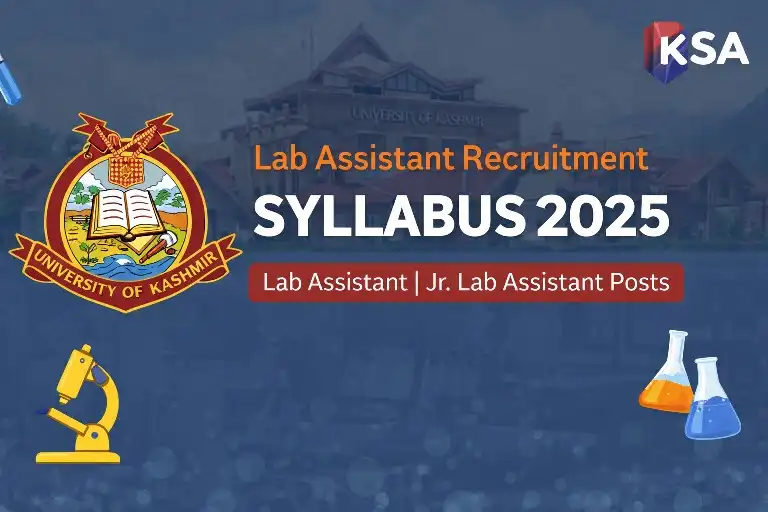
The University of Kashmir, a NAAC A++ accredited institution, has officially released the detailed syllabus for the posts of Lab Assistant and Junior Lab Assistant in multiple departments. The syllabus has been issued in connection with Advertisement Notification No. 01 of 2025 dated January 2, 2025, providing crucial guidance to candidates preparing for the upcoming screening tests.
This notification is a significant development for aspirants seeking non-teaching technical positions at the University, as it clearly outlines the subject-wise syllabus, examination pattern, and core competencies required for selection. According to the official notice dated January 21, 2026, the syllabus has been annexed department-wise to ensure transparency and uniform preparation standards .
Posts and Departments Covered Under the Syllabus
The released syllabus applies to the following posts and departments at the University of Kashmir:
Lab Assistant Posts
- Centre of Research for Development (CORD)
- Department of Earth Sciences
- Department of Geo-informatics
- Institute of Home Science
- Media Education Research Centre (MERC)
- Department of Pharmaceutical Sciences
- Department of Zoology
- Department of Geography and Disaster Management
Junior Lab Assistant Posts
- Department of Computer Science
- Department of Electronics
Each department has a distinct and specialized syllabus, reflecting the technical and practical nature of laboratory work in the respective discipline.
Examination Pattern and Screening Test Details
For most Lab Assistant posts, particularly in science-related departments such as Microbiology (CORD), the screening test has been designed with a strong focus on core laboratory skills and applied knowledge.
Key Highlights of the Screening Test:
- Total Questions: 100 Multiple Choice Questions (MCQs)
- Total Marks: 100
- Duration: 120 minutes (2 hours)
- Marking Scheme: 1 mark per question
- Credits: 10 credits with 10 questions per credit
The syllabus emphasizes a balanced integration of theory and practical knowledge, aligned broadly with undergraduate-level curricula, especially B.Sc. programmes.
Focus Areas for Lab Assistant (CORD – Microbiology)
The syllabus for the Microbiology Laboratory Assistant post is among the most detailed and structured. It focuses on the daily responsibilities of a laboratory assistant, ensuring candidates are tested on real-world laboratory competencies.
Major Areas Covered:
- History and scope of microbiology
- Laboratory safety, biosafety levels (BSL-I to BSL-V), and waste disposal
- Microscopy techniques (light, fluorescence, electron microscopy)
- Sterilization, staining, and aseptic techniques
- Culture media preparation and microbial cultivation
- Microbial identification and biochemical tests
- Diagnostic microbiology (clinical samples, antibiotic sensitivity testing)
- Immunology and immunodiagnostic techniques
- Biochemistry, enzymology, and microbial metabolism
- Molecular techniques such as PCR and agarose gel electrophoresis
- Environmental and industrial microbiology
This structure ensures that candidates are evaluated not just on memorization, but on functional laboratory readiness .
Department-Specific Syllabi: A Broad Academic Spectrum
Earth Sciences
The syllabus includes advanced topics such as structural geology, stratigraphy, sedimentology, mineralogy, petrology, hydrogeology, tectonic geomorphology, and engineering geology. It is designed to test both conceptual clarity and applied geological understanding.
Geo-informatics
Candidates will be assessed on remote sensing, GIS, GNSS, geospatial statistics, modelling, open-source GIS platforms, programming fundamentals, geospatial databases, and artificial intelligence applications.
Institute of Home Science
The syllabus spans advanced nutrition, life-span nutrition, clinical and therapeutic nutrition, biochemistry of carbohydrates, lipids and proteins, communication techniques, community participation methods, gender and development, and extension programme planning.
Media Education Research Centre (MERC)
The focus is on communication theory, media models, newsroom practices, camera handling, lighting, sound, video production, editing software, studio setup, podcasting, and basic computer knowledge.
Pharmaceutical Sciences
This is one of the most extensive syllabi, covering pharmaceutical analysis, spectroscopy, chromatography, pharmacology, pharmacognosy, drug formulation, hospital pharmacy, clinical trials, and drug legislation in India.
Zoology
The syllabus includes animal diversity, anatomy and physiology, developmental biology, microscopy, laboratory instruments, histological techniques, and modern biotechnological methods.
Geography and Disaster Management
Candidates will be tested on physical geography, climatology, oceanography, population studies, environmental geography, surveying, remote sensing, GIS, and statistical techniques.
Junior Lab Assistant Syllabus: Computer Science and Electronics
Junior Lab Assistant (Computer Science)
The syllabus focuses on office productivity tools, operating systems, networking fundamentals, cybersecurity basics, system administration, virtual classrooms, CCTV systems, server infrastructure, web programming, cloud computing, and web security.
Junior Lab Assistant (Electronics)
Core areas include circuit theory, semiconductor devices, rectifiers, amplifiers, oscillators, operational amplifiers, digital electronics, communication systems, and electronic instruments and measurements.
This ensures that Junior Lab Assistants are equipped to support IT infrastructure, laboratories, and teaching environments effectively .
Why This Syllabus Notification Is Important
The release of a comprehensive, department-wise syllabus brings much-needed clarity for aspirants. It helps candidates:
- Prepare in a targeted and structured manner
- Understand the depth and scope of the screening test
- Align preparation with practical job requirements
- Avoid ambiguity regarding exam content
For the University, it reinforces transparency, merit-based recruitment, and academic rigor.
The University of Kashmir’s syllabus notification for Lab Assistant and Junior Lab Assistant posts is a crucial step in the ongoing recruitment process for 2025. With detailed subject coverage, a clearly defined exam pattern, and an emphasis on applied laboratory skills, the syllabus sets a high standard for selection.
Aspirants are strongly advised to download and study the official syllabus carefully, focus on concept clarity, and practice MCQs aligned with laboratory applications to enhance their chances of success.