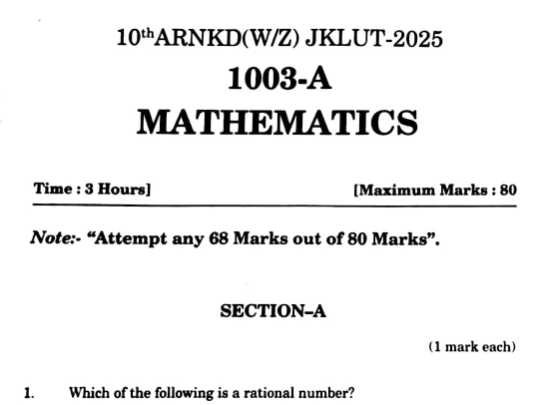
JKBOSE Class 10th Mathematics Question Paper 2025 (Session: October–November) – Download PDF, Exam Analysis, and Key Highlights
The Jammu and Kashmir Board of School Education (JKBOSE) successfully conducted the Class 10th Mathematics examination for the October–November 2025 session. Students across Jammu, Kashmir, and Ladakh divisions appeared for this crucial paper under tight supervision. The exam, which is a key determinant in students’ academic performance, followed the updated syllabus and question pattern prescribed by JKBOSE for the 2025 academic year.
In this article, we provide a complete overview of the JKBOSE Class 10th Mathematics Question Paper 2025, including the PDF download link, exam format, marking scheme, and a detailed section-wise analysis to help future candidates prepare effectively.
JKBOSE Class 10th Math Exam 2025 Overview
| Particulars | Details |
|---|---|
| Board Name | Jammu and Kashmir Board of School Education (JKBOSE) |
| Class | 10th |
| Subject | Mathematics |
| Session | October–November 2025 |
| Exam Mode | Offline (Pen and Paper) |
| Paper Type | Descriptive and Objective Mix |
| Maximum Marks | 100 Marks |
| Time Duration | 3 Hours |
| Official Website | jkbose.nic.in |
JKBOSE Class 10th Mathematics Question Paper 2025 PDF Download
Students who appeared for the exam or are preparing for upcoming sessions can now download the complete question paper PDF for reference and practice.
This question paper helps students understand the latest question trends, important topics, and the difficulty level of the examination.
Exam Pattern and Marking Scheme
The JKBOSE Class 10th Mathematics paper for 2025 followed the latest pattern with a blend of theory-based and application-based questions. The paper was divided into three sections:
- Section A: Very Short Answer Questions (VSAQs) – 1 mark each
- Simple numerical or conceptual questions
- Total marks: 20
- Section B: Short Answer Questions (SAQs) – 2–3 marks each
- Step-wise questions testing understanding and procedure
- Total marks: 30
- Section C: Long Answer Questions (LAQs) – 4–6 marks each
- Complex problems requiring detailed steps and reasoning
- Total marks: 50
Overall, the paper carried 100 marks, with internal choice provided in most sections to help reduce stress among students.
Detailed Question Paper Analysis
The Mathematics question paper (Session Oct–Nov 2025) was balanced in terms of difficulty, offering a fair mix of easy, moderate, and challenging questions. Here’s a section-wise breakdown:
1. Algebra (20 Marks)
Topics like Quadratic Equations, Polynomials, and Arithmetic Progressions dominated this section.
- Most students found the algebra questions straightforward.
- A few tricky problems appeared in factorization and sum of roots.
2. Geometry (15 Marks)
Questions from Triangles, Circles, and Constructions were included.
- One question involved proving similarity, which was slightly challenging.
- Constructions carried 4 marks, requiring precision and neatness.
3. Trigonometry (15 Marks)
This section tested conceptual understanding through identities and height and distance problems.
- The application-based trigonometry questions required strong formula recall.
- Most students rated this section as moderate.
4. Mensuration (10 Marks)
Problems were based on Surface Area and Volume of Solids.
- The question on frustum of a cone was a bit complex.
- Students who practiced NCERT exercises found this manageable.
5. Statistics and Probability (10 Marks)
- The mean, median, and mode problems were simple and scoring.
- A basic probability question based on playing cards was included.
- This section helped students gain quick marks.
6. Coordinate Geometry (10 Marks)
- Focused on distance formula and area of triangles.
- Easy for students who practiced examples from the textbook.
7. Linear Equations and Graphs (10 Marks)
- Question asked to draw graph for given equations.
- Marks were awarded for correct plotting and scaling.
Difficulty Level and Student Reactions
After the exam, most students rated the Math paper as moderate in difficulty.
- 60% of the paper was directly from NCERT exercises and examples.
- A few application-based questions required analytical thinking and multi-step solutions.
- Students appreciated the balanced question paper, saying it allowed time for revision within the 3-hour limit.
Teachers also agreed that the 2025 paper was conceptually strong and aligned with the revised JKBOSE syllabus.
Tips for Future Students
If you’re preparing for the JKBOSE Class 10th Mathematics exam 2026, here are some proven tips based on this year’s paper:
- Focus on NCERT: 70–80% of questions come directly from the JKBOSE-prescribed NCERT textbook.
- Practice Previous Papers: Solving past year papers like the 2025 Math paper gives you a clear idea of exam trends.
- Understand Concepts, Don’t Memorize: Especially for Trigonometry, Algebra, and Geometry, concept clarity is key.
- Time Management: Allocate time per section — attempt easier ones first.
- Show Steps Clearly: Marks are given for logical steps, not just final answers.
- Work on Presentation: Neat diagrams and step-wise solving can fetch additional marks.
Importance of Solving Previous Year Papers
Practicing with question papers such as the JKBOSE Class 10th Math Question Paper 2025 helps students:
- Familiarize with question formats and marking patterns
- Identify high-weightage topics
- Improve speed and accuracy
- Build confidence for the actual exam
Students can also use this paper to conduct mock tests and self-evaluate their performance.
How to Download the JKBOSE Class 10th Math Paper 2025
You can easily download the question paper PDF below:
🔗 Download JKBOSE Class 10th Math Question Paper 2025 PDF (A Series)
Alternatively, visit the Kashmir Student Alerts website for more study materials, previous year papers, and JKBOSE updates
The JKBOSE Class 10th Mathematics Question Paper 2025 (Session: Oct–Nov) was well-structured, moderately difficult, and aligned with the official syllabus. It tested both conceptual understanding and practical application. Students who prepared systematically with NCERT-based revision found the paper straightforward and manageable.
For students appearing in 2026 and beyond, analyzing this paper can provide a significant advantage. Keep practicing, revise important formulas daily, and stay confident — success will surely follow!