JKBOSE Class 12th Environmental Science Question Paper 2025 (03 December) – Download PDF, Pattern, and Complete Analysis
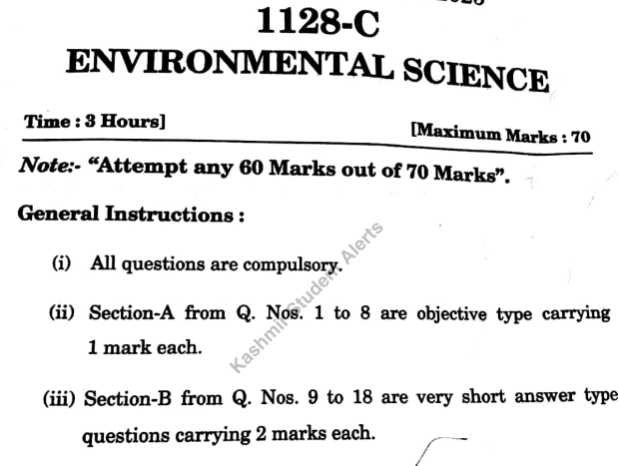
Students across Jammu and Kashmir today appeared for the JKBOSE Class 12th Environmental Science (EVS) Examination held on 03 December 2025. The Environmental Science paper, listed under Paper Code 1128-C, was conducted for 3 hours and carried a total of 70 marks.
The question paper followed JKBOSE’s standard pattern and included Objective Type, Very Short Answer, Short Answer, and Long Answer questions.
Students who missed the exam preview or wish to cross-check can now download the complete EVS question paper PDF from the link provided below.
📄 Download JKBOSE Class 12th Environmental Science Question Paper (03 December 2025)
🕒 Exam Overview
- Subject: Environmental Science
- Class: 12th
- Board: JKBOSE
- Date of Exam: 03 December 2025
- Maximum Marks: 70
- Time Duration: 3 Hours
- Paper Code: 1128-C
The instructions on Page 1 clearly outline that students were required to attempt any 60 marks out of the total 70 marks, giving them flexibility in question selection.
JKBOSE 12th EVS Question Paper Pattern – December 2025
The question paper was divided into four structured sections:
SECTION A – Objective / Multiple Choice Questions (1 Mark Each)
Section A contained 8 objective questions, such as:
- Excessive use of loudspeakers causes ___ pollution.
- Burning of fossil fuels is the main source of urban air pollution (True/False).
- Which gas is likely to decrease in water due to organic pollution?
- (a) Nitrogen
- (b) Oxygen ✔
- (c) Carbon dioxide
- (d) Hydrogen
Other MCQs addressed concepts like greenhouse gases, Sustainable Development, EIS, etc. All of these appear on Pages 2–3 of the question paper.
SECTION B – Very Short Answer Questions (2 Marks Each)
Students had to answer concise questions, each within 30 words.
Some questions included (Page 3–4):
- Explain how eutrophication changes aquatic ecosystems.
- What are mountain soils?
- Define recycling.
- Name two sources of biomedical waste.
- Why is the ozone layer important for life on Earth?
- What are the main causes of global warming?
- Write two Sustainable Development Goals.
- Salient features of Environmental Protection Act, 1986.
These questions required concept clarity but were relatively scoring.
SECTION C – Short Answer Type (3 Marks Each)
Each response in this section was limited to 75 words.
Some major questions included (Page 5–6):
- Name two major air pollutants and their primary sources.
- Difference between primary and secondary sewage treatment.
- Describe eutrophication in detail.
- Differentiate between sheet erosion and gully erosion.
- What are the three R’s of solid waste management?
- Climate change and its impacts on ecosystems.
- Key elements of Environmental Impact Assessment (EIA).
Students found this section moderately challenging due to the detailed explanations required.
SECTION D – Long Answer Questions (5 Marks Each)
This section required descriptive answers, each within 150 words.
Important questions from pages 7–8:
- Main sources and types of air pollution; harmful effects on environment & human health.
- Noise pollution – effects & control measures.
- Soil pollution in India – causes & mitigation.
- Soil erosion – natural vs human-induced causes.
- Biodiversity – levels and importance.
- Ex-situ conservation methods with examples.
The long-answer section tested analytical and explanatory skills. Students who prepared well for environmental laws, pollution, and biodiversity topics reported feeling confident.
Detailed Analysis of the EVS Question Paper (03 December 2025)
Here is a comprehensive breakdown of how the paper performed in terms of difficulty, scoring potential, and coverage of the syllabus.
1. Overall Difficulty Level
The paper can be classified as:
- Easy: 40%
- Moderate: 45%
- Difficult: 15%
Most students felt comfortable with MCQs, basic definitions, and concepts like recycling, ozone layer, and Sustainable Development.
However, the long-answer questions and topics such as EIA elements, climate change impacts, and soil erosion required deeper understanding.
2. Syllabus Coverage
The paper covered almost all the major units, including:
- Pollution (Air, Water, Soil, Noise)
- Climate Change
- Biodiversity
- Environmental Laws
- Waste Management
- Sustainable Development
- Eutrophication
- Ecosystems
This indicates a balanced distribution across the entire EVS curriculum.
3. High-Scoring Areas
Students could easily score in:
- Section A MCQs
- Short definitions (Recycling, Mountain soils, Cryogenic preservation)
- Sustainable Development Goals
- Biomedical waste sources
These direct questions required straightforward recall.
4. Most Challenging Questions
Based on student feedback and the complexity of topics, the following were considered toughest:
- Explain in detail the process of eutrophication.
- Describe the key elements of Environmental Impact Assessment.
- Describe natural and human causes of soil erosion.
- Discuss ex-situ biodiversity conservation with examples.
These required conceptual clarity, examples, and structured explanations.
Important Themes Highlighted in This Year’s Paper
1. Pollution & Its Effects
Air pollution, noise pollution, water pollution, and soil pollution dominated the long and short answer sections. Students needed to provide causes, effects, and preventive measures.
2. Environmental Legislation
Questions from:
- Environmental Protection Act, 1986
- Water (Prevention & Control of Pollution) Act, 1974
- Air (Prevention & Control of Pollution) Act, 1981
appeared in Sections B and C, indicating a strong emphasis on environmental governance.
3. Climate Change
Students were tested on ecosystem impacts due to climate change—one of the central themes of environmental science today.
4. Biodiversity Conservation
Both in-situ and ex-situ conservation methods were highlighted, showing the importance of preserving ecological balance.
The JKBOSE Class 12th EVS Question Paper (03 December 2025) was a well-structured and balanced paper that covered a wide range of topics from the syllabus. Students who prepared thoroughly with conceptual understanding of environmental issues, laws, and ecosystem functions would find the paper manageable and high-scoring.
With increasing global emphasis on sustainability, questions related to biodiversity, climate change, pollution, and waste management continue to remain core areas of focus in JKBOSE exams.
Students are advised to refer to the full question paper PDF for revision and future preparation.