The University of Kashmir has released an official recruitment notification for research-based positions under a prestigious Himalayan ecological project. This is an excellent opportunity for candidates with a background in Botany and environmental sciences to work on a government-funded research initiative focused on ecological restoration.
📌 Overview of University of Kashmir Recruitment 2026
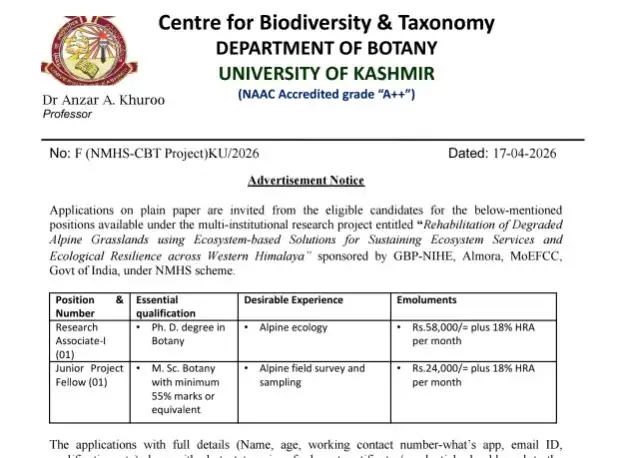
The recruitment is being conducted by the Centre for Biodiversity & Taxonomy, Department of Botany at the University of Kashmir. The positions are part of a multi-institutional project titled:
“Rehabilitation of Degraded Alpine Grasslands using Ecosystem-based Solutions for Sustaining Ecosystem Services and Ecological Resilience across Western Himalaya.”
This project is sponsored by the Ministry of Environment Forest and Climate Change (MoEFCC), Government of India, under the NMHS scheme, in collaboration with G B Pant National Institute of Himalayan Environment (GBP-NIHE), Almora.
📄 Official Notification PDF:
👉
📅 Important Dates
- Notification Release Date: April 17, 2026
- Last Date to Apply: April 30, 2026
- Interview Date: To be notified via email
Applicants are advised to submit their applications well before the deadline to avoid last-minute issues.
🧪 Available Positions and Vacancy Details
The recruitment includes the following two positions:
1. Research Associate-I (01 Post)
Essential Qualification:
- Ph.D. in Botany
Desirable Experience:
- Specialization in Alpine Ecology
Salary:
- ₹58,000 per month + 18% HRA
2. Junior Project Fellow (JPF) (01 Post)
Essential Qualification:
- M.Sc. in Botany with at least 55% marks
Desirable Experience:
- Experience in alpine field survey and sampling
Salary:
- ₹24,000 per month + 18% HRA
🌿 Nature of the Project
The project focuses on restoring degraded alpine grasslands across the Western Himalayas. These fragile ecosystems are vital for biodiversity conservation, water regulation, and climate resilience.
Selected candidates will gain exposure to:
- Ecosystem restoration techniques
- Biodiversity conservation strategies
- Field-based ecological research
- Himalayan environmental challenges
This makes the opportunity ideal for candidates aspiring to build a career in ecological research, conservation biology, or environmental science.
📍 Job Location
- Centre for Biodiversity & Taxonomy
- Department of Botany
- University of Kashmir
- Hazratbal, Srinagar, J&K – 190006
📝 Application Process
Candidates need to apply offline or via email. Follow the steps below:
📄 How to Apply:
- Prepare an application on plain paper including:
- Full Name
- Age
- Contact Number (WhatsApp preferred)
- Email ID
- Educational Qualifications
- Relevant Experience
- Attach photocopies of:
- Academic certificates
- Experience certificates
- Any relevant credentials
- Submit the application via either of the following methods:
📮 By Post:
Send to the office of Centre for Biodiversity & Taxonomy, University of Kashmir📧 By Email:
Send a single PDF (less than 10 MB) to: anzarak@uok.edu.in
⚠️ Important Instructions
- The positions are temporary and co-terminus with the project duration.
- Only shortlisted candidates will be called for an interview.
- Interview details will be shared via email.
- No TA/DA will be provided for attending the interview.
🎓 Why You Should Apply
Working with the University of Kashmir on a government-funded ecological project offers multiple advantages:
- Hands-on research experience in Himalayan ecosystems
- Opportunity to work with leading scientists like Prof. Anzar A. Khuroo
- Exposure to national-level environmental projects
- Strong addition to academic and research profiles
- Competitive salary with HRA benefits
The University of Kashmir’s latest recruitment notification opens doors for young researchers and experienced scholars to contribute to meaningful environmental work in the Western Himalayas. With only two positions available, competition is expected to be high. Candidates meeting the eligibility criteria should apply as soon as possible.
This is not just a job—it’s an opportunity to be part of a mission aimed at restoring fragile ecosystems and ensuring long-term ecological sustainability.