The University of Kashmir has officially released the detailed syllabus and examination scheme for the posts of Junior Engineer (Civil, Electrical, and Mechanical) advertised under Advertisement Notice No. 05 of 2026 dated March 30, 2026. The notification provides clarity to aspirants preparing for the OMR-based written examination and outlines the subject-wise syllabus for all engineering streams.
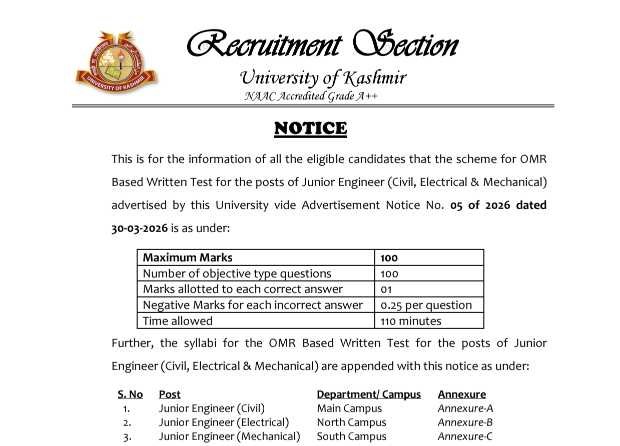
This announcement has brought relief and direction to thousands of candidates who have been eagerly waiting for the detailed exam pattern and syllabus. The University has clearly stated that the OMR-based written test will consist of 100 objective-type questions carrying a total of 100 marks. Additionally, a negative marking system has also been introduced, where 0.25 marks will be deducted for every incorrect answer. The duration of the examination will be 110 minutes.
Candidates applying for Junior Engineer posts must now focus on structured preparation according to the officially prescribed syllabus. Since the examination is highly competitive, understanding the syllabus thoroughly is extremely important for scoring well and securing a place in the merit list.
In this article, we provide a complete overview of the University of Kashmir Junior Engineer Syllabus 2026, including exam pattern, subject-wise topics, preparation strategy, recommended study approach, and important guidelines for candidates.
University of Kashmir JE Recruitment 2026 Overview
The University of Kashmir has invited applications for various Junior Engineer posts in Civil, Electrical, and Mechanical disciplines across different campuses. The syllabus and exam scheme notification was issued on May 11, 2026 by the Recruitment Section of the University of Kashmir.
Posts Covered Under the Notification
| Post | Campus | Annexure |
|---|---|---|
| Junior Engineer (Civil) | Main Campus | Annexure-A |
| Junior Engineer (Electrical) | North Campus | Annexure-B |
| Junior Engineer (Mechanical) | South Campus | Annexure-C |
The University has clarified that the exact date of the OMR-based written examination will be notified separately.
University of Kashmir JE Exam Pattern 2026
The examination scheme released by the University provides all key details related to the written test.
Detailed Exam Pattern
| Particulars | Details |
|---|---|
| Examination Mode | OMR-Based Written Test |
| Type of Questions | Objective Type |
| Total Questions | 100 |
| Maximum Marks | 100 |
| Marks for Correct Answer | 1 Mark |
| Negative Marking | 0.25 Marks |
| Exam Duration | 110 Minutes |
The inclusion of negative marking makes accuracy extremely important. Candidates must avoid guesswork and focus on conceptual clarity.
Importance of the Official Syllabus
The official syllabus acts as the roadmap for preparation. Candidates who prepare according to the prescribed topics have a higher chance of success compared to those relying on random study material.
The syllabus also helps aspirants:
- Understand topic weightage
- Plan a structured timetable
- Identify important concepts
- Avoid irrelevant topics
- Improve time management
- Focus on technical subjects
Since the examination is technical in nature, candidates are expected to possess strong fundamentals in their respective engineering disciplines.
University of Kashmir Junior Engineer Civil Syllabus 2026
The syllabus for Junior Engineer (Civil) is comprehensive and covers important subjects from diploma and engineering-level studies. The topics mentioned in Annexure-A include surveying, mechanics, RCC structures, soil mechanics, hydraulics, irrigation engineering, highway engineering, railway engineering, and construction planning.
Below is a detailed breakdown of the Civil Engineering syllabus.
1. Surveying
Surveying is one of the foundational subjects in Civil Engineering and is important for planning and construction activities.
Topics Included
- Importance of surveying
- Principles and classifications
- Measurement of distances and directions
- Chain surveying
- Compass surveying
- Levelling
- Tachometry
- Theodolite surveying
- Contouring
- Plane table surveying
- Curves
Candidates should focus on numerical problems and field applications.
2. Mechanics and Structural Analysis
This section deals with the behavior of structures and forces.
Important Topics
- Scalars and vectors
- Laws of force
- Moment and friction
- Centre of gravity
- Stress and strain
- Simple stress and strain relationship
- Thin-walled pressure vessels
- Shear force and bending moment
- Flexural and shear stresses
- Columns
- Deflection and slope
- Analysis of trusses
This section often carries conceptual as well as numerical questions.
3. RCC Structures
RCC is one of the most important areas in Civil Engineering.
Topics Covered
- Concrete technology
- Ingredients of concrete
- Water-cement ratio
- Workability
- Admixtures
- Special concretes
- Nondestructive tests
- Design concepts
- Limit state methods
- Compression and torsion
- One-way and two-way slabs
Students should focus on design principles and concrete properties.
4. Soil Mechanics
Soil mechanics plays a major role in foundation engineering.
Important Areas
- Origin of soils
- Soil classification
- Permeability and seepage
- Effective stress principle
- Consolidation
- Compaction
- Shear strength
- Density control
- Soil exploration
- Bearing capacity
Numerical practice is crucial for mastering this section.
5. Fluid Mechanics and Hydraulics
This topic covers water flow behavior and hydraulic systems.
Key Topics
- Properties of fluids
- Hydrostatic pressure
- Bernoulli’s equation
- Flow through pipes
- Laminar and turbulent flow
- Hydraulic jump
- Open channel flow
- Specific energy
- Dimensional analysis
- Hydraulic modeling
Questions may include theoretical concepts and calculations.
6. Irrigation Engineering
Topics Included
- Hydrological cycle
- Dams and canals
- Canal headworks
- Drainage works
- Groundwater recharge
- River training works
Candidates should understand irrigation systems and water management principles.
7. Water Supply and Waste Water Engineering
Important Topics
- Water treatment
- Sewerage systems
- Plumbing
- Drainage systems
- Disposal methods
- Building water supply systems
This section is important from a practical engineering perspective.
8. Highway Engineering
Topics Covered
- Highway development
- Pavement design
- Road construction
- Traffic engineering
- CBR method
- WBM and WMM
- Bituminous roads
Focus on IRC standards and road materials.
9. Railway Engineering
Major Topics
- Railway gauges
- Permanent way
- Rail fixtures
- Signalling
- Bridge terminology
- Railway foundations
10. Construction Planning and Management
Topics Included
- Network diagrams
- PERT and CPM
- Cost optimization
- Contracts and tenders
- Estimation and costing
- Quality control
- Construction management
This section is highly scoring if prepared properly.
University of Kashmir Junior Engineer Electrical Syllabus 2026
The Electrical Engineering syllabus includes core subjects such as circuits, control systems, machines, measurements, electronics, digital electronics, power systems, and power electronics.
1. Electric Circuits and Fields
Topics Included
- Resistance
- Inductance
- Capacitance
- KCL and KVL
- Circuit theorems
- AC and DC circuits
- Three-phase systems
- Electromagnetic fields
2. Control Systems
Important Topics
- Transfer functions
- Block diagrams
- Feedback systems
- Stability analysis
- Open-loop and closed-loop systems
3. Electrical and Electronic Measurements
Topics Included
- PMMC instruments
- Voltmeters and ammeters
- Oscilloscopes
- Digital meters
- Frequency measurement
- Measurement of power and energy
4. Electronic Devices and Circuits
Key Areas
- Semiconductors
- Diodes and transistors
- MOSFET
- Amplifiers
- Oscillators
- Operational amplifiers
- Power supplies
5. Digital Electronics and Microprocessor
Topics Included
- Number systems
- Logic gates
- Boolean algebra
- Flip-flops
- Counters
- Registers
- ADC and DAC
- Microprocessors 8085 and 8086
6. Power Electronics and Drives
Important Topics
- Rectifiers
- Choppers
- Inverters
- Triggering circuits
- MOSFETs
- AC and DC drives
7. Electrical Machines
Topics Included
- Transformers
- DC machines
- Induction motors
- Synchronous motors
- Motor starting methods
- Speed control
8. Power Systems
Major Topics
- Power generation
- Transmission systems
- Distribution systems
- Fault analysis
- Switchgear and protection
- Substations
- Electrical utilization
Candidates should practice numerical problems extensively for Electrical Engineering subjects.
University of Kashmir Junior Engineer Mechanical Syllabus 2026
The Mechanical Engineering syllabus covers major engineering subjects including thermodynamics, strength of materials, production engineering, fluid mechanics, refrigeration, automobile engineering, CAD/CAM, and industrial management.
1. Theory of Machines and Machine Design
Topics Included
- Four-bar linkage
- Flywheels
- Belt drives
- Gears
- Cams
- Riveted joints
- Couplings
- Machine design principles
2. Engineering Mechanics and Strength of Materials
Key Areas
- Laws of motion
- Friction
- Stress and strain
- Elastic constants
- Bending moments
- Columns
- Pressure vessels
3. Thermal Engineering and Refrigeration
Topics Included
- Thermodynamics
- Carnot cycle
- Otto and Diesel cycles
- Boilers
- Steam turbines
- Refrigeration cycles
- Psychrometry
4. Fluid Mechanics and Machinery
Important Topics
- Fluid properties
- Bernoulli theorem
- Laminar and turbulent flow
- Hydraulic turbines
- Centrifugal pumps
5. Material Science and Production Engineering
Topics Covered
- Iron-carbon diagram
- Welding
- Casting
- Forging
- Extrusion
- Machining
- Cutting tools
6. Metrology and Automobile Engineering
Topics Included
- Linear measurement
- Angular measurement
- Surface finish
- Automobile transmission
- Steering system
- Braking system
- IC engines
7. Industrial Management and CAD/CAM
Topics Covered
- Planning and organizing
- Inventory control
- Quality control
- CAD/CAM basics
- CNC and NC machines
Mechanical Engineering aspirants should focus equally on theoretical understanding and numerical problem-solving.
Best Preparation Strategy for University of Kashmir JE Exam 2026
Preparation for the Junior Engineer examination requires a disciplined and smart approach.
1. Understand the Syllabus Thoroughly
The first step is to study the syllabus carefully and divide it into manageable sections.
2. Prepare a Study Timetable
Candidates should dedicate fixed hours daily to technical subjects, revision, and mock tests.
3. Focus on Core Concepts
Since the exam includes objective questions, conceptual clarity is more important than rote memorization.
4. Practice Previous Questions
Practicing objective questions improves speed and accuracy.
5. Revise Regularly
Regular revision is essential to retain technical concepts and formulas.
6. Attempt Mock Tests
Mock tests help improve time management and reduce exam anxiety.
Importance of Negative Marking
The presence of negative marking means candidates must avoid random guessing.
Smart Attempt Strategy
- Attempt only questions you are confident about
- Avoid unnecessary risks
- Use elimination methods carefully
- Manage time wisely
Accuracy will play a crucial role in final merit ranking.
Time Management Tips for the OMR Exam
Since the duration is 110 minutes for 100 questions, candidates should maintain a steady pace.
Suggested Strategy
| Activity | Time |
|---|---|
| First Round (Easy Questions) | 45 Minutes |
| Second Round (Moderate Questions) | 40 Minutes |
| Difficult Questions & Review | 20 Minutes |
| Final OMR Check | 5 Minutes |
Recommended Books for Preparation
Civil Engineering
- R.K. Rajput
- B.C. Punmia
- S.K. Duggal
- R.S. Khurmi
Electrical Engineering
- V.K. Mehta
- Nagrath & Kothari
- J.B. Gupta
- A.K. Sawhney
Mechanical Engineering
- R.K. Rajput
- R.S. Khurmi
- P.K. Nag
- Bansal
Common Mistakes Candidates Should Avoid
Many aspirants lose marks due to avoidable mistakes.
Avoid These Errors
- Ignoring the official syllabus
- Depending only on short notes
- Not practicing MCQs
- Poor time management
- Excessive guessing
- Skipping revision
Why This Recruitment is Important
The University of Kashmir is one of the most prestigious institutions in Jammu and Kashmir. Securing a Junior Engineer position in the University offers:
- Stable government employment
- Good salary structure
- Career growth opportunities
- Job security
- Professional experience
Because of these advantages, competition for these posts is expected to be high.
Expected Difficulty Level of the Exam
Based on the syllabus and previous technical examinations, the difficulty level is expected to range from moderate to difficult.
Candidates with strong technical fundamentals and consistent preparation are likely to perform well.
The release of the University of Kashmir Junior Engineer Syllabus 2026 has officially started the serious preparation phase for aspirants. Candidates applying for Civil, Electrical, and Mechanical Junior Engineer posts must now focus on systematic preparation according to the prescribed syllabus.
The examination will test not only theoretical knowledge but also conceptual clarity, numerical solving ability, and time management skills. Since there is negative marking, candidates must prioritize accuracy alongside speed.
Aspirants are advised to begin preparation immediately, revise technical subjects regularly, solve objective questions daily, and stay updated regarding the examination date notification.
With proper planning, dedication, and smart preparation, candidates can significantly improve their chances of securing a Junior Engineer post in the University of Kashmir.