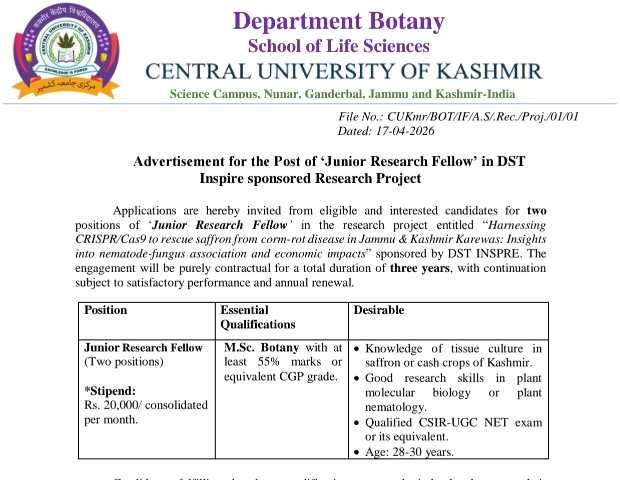
The Central University of Kashmir (CUK) has released an important recruitment notification for aspiring researchers and postgraduate candidates in the field of Botany and Plant Sciences. The university has invited applications for the post of Junior Research Fellow (JRF) under a prestigious DST INSPIRE sponsored research project. This opportunity is highly beneficial for students interested in plant molecular biology, CRISPR technology, saffron research, nematology, biotechnology, and advanced agricultural sciences.
The notification has generated significant interest among science graduates and postgraduates across Jammu & Kashmir and other parts of India, especially because the project focuses on saffron cultivation and disease management—an issue deeply linked with the economy and agriculture of Kashmir.
According to the official notification, two positions of Junior Research Fellow are available under the Department of Botany, School of Life Sciences, Central University of Kashmir. The project aims to use advanced CRISPR/Cas9 technology to rescue saffron from corm-rot disease in the Karewa regions of Jammu & Kashmir.
Overview of CUK JRF Recruitment 2026
The recruitment has been announced by the Department of Botany, Central University of Kashmir, located at Science Campus, Nunar, Ganderbal, Jammu & Kashmir. The project is sponsored by DST INSPIRE, one of the most reputed research funding initiatives in India.
The recruitment is purely contractual and intended for research purposes. However, the experience gained through this project can significantly boost the academic and professional profile of candidates who wish to pursue PhD programs, scientific careers, biotechnology research, or government-funded research fellowships in the future.
The project is titled:
“Harnessing CRISPR/Cas9 to rescue saffron from corm-rot disease in Jammu & Kashmir Karewas: Insights into nematode-fungus association and economic impacts.”
This title itself reflects the scientific depth and practical importance of the research initiative.
Important Highlights of the Recruitment
| Particulars | Details |
|---|---|
| Organization | Central University of Kashmir |
| Department | Department of Botany |
| Post Name | Junior Research Fellow (JRF) |
| Number of Posts | 2 |
| Project Type | DST INSPIRE Sponsored Research Project |
| Job Nature | Contractual |
| Salary | Rs. 20,000 per month |
| Last Date to Apply | 29 May 2026 |
| Location | Ganderbal, Jammu & Kashmir |
| Qualification | M.Sc. Botany |
| Selection Mode | Shortlisting and Interview |
About the Research Project
The research project is centered on saffron cultivation, which is an iconic agricultural product of Kashmir. Kashmir saffron is internationally known for its quality, aroma, and medicinal value. However, saffron cultivation has been facing serious threats due to diseases, environmental stress, and declining productivity.
One of the major diseases affecting saffron is corm-rot disease. This disease damages saffron corms and significantly reduces yield. The project intends to address this challenge using modern biotechnology techniques, especially CRISPR/Cas9 genome editing.
The study also investigates the role of nematodes and fungal associations responsible for disease spread and economic losses. This means the selected candidates will get exposure to interdisciplinary research involving:
- Plant pathology
- Molecular biology
- Tissue culture
- Biotechnology
- Genome editing
- Agricultural economics
- Nematology
- Saffron crop science
The project provides a rare opportunity for young researchers to work on advanced scientific technologies with real-world agricultural applications.
What is CRISPR/Cas9 Technology?
CRISPR/Cas9 is one of the most revolutionary technologies in modern biology. It allows scientists to edit genes with high precision. This technology has transformed agriculture, medicine, and biotechnology.
In agriculture, CRISPR is being used to:
- Develop disease-resistant crops
- Improve crop productivity
- Enhance stress tolerance
- Reduce dependence on pesticides
- Improve nutritional quality
In this project, researchers aim to use CRISPR/Cas9 to protect saffron plants from corm-rot disease. Such research can have long-term impacts on saffron production in Kashmir and may benefit farmers economically.
For candidates interested in molecular biology and genetic engineering, this project can serve as an excellent learning platform.
Number of Vacancies
The official notification clearly states that there are two positions available for Junior Research Fellow.
Since the number of posts is limited, competition is expected to be high. Candidates with strong academic backgrounds and relevant research skills may have better chances of selection.
Eligibility Criteria
Candidates must carefully review the eligibility requirements before applying.
Educational Qualification
Applicants must possess:
- M.Sc. in Botany
- Minimum 55% marks or equivalent CGPA
Candidates should ensure that their degree certificates and mark sheets are complete and available at the time of application.
Desirable Qualifications
In addition to essential qualifications, the notification mentions several desirable skills and qualifications. Candidates having these skills may receive preference during shortlisting.
These include:
- Knowledge of tissue culture in saffron or cash crops of Kashmir
- Research skills in plant molecular biology
- Experience in plant nematology
- Qualified CSIR-UGC NET or equivalent examination
These desirable qualifications indicate that the university is looking for candidates who already have some research exposure or technical expertise.
Age Limit
The preferred age range mentioned in the notification is:
- 28 to 30 years
However, candidates should check if age relaxation rules apply as per university or government norms.
Salary and Fellowship Amount
Selected candidates will receive:
- Rs. 20,000 consolidated stipend per month
Although the amount is fixed and contractual, the value of research experience gained through such projects is extremely important for long-term academic and scientific careers.
Duration of the Project
The engagement is purely temporary and contractual for a total period of three years. Continuation each year depends upon satisfactory performance and annual renewal.
This means candidates who perform well can continue throughout the project duration.
Why This Recruitment is Important
This recruitment is important for several reasons:
1. Opportunity to Work on Cutting-Edge Biotechnology
Very few projects at university level involve CRISPR/Cas9 technology. Candidates selected for this project will gain hands-on exposure to advanced molecular techniques.
2. Research Experience
Research projects under government funding agencies like DST are highly valued for future PhD admissions and scientific careers.
3. Exposure to Saffron Research
Saffron is a high-value crop unique to Kashmir. Research experience in saffron biotechnology can open doors to agricultural research careers.
4. Networking Opportunities
Candidates will interact with faculty members, scientists, and researchers which may help in future collaborations and career growth.
5. Strong Academic Profile
Experience as a JRF adds significant value to resumes and academic CVs.
Application Process
Candidates must submit their applications in the prescribed format available on the university website.
Applications can be submitted either:
- By hand
- Through post
The completed application form along with self-attested supporting documents should reach the Department of Botany before the deadline.
Last Date to Apply
The last date for submission of applications is:
29 May 2026
Candidates should avoid waiting till the last moment because postal delays may occur.
Required Documents
The application form includes a checklist of documents to be attached. These include:
- Matriculation certificate
- 10+2 certificate
- Graduation marksheets and degree
- Postgraduation marksheets and degree
- NET/GATE certificates
- Experience certificates
- Caste certificate (if applicable)
- Publications
- Awards or fellowships
Candidates must ensure that all documents are self-attested.
Details Mentioned in Application Form
The application form requires candidates to provide:
- Personal details
- Educational qualifications
- Research experience
- Publications
- Seminar participation
- Contact information
- Declaration and signature
Candidates should fill the form carefully to avoid rejection.
Selection Process
The selection process will likely involve:
- Shortlisting of applications
- Interview of shortlisted candidates
The notification states that interview dates will be notified separately.
No TA/DA for Interview
The university has clarified that:
- No TA/DA will be provided for attending interviews or joining the post.
Candidates should prepare accordingly.
Terms and Conditions
Some important conditions mentioned in the notification include:
- Appointment is temporary
- No claim for permanent job
- University may terminate engagement with one-week notice
- Canvassing is prohibited
- Corrigendum will only be uploaded on university website
Applicants must read all conditions carefully.
About Central University of Kashmir
The Central University of Kashmir is one of the prominent central universities in Jammu & Kashmir. It offers quality education and promotes advanced research in multiple disciplines.
The Department of Botany under the School of Life Sciences is known for research in:
- Plant sciences
- Molecular biology
- Biotechnology
- Environmental biology
- Crop sciences
Working under a reputed institution adds immense value to a candidate’s research experience.
Career Opportunities After JRF
Candidates who complete JRF projects often move into various career paths such as:
PhD Programs
Research experience greatly helps in securing PhD admissions in top institutions.
Research Scientist Roles
Government and private laboratories prefer candidates with project experience.
Biotechnology Industry
Knowledge of CRISPR and molecular biology is highly demanded in biotech industries.
Academic Careers
Research publications and project experience support careers in teaching and academia.
Government Research Organizations
Organizations like ICAR, CSIR, DBT, and ICMR recruit candidates with research backgrounds.
Tips for Applicants
Here are some useful tips for candidates applying for this recruitment:
Prepare a Strong CV
Highlight:
- Academic achievements
- Research skills
- Laboratory techniques
- Publications
- Presentations
Mention Relevant Skills
If you have experience in:
- PCR
- DNA extraction
- Tissue culture
- Molecular markers
- Plant pathology
mention them clearly.
Attach Proper Documents
Ensure all certificates are properly self-attested.
Keep Application Neat
A clean and properly organized application creates a positive impression.
Prepare for Interview
Study topics like:
- CRISPR technology
- Saffron diseases
- Molecular biology
- Plant pathology
- Tissue culture
Importance of Saffron Research in Kashmir
Saffron cultivation is deeply linked with Kashmir’s cultural and economic identity. However, saffron farming has suffered due to:
- Climate change
- Disease outbreaks
- Declining productivity
- Poor soil conditions
Research projects like this can help revive saffron cultivation through scientific innovation.
If successful, the project may help:
- Increase saffron productivity
- Reduce crop losses
- Improve farmer income
- Preserve Kashmir saffron globally
This highlights the social and economic relevance of the research.
Role of Biotechnology in Agriculture
Biotechnology is transforming agriculture worldwide. Advanced tools such as CRISPR, genetic engineering, and molecular diagnostics are helping scientists create resilient crops.
Benefits include:
- Faster crop improvement
- Better disease resistance
- Reduced pesticide use
- Improved food security
Students entering this field today have excellent future prospects.
Why NET Qualification Matters
The notification prefers candidates qualified in CSIR-UGC NET or equivalent exams. NET qualification demonstrates:
- Strong academic knowledge
- Research aptitude
- Eligibility for higher fellowships
Candidates with NET qualification often receive preference in research recruitment.
Research Skills That May Help Candidates
Candidates possessing the following skills may have advantages:
- Molecular cloning
- Gene editing
- Bioinformatics
- Microscopy
- Plant tissue culture
- Nematode identification
- Fungal culture techniques
- Scientific writing
Even basic familiarity with these areas can strengthen applications.
Interview Preparation Strategy
Candidates shortlisted for interview should prepare:
Subject Knowledge
Focus on:
- Botany fundamentals
- Molecular biology
- Biotechnology
- Plant diseases
Research Aptitude
Understand:
- Research methodology
- Experimental design
- Scientific ethics
Communication Skills
Candidates should explain their academic background clearly and confidently.
Common Mistakes to Avoid
Applicants should avoid:
- Incomplete application forms
- Missing signatures
- Unattested documents
- Wrong contact details
- Late submissions
Such mistakes can lead to rejection.
Future Scope of CRISPR Research
CRISPR technology is expected to shape the future of:
- Agriculture
- Medicine
- Biotechnology
- Environmental science
Researchers with CRISPR exposure may find opportunities in:
- International laboratories
- Research institutes
- Biotechnology startups
- Academic institutions
This makes the current recruitment highly valuable for young researchers.
The CUK JRF Recruitment 2026 offers an excellent opportunity for postgraduate students in Botany and related disciplines to participate in a prestigious DST INSPIRE sponsored research project. The project combines modern biotechnology with agricultural problem-solving and focuses on safeguarding Kashmir’s world-famous saffron crop.
For candidates passionate about scientific research, plant molecular biology, biotechnology, and crop science, this fellowship can serve as a major stepping stone toward a successful research career.
Interested candidates should carefully review the eligibility criteria, prepare the required documents, and submit their applications before the deadline.
With only two positions available, applicants are advised to apply early and ensure their applications are complete in all respects.
Official PDF Notification
PDF Link: Detailed Notifications Here