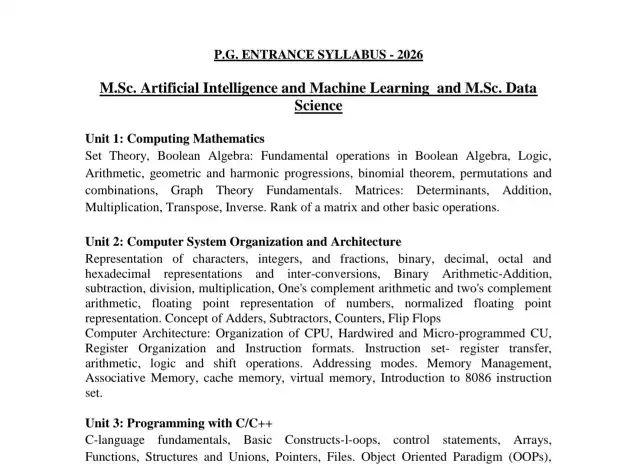
The Cluster University of Srinagar has officially released the PG Entrance Syllabus for the Academic Session 2026-27 for various postgraduate programmes offered under the university. The syllabus has been uploaded by the Directorate of Admissions to help students prepare effectively for the upcoming postgraduate entrance examinations.
Students seeking admission to postgraduate programmes including M.Sc., M.A., MBA, and other professional and academic courses must carefully review the syllabus before beginning preparation. The syllabus provides a detailed outline of subjects, units, concepts, and important topics from which questions will be asked in the entrance examination.
This comprehensive article explains the syllabus structure, preparation strategy, important subjects, course-wise overview, and key examination guidance for candidates appearing in the Cluster University of Srinagar PG Entrance Examination 2026-27.
Official Notification Overview
According to the official notification issued by the Directorate of Admissions, the syllabus for the PG Entrance Examination has been uploaded on the official university website under the Admissions section. Candidates have been advised to regularly visit the university portal for updates regarding examinations, admission schedules, and counselling notifications.
The notification was issued under:
- Directorate of Admissions
- Cluster University of Srinagar
- Notification No: CUS/Adm-PG(CUSET-2026)/2506-25
- Dated: 20-04-2026
Importance of PG Entrance Syllabus
The entrance syllabus is one of the most important documents for postgraduate aspirants because it:
- Defines the exact examination pattern
- Helps students focus on relevant topics
- Reduces unnecessary preparation
- Assists in time management
- Improves conceptual clarity
- Helps in identifying important subject areas
- Enables smart revision planning
Students preparing without referring to the official syllabus often waste valuable time studying irrelevant topics.
Courses Covered Under the PG Entrance Syllabus 2026-27
The syllabus released by Cluster University of Srinagar covers a wide range of postgraduate programmes, including:
- M.Sc. Artificial Intelligence & Machine Learning
- M.Sc. Data Science
- M.Sc. Biochemistry
- M.Sc. Botany
- MBA
- M.Sc. Chemistry
- M.A. Economics
- M.A. Education
- M.A. English
- M.Sc. Environmental Science
- M.A./M.Sc. Geography
- M.A. History
- Various other postgraduate programmes
The syllabus document spans multiple disciplines and contains subject-wise units for each course.
M.Sc. Artificial Intelligence & Machine Learning / Data Science Syllabus
One of the most sought-after programmes in recent years is M.Sc. Artificial Intelligence & Machine Learning and M.Sc. Data Science. The syllabus is highly technical and interdisciplinary.
Major Units Included
1. Computing Mathematics
Topics include:
- Set Theory
- Boolean Algebra
- Graph Theory
- Matrices
- Determinants
- Permutations and Combinations
- Progressions
2. Computer Organization and Architecture
Students need to prepare:
- Binary arithmetic
- CPU organization
- Memory management
- Cache memory
- Virtual memory
- 8086 instruction set
3. Programming with C/C++
Important areas:
- Arrays
- Functions
- Structures
- Pointers
- OOP concepts
- Polymorphism
- Inheritance
- Virtual functions
4. Database Management Systems
Topics include:
- DBMS architecture
- SQL
- Normalization
- Transaction management
- Recovery techniques
5. Data Structures
Candidates should prepare:
- Stacks
- Queues
- Trees
- Graphs
- Sorting algorithms
- Searching algorithms
- Hashing
6. Operating Systems
Includes:
- Deadlocks
- Paging
- Segmentation
- Disk scheduling
- Process management
7. Networking
Important concepts:
- OSI model
- TCP/IP
- Network layers
- Transmission media
8. Software Engineering
Preparation areas include:
- SDLC
- Agile model
- Waterfall model
- PERT and CPM
- CASE tools
9. Logical Reasoning
Includes:
- Syllogisms
- Blood relations
- Coding-decoding
- Seating arrangements
10. Calculus and Functions
Students should prepare:
- Differentiation
- Integration
- Functions
- Relations
- Differential equations
M.Sc. Biochemistry Syllabus
The M.Sc. Biochemistry entrance syllabus is extensive and combines biology, chemistry, genetics, microbiology, and molecular biology.
Important Units
Introduction to Biochemistry
- Biomolecules
- pH and buffers
- Water chemistry
- Stereoisomerism
Cell Biology
- Cell organelles
- Cell cycle
- Cytoskeleton
- Membrane transport
Enzymology
- Enzyme kinetics
- Michaelis-Menten equation
- Enzyme inhibition
Immunology
- Immune responses
- Immunoglobulins
- Vaccines
- Autoimmunity
Human Physiology
- Digestive system
- Respiratory system
- Nervous system
- Kidney function
Genetics
- Mendelian genetics
- Linkage
- Crossing over
- Chromosomal disorders
Biotechnology
- PCR
- Cloning vectors
- Recombinant DNA technology
Molecular Biology
- DNA replication
- Transcription
- Translation
- Operon concept
Clinical Biochemistry
- KFT
- LFT
- TFT
- Lipid profile
M.Sc. Botany Syllabus
The Botany syllabus is divided into fifteen major units covering plant sciences comprehensively.
Major Areas
Microbes and Algae
- Viruses
- Bacteria
- Algae classification
- Life cycles
Fungi and Plant Pathology
- Fungal classification
- Plant diseases
- Mycorrhiza
Bryophytes, Pteridophytes and Gymnosperms
- Alternation of generations
- Seed habit
- Gymnosperm diversity
Plant Taxonomy
- ICN principles
- Botanical nomenclature
- Families and classifications
Plant Physiology
- Photosynthesis
- Respiration
- Plant hormones
Cell Biology
- Organelles
- Cell cycle
- Mitosis and meiosis
Genetics and Cytogenetics
- Mendelian laws
- Chromosomal aberrations
- Polyploidy
Plant Biotechnology
- Tissue culture
- PCR
- Transgenic plants
Ecology and Conservation Biology
- Biodiversity
- Food chains
- Conservation strategies
- SDGs
MBA Entrance Test Syllabus 2026-27
The MBA entrance syllabus is designed to test managerial aptitude, reasoning ability, quantitative skills, communication ability, and business awareness.
Sections Included
Verbal Ability and Reading Comprehension
- Grammar
- Vocabulary
- Reading comprehension
- Sentence completion
Data Interpretation and Logical Reasoning
- Tables
- Graphs
- Syllogisms
- Blood relations
Quantitative Aptitude
- Number systems
- Profit and loss
- Probability
- Time and work
English Communication Aptitude
- Verbal ability
- Grammar
- Reading skills
- Synonyms and antonyms
Current Business Awareness
- Business current affairs
- Economy-related developments
M.Sc. Chemistry Syllabus
The Chemistry syllabus includes Physical, Organic, and Inorganic Chemistry.
Physical Chemistry
- Thermodynamics
- Chemical kinetics
- Quantum chemistry
- Surface chemistry
Inorganic Chemistry
- Coordination chemistry
- Transition elements
- Organometallic chemistry
- Chemical bonding
Organic Chemistry
- Stereochemistry
- Hydrocarbons
- Carbonyl reactions
- Spectroscopy
M.A. Economics Syllabus
The Economics syllabus covers both theoretical and applied aspects.
Key Areas
- Microeconomics
- Macroeconomics
- Indian Economy
- Public Economics
- International Trade
- Development Economics
- Money and Banking
- Statistical Methods
- Mathematical Economics
M.A. Education Syllabus
Important areas include:
- Philosophical foundations of education
- Educational psychology
- NEP 2020
- Inclusive education
- Educational technology
- Creativity and education
- Guidance and counselling
M.A. English Syllabus
The English syllabus is literature-intensive and includes poetry, drama, fiction, criticism, linguistics, and literary theory.
Major Authors Included
- Geoffrey Chaucer
- William Shakespeare
- John Donne
- William Wordsworth
- T. S. Eliot
- Virginia Woolf
- Chinua Achebe
- George Orwell
- Salman Rushdie
- Emily Dickinson
Important Literary Areas
- Poetry
- Drama
- Fiction
- Literary criticism
- Modern literary theory
- Linguistics and ELT
M.Sc. Environmental Science Syllabus
Key preparation topics include:
- Ecology
- Biodiversity
- Environmental pollution
- Climate change
- Environmental laws
- Disaster management
- Sustainable development
- Pollution control technologies
Geography Entrance Syllabus
The Geography syllabus includes:
- Physical Geography
- Climatology
- Oceanography
- Hydrology
- Human Geography
- Economic Geography
- GIS & Remote Sensing
- Cartography
- Quantitative Geography
History Entrance Syllabus
Important areas include:
Ancient India
- Indus Valley Civilization
- Vedic Age
- Mauryan Empire
- Buddhism and Jainism
Medieval India
- Delhi Sultanate
- Mughal Empire
- Persian sources
The syllabus also covers modern Indian history and historiography in later sections of the document.
Preparation Strategy for CUSET PG Entrance 2026
1. Understand the Syllabus Thoroughly
Start by downloading and reading the official syllabus carefully. Mark important units and recurring concepts.
2. Make a Study Plan
Divide preparation into:
- Daily targets
- Weekly revisions
- Mock test practice
3. Focus on Core Concepts
Most entrance examinations test conceptual clarity rather than rote learning.
4. Solve Previous Papers
Practice previous entrance questions whenever available.
5. Improve Time Management
Entrance tests are time-bound. Learn to solve questions quickly and accurately.
6. Revise Regularly
Revision is essential for retention.
Recommended Study Resources
Students may use:
- Standard undergraduate textbooks
- NCERT books (for fundamentals)
- Reference books
- Previous CUET/CUSET papers
- Online mock tests
- Subject-specific MCQ books
Important Instructions for Candidates
Candidates are advised to:
- Regularly check the official university website
- Follow admission notifications carefully
- Stay updated about examination dates
- Download admit cards on time
- Keep documents ready for counselling
The university has specifically instructed candidates to remain in touch with the official website for updates regarding the admission process and examination schedule.
Why CUSET PG Entrance Matters
Cluster University of Srinagar has emerged as one of the leading higher education institutions in Jammu and Kashmir. Admission through the PG entrance examination ensures merit-based selection into various postgraduate programmes.
Benefits include:
- Quality higher education
- Research opportunities
- Career-oriented programmes
- Skilled faculty
- Modern academic infrastructure
The release of the PG Entrance Syllabus 2026-27 by Cluster University of Srinagar marks the beginning of preparation season for thousands of aspirants across Jammu and Kashmir and beyond. Students should begin focused preparation immediately and align their studies strictly with the official syllabus.
A well-planned strategy, proper understanding of concepts, regular revision, and smart preparation can significantly improve the chances of securing admission into the desired postgraduate programme.
Candidates are strongly advised to download the official syllabus PDF and thoroughly study the course-specific units before appearing in the entrance examination.