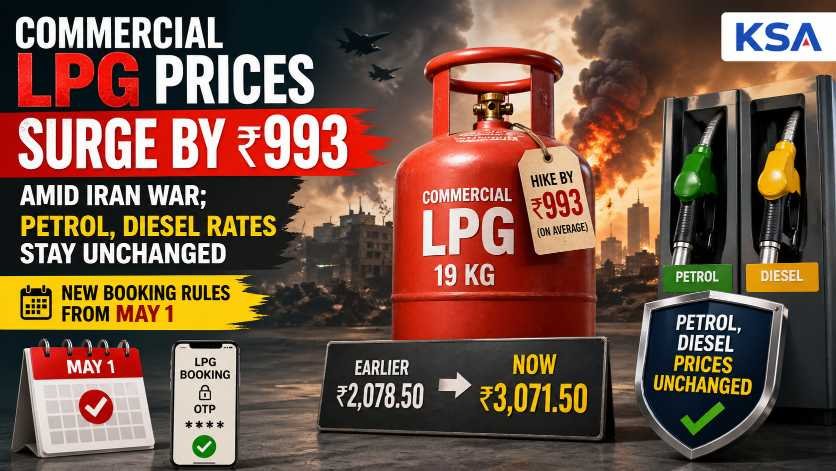
Commercial LPG Price Hike: Despite mounting pressure to raise fuel prices amid the Iran war disruption, the central government has decided to keep the domestic LPG rates unchanged.
However, the price of commercial LPG (19 kg) has been increased by Rs 993 (on average). Commercial LPG cylinder prices in Delhi are now at Rs 3,071.50 (from Rs 2,078.50 earlier). Similarly, commercial LPG cylinder prices in Mumbai have been raised from Rs 2,031 to Rs 3,024.
Significantly, the price of a 19-kg commercial LPG cylinder has been increased thrice since February 28 when the Iran war began. It was first increased by Rs 144 in March, followed by another hike of nearly Rs 200 on April 1.
The triple hike is expected to hit restaurants, eateries, and other businesses hard, since they rely on cooking fuel for their day-to-day operations. The restaurants are likely to pass on the burden to the consumers, making outside dining and food delivery a bit more expensive.
| City | Domestic LPG (14.2 Kg) Price |
| New Delhi | Rs 913.00 |
| Kolkata | Rs 939.00 |
| Mumbai | Rs 912.50 |
| Chennai | Rs 928.50 |
| Gurugram | Rs 921.50 |
| Noida | Rs 910.50 |
| Bengaluru | Rs 915.50 |
| Bhubaneshwar | Rs 939.00 |
| Chandigarh | Rs 922.50 |
| Hyderabad | Rs 965.00 |
| Jaipur | Rs 916.50 |
| Lucknow | Rs 950.50 |
| Patna | Rs 1,002.50 |
Petrol, Diesel Prices Remain Unchanged
Meanwhile, the retail prices of petrol and diesel also remain unchanged. Separately, in a big relief for the aviation sector, the government has also made no change in aviation turbine fuel (ATF) prices for domestic airlines (scheduled operations).
While the decision has been welcomed by households, oil marketing companies (OMCs) will have to continue bleeding money to shield consumers. As NDTV reported earlier, OMCs are losing Rs 16,000 crore (approximately) every day as they are buying crude oil at an elevated rate (over $120 per barrel), but selling at the same price. With voting in states concluded, OMCs were pushing for an increase in petrol, diesel, aviation turbine fuel and LPG prices, according to media reports.
The government is also walking a tight rope. While raising prices would ease OMC finances, it could risk stoking inflation and weigh on country’s growth. Also, the government is already bearing the increased cost of LPG and fertiliser subsidies. However, OMCs, as per reports, may reach out to the Centre for some compensation to absorb petrol and diesel under-recoveries.
The initial bet after the war-driven price surge was that OMCs could absorb losses. These companies recorded strong profits in recent years. However, with no end to the Middle East crisis in sight, absorbing further losses can become unsustainable.
So far, OMCs have selectively raised prices. Prices of premium petrol, bulk diesel and ATF for international flights have been increased in line with global trends. In contrast, regular pump prices for petrol and diesel remain unchanged. ATF for domestic airlines has been only partially raised.
New LPG Cylinder Rules From May 1
While the price of domestic LPG remains unchanged, households in cities will now be able to book cylinder only after 25 days (as opposed to 21 days earlier).
India’s three major oil marketing companies — Indian Oil Corporation (Indane), Bharat Petroleum (Bharat Gas), and Hindustan Petroleum (HP Gas) — have finalised new rules (effective May 1).
Starting May 1, the interval between LPG bookings has been increased from 21 to 25 days in urban areas and up to 45 days in rural areas. The system will automatically block any booking attempt made before the permitted gap has elapsed.
Further, the Delivery Authentication Code (DAC) has been made non-negotiable under the new directives. Customers will no longer receive their cylinders simply by showing a physical blue book or receipt. Upon booking a refill, an OTP will be sent to the customer’s registered mobile number.