Monday, March 23, 2026
Advertisementspot_img
Home Blog Page 57

University of Kashmir Makes Biometric Attendance Mandatory in Private Affiliated Colleges from 2026–27

University of Kashmir Makes Biometric Attendance Mandatory in Private Affiliated Colleges from 2026–27

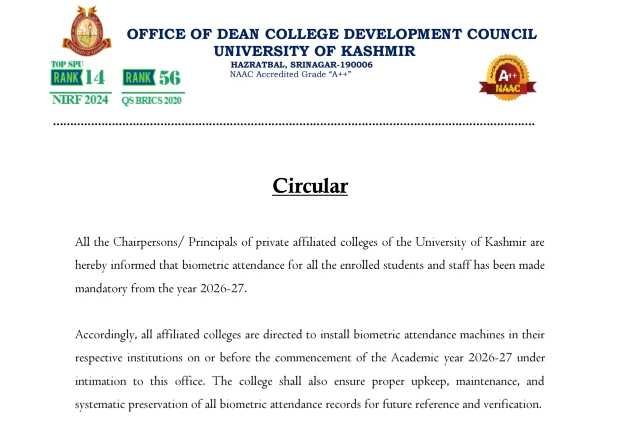
The University of Kashmir (KU) has officially announced that biometric attendance will be mandatory for all students and staff in private affiliated colleges from the academic session 2026–27. The decision has been communicated through a formal circular issued by the Office of the Dean, College Development Council (CDC), University of Kashmir.

This move is aimed at strengthening academic discipline, improving attendance monitoring, and ensuring greater transparency in private colleges affiliated with the university.


Key Highlights of the Circular

  • Biometric attendance made compulsory for students and staff
  • Applicable to all private affiliated colleges of KU
  • Effective from academic year 2026–27
  • Colleges must install biometric machines before session commencement
  • Proper maintenance and record preservation mandated
  • Non-compliance may invite strict action

What Does the Circular Say?

According to the official notification, all Chairpersons and Principals of private affiliated colleges under the University of Kashmir have been directed to implement biometric attendance systems in their respective institutions.

The circular clearly states that:

  • Attendance of all enrolled students and staff members must be recorded through biometric systems.
  • Colleges are required to install biometric attendance machines well in advance of the start of the 2026–27 academic session.
  • Institutions must ensure proper upkeep, maintenance, and systematic preservation of biometric attendance records.
  • Attendance data must be retained for future reference and verification whenever required by the university.

The circular further emphasizes that colleges must comply with the directive without fail.


Why Has KU Introduced Biometric Attendance?

The introduction of biometric attendance aligns with broader reforms in higher education to improve accountability and academic governance. Some key objectives behind this decision include:

1. Ensuring Transparency

Biometric systems minimize manual manipulation of attendance records and ensure authenticity.

2. Improving Academic Discipline

Regular attendance is crucial for academic performance. The system encourages punctuality among both students and staff.

3. Monitoring Teaching Standards

Accurate staff attendance helps the university ensure that teaching hours and workload norms are strictly followed.

4. Strengthening Affiliation Norms

The move reinforces KU’s regulatory oversight over private colleges affiliated with it.


Responsibilities of Private Affiliated Colleges

Under the new directive, private colleges affiliated with the University of Kashmir must:

  • Procure and install reliable biometric attendance machines
  • Ensure the system is fully functional before the 2026–27 session
  • Train administrative staff to manage the system
  • Maintain secure digital or physical attendance records
  • Produce attendance data when demanded by the university or regulatory bodies

Failure to meet these requirements could result in administrative action under university affiliation rules.


Impact on Students

For students, the new system means:

  • Strict monitoring of attendance
  • Reduced scope for proxy or fake attendance
  • Greater emphasis on regular class participation
  • Possible linkage of attendance records with internal assessment and eligibility norms

Students are advised to take the directive seriously to avoid academic complications.


Impact on Teaching and Non-Teaching Staff

Teaching and non-teaching staff in private colleges will also come under the biometric attendance framework. This is expected to:

  • Improve punctuality and accountability
  • Ensure adherence to prescribed working hours
  • Bring staff attendance on par with government institutions

Effective Date and Reference Details

  • Effective From: Academic Session 2026–27
  • Issuing Authority: Office of Dean, College Development Council, University of Kashmir
  • Circular Date: January 8, 2026
  • Issued By: Assistant Registrar, College Development Council
  • Reference No.: F (Cir–Biometric) CDC/KU/26

Official Source

The circular has been published on the official website of the University of Kashmir and is available through the College Development Council portal.

The University of Kashmir’s decision to mandate biometric attendance in private affiliated colleges marks a significant step towards improving academic governance and institutional accountability. With the implementation deadline set well ahead of the 2026–27 academic session, colleges have ample time to prepare and comply.

Students and staff should stay informed and be prepared for a more structured and transparent attendance system in the coming years.

Kashmir University: Supplementary List 2026 Released for Provisionally Selected Students for Boys Hostel Accommodation

Kashmir University: Supplementary List 2026 Released for Provisionally Selected Students for Boys Hostel Accommodation

The University of Kashmir has officially released the Supplementary List (2026) of Provisionally Selected Students for Boys Hostel Accommodation. The notification, issued by the Office of the Provost (Boys Hostels), provides crucial information for students who have been newly recommended for hostel accommodation at the Zakura Campus. The list is dated 8 January 2026 and applies to bonafide students from both the Main Campus and Zakura Campus.

This supplementary list comes as a relief for students who were not included in the initial hostel allotment list and were awaiting further vacancies. Candidates whose names appear in this list must complete all required formalities within the stipulated timeline to confirm their accommodation.


Overview of Boys Hostel Supplementary List 2026

According to the official notice issued by the University authorities, the supplementary list includes students who have been provisionally recommended for accommodation in various Boys Hostels at the Zakura Campus. The allotment is temporary in nature and subject to:

  • Availability of hostel vacancies
  • Verification of original documents
  • Completion of admission and hostel formalities

The notification has been signed by Prof. Md. Meraj, Provost (Boys), and carries clear instructions for all selected candidates .


Important Dates to Remember

Students selected under the supplementary list must strictly adhere to the following deadlines:

  • Last date to complete hostel formalities: 17 January 2026
  • Last date for submitting grievances or queries: 13 January 2026

Failure to act within these deadlines may result in cancellation of hostel allotment.


What Selected Students Need to Do Next

All provisionally selected students are required to follow a step-by-step process to secure their hostel accommodation:

1. Collect Authority Slip

Selected students must visit the Office of the Provost (Boys Hostels) at the University of Kashmir to collect their authority slip.

2. Report to Allotted Hostel

After obtaining the authority slip, students must report to the Warden’s Office of the hostel allotted to them.

3. Complete Formalities

Students need to submit:

  • Authority slip
  • Original documents for verification
  • Any additional forms or declarations required by hostel authorities

Only after completing these steps will the hostel accommodation be confirmed.


Hostels Covered Under Supplementary List 2026

The supplementary list includes hostel allotments in the following Boys Hostels at Zakura Campus:

  • S A Boys Hostel Block-A
  • S A Boys Hostel Block-B
  • Syed Meerak Shah Hostel

Allotments have been made based on availability, academic course, and other institutional norms .


District-Wise Representation of Selected Students

The supplementary list includes students from several districts of Jammu and Kashmir, reflecting the University’s diverse academic intake. Some of the districts covered include:

  • Anantnag
  • Bandipora
  • Baramulla
  • Kupwara
  • Poonch
  • Pulwama
  • Ramban
  • Shopian

Students from disciplines such as Physics, Pharmaceutical Sciences, Law, Economics, Statistics, Sociology, Computer Science, Political Science, Microbiology, and Engineering have been provisionally selected for accommodation.


Provisional Nature of Hostel Allotment

It is important for students to note that the hostel allotment mentioned in the supplementary list is purely provisional. The accommodation is subject to:

  • Authenticity of academic and personal documents
  • Compliance with university hostel rules
  • Availability of seats in the allotted hostel

If any discrepancy is found during verification, the University reserves the right to cancel the allotment without prior notice.


Grievance Redressal: Contact Details

Students who have any queries or grievances regarding the supplementary list must contact the Office of the Provost within the specified timeframe.

Official Contact Numbers:

  • 8825008944
  • 7006088122

No grievances will be entertained after 13 January 2026, as clearly stated in the notification .


Why This Supplementary List Is Important

The release of the supplementary hostel list is a significant step for students who depend on on-campus accommodation, especially those coming from distant districts. Hostel facilities play a vital role in ensuring:

  • Academic continuity
  • Safe and affordable living
  • Access to campus resources
  • Better student engagement

The University of Kashmir continues its efforts to accommodate as many eligible students as possible through such supplementary allotments.


Advisory for Students

Selected candidates are advised to:

  • Visit the Provost Office at the earliest
  • Carry all original documents
  • Strictly follow deadlines
  • Avoid relying on unofficial sources or misinformation

Students should regularly check official university platforms for any further updates related to hostel accommodation.

The Supplementary List 2026 for Boys Hostel Accommodation issued by the University of Kashmir provides a fresh opportunity for eligible students to secure campus housing. However, timely action, document verification, and compliance with hostel rules are crucial to confirm the allotment. Students are strongly advised to complete all formalities well before the deadline to avoid any inconvenience.


📄 Download Official PDF Notification

👉 https://www.kashmiruniversity.net/events/10459.pdf

JKPSC Amends Business & Procedure Rules 2021: Key Changes Explained (Notification No. 18-PSC (DR-P) of 2025)

0

JKPSC Amends Business & Procedure Rules 2021: Key Changes Explained (Notification No. 18-PSC (DR-P) of 2025)

The Jammu and Kashmir Public Service Commission (JKPSC) has officially notified important amendments to its Business and Procedure Rules, 2021, introducing several changes that directly affect recruitment, selection procedures, interviews, and evaluation criteria for various posts across departments.

The amendments were issued through Notification No. 18-PSC (DR-P) of 2025, dated 30 December 2025, and are aimed at enhancing transparency, uniformity, and efficiency in the recruitment process. These changes will be applicable to all future selections conducted by JKPSC unless specified otherwise.

This article explains the major amendments, revised selection criteria, interview process, cut-off rules, and their impact on aspirants.


Background of the JKPSC Rule Amendments

The amendments have been made under Section 93 of the Jammu and Kashmir Reorganisation Act, 2019, read with relevant provisions of the Constitution of India. According to the notification, the changes were approved in the 35th meeting of the Commission held on 26 December 2025.

The primary objective behind revising Rules 19, 28(m), 31(a), 31(m), 34, 43, 44, and 45 is to:

  • Streamline recruitment procedures
  • Introduce structured evaluation metrics
  • Ensure fairness in interviews and written exams
  • Reduce ambiguity in eligibility and shortlisting


Rule 19: Cut-Off Date for Eligibility Clarified

Under the amended Rule 19, the last date of application submission mentioned in the advertisement will now be considered the cut-off date for:

  • Determining eligibility
  • Acquiring minimum educational qualifications
  • Calculating age limits
  • Assessing experience and other criteria

This change eliminates confusion regarding eligibility timelines and brings uniformity across all JKPSC recruitments.


Rule 28(m): Authority of Controller of Examinations

The amended Rule 28(m) empowers the Controller of Examinations to seek guidance from the Commission in special or peculiar cases related to eligibility.

If required, such matters can be referred to the Appellate Authority, ensuring that complex cases are resolved lawfully and transparently rather than arbitrarily.


Rule 31(a): Revised Candidate-to-Post Ratio

One of the most significant changes has been made to Rule 31(a), which governs the number of candidates called for interviews.

New Interview Ratios:

  • Up to 5 posts5 times the number of posts
  • 6 to 10 posts4 times the number of posts
  • More than 10 posts3 times the number of posts

Additionally, candidates securing marks equal to the last shortlisted candidate will also be called for interviews, ensuring fairness and eliminating cut-off disputes.


Rule 34: Commission’s Power to Modify Selection Stages

The amended Rule 34 authorizes JKPSC to:

  • Cancel or modify interviews
  • Change selection stages
  • Rectify errors discovered at any stage

This power can be exercised if procedural irregularities, eligibility issues, or other discrepancies are detected, safeguarding the integrity of the recruitment process.


Rule 39: Official Correspondence Protocol

Under Rule 39, all examination-related correspondence will now be handled exclusively by the Controller of Examinations, while the Secretary of the Commission will deal with matters under the overall supervision of the Chairman.

This administrative clarity reduces delays and overlapping responsibilities.


Rule 43: Revised Selection Criteria for Teaching & Non-Teaching Posts

Teaching Posts

Selection will now be based on:

  • Written Examination (78 points)
  • Interview / Domain Knowledge (14 points)
  • Demonstration (05 points)
  • Higher Qualifications (up to 07 points)
  • NCC / NSS (01 point)

Total: 100 points

Non-Teaching Posts

  • Written Examination: 82 points
  • Interview: 14 points
  • Higher Qualification: 03 points
  • NCC / NSS: 01 point

This structured evaluation ensures merit-based selection with measurable benchmarks.


Rule 44: Health & Medical Education Department Selections

Rule 44 introduces detailed assessment frameworks for posts such as:

  • Consultant
  • Lecturer
  • Assistant Professor
  • Professor (Direct Recruitment & Promotion)

The assessment includes:

  • Academic record
  • Research publications
  • Teaching experience
  • Domain knowledge
  • Interview and demonstration

Clear weightage has been defined for each component, removing subjectivity from high-stakes medical faculty selections.


Rule 45: Higher Education Department Posts

For posts like Assistant Professor and Librarian, Rule 45 prescribes:

  • Written examination (70 points)
  • Academic merit (NET/JRF/PhD)
  • Research publications
  • Awards and experience
  • Interview and domain assessment

This aligns JKPSC recruitment with UGC norms and national standards.


Why These Amendments Matter for Aspirants

These changes are crucial for candidates because they:

  • Remove ambiguity in eligibility rules
  • Ensure predictable shortlisting ratios
  • Introduce transparent marking schemes
  • Reduce discretionary decision-making
  • Improve fairness in interviews

Candidates preparing for JKPSC recruitment exams 2026 and beyond must align their preparation strategies according to the revised rules.

The JKPSC Business & Procedure Rules Amendment 2025 represents a significant step toward transparent, merit-driven recruitment in Jammu and Kashmir. With clearly defined evaluation parameters, structured interviews, and standardized shortlisting norms, the Commission has strengthened the credibility of its selection process.

All aspirants are strongly advised to read the official notification carefully and stay updated with JKPSC announcements to avoid missing crucial changes that may impact their eligibility or selection.


📄 Official PDF Notification

👉 Download Here: https://jkpsc.nic.in/Pdf/Downloader1.ashx?nid=17540&type=n

CUET PG 2026 Registration Last Date: Apply Online, Eligibility, Fees, Exam Date & Complete Details

0

CUET PG 2026 Registration Last Date: Apply Online, Eligibility, Fees, Exam Date & Complete Details 

The Common University Entrance Test for Postgraduate (CUET PG) 2026 is one of the most important national-level entrance examinations for students aspiring to pursue postgraduate studies in India. Conducted by the National Testing Agency (NTA), CUET PG serves as a single-window entrance test for admission to MA, MSc, MCom, and several other PG programmes offered by Central Universities, State Universities, Deemed Universities, and private institutions across the country.

With lakhs of candidates expected to appear, awareness about the CUET PG 2026 registration last date, application process, eligibility criteria, exam pattern, and important deadlines is crucial. This article provides a detailed, SEO-friendly guide covering everything you need to know about CUET PG 2026.


CUET PG 2026 Registration Last Date (Official Update)

As per the latest information, the CUET PG 2026 registration last date is January 14, 2026 (up to 11:50 PM). Candidates must complete the online application process and submit the application fee before the deadline. Applications submitted after the last date will not be accepted under any circumstances.

CUET PG 2026 Important Dates (Tentative)

Event Date
Start of CUET PG 2026 registration December 14, 2025
CUET PG 2026 registration last date January 14, 2026
Application correction window January 18–20, 2026
Release of admit card February 2026
CUET PG 2026 exam dates March 2026
Result declaration April 2026

Note: Candidates are advised to regularly check the official website for updates, as dates may be revised by NTA.


What Is CUET PG 2026?

CUET PG is a centralized entrance examination introduced to streamline postgraduate admissions in India. Instead of appearing for multiple university-specific entrance tests, candidates can take CUET PG and apply to multiple participating universities using a single scorecard.

Courses Offered Through CUET PG

  • Master of Arts (MA)
  • Master of Science (MSc)
  • Master of Commerce (MCom)
  • LLM, MFA, MEd, and other specialised PG programmes

Eligibility Criteria for CUET PG 2026

Before applying, candidates must ensure they meet the eligibility requirements:

Educational Qualification

  • Candidates must have completed a Bachelor’s degree from a recognized university.
  • Final-year undergraduate students are also eligible to apply, provided they meet the qualification criteria at the time of admission.

Minimum Marks

  • General category: Usually 50–55% marks in graduation
  • Reserved categories (SC/ST/OBC/PwD): Relaxation as per university norms

Age Limit

  • No upper age limit for appearing in CUET PG 2026.

Eligibility criteria may vary slightly depending on the university and course applied for.


How to Apply for CUET PG 2026 Online

Candidates must complete the application process online before the CUET PG 2026 registration last date. Follow the step-by-step process below:

Step 1: Visit the Official Website

Go to the official NTA CUET PG portal.

Step 2: New Registration

  • Click on “New Registration”
  • Enter basic details like name, email ID, mobile number
  • Generate login credentials

Step 3: Fill Application Form

  • Log in using credentials
  • Enter personal, academic, and communication details
  • Select course(s) and participating universities

Step 4: Upload Documents

Upload scanned copies of:

  • Passport-size photograph
  • Signature
    (as per prescribed format and size)

Step 5: Pay Application Fee

Pay the application fee online via:

  • Debit card
  • Credit card
  • Net banking
  • UPI

Step 6: Submit and Download Confirmation Page

After successful payment, submit the form and download the confirmation page for future reference.


CUET PG 2026 Application Fee Structure (Expected)

Category Fee (One Paper)
General ₹1,200
OBC ₹1,000
SC/ST/PwD ₹900
Additional papers Extra charges applicable

Applications without fee payment will be considered incomplete.


Application Correction Window

NTA will open a CUET PG 2026 application correction window after the registration process ends. During this period, candidates can edit specific fields such as:

  • Personal details
  • Academic information
  • Exam center choices

However, not all fields may be editable. Corrections must be done carefully within the stipulated time.


CUET PG 2026 Exam Pattern

Understanding the exam pattern helps in effective preparation:

  • Mode of Exam: Computer-Based Test (CBT)
  • Duration: 90–120 minutes (varies by subject)
  • Question Type: Multiple Choice Questions (MCQs)
  • Medium: English/Hindi (subject-specific)

Marking Scheme

  • +4 marks for each correct answer
  • −1 mark for each incorrect answer
  • No marks for unanswered questions

CUET PG 2026 Syllabus

The syllabus is subject-specific and based on undergraduate-level concepts. Candidates are advised to:

  • Refer to official syllabus PDFs
  • Study core graduation subjects
  • Practice previous years’ question papers

Admit Card and Exam City Slip

After successful registration:

  • NTA will release the exam city intimation slip
  • The CUET PG 2026 admit card will be available a few days before the exam

Candidates must download the admit card and carry a valid photo ID to the exam center.


CUET PG 2026 Result and Counselling

Result Declaration

CUET PG 2026 results are expected in April 2026. Scorecards will be available online.

Counselling Process

  • Conducted separately by participating universities
  • Based on CUET PG score, merit list, and preferences
  • Candidates must apply individually on university portals

Why Is CUET PG Important?

  • Single exam for multiple universities
  • Transparent and merit-based admissions
  • Saves time, money, and effort
  • Standardized evaluation system

Important Tips for CUET PG 2026 Aspirants

  • Apply well before the CUET PG 2026 registration last date
  • Double-check details before submission
  • Keep copies of application and fee receipt
  • Start preparation early with a clear strategy
  • Stay updated with official notifications

Frequently Asked Questions (FAQs)

Q1. What is the CUET PG 2026 registration last date?

The CUET PG 2026 registration last date is January 14, 2026.

Q2. Can I apply after the last date?

No. Applications submitted after the deadline will not be accepted.

Q3. Is CUET PG mandatory for PG admissions?

For many Central and participating universities, CUET PG scores are mandatory.

Q4. Is there any age limit for CUET PG 2026?

No, there is no upper age limit.

The CUET PG 2026 registration last date is a crucial deadline for postgraduate aspirants across India. Missing the deadline means losing the opportunity to apply for admissions in top universities through a single entrance test. Candidates are strongly advised to complete the registration process early, verify all details carefully, and begin exam preparation without delay.

Stay connected with official notifications and reliable education portals to ensure you don’t miss any updates related to CUET PG 2026.

KVS NVS Admit Card 2026 Released for Teaching and Non-Teaching Posts – Download Hall Ticket, Exam Date, Instructions

KVS NVS Admit Card 2026 Released for Teaching and Non-Teaching Posts – Download Hall Ticket, Exam Date, Instructions

The KVS NVS Admit Card 2026 has been officially released, bringing relief and excitement to thousands of candidates preparing for teaching and non-teaching recruitment examinations. The hall tickets are now available online for candidates who have successfully registered for various posts under Kendriya Vidyalaya Sangathan (KVS) and Navodaya Vidyalaya Samiti (NVS). The examinations are being conducted by the Central Board of Secondary Education (CBSE) on behalf of both organisations.

In this detailed article, candidates will find complete information about the KVS NVS Admit Card 2026, including the direct download process, exam dates, post details, exam pattern, important instructions, and FAQs. This SEO-friendly guide is designed to help aspirants quickly access authentic and structured information in one place.


KVS NVS Admit Card 2026: Key Highlights

Here is a quick overview of the recruitment and admit card details:

  • Recruitment Bodies: KVS & NVS
  • Exam Conducting Authority: CBSE
  • Posts Covered: Teaching & Non-Teaching
  • Exam Mode: Computer-Based Test (CBT)
  • Exam Dates: January 2026
  • Admit Card Status: Released
  • Official Websites: kvsangathan.nic.in, navodaya.gov.in, cbse.gov.in

The release of the KVS NVS Admit Card 2026 is a crucial step, as no candidate will be allowed to appear for the examination without a valid hall ticket.


About KVS and NVS Recruitment 2026

The KVS and NVS recruitment drive is one of the largest central government education recruitments in India. It aims to fill thousands of vacancies across the country in central and residential schools.

Posts Included

  • Teaching Posts
    • Primary Teacher (PRT)
    • Trained Graduate Teacher (TGT)
    • Post Graduate Teacher (PGT)
    • Librarian
  • Non-Teaching Posts
    • Junior Secretariat Assistant (JSA)
    • Multi-Tasking Staff (MTS)
    • Assistant Section Officer
    • Stenographer and other administrative roles

Candidates from all states have applied for this recruitment, making the KVS NVS Admit Card 2026 a highly searched and important document.


How to Download KVS NVS Admit Card 2026 (Step-by-Step Guide)

Candidates can easily download their hall ticket by following these steps:

  1. Visit the official website of KVS, NVS, or CBSE.
  2. Click on the link titled “KVS NVS Admit Card 2026 for Teaching and Non-Teaching Posts”.
  3. Enter your Application Number and Date of Birth/Password.
  4. Click on Submit.
  5. Your KVS NVS Admit Card 2026 will appear on the screen.
  6. Download the PDF and take at least two printouts for future use.

👉 It is advised to download the admit card well in advance to avoid last-minute technical issues.


Details Mentioned on KVS NVS Admit Card 2026

After downloading the hall ticket, candidates must carefully verify all details printed on it. The admit card contains:

  • Candidate’s Name
  • Roll Number
  • Application Number
  • Photograph and Signature
  • Post Applied For
  • Exam Date and Shift Timing
  • Reporting Time
  • Examination Centre Address
  • Important Exam Instructions

If any discrepancy is found, candidates should immediately contact the concerned authority before the exam date.


KVS NVS Exam Date and Shift Timings

The KVS and NVS examinations are scheduled to be conducted in January 2026 across multiple shifts. Due to the large number of candidates, exams will be held over multiple days and sessions.

  • Morning Shift: Reporting time usually 7:30 AM – 8:30 AM
  • Afternoon Shift: Reporting time usually 12:30 PM – 1:30 PM

Exact shift timing and reporting time are clearly mentioned on the KVS NVS Admit Card 2026.


Exam Pattern for KVS & NVS Recruitment 2026

Understanding the exam pattern is essential for effective preparation.

General Exam Pattern

  • Mode: Computer-Based Test (CBT)
  • Question Type: Multiple Choice Questions (MCQs)
  • Medium: Bilingual (English & Hindi)
  • Negative Marking: As per official notification

Subjects Included

  • General Awareness
  • Reasoning Ability
  • English Language
  • Hindi Language
  • Teaching Aptitude / Subject-Specific Knowledge (for teaching posts)
  • Computer Knowledge (for certain non-teaching posts)

The exact syllabus and weightage vary depending on the post applied for.


Documents to Carry Along with Admit Card

On the examination day, candidates must carry the following:

  • Printed copy of KVS NVS Admit Card 2026
  • One valid photo ID proof (Aadhaar Card, Voter ID, PAN Card, Passport, or Driving Licence)
  • Recent passport-size photograph (same as uploaded in application form)

❌ Entry will be denied without the admit card and valid ID proof.


Important Exam Day Instructions

Candidates must strictly follow the instructions mentioned on the admit card:

  • Reach the exam centre at least 60 minutes before reporting time.
  • Electronic gadgets such as mobile phones, smartwatches, calculators, and Bluetooth devices are strictly prohibited.
  • Do not carry bags, books, or notes inside the examination hall.
  • Follow COVID-19 or other safety guidelines if mentioned.
  • Any form of unfair practice may lead to disqualification.

What After the KVS NVS Exam 2026?

After the completion of the written examination:

  1. Answer Key will be released by CBSE.
  2. Candidates will be allowed to raise objections (if applicable).
  3. Result Declaration will follow on the official websites.
  4. Shortlisted candidates will be called for Skill Test / Interview (for applicable posts).
  5. Final merit list and appointment process will be completed thereafter.

Why KVS and NVS Jobs Are Highly Sought After

Government teaching and non-teaching jobs under KVS and NVS are considered prestigious due to:

  • Job security
  • Attractive salary under 7th Pay Commission
  • All-India transfer policy (especially in KVS)
  • Housing and medical benefits
  • Opportunity to work in reputed central institutions

This is why the release of the KVS NVS Admit Card 2026 has generated massive interest nationwide.

KVS NVS admit card download link


Frequently Asked Questions (FAQs)

Q1. Is KVS NVS Admit Card 2026 released?

Yes, the admit card has been officially released and is available for download online.

Q2. Can I appear for the exam without a printed admit card?

No, carrying a printed copy of the admit card is mandatory.

Q3. What should I do if I forget my login credentials?

Use the “Forgot Password” option available on the login page or contact the helpdesk.

Q4. Are KVS and NVS exams conducted together?

Yes, the recruitment exam is being conducted by CBSE for both organisations.

The release of the KVS NVS Admit Card 2026 marks a significant milestone in the recruitment process for teaching and non-teaching posts. Candidates are advised to download their hall tickets immediately, verify all details carefully, and prepare well for the upcoming examination. Staying updated with official notifications and following exam-day instructions will ensure a smooth and stress-free experience.

For the latest updates on KVS NVS Admit Card 2026, exam results, answer keys, and government job news, keep visiting our website regularly.

NMC Additional PG Medical Seats 2025–26: 450+ Seats Approved, Big Relief for NEET-PG Aspirants

0

NMC Additional PG Medical Seats 2025–26: 450+ Seats Approved, Big Relief for NEET-PG Aspirants

The NMC additional PG medical seats 2025–26 approval has brought major relief to thousands of medical graduates across India. In a significant move aimed at strengthening postgraduate medical education, the National Medical Commission (NMC) has approved over 450 additional postgraduate (PG) medical seats for the academic year 2025–26.

This expansion is expected to ease the intense competition faced by students appearing for NEET-PG 2025, improve access to specialist training, and help address India’s growing shortage of specialist doctors.

In this article, we explain what the NMC approval means, which courses and states benefit, how it impacts NEET-PG counselling, and what aspirants should expect next.


NMC Approves 450+ Additional PG Medical Seats for 2025–26

The National Medical Commission has cleared more than 450 new PG medical seats following appeals filed by medical colleges across the country. These approvals were granted after detailed inspections and assessments by the Medical Assessment and Rating Board (MARB) and its First Appeal Committee.

The decision comes under Section 28(5) of the NMC Act, 2019, which allows institutions to appeal if their applications for seat increases were earlier rejected or partially approved.

Why the NMC Decision Is Important

  • India faces a severe shortage of specialist doctors
  • Demand for PG medical seats far exceeds supply
  • Every year, lakhs of MBBS graduates compete for limited PG seats
  • Increasing seats directly improves healthcare capacity

The NMC additional PG medical seats 2025–26 approval is therefore being seen as a strategic reform rather than a routine administrative step.


Which PG Medical Courses Got Additional Seats?

The newly approved seats span both clinical and non-clinical disciplines, with priority given to high-demand specialties.

Major Specialties Included

  • MD General Medicine
  • MS General Surgery
  • MD Paediatrics
  • MD Radiodiagnosis
  • MD Anaesthesiology
  • MS Orthopaedics
  • MD Dermatology
  • MD Psychiatry
  • MS Obstetrics and Gynaecology
  • ENT and Ophthalmology

These disciplines traditionally witness the highest cut-offs in NEET-PG, and the increase is expected to slightly moderate competition.


State-Wise Impact of NMC PG Seat Increase

Medical colleges from over 20 states and Union Territories have benefited from the NMC approval. Some of the major states include:

  • Maharashtra
  • Uttar Pradesh
  • Tamil Nadu
  • Karnataka
  • Kerala
  • West Bengal
  • Andhra Pradesh
  • Telangana
  • Punjab
  • Haryana
  • Bihar
  • Rajasthan

This wider geographic distribution ensures that PG opportunities are not limited to metro cities alone and improves regional healthcare infrastructure.


No Delay in Counselling: NMC Issues Clear Instructions

One of the most crucial aspects of the NMC announcement is its clear instruction to counselling authorities.

The NMC has directed that NEET-PG counselling should not be delayed for want of individual Letters of Permission (LOPs) from colleges. Instead:

  • The approved list issued by the appeal committee will be considered valid
  • Counselling bodies can include these seats immediately
  • Formal LOPs will follow later

This instruction ensures that aspirants do not suffer due to procedural delays.


Impact on NEET-PG 2025 Counselling

The approval of NMC additional PG medical seats 2025–26 will directly affect the upcoming counselling rounds conducted by the Medical Counselling Committee (MCC) and state authorities.

Key Benefits for Aspirants

  • Higher chances of seat allotment
  • Better options in later counselling rounds
  • Reduced seat wastage
  • More opportunities in government and private colleges

Candidates who narrowly miss cut-offs may particularly benefit from the expanded seat matrix.


Why PG Seat Expansion Is a Long-Term Necessity

India produces a large number of MBBS graduates every year, but PG seat availability has not kept pace. This imbalance has resulted in:

  • Extremely high competition ratios
  • Repeated attempts by candidates
  • Migration of doctors abroad
  • Shortage of trained specialists in public hospitals

By approving additional seats, the NMC aims to create a sustainable medical education ecosystem aligned with national healthcare goals.


Previous PG Seat Approvals: A Continuing Trend

The current approval of over 450 seats is not a one-time decision. Earlier, the NMC had already cleared:

  • 171 additional PG seats in earlier rounds of approval
  • Multiple batches of seat increases across institutions

This indicates that more PG seats may still be approved before the final counselling rounds conclude.


Quality Assurance: NMC’s Stand on Standards

While expanding capacity, the NMC has emphasized that quality will not be compromised. Colleges were approved only after verification of:

  • Faculty strength
  • Clinical material
  • Infrastructure
  • Bed occupancy
  • Teaching facilities

This ensures that students admitted under the expanded seat matrix receive standard-compliant training.


What NEET-PG Aspirants Should Do Now

If you are preparing for or appearing in NEET-PG 2025, here are some practical steps:

Action Plan for Candidates

  1. Regularly check the MCC website for updated seat matrices
  2. Monitor state counselling portals
  3. Be flexible with college and speciality preferences
  4. Prepare for multiple counselling rounds
  5. Track newly added colleges and seat increases

The NMC additional PG medical seats 2025–26 could significantly improve outcomes even in later rounds.


What Lies Ahead: More Seats Possible?

According to official indications, the NMC’s appeal committees are still reviewing applications. This means:

  • Additional PG seats may be approved
  • Seat matrices could be revised again
  • Counselling dynamics may continue to change

Students are advised to stay alert and not make early assumptions about cut-offs.


Expert Opinion on PG Seat Expansion

Medical education experts have largely welcomed the move, stating that:

  • India needs more specialists, not fewer
  • PG expansion is essential for public healthcare delivery
  • Transparent approvals improve trust in the system

However, they also stress the need for parallel faculty development and hospital strengthening.

The approval of NMC additional PG medical seats 2025–26 marks a major milestone in India’s medical education reforms. With over 450 new seats added across multiple specialties and states, the decision offers renewed hope to NEET-PG aspirants and strengthens the country’s healthcare future.

By ensuring timely counselling, maintaining quality standards, and expanding opportunities, the National Medical Commission has taken a decisive step toward bridging the long-standing gap between demand and availability of PG medical seats.

Medical graduates are strongly advised to stay updated, remain flexible in counselling choices, and make the most of this expanded opportunity landscape.

NABARD Young Professional Recruitment 2026: Apply Online for 44 Posts Before January 12

0

NABARD Young Professional Recruitment 2026: Apply Online for 44 Posts Before January 12

The National Bank for Agriculture and Rural Development (NABARD) has officially announced the NABARD Young Professional Recruitment 2026, inviting online applications for 44 Young Professional (YP) posts across multiple technical and non-technical disciplines. This recruitment drive is a golden opportunity for young graduates and postgraduates who aspire to work in the field of agriculture, rural development, finance, technology, climate action, and policy implementation.

The Young Professional Programme is designed to bring fresh talent into NABARD’s ecosystem, enabling candidates to gain hands-on exposure while contributing to key national initiatives. Eligible and interested candidates must submit their applications on or before January 12, 2026, through the official NABARD website.

In this detailed article, we cover everything you need to know about NABARD Young Professional Recruitment 2026, including vacancy details, eligibility criteria, age limit, salary, selection process, application steps, and important dates.


About NABARD Young Professional Programme

The NABARD Young Professional Programme aims to engage dynamic and motivated young professionals on a contractual basis to support NABARD’s diverse functions. Young Professionals play a vital role in research, project monitoring, data analysis, IT systems, communication, sustainability initiatives, and policy support.

Through this programme, candidates gain exposure to:

  • Rural development and financial inclusion projects
  • Agriculture and allied sector reforms
  • Digital transformation and data-driven decision-making
  • Climate action and sustainability programmes

The experience gained under this programme significantly enhances career prospects in banking, development institutions, public policy, consulting, and research organizations.


NABARD Young Professional Recruitment 2026: Overview

Particulars Details
Recruitment Name NABARD Young Professional Recruitment 2026
Organization National Bank for Agriculture and Rural Development
Total Vacancies 44
Post Name Young Professional
Job Nature Contractual
Contract Period 1 year (extendable up to 3 years)
Application Mode Online
Last Date to Apply January 12, 2026
Official Website nabard.org

NABARD Young Professional Vacancy 2026 – Discipline-wise Posts

Under the NABARD Young Professional Recruitment 2026, a total of 44 vacancies have been announced across several specialized domains. These include both technical and functional roles.

Major Disciplines Covered:

  • Climate Change & Sustainability
  • Economics & Research
  • Development Management
  • Project Monitoring & Evaluation
  • Data Science & Analytics
  • Cyber Security
  • Information Technology
  • Geoinformatics
  • Finance & Accounts
  • Academic Administration
  • Public Relations & Communication
  • Graphic Designing
  • UI/UX Designing
  • Software Testing

The distribution of vacancies ensures opportunities for candidates from diverse academic backgrounds.


NABARD Young Professional Eligibility Criteria 2026

Candidates applying for NABARD Young Professional Recruitment 2026 must fulfill the eligibility conditions related to age, educational qualification, and experience.

Age Limit

  • Minimum Age: 21 years
  • Maximum Age: 30 years
  • Age is calculated as per the date mentioned in the official notification.
  • Age relaxation may be applicable as per NABARD norms for reserved categories.

Educational Qualification

Candidates must possess a Bachelor’s or Master’s degree in a relevant discipline from a recognized university or institution. Discipline-specific qualifications may include:

  • Engineering / Technology
  • Economics
  • Agriculture & Allied Sciences
  • Management
  • Finance / Commerce
  • Computer Science / IT
  • Design / Communication

Work Experience

  • Some posts require minimum one year of relevant work experience.
  • Internships and project experience may be considered for certain roles.

NABARD Young Professional Salary 2026

One of the key highlights of the NABARD Young Professional Recruitment 2026 is the attractive remuneration.

  • Monthly Consolidated Stipend: ₹70,000
  • The stipend is inclusive of all allowances.
  • No additional perks such as DA, HRA, or TA are admissible.

The compensation makes this programme highly appealing for early-career professionals seeking both learning and financial stability.


Contract Duration & Extension

  • Initial contract period: 1 year
  • Extension: Up to 3 years, based on performance review and organizational requirements
  • The contract does not guarantee permanent employment with NABARD.

NABARD Young Professional Selection Process 2026

The selection process for NABARD Young Professional Recruitment 2026 is designed to identify candidates with strong academic background, domain expertise, and practical skills.

Selection Stages:

  1. Screening of Applications
    • Applications are shortlisted based on qualifications, experience, and relevance.
  2. Interview
    • Shortlisted candidates are called for a personal interview (online or offline).
    • The interview assesses subject knowledge, analytical ability, and suitability for the role.

Final selection is based on overall performance in the interview.


NABARD Young Professional Application Fee 2026

Candidates are required to pay a non-refundable application fee while submitting the online form.

  • Application Fee: ₹150 + applicable GST
  • Payment Mode: Online (Debit Card / Credit Card / Net Banking)

How to Apply for NABARD Young Professional Recruitment 2026

Follow these steps to apply online successfully:

  1. Visit the official website of NABARD – nabard.org
  2. Go to the Careers / Recruitment section
  3. Click on the Young Professional Recruitment 2026 notification
  4. Register using a valid email ID and mobile number
  5. Fill in the online application form carefully
  6. Upload required documents (photograph, signature, certificates)
  7. Pay the application fee online
  8. Submit the form and take a printout for future reference

Candidates are advised to verify all details before final submission.


Important Dates: NABARD Young Professional Recruitment 2026

Event Date
Online Application Start Date December 26, 2025
Last Date to Apply January 12, 2026
Interview Schedule To be notified

Job Locations

Selected Young Professionals may be posted at NABARD offices across India, including:

  • Mumbai
  • New Delhi
  • Chennai
  • Kolkata
  • Lucknow
  • Guwahati
  • Chandigarh
  • Dehradun
  • Shimla
  • Aizawl

Posting locations depend on organizational requirements and candidate specialization.


Why Apply for NABARD Young Professional Recruitment 2026?

Here are some compelling reasons to apply:

  • Prestigious opportunity with a national-level institution
  • Attractive monthly stipend of ₹70,000
  • Exposure to real-world rural development projects
  • Skill enhancement and professional networking
  • Career boost for future roles in banking, policy, and development sectors

Important Instructions for Candidates

  • Apply well before the deadline to avoid last-minute issues
  • Ensure eligibility before submitting the application
  • Keep a copy of the application form and fee receipt
  • Regularly check the official website for updates

The NABARD Young Professional Recruitment 2026 is an excellent opportunity for young, talented individuals who want to contribute to India’s rural and agricultural development while building a strong professional foundation. With 44 vacancies, competitive pay, and exposure to impactful projects, this recruitment drive stands out as one of the most sought-after opportunities in 2026.

Eligible candidates should not miss this chance and must complete the online application process before January 12, 2026.

RRB ALP Exam Dates 2025 Announced: Check CBT Schedule, Exam City Slip & Admit Card Details

0

RRB ALP Exam Dates 2025 Announced: Check CBT Schedule, Exam City Slip & Admit Card Details

The Railway Recruitment Board (RRB) has officially announced the RRB ALP Exam Dates 2025 under Centralised Employment Notice (CEN) 01/2025. This update brings clarity for thousands of aspirants preparing for the Assistant Loco Pilot (ALP) recruitment examination, one of the most competitive government exams in India.

Along with the exam schedule, RRB has also released crucial information regarding the exam city intimation slip and admit card (hall ticket) availability. Candidates are advised to carefully note all dates and instructions to avoid last-minute confusion.


RRB ALP Exam Dates 2025: Official CBT 1 Schedule

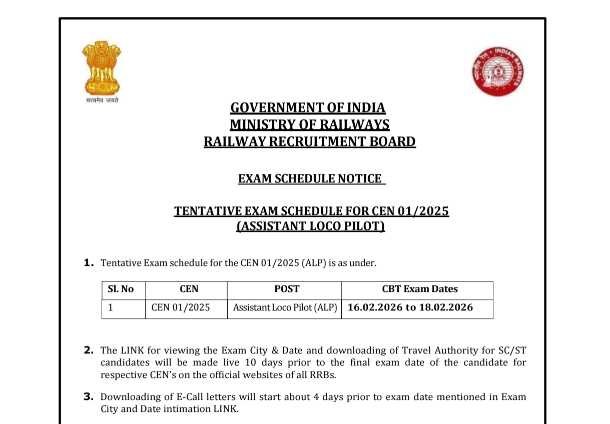
As per the official notification, the RRB ALP CBT 1 examination will be conducted in multiple shifts across three days:

  • Exam Dates: 16 February 2026 to 18 February 2026
  • Mode of Exam: Computer Based Test (CBT)
  • Post: Assistant Loco Pilot (ALP)
  • Notification: CEN 01/2025

The examination will be held at various centres across India to accommodate the large number of applicants. The exact exam date, shift timing, and exam city for each candidate will be communicated through the city intimation slip and admit card.


Official PDF Notice for RRB ALP Exam Dates

Candidates are strongly advised to download and read the official notice released by RRB to avoid relying on unofficial sources.

This PDF contains the officially approved tentative schedule for the RRB ALP examination and serves as the most authentic source of information.


RRB ALP Exam City Intimation Slip 2025

The exam city intimation slip is an important pre-exam document that allows candidates to know their exam city, date, and shift in advance.

Key Details:

  • Release Date: Approximately 10 days before the exam
  • Purpose: To help candidates plan travel and accommodation
  • Login Credentials Required:
    • Registration Number
    • Date of Birth

Candidates should note that the city slip is not the admit card and does not allow entry into the exam hall.


RRB ALP Admit Card 2025: Hall Ticket Download

The RRB ALP Admit Card 2025 will be issued shortly before the exam and is mandatory for entry into the examination centre.

Admit Card Highlights:

  • Release Timeline: Around 4 days before the exam date
  • Contains:
    • Candidate’s name and roll number
    • Exam date and shift timing
    • Exam city and centre address
    • Important exam day instructions

Candidates must carry:

  • A printed copy of the admit card
  • A valid photo ID proof (Aadhaar, Voter ID, PAN Card, Passport, etc.)

Failure to produce these documents may result in disqualification from appearing in the exam.


RRB ALP Selection Process 2025

The recruitment process for Assistant Loco Pilot under CEN 01/2025 consists of multiple stages designed to test candidates thoroughly.

Stages of Selection:

  1. CBT 1 – Screening test
  2. CBT 2 – Advanced technical and aptitude assessment
  3. CBAT (Computer Based Aptitude Test) – Applicable for ALP posts
  4. Document Verification & Medical Examination

Candidates must qualify each stage to progress to the next.


How to Download RRB ALP City Slip and Admit Card

Follow these simple steps to access your exam-related documents:

  1. Visit your regional RRB official website (e.g., rrbcdg.gov.in, rrbapply.gov.in).
  2. Click on the link for RRB ALP CEN 01/2025 – City Intimation Slip / Admit Card.
  3. Enter your Registration Number and Date of Birth.
  4. Submit the details and download the document.
  5. Take a clear printout for future reference.

Important Instructions for Candidates

✔️ Verify all details mentioned on the city slip and admit card carefully
✔️ Reach the exam centre well before reporting time
✔️ Follow all instructions related to biometric verification and frisking
✔️ Do not carry prohibited items such as mobile phones, smartwatches, or notes
✔️ Contact the concerned RRB immediately in case of discrepancies


Preparation Tips for RRB ALP CBT 1

With the exam dates officially announced, candidates should now focus on revision and practice.

  • Revise core topics from Mathematics, General Intelligence & Reasoning, General Science, and General Awareness
  • Attempt mock tests to improve speed and accuracy
  • Practice previous year question papers
  • Focus on time management and reducing negative marking

Final Words

The announcement of RRB ALP Exam Dates 2025 marks the final phase of preparation for lakhs of aspirants. Candidates are advised to rely only on official RRB websites and the official PDF notice for authentic information.

Stay calm, stay focused, and ensure that all documents are downloaded well in advance. With proper preparation and awareness of exam-day guidelines, candidates can confidently approach the RRB ALP CBT 1 examination.


Stay tuned for further updates on RRB ALP results, CBT 2 dates, and CBAT schedule.

Official PDF Link (CEN 01/2025 – Tentative Dates)

BOSE Warns Students Against Fake Result Links, Says Class 10 Results Await Formal Approval

BOSE Warns Students Against Fake Result Links, Says Class 10 Results Await Formal Approval

Jammu: The Jammu and Kashmir Board of School Education has advised students to remain cautious and not fall prey to fake links and misleading websites claiming to announce the Class 10 examination results.

In an official statement issued late evening to the news agency Kashmir News Trust, the Board clarified that the results of the Class 10 annual examinations are expected to be declared within the next few days, following the appointment of a new Chairman.

The Board said that several unauthorised platforms have been circulating false information regarding the declaration of results, creating unnecessary anxiety among students.

BOSE officials stated that the results of the annual Class 10 examinations of the Kashmir Valley and the winter zone areas of the Jammu Division are almost ready. However, the formal approval of the Result Declaration Committee, which is headed by the BOSE Chairman, remains a mandatory step before the results can be officially declared.

The Board explained that due to the absence of a Chairman at present, the declaration process has witnessed a slight delay. It reiterated that once the required approval is granted, the results will be made public without further delay.

Students have been advised to rely only on the official website of the Board for authentic updates and announcements. BOSE warned that certain mischievous elements are spreading fake narratives with the sole intention of misleading innocent students and creating confusion.

The Board urged students and their guardians to stay patient and avoid engaging with unverified sources, assuring that all credible information regarding the results will be shared through official channels only. [KNT]

UPSC CDS I Result 2025: Marks of Recommended Candidates Released, Direct Link at upsc.gov.in

0

UPSC CDS I Result 2025: Marks of Recommended Candidates Released, Direct Link at upsc.gov.in

The Union Public Service Commission (UPSC) has officially released the UPSC CDS I Result 2025 marks of recommended candidates on its website. Candidates who qualified the Combined Defence Services (CDS) Examination (I) 2025) can now check their written exam marks, SSB interview marks, and final aggregate score by visiting upsc.gov.in.

This is a crucial update for aspirants aiming to join the Indian Armed Forces through prestigious institutions such as the Indian Military Academy (IMA), Indian Naval Academy (INA), Air Force Academy (AFA), and Officers’ Training Academy (OTA). The release of marks brings clarity on individual performance and cut-off trends for CDS I 2025.

In this detailed article, we cover everything you need to know about UPSC CDS I Result 2025, including how to check marks, result details, selection process, academies, cut-off insights, and what candidates should do next.


What Is UPSC CDS I Examination?

The Combined Defence Services (CDS) examination is conducted twice a year by UPSC to recruit officers for various wings of the Indian Armed Forces. CDS I 2025 was held earlier in the year, followed by the Services Selection Board (SSB) interview for shortlisted candidates.

The final selection is based on:

  • Performance in the written examination
  • Performance in the SSB interview
  • Medical fitness as per defence standards

Only candidates who clear all stages are included in the final merit list.


UPSC CDS I Result 2025: Marks Released

UPSC has now uploaded the marks of recommended candidates for CDS I 2025. The marks are released after the completion of the entire selection process, ensuring transparency and helping candidates assess their performance.

The marks PDF includes:

  • Roll number of the candidate
  • Marks obtained in the written examination
  • Marks secured in the SSB interview
  • Final aggregate marks
  • Qualification status

This marksheet is especially useful for future aspirants preparing for CDS II and upcoming defence examinations.


How to Check UPSC CDS I Result 2025 Marks Online

Candidates can follow the steps below to download the marks PDF:

  1. Visit the official website of UPSC: upsc.gov.in
  2. Go to the “Examinations” or “Marks Information” section
  3. Click on the link titled “CDS Examination (I) 2025 – Marks of Recommended Candidates”
  4. The PDF file will open on the screen
  5. Use Ctrl + F to search your roll number
  6. Download and save the PDF for future reference

👉 It is advised to keep a printed copy of the marksheet for documentation and counselling purposes.


UPSC CDS I 2025: Academies and Courses

Candidates recommended through UPSC CDS I Result 2025 are selected for training at the following academies:

🪖 Indian Military Academy (IMA)

  • Located in Dehradun
  • Trains candidates for Permanent Commission in the Indian Army

⚓ Indian Naval Academy (INA)

  • Located in Ezhimala, Kerala
  • Prepares officers for the Indian Navy

✈️ Air Force Academy (AFA)

  • Located in Dundigal, Hyderabad
  • Trains candidates for the Flying Branch and Ground Duties

🎖 Officers’ Training Academy (OTA)

  • Located in Chennai
  • Trains candidates for Short Service Commission (SSC)

Allocation to academies depends on:

  • Candidate’s preference
  • Rank in final merit list
  • Medical fitness
  • Availability of vacancies

Importance of UPSC CDS I Result 2025 Marks

The release of marks plays a vital role for candidates and future aspirants:

  • Helps candidates evaluate their performance
  • Provides insight into written vs SSB score balance
  • Useful for candidates planning to reappear in CDS II
  • Assists coaching institutes and aspirants in understanding cut-off trends

UPSC maintains full transparency by releasing marks only after the final admission process is complete.


Expected Cut-Off Trends for CDS I 2025

While UPSC does not release category-wise cut-offs immediately, analysis of marks indicates:

  • IMA & INA generally have higher cut-offs
  • AFA cut-offs depend heavily on flying branch requirements
  • OTA cut-offs are comparatively lower but still competitive

Cut-offs vary each year depending on:

  • Number of vacancies
  • Difficulty level of the exam
  • Performance of candidates

Candidates scoring well above the cut-off in both written and SSB stages stand a higher chance of final selection.


What After UPSC CDS I Result 2025?

Candidates whose names appear in the recommended list and marks PDF must now prepare for the next stages:

1. Medical Examination

  • Conducted by authorized military hospitals
  • Includes physical, visual, and medical fitness tests

2. Document Verification

  • Original certificates for age, education, and identity
  • NCC certificates (if applicable)

3. Joining Instructions

  • Issued by respective defence headquarters
  • Includes reporting date, training schedule, and academy details

Failure to meet medical or documentation requirements may lead to cancellation of candidature, even after selection.


For Candidates Not Recommended

If your roll number does not appear in the UPSC CDS I Result 2025 recommended list, do not be discouraged.

You can:

  • Analyze your marks to identify weak areas
  • Improve performance in SSB interviews
  • Apply for CDS II 2025 or other defence exams like AFCAT

Many successful officers clear CDS after multiple attempts.


Key Highlights: UPSC CDS I Result 2025

  • ✔ Marks of recommended candidates released
  • ✔ Available on official website upsc.gov.in
  • ✔ Includes written, SSB, and final aggregate marks
  • ✔ Selection for IMA, INA, AFA, and OTA
  • ✔ Transparency ensured by UPSC

Frequently Asked Questions (FAQs)

Q1. Is UPSC CDS I Result 2025 marks released for all candidates?

No, marks are released only for recommended candidates after completion of the entire selection process.

Q2. Where can I check my CDS I 2025 marks?

You can check your marks on the official UPSC website upsc.gov.in under the Marks Information section.

Q3. Will UPSC release marks for non-recommended candidates?

Historically, UPSC releases marks only for recommended candidates in CDS exams.

Q4. Are these marks final?

Yes, the marks released are final and include written exam and SSB interview scores.

The release of UPSC CDS I Result 2025 marks marks the final milestone in the CDS I selection process. Candidates can now clearly see how they performed in both the written examination and the SSB interview. For those recommended, this is the beginning of a prestigious journey in the Indian Armed Forces. For others, the marks serve as valuable feedback for future attempts.

Aspirants are advised to regularly check the official UPSC website for further updates regarding joining instructions and training schedules.

🔔 Stay connected with us for the latest updates on UPSC, CDS II 2025 notifications, defence exam results, and career guidance.