Sunday, April 12, 2026
Advertisementspot_img
Home Blog Page 134

JKBOPEE Releases Provisional Merit Lists and Selection Lists for NEET PG & UG 2025 Admissions — Check Complete Details Here

0

JKBOPEE Releases Provisional Merit Lists and Selection Lists for NEET PG & UG 2025 Admissions — Check Complete Details Here

The Jammu and Kashmir Board of Professional Entrance Examinations (JKBOPEE) has released multiple important notifications for NEET 2025 aspirants belonging to the Union Territories of Jammu & Kashmir and Ladakh. These include:

  1. The Provisional Merit List (PML) for NEET MD/MS/PG Diploma Courses 2025.
  2. The opening of online registration for NEET UG 2025 qualified candidates seeking admission to AYUSH and BPT Courses 2025.
  3. The Provisional Selection List for MBBS 2025 admissions for HM/NRI seats at ASCOMS, Jammu, after the physical round of counselling.

All these notifications were released on October 28, 2025, and are available on the official JKBOPEE website — https://www.jkbopee.gov.in/Notifications.aspx.

This comprehensive update is crucial for all NEET 2025 aspirants from the J&K/Ladakh region, as it covers both undergraduate and postgraduate admission procedures.


1. JKBOPEE Provisional Merit List (PML) for NEET MD/MS/PG Diploma Courses 2025

The Provisional Merit List (PML) for NEET PG 2025 candidates from Jammu & Kashmir and Ladakh has been released under notification NEET-PG-NN-161 dated 28-10-2025.

This list includes the names of all eligible candidates who have qualified for the MD/MS/PG Diploma Courses 2025 based on their NEET PG 2025 scores and domicile eligibility.

Key Highlights:

  • Category: NEET PG 2025
  • Region: J&K and Ladakh
  • Type: Provisional Merit List (PML)
  • Notification No.: NEET-PG-NN-161
  • Date: October 28, 2025
  • Purpose: To invite objections, if any, from candidates

Candidates who find any discrepancy in their name, category, or score can submit objections to JKBOPEE within the stipulated time period mentioned in the notice.

How to Check the Provisional Merit List:

  1. Visit the official website – www.jkbopee.gov.in
  2. Click on the “Provisional Merit List (PML) of NEET MD/MS/PG Diploma 2025” notification.
  3. Download the PDF file.
  4. Search for your Roll Number or Name to verify your ranking and details.

Important Note for Candidates:

Candidates are advised to:

  • Verify all details carefully before final submission.
  • Keep their documents ready for the upcoming counselling process.
  • Regularly check the JKBOPEE website for updates on final merit lists and counselling schedules.

2. Online Registration for NEET UG 2025 AYUSH and BPT Courses

In another major update, JKBOPEE has started online registration for NEET UG 2025 qualified candidates of J&K and Ladakh for admissions into AYUSH (BAMS/BHMS/BNYS) and Bachelor of Physiotherapy (BPT) courses.

This was announced under notification NEET-UG-AYUSH-BPT-NN-160 dated 28-10-2025.

Key Details:

  • Notification No.: NEET-UG-AYUSH-BPT-NN-160
  • Courses: AYUSH (BAMS, BHMS, BNYS) and BPT
  • Eligible Candidates: NEET UG 2025 qualified aspirants from UTs of J&K/Ladakh
  • Mode of Application: Online only
  • Official Website: www.jkbopee.gov.in

Steps for Online Registration:

  1. Visit the official JKBOPEE portal.
  2. Click on the NEET UG 2025 AYUSH/BPT Registration link.
  3. Fill out the online application form with accurate details.
  4. Upload the required documents, including the NEET scorecard.
  5. Pay the registration fee via the online payment gateway.
  6. Submit and take a printout for future reference.

Documents Required:

  • NEET UG 2025 Scorecard
  • Domicile Certificate of J&K or Ladakh
  • Category Certificate (if applicable)
  • 10th and 12th Mark Sheets
  • Recent Passport-size Photograph
  • Identity Proof

Important Advice:

Candidates must ensure all information is accurate and documents are valid, as any discrepancy may lead to rejection during verification or counselling.


3. Provisional Selection List for MBBS 2025 (HM/NRI Seats) in ASCOMS Jammu

JKBOPEE has also published the Provisional Selection List of candidates for MBBS admission under HM/NRI quota seats at the Acharya Shri Chander College of Medical Sciences (ASCOMS), Jammu, following the physical round of counselling.

This list is available under notification NEET-UG-NRI-HM-NN-159 dated 28-10-2025.

Key Highlights:

  • Notification No.: NEET-UG-NRI-HM-NN-159
  • Course: MBBS 2025
  • Institute: ASCOMS, Jammu
  • Seat Type: HM/NRI quota
  • Status: Provisional Selection List
  • Date: October 28, 2025

The candidates whose names appear in the list must report to the concerned college within the prescribed time frame to complete the admission formalities.

Admission Formalities Include:

  • Verification of documents
  • Payment of admission fee
  • Submission of undertaking forms
  • Medical fitness check (as per college policy)

Failure to report within the given period may lead to forfeiture of the seat.


4. How to Download All JKBOPEE Notifications

Candidates can access all the latest notifications and merit lists through the official JKBOPEE portal.

Steps:

  1. Visit https://www.jkbopee.gov.in/Notifications.aspx.
  2. Scroll to the “Latest Notifications” section.
  3. Click on the relevant link (NEET PG, NEET UG AYUSH/BPT, or NRI MBBS list).
  4. Download the official PDF and check your details carefully.

5. Important Dates and Deadlines

Event Notification No. Date of Issue Remarks
Provisional Merit List (NEET PG 2025) NEET-PG-NN-161 28-10-2025 Objections invited
Online Registration (AYUSH & BPT 2025) NEET-UG-AYUSH-BPT-NN-160 28-10-2025 Open for NEET UG qualified candidates
MBBS Selection List (NRI/HM Seats) NEET-UG-NRI-HM-NN-159 28-10-2025 After physical counselling

6. What’s Next for Candidates

Candidates should now focus on:

  • Submitting objections (if any) within the deadline.
  • Completing registration for AYUSH/BPT courses before the portal closes.
  • Reporting to ASCOMS Jammu if selected under NRI/HM quota.
  • Regularly monitoring the official website for final merit lists and counselling schedules for both NEET PG and NEET UG streams.

7. Direct Links for Candidates

  • 🔗 JKBOPEE Official Portal: www.jkbopee.gov.in
  • 📄 Notifications Page: Click Here
  • 🧾 Download NEET PG PML 2025: Available under Notification NEET-PG-NN-161
  • 🧑‍⚕️ NEET UG AYUSH & BPT Registration: Active under Notification NEET-UG-AYUSH-BPT-NN-160
  • 🏥 ASCOMS Jammu MBBS NRI/HM Selection List: NEET-UG-NRI-HM-NN-159

8. Conclusion

The JKBOPEE NEET 2025 updates mark an important phase in the medical admission process for students from Jammu & Kashmir and Ladakh. With the release of the Provisional Merit List for NEET PG, the online registration for AYUSH and BPT courses, and the MBBS selection list for NRI/HM seats, aspirants should remain attentive and adhere to the deadlines mentioned in the official notices.

Candidates are strongly advised to visit the official JKBOPEE website regularly for any further announcements, corrections, or counselling updates to ensure a smooth admission process.
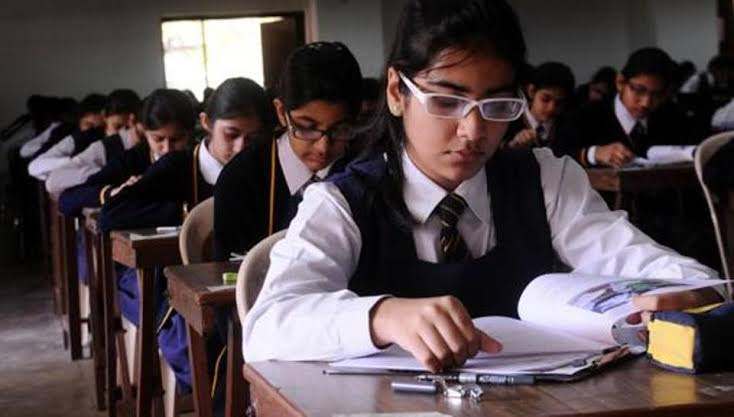

CBSE Class 10 Board Exam 2026 Datesheet Out – Exams from February 17, Check Complete Schedule Here

0

CBSE Class 10 Board Exam 2026 Datesheet Released: Check Complete Timetable at cbse.gov.in


The Central Board of Secondary Education (CBSE) has officially released the final datesheet for Class 10 Board Exam 2026, putting an end to the long wait for lakhs of students across India. The detailed timetable is now available on the CBSE’s official website — cbse.gov.in.

The exams will begin on February 17, 2026, and will conclude on March 10, 2026, with all papers to be conducted in a single shift — from 10:30 a.m. to 1:30 p.m.

This early release of the CBSE Class 10 Board Exam 2026 Datesheet comes as a major advantage for students and schools, offering ample preparation time for the crucial board exams.


🗓️ CBSE Class 10 Board Exam 2026 Datesheet: Key Highlights

  • Exam Commencement: February 17, 2026
  • Exam Conclusion: March 10, 2026
  • Timing: 10:30 a.m. to 1:30 p.m. (single shift)
  • Official Website: cbse.gov.in
  • Number of Subject Combinations: Over 40,000
  • Gap Between Papers: Adequate gap provided between major subjects
  • Special Note: No student will have two exams on the same day

The board has stated that the CBSE 10th Exam 2026 timetable has been meticulously planned to ensure that students have sufficient intervals between subjects. Additionally, special attention was paid to avoid overlapping for candidates with diverse subject combinations — a common challenge due to CBSE’s wide range of elective subjects.

Direct link to check CBSE Class 10 Board Exam 2026 final datesheet

📘 How to Download the CBSE Class 10 Board Exam 2026 Datesheet PDF

Students can easily access the official CBSE datesheet for 2026 by following these steps:

  1. Visit the official CBSE website – https://www.cbse.gov.in
  2. Click on the link titled “CBSE Class 10 Board Exam 2026 Datesheet” on the homepage.
  3. The PDF will open in a new tab showing the complete schedule.
  4. Download and print a copy for reference.

Alternatively, you can also visit cbse.nic.in — both websites are officially managed by the Central Board of Secondary Education.


🧾 CBSE Class 10 Exam 2026 – Expected Major Subject Dates

While the detailed subject-wise timetable is available on the official site, here’s a general overview of the likely schedule for key subjects (as per the CBSE pattern):

Subject Tentative Date Day
English Language & Literature February 19, 2026 Thursday
Hindi Course A & B February 24, 2026 Tuesday
Mathematics (Standard/Basic) February 28, 2026 Saturday
Science March 3, 2026 Tuesday
Social Science March 6, 2026 Friday
French / Sanskrit / Other Languages March 10, 2026 Monday

💡 Note: Students must verify the exact subject-wise schedule from the official PDF provided by CBSE.


🎯 Why the Early Release of Datesheet Is Important

This year, the CBSE has released the final exam schedule almost 110 days before the first paper. This is significantly earlier than previous years, and it reflects the board’s emphasis on transparency and preparedness.

Benefits for Students:

  • Ample Preparation Time: Students can now design a clear, realistic study plan.
  • Reduced Stress: No uncertainty over exam dates means students can focus purely on revision.
  • Time for Mock Tests: Schools can organize multiple rounds of pre-boards and practice exams.
  • Strategic Study Planning: Students can allocate more time to difficult subjects or chapters.

Benefits for Schools:

  • Better Academic Planning: Schools can adjust teaching schedules and finalize internal assessments.
  • Smooth Logistics: More time to prepare seating arrangements, admit cards, and invigilation plans.
  • Enhanced Guidance: Teachers can now plan subject-wise revision strategies well in advance.

🧠 CBSE Class 10 Preparation Tips for 2026 Board Exams

With the CBSE Class 10 Board Exam 2026 Datesheet now officially out, this is the perfect time for students to refocus their energy and fine-tune their preparation. Here are some expert-backed tips:

1. Make a Study Calendar

Use the official timetable to create a daily and weekly study plan. Allocate more time to subjects where you feel less confident.

2. Prioritize Conceptual Clarity

Instead of memorizing, focus on understanding the core concepts in Science, Math, and Social Science.

3. Revise Through NCERT

Most CBSE board exam questions come directly or indirectly from NCERT textbooks. Revise every chapter thoroughly.

4. Practice Sample Papers

Attempt CBSE’s official sample papers and previous year question papers available on cbseacademic.nic.in.

5. Take Mock Exams at Exam Time

Simulate the real exam by taking mock tests from 10:30 a.m. to 1:30 p.m. This helps your body and mind adapt to the exam timing.

6. Use Mind Maps and Notes

Summarize lengthy chapters into short notes or mind maps. This helps with quick revision during the last few weeks.

7. Stay Healthy

Eat balanced meals, stay hydrated, and ensure 7–8 hours of sleep every night. Mental health is just as important as academic preparation.


📣 Guidelines for CBSE Class 10 Board Exams 2026

The CBSE has also issued certain important instructions for students appearing in the 2026 exams:

  • Admit Cards: Students must collect admit cards from their schools before the exam.
  • Reporting Time: Reach the examination centre at least 30 minutes before the exam starts.
  • Stationery: Carry only allowed stationery — blue/black pens, pencils, erasers, and geometry tools.
  • Electronic Gadgets: Mobile phones, calculators, and smartwatches are strictly prohibited.
  • Dress Code: Follow school guidelines for uniform and ID card.
  • Answer Sheet Guidelines: Write neatly, leave margins, and ensure correct question numbering.

🏫 CBSE’s Focus on Smooth Conduct of Exams

The CBSE has reiterated that over 40,000 subject combinations are being offered this year. Despite this vast range, the board has ensured no student faces overlapping exams.

This structured approach also helps maintain a stress-free environment, with fair opportunities for all students to perform to their best potential.


💬 Expert Opinions on the CBSE Class 10 Board Exam 2026 Datesheet

Education experts have welcomed CBSE’s proactive approach in releasing the timetable early.
Dr. R.K. Sharma, a Delhi-based education consultant, noted:

“By releasing the datesheet three months early, CBSE is empowering students to study with a strategic mindset. This move reduces panic and promotes discipline in exam preparation.”

Teachers have also appreciated that the gaps between major subjects are sufficient to allow students time for thorough revision.

The release of the CBSE Class 10 Board Exam 2026 Datesheet marks the beginning of the final lap for students preparing for their first major academic milestone. With exams beginning on February 17, 2026, and concluding on March 10, 2026, this is the ideal time to finalize your preparation strategy.

Students are advised to:

  • Download the official timetable from cbse.gov.in
  • Prepare a detailed study plan
  • Revise consistently and maintain a positive attitude

Remember, the board exams are not just a test of knowledge — they are also a test of consistency, planning, and confidence.

Wishing every CBSE Class 10 student the best of luck for the 2026 board examinations!


📌 Quick Links

Jammu and Kashmir Government Vacancies 2025: 17,953 Posts Vacant Across 32 Departments

0

Jammu and Kashmir Government Vacancies 2025: 17,953 Posts Vacant Across 32 Departments

The Jammu and Kashmir Government has officially confirmed a major revelation about its staffing structure — over 17,953 government posts are currently lying vacant across 32 administrative departments. These include 2,960 gazetted posts and 14,993 non-gazetted positions, reflecting a significant human resource gap in various key sectors.

For thousands of job aspirants across the Union Territory, this announcement brings hope and opportunity. Departments like Education, Health, Public Works, and Power Development are among those with the highest number of vacancies. This article explores the department-wise details, reasons behind the vacancies, upcoming recruitment plans, and what this means for job seekers in Jammu and Kashmir.


Total Vacancies in J&K Government Departments

According to official data presented in a recent government reply, 17,953 vacancies exist across 32 government departments. Out of these, 2,960 are gazetted posts (Group A and B officers), while 14,993 are non-gazetted positions (clerical, teaching, and technical roles).

Category Number of Vacancies Remarks
Gazetted Posts 2,960 Senior-level officers and specialists
Non-Gazetted Posts 14,993 Clerical, teaching, and technical staff
Total 17,953 Across 32 departments

Departments with the Highest Vacancies

The government’s data shows that several crucial departments are struggling with manpower shortages. The School Education Department tops the list, followed by Health and Medical Education and Public Works (R&B).

Here are the top departments with the largest number of vacancies:

Department Name Approximate Vacancies
School Education Department 7,727
Health and Medical Education Department 5,300
Public Works (R&B) and Power Development 2,500+
Rural Development and Panchayati Raj 1,200
Agriculture and Allied Departments 800
Other Departments (combined) 2,400+

This data highlights the pressing need to fill positions in sectors directly linked with public welfare, healthcare, infrastructure, and education.


Reasons Behind Large Number of Vacancies

The revelation of such a huge number of unfilled posts raises several questions. Here are some of the key reasons contributing to the issue:

1. Recruitment Process Delays

Due to procedural delays, verification requirements, and periodic restructuring of recruiting agencies, many positions remain unfilled despite being sanctioned.

2. Policy and Administrative Changes

After the reorganization of Jammu and Kashmir into a Union Territory in 2019, several administrative processes, including service recruitment rules, were revised. This led to temporary suspension of recruitment in certain departments.

3. Pending Departmental References

Departments often fail to refer vacant positions to the JKPSC (Jammu and Kashmir Public Service Commission) or JKSSB (Jammu and Kashmir Services Selection Board) in time, delaying advertisement and selection.

4. Retirements and Resignations

A large number of officials have retired in recent years, while some left service or were promoted, creating unfilled vacancies in the lower cadres.

5. Transition to Digital Recruitment

The government’s recent shift to computer-based recruitment examinations and online application systems has improved transparency but slowed down initial rollouts due to testing and standardization.


Government’s Plan to Fill Vacancies

The Jammu and Kashmir Government has assured the public that steps are being taken to fill these vacancies in a time-bound and transparent manner.

Key measures include:

  • Departments instructed to refer vacancies promptly to JKPSC and JKSSB.
  • Computer-Based Recruitment Tests (CBRTs) to ensure fair and merit-based selections.
  • Online application systems to minimize manual interference.
  • Time-bound recruitment drives for critical departments like health, education, and infrastructure.
  • Regular reviews of recruitment status to track progress across departments.

According to officials, new recruitment notifications for many of these posts are expected in late 2025 and early 2026, once procedural approvals are complete.


Impact on Governance and Public Services

The large number of unfilled posts affects more than just employment statistics — it has a direct impact on governance and service delivery:

  • Education Sector: Shortage of teachers affects classroom quality, student-teacher ratios, and learning outcomes.
  • Health Sector: Vacant doctor, nurse, and technician posts strain hospitals and healthcare centres.
  • Infrastructure Departments: Projects in PWD, Power, and Rural Development often get delayed due to lack of manpower.
  • Administrative Efficiency: Vacancies in gazetted posts reduce decision-making speed and departmental oversight.

By filling these posts, the government can improve efficiency, reduce workload on existing staff, and ensure better public service delivery across Jammu and Kashmir.


Opportunities for Job Aspirants

For aspirants in Jammu and Kashmir, these vacancies open a wide range of opportunities across different qualification levels.

1. Gazetted Posts (JKPSC)

These include positions such as lecturers, assistant engineers, medical officers, and administrative officers. Most of these require graduate or postgraduate degrees and are filled through the Jammu and Kashmir Public Service Commission (JKPSC).

2. Non-Gazetted Posts (JKSSB)

The majority of vacancies fall in this category — teachers, clerks, technical assistants, and field staff. These are handled by the Jammu and Kashmir Services Selection Board (JKSSB) through written tests or computer-based examinations.

3. Department-Specific Recruitment

Departments like the School Education Department, Health Department, and PWD are likely to conduct special recruitment drives in coordination with JKSSB and JKPSC.

Aspirants are advised to regularly check:


How to Prepare for Upcoming J&K Recruitment Exams

Since the recruitment process is increasingly competitive and technology-driven, candidates should start early preparation. Here are some tips:

  1. Understand the Exam Pattern: JKSSB and JKPSC exams typically include general awareness, English, reasoning, and domain-specific subjects.
  2. Follow Official Syllabi: Study according to the official syllabus released with each notification.
  3. Stay Updated: Follow official websites and government press releases for real-time updates.
  4. Practice Mock Tests: Regular practice helps adapt to computer-based test formats.
  5. Revise J&K General Knowledge: History, geography, culture, and current affairs of J&K are common in almost every paper.
  6. Document Preparation: Keep domicile certificates, degree marksheets, and identity proofs ready for application.

Future Outlook

The Jammu and Kashmir administration’s focus on transparent and efficient recruitment marks a positive shift in governance. Once the pending posts are filled, it is expected to:

  • Generate thousands of employment opportunities for educated youth.
  • Strengthen the administrative capacity of the Union Territory.
  • Improve public services like healthcare, education, and infrastructure.
  • Build trust in the recruitment process through transparency.

Officials have hinted that filling all 17,953 vacancies may take multiple phases over the next one to two years. However, priority departments such as education and healthcare will likely see faster recruitment in upcoming months.


Conclusion

The disclosure of Jammu and Kashmir Government Vacancies 2025 — with nearly 18,000 posts lying vacant — underlines both a challenge and an opportunity. For the government, it means accelerating recruitment and improving governance efficiency. For the youth, it represents a rare chance to secure stable, respectable employment in the public sector.

As the administration gears up for large-scale recruitment drives, aspirants are advised to stay alert, prepare systematically, and seize these opportunities. The upcoming notifications from JKPSC and JKSSB could redefine employment prospects in the Union Territory and strengthen the foundations of public service for years to come.

Syllabus and Selection Criteria for the Post of Assistant Registrar, Cluster University of Srinagar

0

Syllabus and Selection Criteria for the Post of Assistant Registrar, Cluster University of Srinagar

Cluster University of Srinagar (CUS) has officially released the Syllabus and Selection Criteria for the Post of Assistant Registrar, a key administrative position in the university’s non-teaching cadre. Aspirants preparing for this competitive recruitment should clearly understand the examination structure, syllabus topics, and interview process to excel.

The Assistant Registrar plays a vital role in maintaining administrative efficiency and policy compliance within the university. Hence, the selection process is designed to evaluate both knowledge and managerial aptitude.

This article provides the complete details of the Assistant Registrar Syllabus, Selection Criteria, and the official PDF download link shared by the university.


Official Notification and PDF Link

Cluster University of Srinagar published the detailed syllabus and selection pattern in an official notification. Candidates can directly access the document from the university’s website.

📄 Download the Official Syllabus PDF:
👉 Click Here to View/Download PDF

The document contains topic-wise information for the written test, weightage distribution, and post-specific requirements.


About the Post: Assistant Registrar at Cluster University of Srinagar

The Assistant Registrar position is a prestigious administrative post responsible for supervising academic records, examinations, staff coordination, policy implementation, and compliance with the university’s financial and service rules.

Key Highlights:

  • University: Cluster University of Srinagar
  • Post: Assistant Registrar (Non-Teaching)
  • Eligibility: Master’s Degree with at least 55% marks or equivalent grade
  • Selection Process: Written Test + Interview
  • Official Website: www.cusrinagar.edu.in

Selection Criteria Overview

The recruitment process for Assistant Registrar at CUS consists of two main stages:

1. Written Examination

The written test evaluates a candidate’s administrative aptitude, reasoning skills, and understanding of university governance.

2. Interview / Viva-Voce

Candidates shortlisted from the written examination will appear for the interview. The interview assesses communication skills, decision-making ability, subject knowledge, and awareness of administrative procedures.

Although the exact marks distribution is provided in the official PDF, generally, the written test carries more weightage than the interview component.


Detailed Syllabus for Assistant Registrar (CUS Srinagar)

The Assistant Registrar Syllabus of Cluster University of Srinagar includes a blend of reasoning, general knowledge, English comprehension, financial administration, and university management topics. Below is a detailed overview.


1. English Language and Comprehension

This section evaluates linguistic accuracy and writing ability—essential for administrative communication.

Topics Include:

  • Vocabulary, grammar, and sentence correction
  • Reading comprehension passages
  • Precis writing and paraphrasing
  • Synonyms, antonyms, idioms, and phrases
  • Usage of English in an administrative context

Preparation Tip: Read editorials from reputed newspapers and practise comprehension tests daily.


2. General Awareness

Covers national, international, and regional awareness—especially regarding the education sector and policy reforms.

Key Topics:

  • Current affairs (National & International)
  • Indian Polity and Constitution
  • History, Geography, and Economy of India
  • Educational Policies (including NEP 2020)
  • Higher Education Institutions in J&K

Preparation Tip: Regularly follow news portals, government websites, and academic policy updates.


3. Reasoning and Analytical Ability

Assesses logical thinking, decision-making skills, and the ability to interpret data.

Main Areas:

  • Verbal and non-verbal reasoning
  • Coding–decoding, analogy, series completion
  • Syllogisms and logical deductions
  • Numerical aptitude and data interpretation

Preparation Tip: Solve 10–15 reasoning questions daily from standard books like RS Aggarwal or Arihant Reasoning Guide.


4. University Administration and Governance

A crucial section that focuses on how a university functions under various acts and regulations.

Topics Include:

  • University Acts, Statutes, and Regulations
  • Role of Academic Council, Syndicate, and Board of Studies
  • Examination and evaluation systems
  • Maintenance of service records, RTI Act, Leave rules
  • University financial and administrative procedures

Preparation Tip: Study the University Grants Commission (UGC) guidelines and familiarize yourself with NEP 2020 and UGC regulations.


5. Financial Administration, Accounts, and Audit

This portion tests knowledge of financial management within educational institutions.

Key Topics:

  • Budget preparation and accounting principles
  • Cash book, ledger, trial balance, and reconciliation
  • General Financial Rules (GFR 2017)
  • Audit procedures and internal controls
  • Role of Drawing and Disbursing Officer (DDO)

Preparation Tip: Understand basic accounting concepts and read summaries of GFR and Audit rules.


6. Procurement and Tendering Process

Assistant Registrars are often involved in procurement management and tender processing.

Topics Covered:

  • Purchase procedures and documentation
  • e-Procurement and Government e-Marketplace (GeM)
  • Inventory and stock verification
  • Disposal of obsolete items
  • Financial propriety and transparency in procurement

Preparation Tip: Study the Government of India’s procurement manual and familiarize yourself with tender formats.


7. Computer Applications and Office Management

Since administrative operations are mostly digital, this section ensures candidates are proficient in basic software tools.

Topics:

  • MS Office (Word, Excel, PowerPoint)
  • Office automation tools and ERP systems
  • File management, correspondence, and record keeping
  • Email and online document sharing
  • Cyber security basics

Preparation Tip: Practise Excel formulas, document formatting, and ERP basics.


Interview Preparation Strategy

The interview assesses:

  • Knowledge of university governance and procedures
  • Communication and drafting skills
  • Professional conduct and decision-making ability
  • Understanding of recent educational policies

Suggested Practice:

  • Revise key administrative rules, especially GFR and service regulations
  • Prepare examples of past administrative or leadership experience
  • Be clear about the vision and mission of Cluster University of Srinagar
  • Practise mock interviews to gain confidence

Preparation Plan for the Exam

A structured approach can maximize your chances of success:

Phase 1 – Foundation (Weeks 1–3):

  • Focus on English grammar, comprehension, and reasoning
  • Build your vocabulary and analytical accuracy

Phase 2 – Administration Focus (Weeks 4–7):

  • Study university governance, rules, and financial regulations
  • Revise important acts and service laws

Phase 3 – Practice & Revision (Weeks 8–10):

  • Attempt full-length mock tests
  • Focus on time management and speed

Phase 4 – Interview Readiness (Final 2 Weeks):

  • Stay updated with NEP 2020 and higher education news
  • Work on communication and presentation skills

Why This Syllabus Is Important

The Assistant Registrar position demands a blend of academic understanding and administrative expertise. The comprehensive syllabus ensures that candidates are assessed not only for subject knowledge but also for their ability to handle governance, finance, and policy compliance.

By covering diverse domains such as reasoning, administration, and finance, the exam identifies candidates capable of taking leadership roles in academic administration.


Conclusion

The Assistant Registrar Syllabus of Cluster University of Srinagar provides a clear roadmap for aspirants aiming to join one of Jammu and Kashmir’s leading educational institutions. With a focused strategy and regular practice, candidates can excel in both the written test and the interview.

Before beginning your preparation, ensure that you download and study the official syllabus PDF for the most authentic details.

📎 Official PDF Link: Download Here

Prepare systematically, stay consistent, and strengthen both your academic and administrative skills. The Assistant Registrar post at Cluster University of Srinagar is a prestigious opportunity for individuals aiming to contribute to higher education management in J&K.

JKSSB Cancels Withheld Recommendations for Lab Assistant Posts (Health & Medical Education Department) – Full Details

0

JKSSB Cancels Withheld Recommendations for Lab Assistant Posts (Health & Medical Education Department) – Full Details

The Jammu and Kashmir Services Selection Board (JKSSB) has released an important notification concerning the Lab Assistant post (Item No. 260) under the Health and Medical Education Department for the Division Cadre Jammu.

As per the notice issued by the JKSSB, the withheld recommendations of two candidates—Ms. Nageen Begum and Ms. Savi Dutta—have been cancelled due to non-submission of requisite documents and clarifications within the stipulated time period.

The announcement, dated 28th February 2025, and followed by a final notice on 11th August 2025, marks the closure of pending verification cases related to the recruitment advertised under Notification No. 05 of 2015, dated 01.09.2015.


About the Notification

Organization: Jammu and Kashmir Services Selection Board (JKSSB)
Department: Health and Medical Education Department
Cadre: Division Cadre Jammu
Post Name: Lab Assistant
Item No.: 260
Advertisement Notification: No. 05 of 2015 dated 01.09.2015
Notice Issued Date: 28.02.2025 (with follow-up on 11.08.2025)
Type: Cancellation of Withheld Recommendations

This decision by the JKSSB concludes a long-standing selection process that began in 2015, ensuring transparency and closure to pending recruitment cases under the said notification.


Details of the Cancelled Recommendations

The withheld recommendations of the following candidates have been officially cancelled:

S. No. Candidate Name Parentage Address Category Roll No. Reason for Cancellation
1 Ms. Nageen Begum D/o Parvez Ahmed R/o Bahsolhi, Kathua OM 12050005774 Failed to produce bonafide MLT diploma certificate and recognition clarification
2 Ms. Savi Dutta D/o Sudesh Kumar Dutta R/o Rajouri OM 12150005872 Failed to submit clarification regarding dual/overlapping of 10+2 & MLT diploma

According to the official JKSSB order, the candidates were provided multiple opportunities and sufficient time for submission of pending documents, but they failed to comply within the final extended deadline. Consequently, the Board decided to cancel their withheld recommendations in its 320th meeting.


Background of the Recruitment

The recruitment process for the Lab Assistant (Item No. 260) post was advertised by JKSSB through Notification No. 05 of 2015, issued on September 1, 2015.

Over the years, the selection list underwent multiple stages, including document verification, clarification of educational credentials, and production of bonafide certificates by selected candidates.

While most candidates completed their documentation and joined as per the selection list, a few recommendations—including those of Ms. Nageen Begum and Ms. Savi Dutta—remained withheld due to pending verification of their MLT (Medical Laboratory Technician) diplomas and other clarifications.


Why Were the Recommendations Withheld?

JKSSB initially withheld the recommendations of the above-mentioned candidates because of the following reasons:

  1. Verification of Diploma Authenticity:
    Candidates were required to submit bonafide certificates from recognized institutions, confirming the authenticity of their Medical Laboratory Technology diploma.
  2. Recognition Status of the Institute:
    The Board sought confirmation about whether the institute issuing the MLT diploma was recognized by the competent authority or university.
  3. Clarification of Dual/Overlapping Qualification:
    There were doubts regarding the overlapping of 10+2 qualifications with the MLT diploma course duration. Candidates were asked to clarify that their courses were not pursued simultaneously.

However, even after issuing multiple notices, including a final reminder notice on 11th August 2025, the required documents were not submitted, leading to cancellation of the withheld recommendations.


Official Notice Summary

The official notice states:

“Whereas, among the selectees, the recommendation of candidates namely Ms. Nageen Begum and Ms. Savi Dutta were kept withheld subject to production of bonafide certificate of diploma and recognition status of institute issuing degree and relevance and subject to clarification with regard to dual/overlapping of 10+2 & diploma in MLT respectively…

Whereas, the mentioned candidates failed to produce the requisite certificates and accordingly, the withheld recommendation cases were placed before the 320th Board Meeting. Taking note of the fact that despite sufficient opportunities afforded to the candidates, they failed to produce the requisite certificates, the Board decided to cancel their withheld recommendations.”

The notice is duly signed by Atul Kumar, JKAS, Secretary, J&K Services Selection Board.


What Does This Mean for Other Candidates?

This decision primarily affects only the two candidates whose recommendations were withheld. However, for other candidates who were selected and verified under the same advertisement, there is no change in their status.

JKSSB’s decision highlights the importance of timely document submission and clarity in educational qualifications during recruitment processes. Candidates appearing in future JKSSB examinations should take note of the following lessons:

  1. Always verify recognition of institutions before applying.
  2. Avoid overlapping courses (like pursuing 10+2 and diploma simultaneously).
  3. Respond to JKSSB notices within deadlines to prevent cancellation of candidature.
  4. Maintain clear records and copies of all certificates to avoid complications during verification.

JKSSB’s Continued Focus on Transparency

JKSSB has been consistently issuing updates to streamline pending recruitment cases from past years, especially those advertised before the formation of the Union Territory of Jammu and Kashmir.

By resolving withheld or pending cases, the Board ensures that:

  • Recruitment processes remain transparent and merit-based.
  • Pending selections from older notifications are brought to closure.
  • Eligible candidates are not kept waiting due to incomplete verifications.

This notification reflects JKSSB’s ongoing efforts to maintain integrity and accountability in its functioning.


How to Check the Official Notification PDF

Candidates can download the official JKSSB notification PDF from the official website link below:

🔗 JKSSB Notification PDF – Cancellation of Withheld Recommendations for Lab Assistant Posts (Item No. 260)

(Note: The exact file name and link may vary. Visit the official JKSSB website – www.jkssb.nic.in – for updated and authentic notices.)

The JKSSB Lab Assistant Selection List 2025 update serves as an important administrative decision finalizing the fate of pending withheld recommendations under Notification No. 05 of 2015.

While two candidates have faced cancellation due to non-compliance, this move reinforces JKSSB’s commitment to fair and rule-based recruitment practices in Jammu and Kashmir.

Candidates awaiting other recruitment results or pending verifications are advised to closely monitor the official JKSSB portal for any updates and ensure timely submission of all necessary documents to avoid disqualification

JKBOSE Class 12 Pass Marks 2025–26: Download PDF

0

JKBOSE Class 12 Pass Marks 2025–26: Subject-Wise Minimum and Maximum Marks, Criteria, and Official PDF Download

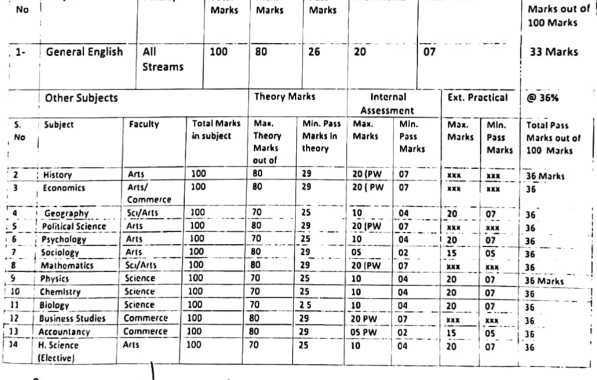
The Jammu and Kashmir Board of School Education (JKBOSE) plays a pivotal role in determining the academic future of lakhs of students across the Union Territory. As students prepare for their Higher Secondary Part-II (Class 12th) examinations for the 2025–26 academic session, one of the most searched topics is the JKBOSE Class 12 Pass Marks and the subject-wise marks distribution.

Understanding the minimum pass marks, theory–practical breakup, and grading system is essential for students to plan their preparation and avoid last-minute confusion. In this comprehensive article, we will explain:

  • JKBOSE Class 12 minimum and maximum marks
  • Stream-wise and subject-wise pass criteria
  • Importance of theory and practical marks
  • Official marks distribution PDF link
  • Tips to ensure passing with good grades

At the end of this post, you’ll find the official PDF link provided by JKBOSE for the 2025–26 session.


📘 Official PDF: JKBOSE Class 12 Marks Distribution 2025–26

Students and teachers can directly access the official marks distribution and pass criteria using the link below:

👉 Download Official PDF – JKBOSE Class 12 Marks Distribution 2025–26

This PDF outlines:

  • Maximum marks for each subject
  • Theory and practical split
  • Internal assessment weightage
  • Minimum marks required for passing

🎓 JKBOSE Class 12 Pass Marks Overview (2025–26)

The JKBOSE Class 12 examination evaluates students in multiple streams — Science, Commerce, Arts, and Home Science. The board has established uniform minimum marks criteria applicable across all subjects with certain exceptions.

Here’s the general rule:

Subject Type Minimum Pass Percentage Required Marks (Out of 100) Remarks
General English 33% 33 Marks Purely theoretical subject
Other Elective Subjects 36% 36 Marks Includes all optional papers
Subjects with Practical Components 36% in each component 36 Marks overall Separate pass marks for theory and practical

🔹 Note: Students must pass both theory and practical components individually to be declared “pass” in the subject.


📚 Detailed Subject-Wise Marks Distribution

JKBOSE follows a specific marks breakup pattern between theory, internal assessment, and practical examinations. Below is an approximate structure based on the latest scheme:

Stream Subject Total Marks Theory Internal/Practical Minimum Pass Marks
Science Physics 100 70 30 25 (theory), 11 (practical)
Science Chemistry 100 70 30 25 (theory), 11 (practical)
Science Biology 100 70 30 25 (theory), 11 (practical)
Science Mathematics 100 100 36
Commerce Accountancy 100 80 20 29 (theory), 7 (internal)
Commerce Business Studies 100 80 20 29 (theory), 7 (internal)
Commerce Economics 100 80 20 29 (theory), 7 (internal)
Arts Political Science 100 100 36
Arts History 100 100 36
Arts Sociology 100 80 20 29 (theory), 7 (internal)
Home Science Food & Nutrition 100 70 30 25 (theory), 11 (practical)

These marks distributions ensure that both academic knowledge and practical understanding are tested effectively.


📏 JKBOSE Class 12 Grading System 2025–26

JKBOSE follows a nine-point grading system for Class 12 students, which helps in standardizing evaluation.

Marks Range Grade Description
90% – 100% A1 Outstanding
80% – 89% A2 Excellent
70% – 79% B1 Very Good
60% – 69% B2 Good
50% – 59% C1 Satisfactory
40% – 49% C2 Acceptable
33% – 39% D Marginal Pass
Below 33% E Fail

Students should aim for at least Grade C1 (50%) or above to secure a solid result and be eligible for competitive examinations and higher studies.


🧮 How JKBOSE Calculates the Overall Result

The final result is determined by combining marks from theory, practical, and internal assessment components. The board ensures that:

  1. Students pass each subject individually.
  2. Practical marks are not used to compensate for poor theory performance.
  3. Aggregate marks are considered for final division (First, Second, Third).

For example:
If a student scores 28/70 in theory and 15/30 in practical for Physics (total 43/100 = 43%), the student passes, provided they meet the separate minimum marks in both components (theory 25+, practical 11+).


⚖️ Minimum and Maximum Pass Criteria Explained

Let’s clarify what “maximum” and “minimum” mean in the JKBOSE marking context:

  • Maximum Marks: Total marks a student can achieve in a paper (usually 100 per subject).
  • Minimum Marks: The least marks required to be declared “pass.”

💡 Example:

If a subject has 70 marks for theory and 30 for practical:

  • Minimum marks in theory = 25
  • Minimum marks in practical = 11
  • Combined total to pass = 36 marks

Even if a student scores 36 in total, they must still score the individual component minimums — otherwise, the result will show “fail in component.”


🧠 Why Understanding Pass Marks is Important

Knowing the JKBOSE pass marks isn’t just about avoiding failure — it’s about strategic exam preparation. Here’s why:

  1. Improved Time Management
    Students can prioritize subjects or sections that contribute more marks or where they’re weaker.
  2. Accurate Self-Evaluation
    Knowing that you need 36 marks minimum helps in setting daily and weekly study goals.
  3. Avoiding Surprises
    Many students fail because they didn’t realize they had to pass practical and theory separately.
  4. Confidence in Exams
    When you know the rules, you focus more on performance than anxiety.

🧾 Stream-Wise Pass Criteria (2025–26)

🔬 Science Stream

  • Must pass both theory and practical components separately.
  • Minimum 36% in each subject.
  • Practical-based subjects (Physics, Chemistry, Biology, Computer Science) require 11 marks minimum in the practical exam.

💼 Commerce Stream

  • Minimum 36% in Accountancy, Business Studies, and Economics.
  • Theory and internal assessment/project work both must be cleared.

🎨 Arts Stream

  • Most subjects are theoretical with some internal marks (20).
  • Minimum 36 marks to pass each paper.

🏠 Home Science Stream

  • 70 marks theory + 30 marks practical split.
  • Students must pass both sections separately.

🧩 What If a Student Fails to Meet the Pass Criteria?

JKBOSE provides several opportunities for students who fail to meet the minimum requirements:

  1. Supplementary Examination (Compartment)
    Students failing in one subject can reappear through the supplementary exam held later in the year.
  2. Revaluation / Rechecking
    Students can apply for answer sheet re-evaluation if they believe they’ve scored more than the awarded marks.
  3. Next Session Attempt
    Those failing in more than one subject need to reappear in the next annual/bi-annual session.

🧾 Division System in JKBOSE Class 12

Percentage Range Division Awarded
60% & above First Division
45% – 59% Second Division
33% – 44% Third Division
Below 33% Fail

Achieving a First Division (60% and above) opens the door to top undergraduate programs and scholarships.


🧭 JKBOSE Evaluation Process (Brief Overview)

JKBOSE follows a structured and transparent evaluation policy:

  • Centralized paper checking with moderation norms.
  • Double-checking of marks entry to avoid clerical errors.
  • Random sampling for quality control.
  • Publishing of result gazettes for transparency.

This ensures fairness and consistency across all zones of Jammu, Kashmir, and Ladakh divisions.


📅 Preparation Strategy to Achieve Good Marks

To not only pass but excel in the JKBOSE Class 12 examination, follow these tips:

  1. Study the Official PDF: Understand your subject’s marks breakup.
  2. Make a Realistic Timetable: Allocate extra time to tough subjects.
  3. Use Previous Year Papers: Identify common question patterns.
  4. Focus on Practical Work: Practice experiments and maintain journals.
  5. Revise Regularly: Weekly revision helps strengthen memory.
  6. Aim Beyond the Minimum: Set a target of at least 60% to stay safe.

🔗 Official Resources and Links

  • JKBOSE Official Website: https://jkbose.nic.in
  • Class 12 Marks Distribution PDF: Download Here
  • JKBOSE Notifications: JKBOSE Latest Updates
  • Revaluation Portal: Re-evaluation Form & Guidelines

🧩 Common FAQs on JKBOSE Class 12 Pass Marks

Q1. What is the minimum passing mark for JKBOSE Class 12 in 2025?
A1. The minimum pass mark is 33% for English and 36% for all other subjects.

Q2. Do I need to pass both theory and practical separately?
A2. Yes, you must secure at least 36% in each component separately.

Q3. Where can I check subject-wise marks distribution?
A3. From the official PDF: JKBOSE Class 12 Marks Distribution 2025–26.

Q4. What happens if I fail in one subject?
A4. You can appear for a supplementary/compartment exam in that subject.

Q5. What grade is considered as “pass”?
A5. Grade D (33%–39%) or above is considered passing.


🏁 Conclusion

The JKBOSE Class 12 Pass Marks 2025–26 criteria serve as the foundation for fair evaluation across all streams. Students must score a minimum of 33% in English and 36% in other subjects, including separate passing marks in theory and practical components. Understanding this helps in strategic planning, balanced preparation, and academic success.

To avoid confusion or misinformation, always refer to the official JKBOSE PDF and stay updated with the latest notifications from JKBOSE.nic.in.

With smart preparation and awareness of pass criteria, every student can aim not just to pass but to excel in the JKBOSE Higher Secondary Part-II Examination.


📥 Download Official PDF Here:
🔗 JKBOSE Class 12 Marks Distribution 2025–26.

JKBOSE Class 10 Marks Distribution 2025: Subject-Wise Pass Marks, Assessment Scheme, and Official PDF Download

0

JKBOSE Class 10 Marks Distribution 2025: Subject-Wise Pass Marks, Assessment Scheme, and Official PDF Download

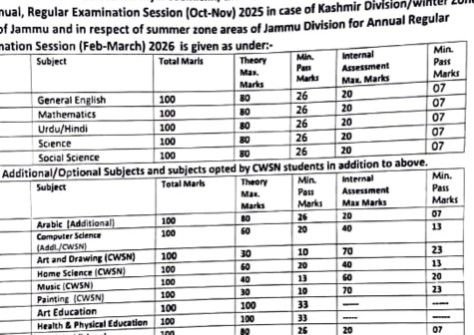
The Jammu and Kashmir Board of School Education (JKBOSE) has officially released the updated Marks Distribution and Passing Criteria for Class 10 Examination 2025-26. This detailed notice outlines the maximum and minimum pass marks, assessment structure, and evaluation methods for both regular and vocational subjects.

The circular applies to:

  • Annual, Regular (Oct–Nov) 2025 Session for Kashmir Division and Winter Zone areas of Jammu Division, and
  • (Feb–March) 2026 Session for Summer Zone areas of Jammu Division.

Students, teachers, and parents can now access the complete marks distribution and scheme of examination through the official JKBOSE notification PDF available below


🏫 Overview: JKBOSE Class 10 Marks Distribution 2025

The JKBOSE Class 10 Examination is a crucial academic milestone for students across Jammu, Kashmir, and Ladakh. The board has revised the assessment and marking scheme in line with the updated syllabus to ensure transparency, fairness, and uniformity across divisions.

According to the official notice, the total marks for each major subject remain 100, divided into theory and internal assessment components. Each student must secure minimum pass marks in both sections to be declared qualified.


📘 Part-I: Academic Subjects Marks Distribution

The following table summarizes the subject-wise marks breakup and minimum pass marks as per the latest JKBOSE guidelines for the 2025-26 academic session:

S.No Subject Total Marks Theory (Max Marks) Min Pass Marks (Theory) Internal Assessment (Max Marks) Min Pass Marks (Internal)
1 English 100 80 26 20 07
2 Mathematics 100 80 26 20 07
3 Urdu / Hindi 100 80 26 20 07
4 Science 100 80 26 20 07
5 Social Science 100 80 26 20 07

This means that students must score a minimum of 26 marks in theory and 7 marks in internal assessment in each subject to pass.


🧩 Additional / Optional Subjects for CWSN Students

JKBOSE has also included a separate section for Children With Special Needs (CWSN) and students opting for additional subjects. The subjects, marks, and passing criteria for these categories are as follows:

S.No Subject Total Marks Theory Max Marks Min Pass (Theory) Internal Assessment Max Marks Min Pass (Internal)
1 Arabic (Additional) 100 80 26 20 07
2 Computer Science (Addl./CWSN) 100 60 20 40 13
3 Art and Drawing (CWSN) 100 30 10 70 23
4 Home Science (CWSN) 100 40 13 60 20
5 Music (CWSN) 100 30 10 70 23
6 Painting (CWSN) 100 30 10 70 23
7 Art Education 100 33 10 67 23
8 Health & Physical Education 100 80 26 20 07
9 Hindi (Additional) 100 80 26 20 07
10 Dogri (Additional) 100 80 26 20 07
11 Sanskrit (Additional) 100 80 26 20 07
12 Bhoti (Additional) 100 80 26 20 07
13 Punjabi (Additional) 100 80 26 20 07
14 Persian (Additional) 100 80 26 20 07
15 Urdu (Additional) 100 80 26 20 07
16 Kashmiri (Additional) 100 80 26 20 07

The inclusion of these subjects ensures inclusive education for all students, especially those under CWSN (Children With Special Needs) programs.


🧾 Part-II: Vocational Subjects (Class 10) – Assessment and Evaluation

JKBOSE has also issued a clear scheme of examination for vocational subjects, highlighting the three major components of assessment:

  1. Knowledge/Theory Test – 60 Marks
  2. Practical Test – 50 Marks
  3. Internal Assessment (CCE) – 20 Marks

At the time of final calculation, the theory marks out of 60 are divided by 2 to convert them into 30 marks, maintaining parity with the overall total of 100 marks per subject.


📊 Detailed Assessment Plan for Vocational Subjects

S.No Method of Assessment Weightage (Max Marks) Minimum Pass Marks Evaluator
1 Theory/Written Test 30 Marks (Out of 60) 10 Marks @33% JKBOSE
2 Practical Test & Oral/Viva 50 Marks 16 Marks @33% Sector Skill Council (SSC)
3 School-Based Assessment 20 Marks 07 Marks @33% Vocational Trainer (School-Based)

To qualify, students must pass separately in theory and practical components. The total of all sections equals 100 marks.


🎓 Key Highlights of JKBOSE Class 10 Marking Scheme 2025

  1. Uniform Evaluation System:
    The new marking system is aligned across all divisions—Kashmir, Jammu (Summer/Winter Zones), ensuring equality in assessment standards.
  2. Clear Passing Criteria:
    Students must secure at least 33% in each component (theory, internal assessment, and practical) to pass a subject.
  3. Inclusive Education Policy:
    The scheme provides special accommodations for CWSN students, introducing flexible marking in creative subjects like art, drawing, and music.
  4. Balanced Skill Development:
    With vocational subjects gaining prominence, JKBOSE integrates both academic knowledge and practical skills for employability.
  5. Transparent Evaluation Process:
    Practical and internal assessments will be conducted under the supervision of Sector Skill Councils (SSC) and school evaluators, ensuring authenticity.

🧠 Understanding Internal Assessment (CCE) in JKBOSE Class 10

The Continuous and Comprehensive Evaluation (CCE) component carries 20 marks for each subject. It includes:

  • Class performance
  • Assignments and projects
  • Attendance and behavior
  • Oral tests and participation in school activities

Students should not ignore internal marks as they significantly contribute to the final result. Scoring well in this section can enhance overall grades.


📅 Applicability of the New Marks Distribution Scheme

The revised marking scheme applies to the following sessions:

  • Annual Regular (October–November 2025): Kashmir Division & Winter Zone areas of Jammu Division
  • Annual Regular (February–March 2026): Summer Zone areas of Jammu Division

This alignment ensures a consistent academic structure across the union territory.


📥 How to Download the JKBOSE Class 10 Marks Distribution PDF 2025-26

Students and teachers can download the official PDF directly from the JKBOSE website. Follow these steps:

  1. Visit the official JKBOSE portal – https://jkbose.nic.in
  2. Navigate to the “Notifications” or “Latest Updates” section.
  3. Look for the circular titled “Maximum and Minimum Pass Marks for Secondary School Examination (Class 10th) 2025–26.”
  4. Click to open or directly download the PDF.
    👉 Download Directly Here

📚 Why This Update Matters for Students

The release of the JKBOSE Class 10 Marks Distribution 2025 is not just an administrative update—it’s a roadmap for effective exam preparation. Students can now:

  • Understand the exact weightage of theory and internal marks
  • Plan better for subject-wise minimum passing marks
  • Focus on practical and internal assessments for vocational and CWSN subjects
  • Avoid last-minute confusion during board exams

Teachers can also use this document to structure classroom teaching, ensuring that students meet all learning objectives.


🏁 Final Words

The JKBOSE Class 10 Marks Distribution 2025 notification provides a transparent and updated assessment framework that supports academic fairness, inclusivity, and skill-based learning. With equal emphasis on theory, internal assessment, and vocational training, the board aims to produce well-rounded, competent students ready for higher education or career-oriented paths.

Students are advised to go through the official notification carefully and align their preparation accordingly.

📄 Official Notification PDF:
👉 Click here to download JKBOSE Class 10 Marks Distribution 2025-26 PDF

BGSBU Super-30 Free IAS/JKAS Coaching 2025 for Female Students: Complete Syllabus, Exam Pattern, and Details

0

BGSBU Super-30 Free IAS/JKAS Coaching 2025 for Female Students: Complete Syllabus, Exam Pattern, and Details

In a significant step toward empowering women through education and leadership opportunities, Baba Ghulam Shah Badshah University (BGSBU), Rajouri, has announced the Super-30 Free IAS/JKAS Coaching Program 2025. This initiative, launched under the Beti Bachao Beti Padhao (BBBP) Scheme, aims to provide free General Studies coaching exclusively for female students from Rajouri District.

The program is designed to help meritorious female aspirants prepare for Civil Services Examinations, including the UPSC IAS and JKPSC JKAS, without the burden of high coaching fees. Let’s dive into the detailed syllabus, exam pattern, and eligibility information for the entrance examination.


Overview of BGSBU Super-30 Free IAS/JKAS Coaching 2025

Particular Details
Conducting Body Baba Ghulam Shah Badshah University (BGSBU), Rajouri
Program Name Super-30 Free IAS/JKAS Coaching
Scheme Beti Bachao Beti Padhao (BBBP)
Beneficiaries Female students from Rajouri District
Coaching Type Free General Studies Coaching
Purpose Preparation for IAS and JKAS exams
Selection Mode Entrance Examination
Maximum Marks 100
Duration of Test 100 Minutes
Question Type Multiple Choice Questions (MCQs)
Negative Marking No Negative Marking

The Super-30 initiative is expected to select 30 deserving candidates who will receive free, high-quality IAS/JKAS coaching under expert faculty guidance at BGSBU. This step ensures equal opportunities for women to compete in civil services exams and contribute to public administration and governance.


BGSBU Super-30 Entrance Exam Syllabus 2025

The entrance examination will assess the candidates’ knowledge and aptitude across two sections — General Studies I and General Studies II (CSAT) — similar to the structure of the UPSC Civil Services Preliminary Examination.


Section I – General Studies I

This section tests candidates’ general awareness and understanding of current national and international issues. It is designed to evaluate analytical skills, historical awareness, and understanding of socio-economic and environmental topics.

Detailed Topics:

  1. Current Events of National and International Importance
    • Recent government schemes and policies
    • Global political and economic developments
    • Awards, sports, and scientific achievements
  2. History of India and Indian National Movement
    • Ancient, Medieval, and Modern Indian History
    • Freedom struggle and contributions of key leaders
    • Socio-cultural reforms and post-independence developments
  3. Indian and World Geography
    • Physical, social, and economic geography of India and the world
    • Climate, natural resources, and population distribution
    • Geographical features and environmental sustainability
  4. Indian Polity and Governance
    • Constitution of India: Preamble, Fundamental Rights, Directive Principles
    • Political system, Panchayati Raj, and Public Policy
    • Governance and Rights Issues
  5. Economic and Social Development
    • Sustainable Development and inclusive growth
    • Poverty, demographics, and social sector initiatives
    • Economic planning and recent reforms
  6. Environmental Ecology, Biodiversity, and Climate Change
    • Ecosystems, pollution, and conservation measures
    • Global environmental issues and sustainable solutions
  7. General Science
    • Everyday science and technological developments
    • Basic concepts of physics, chemistry, and biology relevant to society

Section II – General Studies II (CSAT): Civil Services Aptitude Test

This section evaluates candidates’ aptitude, reasoning, and comprehension abilities — essential for decision-making and problem-solving in administrative roles.

Detailed Topics:

  1. Comprehension
    • Reading comprehension passages
    • Answering questions based on inference and understanding
  2. Interpersonal Skills Including Communication Skills
    • Emotional intelligence and effective communication
    • Conflict resolution and teamwork
  3. Logical Reasoning and Analytical Ability
    • Coding-decoding, syllogisms, and analytical puzzles
    • Pattern recognition and logical conclusions
  4. Decision-Making and Problem-Solving
    • Ethical decision-making in governance scenarios
    • Prioritization and analytical reasoning questions
  5. General Mental Ability
    • Numerical aptitude and general intelligence questions
  6. Basic Numeracy (Up to Class X Level)
    • Numbers and their relations
    • Orders of magnitude, averages, ratios, percentages
  7. Data Interpretation (Up to Class X Level)
    • Charts, graphs, tables, and data sufficiency

BGSBU Super-30 Exam Pattern 2025

Feature Details
Exam Mode Offline (OMR-based)
Type of Questions Objective / Multiple Choice Questions
Total Questions 100
Marks per Question 1 Mark
Total Marks 100
Duration 100 Minutes
Negative Marking No Negative Marking

The absence of negative marking provides an added advantage for aspirants, allowing them to attempt all questions confidently.


Eligibility Criteria for BGSBU Super-30 Free IAS/JKAS Coaching

The program is exclusively for female candidates belonging to Rajouri district. The basic eligibility conditions generally include:

  • Gender: Female only
  • Domicile: Must belong to Rajouri District
  • Education Qualification: Graduate or pursuing final year of graduation from a recognized university
  • Age Limit: As per UPSC/JKPSC eligibility norms

(Official eligibility details are released along with the official notification — candidates must verify with BGSBU’s website.)


How to Apply for BGSBU Super-30 IAS/JKAS Coaching 2025

  1. Visit the Official Website:
    Go to www.bgsbu.ac.in and navigate to the “Admissions” or “Announcements” section.
  2. Find the Super-30 Coaching Notification:
    Download the official notification and read all instructions carefully.
  3. Fill the Application Form:
    Provide accurate personal and educational details.
  4. Submit Required Documents:
    Attach recent passport-size photographs, domicile certificate, and educational certificates.
  5. Appear for Entrance Test:
    Candidates must appear at the designated center on the scheduled date with a valid admit card.

Benefits of BGSBU Super-30 IAS/JKAS Coaching

The Super-30 Coaching Program by BGSBU offers numerous benefits for aspiring women candidates:

  • Free of Cost Coaching: Full coverage of IAS/JKAS General Studies syllabus without any fees.
  • Expert Faculty Guidance: Experienced mentors with deep understanding of civil services examinations.
  • Comprehensive Study Material: Well-structured notes, test series, and mock tests.
  • Motivational and Career Counseling Sessions: Regular workshops to build confidence and leadership skills.
  • Empowerment through Education: An initiative promoting women’s participation in administration and governance.

Preparation Tips for Super-30 Entrance Exam

  1. Understand the Syllabus Thoroughly: Focus on all topics mentioned in General Studies and CSAT.
  2. Read Newspapers Daily: For current affairs, refer to The Hindu or Indian Express.
  3. Revise NCERTs: Study Class 6–12 NCERT books for history, geography, and polity basics.
  4. Practice Mock Tests: Attempt previous year papers and online quizzes.
  5. Focus on Logical and Analytical Questions: For CSAT, practice reasoning and aptitude regularly.

Conclusion

The BGSBU Super-30 Free IAS/JKAS Coaching 2025 is a remarkable initiative to promote female empowerment through education in Jammu and Kashmir. By offering free coaching, structured syllabus, and expert mentorship, the university is nurturing future women leaders and administrators.

Female students from Rajouri district aspiring for UPSC or JKPSC civil services must not miss this golden opportunity. With dedication, proper guidance, and the support of the Beti Bachao Beti Padhao Scheme, success in the civil services examination is well within reach.

NPCIL Recruitment 2025: Apply Online for 122 Deputy Manager & Junior Hindi Translator Posts – Check Eligibility, Dates & Salary

0

NPCIL Recruitment 2025: Apply Online for 122 Deputy Manager & Junior Hindi Translator Posts – Check Eligibility, Dates & Salary

The Nuclear Power Corporation of India Limited (NPCIL) has officially released the NPCIL Recruitment 2025 notification for various managerial and language translator posts. This recruitment drive aims to fill 122 vacancies across several departments including Human Resources, Finance & Accounts, Contracts & Materials Management, Legal, and Hindi Translation.

This is a golden opportunity for candidates aspiring to work in a reputed public sector enterprise under the Department of Atomic Energy, Government of India. NPCIL plays a vital role in the nation’s nuclear power development and offers a stable, rewarding, and growth-oriented career path.

In this detailed article, we cover eligibility criteria, post details, pay scale, selection process, important dates, and step-by-step instructions for applying online.


🏢 About NPCIL

The Nuclear Power Corporation of India Limited (NPCIL) is a premier public sector enterprise responsible for the design, construction, commissioning, and operation of nuclear power plants in India. It operates under the Department of Atomic Energy (DAE) and is known for its contribution to sustainable energy generation.

Working with NPCIL not only offers job security but also provides exposure to advanced technology, challenging roles, and national service by contributing to India’s energy independence.


📋 NPCIL Recruitment 2025 Overview

Particulars Details
Organization Name Nuclear Power Corporation of India Limited (NPCIL)
Post Name Deputy Manager & Junior Hindi Translator
Total Vacancies 122
Application Mode Online
Start Date to Apply 7 November 2025
Last Date to Apply 27 November 2025
Official Website www.npcil.nic.in

🧾 NPCIL Vacancy Details 2025

The total of 122 vacancies has been announced for the following posts:

  • Deputy Manager (HR): 31 Posts
  • Deputy Manager (F&A): 48 Posts
  • Deputy Manager (C&MM): 34 Posts
  • Deputy Manager (Legal): 1 Post
  • Junior Hindi Translator (JHT): 8 Posts

Candidates are advised to go through the detailed NPCIL Recruitment 2025 notification for category-wise and reservation details.


🎓 Eligibility Criteria for NPCIL Recruitment 2025

Eligibility varies according to the post. Candidates must ensure they meet the requirements before applying online.

1. Educational Qualification

  • Deputy Manager (HR): Graduation with MBA or equivalent in Human Resources or Personnel Management.
  • Deputy Manager (F&A): Graduation with CA/ICWA or MBA (Finance).
  • Deputy Manager (C&MM): Engineering degree with MBA/PG Diploma in Materials Management.
  • Deputy Manager (Legal): Degree in Law (LLB/LLM) from a recognized university.
  • Junior Hindi Translator: Master’s degree in Hindi/English or equivalent with proficiency in translation work.

Note: Candidates should refer to the official notification for detailed educational qualifications and experience requirements.


2. Age Limit (as of 27 November 2025)

Post Minimum Age Maximum Age
Deputy Manager 18 years 30 years
Junior Hindi Translator 21 years 30 years

Age Relaxation:

  • SC/ST: 5 years
  • OBC (NCL): 3 years
  • PwBD: 10 years
  • Ex-Servicemen: As per government norms.

💰 NPCIL Salary 2025

NPCIL offers attractive pay scales and benefits to its employees:

  • Deputy Manager: Level 10 – ₹56,100/- per month (plus allowances)
  • Junior Hindi Translator: Level 6 – ₹35,400/- per month (plus allowances)

In addition to the basic salary, selected candidates are entitled to Dearness Allowance (DA), House Rent Allowance (HRA), Transport Allowance, Medical Benefits, and Performance-based Incentives.


🧮 Application Fee

Post Application Fee
Deputy Manager ₹500/-
Junior Hindi Translator ₹150/-
SC/ST/PwBD/Ex-Servicemen/Women Exempted

Fees must be paid online via debit card, credit card, or net banking.


🧑‍💼 Selection Process for NPCIL Recruitment 2025

The NPCIL recruitment process involves multiple stages depending on the post applied for.

For Deputy Manager Posts

  1. Written Examination
  2. Interview
  3. Document Verification
  4. Medical Examination

For Junior Hindi Translator

  1. Written Test
  2. Skill/Translation Test
  3. Document Verification
  4. Medical Examination

Candidates must secure minimum qualifying marks in each stage to progress further.


📅 Important Dates

Event Date
Online Application Start Date 7 November 2025
Last Date to Apply 27 November 2025
Exam Date To be notified
Admit Card Release To be notified
Result Declaration To be notified

🧠 Preparation Tips for NPCIL Recruitment 2025

Cracking NPCIL exams requires both subject knowledge and exam strategy. Follow these proven tips:

  1. Understand the Syllabus & Pattern: Go through previous NPCIL papers and note key topics for each section.
  2. Focus on Core Subjects: For HR, Finance, or Legal streams, emphasize professional topics from your field.
  3. Current Affairs: Stay updated with national, international, and industry-related developments.
  4. Quantitative & Reasoning Practice: Daily practice enhances speed and accuracy in the written exam.
  5. Mock Tests: Take full-length tests regularly to improve time management.
  6. Revision: Maintain concise notes and revise weekly.
  7. Language Skills for JHT: Strengthen translation practice between Hindi and English.

🖋️ How to Apply Online for NPCIL Recruitment 2025

Follow the steps below to apply smoothly:

  1. Visit the official NPCIL website: www.npcil.nic.in
  2. Go to the “Careers” section and click on NPCIL Recruitment 2025 Notification.
  3. Read the detailed advertisement carefully.
  4. Click on Apply Online and register yourself using a valid email ID and mobile number.
  5. Fill in your personal, educational, and communication details.
  6. Upload required documents — photograph, signature, and certificates.
  7. Pay the applicable application fee.
  8. Submit the form and take a printout for future reference.

📌 Why Choose a Career with NPCIL?

Working at NPCIL means being part of India’s journey toward clean and sustainable energy. Employees enjoy:

  • Government pay scales with consistent career growth.
  • Job stability and pension benefits.
  • Opportunities to work with advanced nuclear and engineering technology.
  • Training and professional development programs.
  • Social respect and contribution to national development.

NPCIL is not just an employer but a platform for engineers, managers, and linguists to make a real difference in India’s energy sector.


🧾 Key Points to Remember

  • Apply online only through the official website – no offline applications accepted.
  • Keep scanned copies of documents ready before starting the application.
  • Use a stable internet connection during form submission.
  • Review all entries carefully before final submission.
  • Stay updated through NPCIL’s website for any announcements or changes.

FAQs on NPCIL Recruitment 2025

Q1. How many vacancies are available under NPCIL Recruitment 2025?
A1. There are a total of 122 vacancies for Deputy Managers and Junior Hindi Translators.

Q2. What is the last date to apply for NPCIL Recruitment 2025?
A2. The last date for online application submission is 27 November 2025.

Q3. What is the age limit for Deputy Manager posts?
A3. The age limit is 18 to 30 years, with relaxation as per government rules.

Q4. What is the pay scale for Junior Hindi Translator?
A4. The JHT post carries a pay level of ₹35,400 per month plus allowances.

Q5. Where can I find the official NPCIL notification?
A5. You can download the official advertisement from www.npcil.nic.in under the “Careers” section.


🔍 Conclusion

The NPCIL Recruitment 2025 offers a prestigious opportunity to join one of India’s top government enterprises. With 122 vacancies across multiple domains, this recruitment drive opens doors for skilled professionals and graduates to build a long-term, secure, and impactful career.

If you have the passion, qualifications, and dedication to serve in India’s nuclear power sector, apply online before the 27 November 2025 deadline and take your first step toward a bright future with NPCIL.

Two Govt Teachers Terminated for Anti-National Activities in J&K

0

Two Govt Teachers Terminated for Anti-National Activities in J&K

Srinagar: Jammu and Kashmir Lieutenant Governor Manoj Sinha has ordered the termination of two government employees for their alleged involvement in activities “detrimental to the sovereignty and integrity of India.”

The dismissed employees have been identified as Ghulam Hussain and Majid Iqbal Dar, both serving as teachers in the Education Department. The terminations were approved under Article 311(2)(c) of the Constitution of India, which empowers the government to dismiss employees without holding a departmental inquiry if such action is deemed necessary in the interest of the security of the state.

Authorities said the duo were found to have links with militant organizations and were allegedly engaged in activities that promoted anti-national sentiments. The move is part of the administration’s ongoing effort to root out elements within the government system who are suspected of supporting or aiding militancy in any form.

The decision followed a verification process by multiple agencies, including inputs from security and intelligence departments. “The cases were thoroughly examined before the final approval was granted. The administration maintains a zero-tolerance policy towards anyone found compromising national security or promoting separatist ideology.

Since 2019, the Jammu and Kashmir government has dismissed several employees from various departments under the same constitutional provision, citing threats to state security. [KNT]