Saturday, June 13, 2026
Advertisementspot_img
Home Blog Page 2

UPSC Civil Services Prelims 2026 Held Smoothly Across 9 Kashmir Sub-Centres

0

UPSC civil services prelims 2026 conducted across 9 sub-centres in Kashmir

Srinagar, May 24: The UPSC Civil Services Preliminary Examination 2026 was conducted on Sunday across nine sub-centres established here for the candidates of the Kashmir valley.

”The Union Public Services Commission Civil Services Preliminary examination was conducted today under the strict supervision of Divisional Administration Kashmir, amidst robust security measures, and elaborate administrative arrangements,” an official spokesman said.

He said all necessary arrangements, including uninterrupted power supply, were ensured to facilitate the smooth conduct of the examination.

Meanwhile, for the first time, face authentication for marking the candidates’ attendance was carried out with 100 per cent success across all sub-centres.

As many as 2,000 candidates, including 27 persons with disabilities, appeared in the examination, which is a gateway to All India Services — Indian Administrative Service(IAS), Indian Police Service(IPS) and Indian Forest Service(IFS) — and other Group A services.

One sub-centre was exclusively established and designated for PwD candidates at the Government College of Education, Srinagar, equipped with all the required facilities, the spokesman said.–(PTI)

NCDC Offers International Montessori Education Courses for Aspiring Teachers

NCDC Offers International Montessori Education Courses for Aspiring Teachers

The National Child Development Council (NCDC) is offering vocational courses in International Montessori Education for aspiring preschool teachers and educators. These courses aim to improve professional skills in early childhood education.

According to the organizers, the program includes live classes and is designed to be focused on jobs. The courses are only for women, and there is no age limit for enrollment.

The courses offered include Post Graduate Diploma in International Montessori Education, Diploma in International Montessori Education, Certificate in International Montessori Education, Advanced Diploma in International Montessori Education, and Certificate in International Preschool Education.

Interested candidates can contact 7356606032 for more details and admissions (Advt).

Cluster University of Srinagar Releases PG Entrance Syllabus 2026-27 for All Courses

0

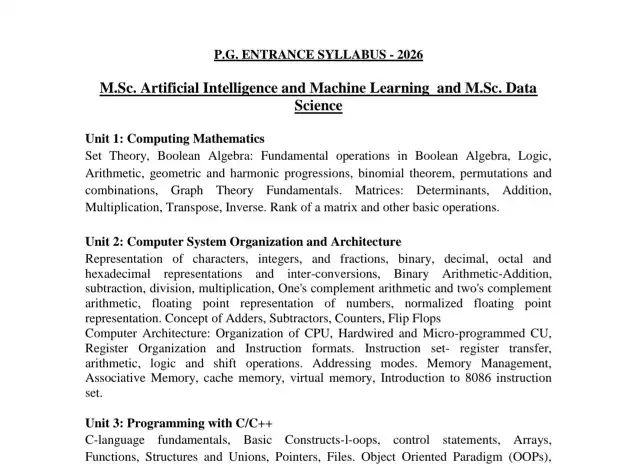
The Cluster University of Srinagar has officially released the PG Entrance Syllabus for the Academic Session 2026-27 for various postgraduate programmes offered under the university. The syllabus has been uploaded by the Directorate of Admissions to help students prepare effectively for the upcoming postgraduate entrance examinations.

Students seeking admission to postgraduate programmes including M.Sc., M.A., MBA, and other professional and academic courses must carefully review the syllabus before beginning preparation. The syllabus provides a detailed outline of subjects, units, concepts, and important topics from which questions will be asked in the entrance examination.

This comprehensive article explains the syllabus structure, preparation strategy, important subjects, course-wise overview, and key examination guidance for candidates appearing in the Cluster University of Srinagar PG Entrance Examination 2026-27.


Official Notification Overview

According to the official notification issued by the Directorate of Admissions, the syllabus for the PG Entrance Examination has been uploaded on the official university website under the Admissions section. Candidates have been advised to regularly visit the university portal for updates regarding examinations, admission schedules, and counselling notifications.

The notification was issued under:

  • Directorate of Admissions
  • Cluster University of Srinagar
  • Notification No: CUS/Adm-PG(CUSET-2026)/2506-25
  • Dated: 20-04-2026

Importance of PG Entrance Syllabus

The entrance syllabus is one of the most important documents for postgraduate aspirants because it:

  • Defines the exact examination pattern
  • Helps students focus on relevant topics
  • Reduces unnecessary preparation
  • Assists in time management
  • Improves conceptual clarity
  • Helps in identifying important subject areas
  • Enables smart revision planning

Students preparing without referring to the official syllabus often waste valuable time studying irrelevant topics.


Courses Covered Under the PG Entrance Syllabus 2026-27

The syllabus released by Cluster University of Srinagar covers a wide range of postgraduate programmes, including:

  • M.Sc. Artificial Intelligence & Machine Learning
  • M.Sc. Data Science
  • M.Sc. Biochemistry
  • M.Sc. Botany
  • MBA
  • M.Sc. Chemistry
  • M.A. Economics
  • M.A. Education
  • M.A. English
  • M.Sc. Environmental Science
  • M.A./M.Sc. Geography
  • M.A. History
  • Various other postgraduate programmes

The syllabus document spans multiple disciplines and contains subject-wise units for each course.


M.Sc. Artificial Intelligence & Machine Learning / Data Science Syllabus

One of the most sought-after programmes in recent years is M.Sc. Artificial Intelligence & Machine Learning and M.Sc. Data Science. The syllabus is highly technical and interdisciplinary.

Major Units Included

1. Computing Mathematics

Topics include:

  • Set Theory
  • Boolean Algebra
  • Graph Theory
  • Matrices
  • Determinants
  • Permutations and Combinations
  • Progressions

2. Computer Organization and Architecture

Students need to prepare:

  • Binary arithmetic
  • CPU organization
  • Memory management
  • Cache memory
  • Virtual memory
  • 8086 instruction set

3. Programming with C/C++

Important areas:

  • Arrays
  • Functions
  • Structures
  • Pointers
  • OOP concepts
  • Polymorphism
  • Inheritance
  • Virtual functions

4. Database Management Systems

Topics include:

  • DBMS architecture
  • SQL
  • Normalization
  • Transaction management
  • Recovery techniques

5. Data Structures

Candidates should prepare:

  • Stacks
  • Queues
  • Trees
  • Graphs
  • Sorting algorithms
  • Searching algorithms
  • Hashing

6. Operating Systems

Includes:

  • Deadlocks
  • Paging
  • Segmentation
  • Disk scheduling
  • Process management

7. Networking

Important concepts:

  • OSI model
  • TCP/IP
  • Network layers
  • Transmission media

8. Software Engineering

Preparation areas include:

  • SDLC
  • Agile model
  • Waterfall model
  • PERT and CPM
  • CASE tools

9. Logical Reasoning

Includes:

  • Syllogisms
  • Blood relations
  • Coding-decoding
  • Seating arrangements

10. Calculus and Functions

Students should prepare:

  • Differentiation
  • Integration
  • Functions
  • Relations
  • Differential equations


M.Sc. Biochemistry Syllabus

The M.Sc. Biochemistry entrance syllabus is extensive and combines biology, chemistry, genetics, microbiology, and molecular biology.

Important Units

Introduction to Biochemistry

  • Biomolecules
  • pH and buffers
  • Water chemistry
  • Stereoisomerism

Cell Biology

  • Cell organelles
  • Cell cycle
  • Cytoskeleton
  • Membrane transport

Enzymology

  • Enzyme kinetics
  • Michaelis-Menten equation
  • Enzyme inhibition

Immunology

  • Immune responses
  • Immunoglobulins
  • Vaccines
  • Autoimmunity

Human Physiology

  • Digestive system
  • Respiratory system
  • Nervous system
  • Kidney function

Genetics

  • Mendelian genetics
  • Linkage
  • Crossing over
  • Chromosomal disorders

Biotechnology

  • PCR
  • Cloning vectors
  • Recombinant DNA technology

Molecular Biology

  • DNA replication
  • Transcription
  • Translation
  • Operon concept

Clinical Biochemistry

  • KFT
  • LFT
  • TFT
  • Lipid profile


M.Sc. Botany Syllabus

The Botany syllabus is divided into fifteen major units covering plant sciences comprehensively.

Major Areas

Microbes and Algae

  • Viruses
  • Bacteria
  • Algae classification
  • Life cycles

Fungi and Plant Pathology

  • Fungal classification
  • Plant diseases
  • Mycorrhiza

Bryophytes, Pteridophytes and Gymnosperms

  • Alternation of generations
  • Seed habit
  • Gymnosperm diversity

Plant Taxonomy

  • ICN principles
  • Botanical nomenclature
  • Families and classifications

Plant Physiology

  • Photosynthesis
  • Respiration
  • Plant hormones

Cell Biology

  • Organelles
  • Cell cycle
  • Mitosis and meiosis

Genetics and Cytogenetics

  • Mendelian laws
  • Chromosomal aberrations
  • Polyploidy

Plant Biotechnology

  • Tissue culture
  • PCR
  • Transgenic plants

Ecology and Conservation Biology

  • Biodiversity
  • Food chains
  • Conservation strategies
  • SDGs


MBA Entrance Test Syllabus 2026-27

The MBA entrance syllabus is designed to test managerial aptitude, reasoning ability, quantitative skills, communication ability, and business awareness.

Sections Included

Verbal Ability and Reading Comprehension

  • Grammar
  • Vocabulary
  • Reading comprehension
  • Sentence completion

Data Interpretation and Logical Reasoning

  • Tables
  • Graphs
  • Syllogisms
  • Blood relations

Quantitative Aptitude

  • Number systems
  • Profit and loss
  • Probability
  • Time and work

English Communication Aptitude

  • Verbal ability
  • Grammar
  • Reading skills
  • Synonyms and antonyms

Current Business Awareness

  • Business current affairs
  • Economy-related developments


M.Sc. Chemistry Syllabus

The Chemistry syllabus includes Physical, Organic, and Inorganic Chemistry.

Physical Chemistry

  • Thermodynamics
  • Chemical kinetics
  • Quantum chemistry
  • Surface chemistry

Inorganic Chemistry

  • Coordination chemistry
  • Transition elements
  • Organometallic chemistry
  • Chemical bonding

Organic Chemistry

  • Stereochemistry
  • Hydrocarbons
  • Carbonyl reactions
  • Spectroscopy


M.A. Economics Syllabus

The Economics syllabus covers both theoretical and applied aspects.

Key Areas

  • Microeconomics
  • Macroeconomics
  • Indian Economy
  • Public Economics
  • International Trade
  • Development Economics
  • Money and Banking
  • Statistical Methods
  • Mathematical Economics


M.A. Education Syllabus

Important areas include:

  • Philosophical foundations of education
  • Educational psychology
  • NEP 2020
  • Inclusive education
  • Educational technology
  • Creativity and education
  • Guidance and counselling


M.A. English Syllabus

The English syllabus is literature-intensive and includes poetry, drama, fiction, criticism, linguistics, and literary theory.

Major Authors Included

  • Geoffrey Chaucer
  • William Shakespeare
  • John Donne
  • William Wordsworth
  • T. S. Eliot
  • Virginia Woolf
  • Chinua Achebe
  • George Orwell
  • Salman Rushdie
  • Emily Dickinson

Important Literary Areas

  • Poetry
  • Drama
  • Fiction
  • Literary criticism
  • Modern literary theory
  • Linguistics and ELT


M.Sc. Environmental Science Syllabus

Key preparation topics include:

  • Ecology
  • Biodiversity
  • Environmental pollution
  • Climate change
  • Environmental laws
  • Disaster management
  • Sustainable development
  • Pollution control technologies


Geography Entrance Syllabus

The Geography syllabus includes:

  • Physical Geography
  • Climatology
  • Oceanography
  • Hydrology
  • Human Geography
  • Economic Geography
  • GIS & Remote Sensing
  • Cartography
  • Quantitative Geography


History Entrance Syllabus

Important areas include:

Ancient India

  • Indus Valley Civilization
  • Vedic Age
  • Mauryan Empire
  • Buddhism and Jainism

Medieval India

  • Delhi Sultanate
  • Mughal Empire
  • Persian sources

The syllabus also covers modern Indian history and historiography in later sections of the document.


Preparation Strategy for CUSET PG Entrance 2026

1. Understand the Syllabus Thoroughly

Start by downloading and reading the official syllabus carefully. Mark important units and recurring concepts.

2. Make a Study Plan

Divide preparation into:

  • Daily targets
  • Weekly revisions
  • Mock test practice

3. Focus on Core Concepts

Most entrance examinations test conceptual clarity rather than rote learning.

4. Solve Previous Papers

Practice previous entrance questions whenever available.

5. Improve Time Management

Entrance tests are time-bound. Learn to solve questions quickly and accurately.

6. Revise Regularly

Revision is essential for retention.


Recommended Study Resources

Students may use:

  • Standard undergraduate textbooks
  • NCERT books (for fundamentals)
  • Reference books
  • Previous CUET/CUSET papers
  • Online mock tests
  • Subject-specific MCQ books

Important Instructions for Candidates

Candidates are advised to:

  • Regularly check the official university website
  • Follow admission notifications carefully
  • Stay updated about examination dates
  • Download admit cards on time
  • Keep documents ready for counselling

The university has specifically instructed candidates to remain in touch with the official website for updates regarding the admission process and examination schedule.


Why CUSET PG Entrance Matters

Cluster University of Srinagar has emerged as one of the leading higher education institutions in Jammu and Kashmir. Admission through the PG entrance examination ensures merit-based selection into various postgraduate programmes.

Benefits include:

  • Quality higher education
  • Research opportunities
  • Career-oriented programmes
  • Skilled faculty
  • Modern academic infrastructure

The release of the PG Entrance Syllabus 2026-27 by Cluster University of Srinagar marks the beginning of preparation season for thousands of aspirants across Jammu and Kashmir and beyond. Students should begin focused preparation immediately and align their studies strictly with the official syllabus.

A well-planned strategy, proper understanding of concepts, regular revision, and smart preparation can significantly improve the chances of securing admission into the desired postgraduate programme.

Candidates are strongly advised to download the official syllabus PDF and thoroughly study the course-specific units before appearing in the entrance examination.

PDF Link

Download Official PG Entrance Syllabus PDF

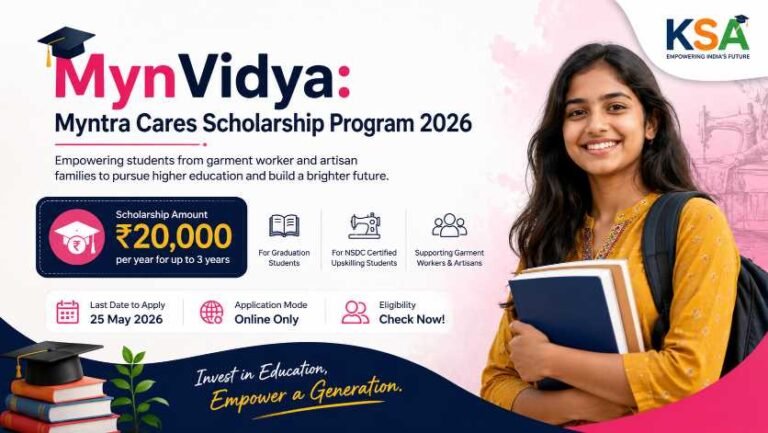
MynVidya: Myntra Cares Scholarship Program 2026 – Apply Online for Rs 20,000 Scholarship for Graduation Students

Education is one of the strongest tools for changing lives, but for many students from economically weaker families, especially those belonging to garment worker and artisan communities, pursuing higher education often becomes difficult due to financial challenges. To support such deserving students and encourage them to continue their academic journey without interruption, the Myntra backed MynVidya: Myntra Cares Scholarship Program 2026 has been launched.

The scholarship aims to empower students from garment worker and artisan families by providing financial assistance for higher education and skill development. Through this initiative, eligible students can receive financial support of ₹20,000 per year for up to three years, helping them cover educational expenses such as tuition fees, books, hostel charges, internet expenses, transportation, and study materials.

This scholarship program also includes support for students pursuing NSDC-certified artisan upskilling courses, thereby promoting vocational learning and career advancement opportunities among India’s artisan community.

Students who meet the eligibility criteria can apply online before the last date, 25 May 2026.


Overview of MynVidya: Myntra Cares Scholarship Program 2026

The MynVidya: Myntra Cares Scholarship Program is a major educational support initiative aimed at helping students from low-income garment worker and artisan families continue their higher education in recognised institutions across India.

The scholarship particularly focuses on students pursuing undergraduate courses in recognised State and Central Universities and those enrolled in recognised NSDC-certified skill development programs.

The program not only provides financial assistance but also seeks to create equal educational opportunities for deserving students who face economic barriers.


Key Highlights of the Scholarship

Particulars Details
Scholarship Name MynVidya: Myntra Cares Scholarship Program 2026
Conducting Organisation Myntra Cares
Beneficiaries Students from garment worker and artisan families
Scholarship Amount ₹20,000 per year
Duration Up to 3 years
Application Mode Online
Last Date to Apply 25 May 2026
Eligible Courses Undergraduate courses and NSDC-certified upskilling programs
Official Application Link www.b4s.in/ksa/MVMCSP1

Objective of the Scholarship Program

The primary objective of the MynVidya Scholarship Program is to reduce financial burdens on students from underprivileged artisan and garment worker backgrounds and encourage them to pursue higher education and skill-based learning opportunities.

Many talented students discontinue their education due to lack of funds. Through this scholarship, Myntra Cares aims to bridge the educational gap and create opportunities for career growth and economic stability.

The initiative also reflects a larger vision of empowering communities associated with the garment and artisan sector by supporting the next generation through education and vocational training.


Who Can Apply?

The scholarship is open to students belonging to families employed as full-time garment workers and artisans. The scheme has two major categories:

  1. Undergraduate Students
  2. NSDC Artisan Upskilling Program Students

Both categories have different eligibility conditions.


Eligibility Criteria for Undergraduate Students

Students applying under the graduation category must fulfil the following requirements:

Educational Qualification

Applicants must have:

  • Passed Class 12 in any stream
  • Secured at least 60% marks in Class 12 examination
  • Taken admission in a full-time undergraduate course

Eligible undergraduate courses include:

  • B.A.
  • B.Sc.
  • B.Com.
  • BBA
  • BCA
  • Other recognised graduation courses

University Requirement

Students must be studying in a recognised:

  • State University
  • Central University

Family Background

The applicant’s family must be engaged as:

  • Full-time garment workers OR
  • Artisans

Income Criteria

The annual family income should be less than:

  • ₹5,00,000 per annum

Eligibility Criteria for NSDC Artisan Upskilling Students

Applicants applying under vocational or artisan training programs must satisfy the following conditions:

Age Limit

Applicants must be between:

  • 14 to 30 years of age

Educational Qualification

Students must have:

  • Passed Class 10
  • No minimum percentage requirement

Course Requirement

Applicants must be enrolled in:

  • Recognised NSDC-certified training courses
  • Approved institutes
  • NHDP programs
  • SAMARTH programs
  • IITHT programs

Scholarship Benefits

Selected students will receive:

₹20,000 Scholarship Per Year

The financial assistance can be used for:

  • Tuition fees
  • Books and stationery
  • Hostel expenses
  • Internet and digital learning
  • Transportation
  • Skill development expenses
  • Examination fees

Scholarship Renewal Benefits

One of the biggest advantages of this scholarship is that it is renewable for up to three years.

However, renewal is subject to:

  • Satisfactory academic performance
  • Continuation in the eligible course
  • Fulfilment of renewal conditions

This long-term support helps students complete their education without financial interruptions.


Why This Scholarship Matters

India’s garment workers and artisans contribute significantly to the country’s economy and cultural heritage. Despite their contribution, many families in this sector struggle financially, making higher education difficult for their children.

The MynVidya Scholarship Program addresses this issue by ensuring that deserving students receive educational support and opportunities for skill enhancement.

The scholarship encourages:

  • Educational inclusion
  • Skill development
  • Economic empowerment
  • Career advancement
  • Reduced dropout rates

Importance of Supporting Artisan Communities

Artisans form the backbone of India’s traditional craftsmanship industry. From handloom weaving to embroidery and handicrafts, artisans preserve centuries-old traditions and skills.

However, many artisan families face:

  • Low income
  • Irregular employment
  • Limited access to quality education
  • Financial insecurity

Educational support programs like MynVidya can help break the cycle of poverty and create better opportunities for future generations.


Role of Skill Development in Modern India

Skill development has become increasingly important in today’s competitive economy. Through support for NSDC-certified programs, this scholarship also encourages vocational education.

Vocational training offers:

  • Employment-oriented learning
  • Practical industry skills
  • Faster job opportunities
  • Entrepreneurial growth
  • Financial independence

This initiative aligns with India’s broader skill development and employment generation goals.


Documents Required for Application

Applicants are generally required to upload the following documents during the online application process:

Educational Documents

  • Class 10 marksheet
  • Class 12 marksheet
  • Admission proof
  • Fee receipt
  • College ID card

Identity Documents

  • Aadhaar Card
  • Passport-size photograph

Income and Employment Proof

  • Income certificate
  • Employer certificate
  • Artisan proof document

Bank Details

  • Student bank account details
  • Cancelled cheque/passbook copy

Applicants should ensure that all documents are clear and valid before submission.


How to Apply Online for MynVidya Scholarship 2026

Eligible students can follow the steps below to submit their application online.

Step 1: Visit the Official Application Portal

Open the official application link:

www.b4s.in/ksa/MVMCSP1

Step 2: Register Yourself

  • Create a new account
  • Enter basic details
  • Verify mobile number and email ID

Step 3: Fill the Application Form

Provide:

  • Personal details
  • Educational details
  • Income information
  • Course information

Step 4: Upload Required Documents

Upload scanned copies of:

  • Marksheets
  • Income certificate
  • Identity proof
  • Admission documents

Step 5: Submit the Application

Review all details carefully and submit the form before the deadline.


Last Date to Apply

The final date for submission of online applications is:

25 May 2026

Students are advised not to wait until the last date to avoid technical issues or server delays.


Common Mistakes to Avoid While Applying

Many scholarship applications get rejected due to small mistakes. Applicants should avoid the following:

  • Entering incorrect personal information
  • Uploading unclear documents
  • Providing invalid income proof
  • Using inactive mobile numbers
  • Submitting incomplete forms
  • Waiting till the last day

Always cross-check every detail before final submission.


Tips to Increase Chances of Selection

Students can improve their chances of scholarship approval by following these suggestions:

Keep Documents Ready

Arrange all required documents before starting the application.

Use Accurate Information

Ensure all information matches official records.

Submit Early

Early applications reduce the risk of technical problems.

Maintain Good Academic Records

Strong academic performance helps during selection and renewal.

Use Valid Contact Information

Always provide active phone numbers and email addresses.


Importance of Scholarships for Higher Education

Scholarships play a critical role in making education accessible for economically weaker students.

They help reduce:

  • Financial burden on families
  • Student debt
  • Educational inequality

Scholarships also encourage students to:

  • Continue studies
  • Perform better academically
  • Pursue career goals confidently

For artisan and garment worker families, such initiatives can transform lives by opening doors to better educational opportunities.


Financial Challenges Faced by Students

Students from low-income backgrounds often face multiple difficulties such as:

  • Expensive tuition fees
  • Cost of books and study materials
  • Transportation expenses
  • Hostel charges
  • Digital learning costs

Many talented students are forced to discontinue their studies due to these challenges.

Programs like MynVidya Scholarship help ensure that deserving students can focus on education rather than financial stress.


Impact of Higher Education on Families

When one student from a financially weaker family completes higher education, the positive impact extends to the entire family.

Higher education can lead to:

  • Better employment opportunities
  • Improved income levels
  • Financial stability
  • Social upliftment
  • Better future for younger siblings

Educational support programs therefore play an important role in community development.


Understanding NSDC-Certified Courses

The National Skill Development Corporation (NSDC) promotes skill-based education and vocational training across India.

NSDC-certified programs are designed to:

  • Improve employability
  • Develop industry-specific skills
  • Encourage entrepreneurship
  • Support traditional crafts and trades

Students pursuing these courses under approved programs can also benefit from the MynVidya Scholarship.


Courses Covered Under Upskilling Programs

The scholarship supports several approved vocational and artisan training programs including:

  • NHDP Programs
  • SAMARTH Programs
  • IITHT Programs
  • NSDC-recognised courses

These courses are aimed at enhancing practical skills and creating sustainable livelihood opportunities.


Digital Education and Modern Learning

Modern education increasingly depends on digital resources. Students require:

  • Smartphones
  • Internet connectivity
  • Online learning platforms
  • Digital study materials

The scholarship amount can help students manage these educational needs more effectively.


Educational Empowerment of Women

Scholarship programs also play a major role in supporting female education, especially among economically weaker communities.

Financial support can encourage families to continue the education of girl students and reduce dropout rates.

Educated women contribute significantly to:

  • Family welfare
  • Economic growth
  • Social progress
  • Community development

Career Opportunities After Graduation

Students completing graduation can explore various career opportunities in fields such as:

  • Banking
  • Information Technology
  • Education
  • Government services
  • Business management
  • Commerce
  • Social work
  • Entrepreneurship

The scholarship helps students complete their academic journey and prepare for professional careers.


Role of Corporate Social Responsibility in Education

The MynVidya Scholarship is an example of how corporate social responsibility initiatives can positively impact society.

Educational CSR initiatives help:

  • Improve literacy
  • Support underprivileged students
  • Promote equality
  • Build skilled human resources

Such programs create long-term social and economic benefits.


Encouraging Students to Apply

Many eligible students miss scholarship opportunities simply because they are unaware of them.

Students from garment worker and artisan families should take advantage of this initiative and submit their applications before the deadline.

Educational support can significantly reduce financial pressure and improve career prospects.


Frequently Asked Questions (FAQs)

What is the scholarship amount under the MynVidya Scholarship Program?

Selected students will receive ₹20,000 per year.


Who can apply for this scholarship?

Students belonging to garment worker and artisan families pursuing graduation or NSDC-certified upskilling programs can apply.


What is the last date to apply?

The last date for online application submission is 25 May 2026.


Is the scholarship renewable?

Yes, the scholarship is renewable for up to 3 years subject to academic performance and eligibility.


What is the income limit for applicants?

The annual family income must be less than ₹5 lakh.


Can diploma students apply?

The notification specifically mentions graduation and NSDC-certified upskilling programs.


Is there any offline application mode?

No, applications are accepted online only.


Is Class 12 mandatory for all applicants?

Class 12 is required for graduation applicants. For NSDC upskilling applicants, Class 10 qualification is sufficient.


Final Words

The MynVidya: Myntra Cares Scholarship Program 2026 is a valuable opportunity for students belonging to garment worker and artisan families to pursue higher education and skill development without financial stress.

By providing annual financial assistance of ₹20,000, the scholarship supports deserving students in building a brighter future and achieving their educational goals.

Students who meet the eligibility criteria should apply online before the last date and ensure all required documents are submitted correctly.

This initiative has the potential to positively impact thousands of students by promoting educational inclusion, skill development, and financial empowerment.

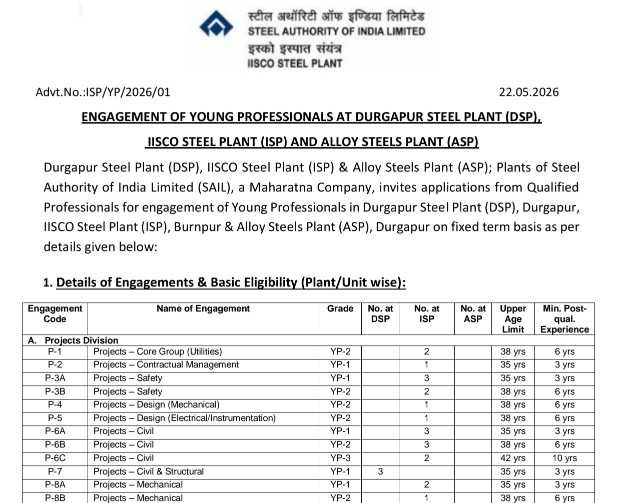
SAIL Young Professional Recruitment 2026: Apply Online for 48 Vacancies at DSP, ISP & ASP

0

The Steel Authority of India Limited (SAIL), one of India’s largest Maharatna Public Sector Undertakings, has officially announced the recruitment of Young Professionals for various technical and management positions at Durgapur Steel Plant (DSP), IISCO Steel Plant (ISP), and Alloy Steels Plant (ASP). The recruitment notification offers a golden opportunity for experienced engineering and management professionals seeking a prestigious career in India’s steel sector.

SAIL has invited applications for 48 Young Professional vacancies across multiple disciplines including Mechanical, Civil, Electrical, Instrumentation, IT, Cybersecurity, Environment, Automation, Safety, SAP, Full Stack Development, Hydraulics, Materials Management, and more. The engagements will be purely on a contractual basis, but the salary packages, benefits, and career exposure make these opportunities highly attractive for eligible candidates.

This recruitment drive is especially important for professionals with prior experience in steel plants, process industries, power sectors, manufacturing industries, infrastructure, automation, and industrial engineering. Candidates with B.E./B.Tech qualifications along with relevant post-qualification experience can apply online through the official SAIL careers portal before the last date.


About SAIL

Steel Authority of India Limited (SAIL) is among the largest steel-making companies in India and is recognized as a Maharatna CPSE under the Government of India. SAIL operates multiple integrated steel plants and special steel plants across the country and plays a vital role in India’s industrial growth and infrastructure development.

The current recruitment notification has been released jointly for:

  • Durgapur Steel Plant (DSP)
  • IISCO Steel Plant (ISP)
  • Alloy Steels Plant (ASP)

These plants are inviting qualified professionals for engagement as Young Professionals on a fixed-term contractual basis.


SAIL Young Professional Recruitment 2026 Overview

Particulars Details
Organization Steel Authority of India Limited (SAIL)
Recruitment Type Young Professional Engagement
Advertisement Number ISP/YP/2026/01
Total Vacancies 48
Job Locations DSP, ISP & ASP
Application Mode Online
Starting Date 22 May 2026
Last Date 06 June 2026
Official Website sail.co.in
Employment Type Contractual
Minimum Qualification B.E./B.Tech or equivalent
Minimum Marks Required 65%
Minimum Age 23 Years


Total Number of Vacancies

SAIL has announced a total of 48 vacancies distributed among the following plants:

Plant Vacancies
Durgapur Steel Plant (DSP) 16
IISCO Steel Plant (ISP) 30
Alloy Steels Plant (ASP) 2


Departments and Posts Available

The vacancies are spread across three major divisions:

  1. Projects Division
  2. Works Division
  3. Materials Management Division

The recruitment includes several specialized engineering and technical roles.


Projects Division Vacancies

The Projects Division includes opportunities for experienced professionals in utilities, safety, civil engineering, mechanical engineering, electrical engineering, structural engineering, logistics, automation, and IT.

Major positions include:

  • Projects – Core Group (Utilities)
  • Projects – Contractual Management
  • Projects – Safety
  • Projects – Design (Mechanical)
  • Projects – Design (Electrical/Instrumentation)
  • Projects – Civil
  • Projects – Civil & Structural
  • Projects – Mechanical
  • Projects – Electrical & Electronics
  • Projects – Road & Logistics
  • Projects – Electrical, Automation, Instrumentation & Power
  • Projects – Mechanical, Hydraulics & Utilities
  • Project – Electrical Engineering Division
  • Project – C & IT


Works Division Vacancies

The Works Division consists of advanced technical and industrial operations roles.

Positions include:

  • Networking and Cybersecurity
  • Environment Management
  • Hydraulics
  • Full Stack Developer
  • SAP Technical
  • Industrial Automation
  • Instrumentation
  • Environment


Materials Management Division Vacancies

This division includes positions related to material inspection and emerging technologies.

Posts include:

  • Material Inspection (Emerging Technologies)


Educational Qualification Required

Candidates must possess full-time regular B.E./B.Tech or equivalent qualifications from government-recognized universities or institutions with a minimum of 65% marks.

Different posts require qualifications in different streams including:

  • Mechanical Engineering
  • Civil Engineering
  • Electrical Engineering
  • Electronics Engineering
  • Instrumentation Engineering
  • Chemical Engineering
  • Computer Science Engineering
  • Information Technology
  • Environmental Engineering
  • Production Engineering
  • Robotics & Automation
  • Structural Engineering
  • Power Systems
  • Communication Engineering
  • Industrial Electronics

In many cases, higher qualifications such as M.E./M.Tech/Ph.D. are desirable.


Experience Requirements

The recruitment is targeted at experienced professionals. Depending on the post and grade, candidates must possess:

  • Minimum 3 years of experience
  • Minimum 6 years of experience
  • Minimum 10 years of experience

The experience should preferably be in:

  • Steel Plants
  • Process Industries
  • Manufacturing Industries
  • Power Distribution
  • Industrial Automation
  • Infrastructure Projects
  • Maintenance
  • Operations
  • Safety Management
  • Environmental Compliance
  • SAP Systems
  • Cybersecurity
  • PLC/DCS/SCADA Systems


Age Limit

The upper age limit varies according to the post category:

Category Maximum Age
YP-1 35 Years
YP-2 38 Years
YP-3 42 Years

Candidates must also have completed 23 years of age to be eligible.


Salary Structure

SAIL is offering attractive consolidated monthly retainership fees to Young Professionals.

Category Monthly Salary
Young Professional – 1 (YP-1) ₹70,000
Young Professional – 2 (YP-2) ₹1,00,000
Young Professional – 3 (YP-3) ₹1,40,000


Annual Increment

Selected candidates will also receive annual performance-based increments.

Category Increment Rate
YP-1 4%
YP-2 7%
YP-3 10%


Tenure of Engagement

The engagement period for Young Professionals will initially be:

  • 3 years

The tenure can further be extended:

  • Up to 2 additional years
  • Extension depends on performance and organizational requirements

Maximum engagement period:

  • 5 years


Working Hours and Leave

Young Professionals will work:

  • 8.5 hours daily
  • 6 days a week

They may also be required to work beyond regular hours depending on work requirements.

Leave entitlement:

  • 18 days per year
  • 1.5 days leave per completed month


Accommodation Benefits

Outstation candidates may receive company accommodation subject to availability.

Facilities include:

  • 2-bedroom accommodation
  • Equivalent rent support
  • Guest House/Transit House stay during initial period

YP-3 candidates may be eligible for 3-bedroom accommodation.


Communication Allowance

Selected candidates will receive reimbursement for mobile and broadband expenses.

Category Monthly Ceiling
YP-1 ₹800
YP-2 ₹1000
YP-3 ₹1200


Medical Benefits

SAIL will provide free OPD and IPD medical facilities at company hospitals for:

  • Self
  • Spouse
  • Two dependent children


Insurance Benefits

Candidates are required to maintain self-insurance coverage.

Reimbursement limits are:

Category Insurance Reimbursement
YP-1 Up to ₹20,000/year
YP-2 Up to ₹25,000/year
YP-3 Up to ₹30,000/year


Official Travel Benefits

SAIL has also defined travel entitlements for official duties.

Benefits include:

  • Air travel for eligible grades
  • AC train fare
  • Boarding reimbursement
  • Lodging reimbursement
  • Local travel reimbursement


Selection Process

The selection process may include:

  1. Application Screening
  2. Computer-Based Test (CBT)
  3. Aptitude Test
  4. Psychometric Test
  5. Personal Interview

The merit list will be prepared using:

  • CBT Weightage: 80%
  • Interview Weightage: 20%


Registration Fee

Candidates need to pay:

  • ₹500 registration and processing fee

The fee is applicable for YP-1, YP-2, and YP-3 categories.


Important Documents Required

Candidates need to upload scanned copies of:

  • Matriculation Certificate
  • Class 12 Certificate
  • Degree Certificates
  • Experience Certificates
  • NOC (if employed in PSU/Government)
  • Aadhaar/PAN/Passport/Voter ID
  • Address Proof
  • CGPA Conversion Certificate (if applicable)


How to Apply Online

Eligible candidates can apply online through the official SAIL careers portal.

Application steps:

  1. Visit SAIL Careers website
  2. Read the advertisement carefully
  3. Register using email and mobile number
  4. Fill the application form
  5. Upload photograph and signature
  6. Upload required documents
  7. Pay application fee
  8. Submit application
  9. Download application form for future reference


Important Instructions for Candidates

Candidates should remember the following points:

  • Applications will be accepted only online
  • Incomplete applications will be rejected
  • Multiple engagement applications may create scheduling conflicts
  • Email and mobile number should remain active
  • Original documents will be verified during the interview
  • SAIL reserves the right to modify the recruitment process


Why This Recruitment Is Important

The SAIL Young Professional Recruitment 2026 offers one of the best contractual engineering opportunities in India’s PSU sector. The recruitment is particularly attractive because of:

  • High salary packages
  • Exposure to major steel plants
  • Opportunity to work on advanced industrial projects
  • Accommodation and medical facilities
  • Scope for professional growth
  • Experience in one of India’s largest steel organizations

Professionals from core engineering, automation, IT, infrastructure, safety, and industrial operations can significantly benefit from these opportunities.


Opportunities for Engineers and IT Professionals

This recruitment drive is highly beneficial for:

  • Mechanical Engineers
  • Civil Engineers
  • Electrical Engineers
  • Electronics Engineers
  • IT Professionals
  • SAP Developers
  • Cybersecurity Experts
  • Full Stack Developers
  • Environmental Engineers
  • Automation Specialists

The notification reflects SAIL’s increasing focus on modernization, automation, digitization, and industrial transformation.


Key Highlights of SAIL Recruitment 2026

  • 48 vacancies announced
  • Salary up to ₹1.4 lakh per month
  • Contract up to 5 years
  • Medical benefits for family
  • Accommodation facility
  • PAN India interview centers
  • Advanced technical and engineering roles
  • Opportunities in steel manufacturing sector

Important Dates

Event Date
Start of Online Application 22 May 2026
Last Date to Apply 06 June 2026

The SAIL Young Professional Recruitment 2026 is a major opportunity for experienced engineering and technical professionals who wish to work in India’s leading steel organization. With excellent remuneration, technical exposure, accommodation support, medical facilities, and long-term engagement possibilities, this recruitment drive stands out among PSU contractual opportunities in 2026.

Candidates who meet the eligibility criteria should apply well before the last date to avoid technical issues or heavy website traffic. Applicants are also advised to carefully read the official notification and ensure they upload all required documents correctly during the application process.

The recruitment reflects SAIL’s continued investment in skilled professionals and advanced industrial operations across its steel plants. For engineers and experienced professionals looking to build a rewarding career in India’s industrial sector, this recruitment can be a strong career milestone.


Official PDF Notification

PDF Link

SKUAST-K Announces UET (UG) 2026 Exam Date for Undergraduate Admissions in J&K

SKUAST-K UET (UG) 2026 Examination Notice: Complete Guide for Aspirants in Jammu & Kashmir

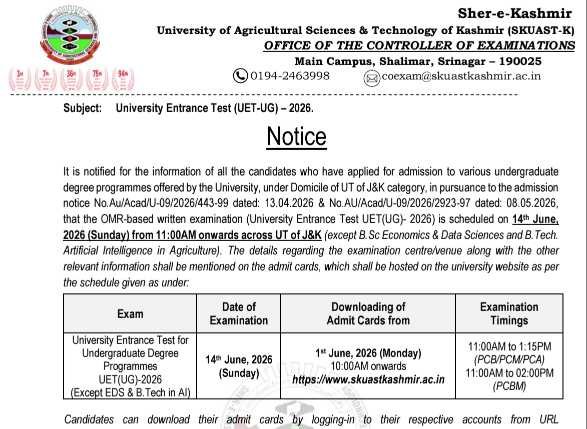
Sher-e-Kashmir University of Agricultural Sciences and Technology of Kashmir (SKUAST-K) has officially announced the schedule for the University Entrance Test (UET-UG) 2026 for admission to various undergraduate degree programmes under the domicile category of the Union Territory of Jammu & Kashmir. The latest notification issued by the Office of the Controller of Examinations has brought clarity for thousands of students eagerly waiting for the entrance examination schedule.

According to the official notice released by SKUAST-K, the OMR-based written examination for undergraduate admissions will be conducted on 14 June 2026 (Sunday) across the Union Territory of Jammu & Kashmir.

This announcement is crucial for students aspiring to secure admission in prestigious agricultural and allied science programmes offered by the university. The entrance examination acts as the gateway for students seeking careers in agriculture, horticulture, forestry, food technology, veterinary sciences, and other related disciplines.


Overview of SKUAST-K UET (UG) 2026

Sher-e-Kashmir University of Agricultural Sciences and Technology of Kashmir is one of the leading agricultural universities in the region. Every year, thousands of candidates apply for admission to its undergraduate programmes through the University Entrance Test (UET).

The University Entrance Test (UET-UG) 2026 will be conducted in OMR mode for candidates applying under the domicile category of Jammu & Kashmir. The examination will be held at multiple centres across the Union Territory to facilitate students from different districts.

As per the official notice, the examination excludes the following programmes:

  • B.Sc Economics & Data Sciences (EDS)
  • B.Tech Artificial Intelligence in Agriculture

The admission procedure and entrance examination schedule for these two programmes will be notified separately by the university at a later stage.


Important Dates for SKUAST-K UET (UG) 2026

Candidates must keep track of all important dates related to the entrance examination to avoid missing any deadlines.

Examination Date

The University Entrance Test (UET-UG) 2026 is scheduled to be conducted on:

14 June 2026 (Sunday)


Admit Card Download Date

The admit cards for the examination will be available online from:

1 June 2026 (Monday), 10:00 AM onwards

Candidates can download their admit cards from the official SKUAST-K website by logging into their accounts using their credentials.


Examination Timing Details

The university has specified different examination timings depending on the subject combinations selected by candidates.

For PCB / PCM / PCA Candidates

  • Examination Time: 11:00 AM to 1:15 PM

For PCBM Candidates

  • Examination Time: 11:00 AM to 2:00 PM

Candidates are advised to reach their examination centres well before the reporting time mentioned on the admit cards.


Official Website for Admit Cards and Updates

Candidates can download their admit cards and receive all important notifications from the official university website:

https://www.skuastkashmir.ac.in

The university has also advised candidates to regularly visit the official website for the latest updates regarding the examination process.


What is SKUAST-K UET (UG)?

The University Entrance Test (UET) is conducted annually by SKUAST-K for admission to undergraduate programmes offered by the university. The test evaluates students on the basis of science subjects such as Physics, Chemistry, Biology, and Mathematics depending on the stream selected.

The examination is highly competitive because SKUAST-K is considered one of the premier institutions for agricultural education in Jammu & Kashmir.

The university offers a wide range of programmes in:

  • Agriculture
  • Horticulture
  • Veterinary Sciences
  • Forestry
  • Food Technology
  • Fisheries
  • Agricultural Engineering
  • Dairy Technology
  • Biotechnology
  • Allied Agricultural Sciences

Students qualifying the entrance examination are considered for admission according to merit and reservation norms applicable in Jammu & Kashmir.


Why SKUAST-K is a Preferred Choice Among Students

SKUAST-K has emerged as a centre of excellence in agricultural education and research. Thousands of students compete for admission because of the institution’s strong academic reputation and career-oriented courses.

Key Advantages of Studying at SKUAST-K

1. Quality Education

The university offers modern academic programmes aligned with the latest developments in agricultural and allied sciences.

2. Research Opportunities

Students get opportunities to participate in research projects, field training, and innovation-based agricultural practices.

3. Career Prospects

Graduates from SKUAST-K are employed in:

  • Government departments
  • Agricultural research institutes
  • Banking sector
  • Agri-business companies
  • Food processing industries
  • Veterinary services
  • Higher education institutions

4. Practical Exposure

The university emphasizes practical learning through field visits, laboratory work, and extension activities.

5. Contribution to Agriculture

SKUAST-K plays a significant role in promoting sustainable agriculture and rural development in Jammu & Kashmir.


Courses Offered Through UET (UG)

Although the detailed admission brochure contains the exact list of programmes, students generally apply for various undergraduate courses such as:

  • B.Sc Agriculture
  • B.Sc Horticulture
  • B.Tech Agricultural Engineering
  • B.Tech Food Technology
  • B.V.Sc & AH
  • B.Sc Forestry
  • B.F.Sc Fisheries Science
  • Other allied programmes

Each programme has its own eligibility criteria and seat intake.


Examination Pattern of SKUAST-K UET

The University Entrance Test is conducted in OMR mode, meaning candidates must mark their answers on Optical Mark Recognition sheets.

Key Features of the Exam

  • Objective-type questions
  • Multiple-choice format
  • Subject-based paper combinations
  • OMR answer sheet
  • Time-bound examination

Candidates are advised to carefully read instructions mentioned on the admit card and examination booklet.


Preparation Strategy for SKUAST-K UET 2026

Since the competition level is expected to be high, candidates should begin their preparation seriously.

1. Understand the Syllabus

Students should first go through the official syllabus and identify important topics from:

  • Physics
  • Chemistry
  • Biology
  • Mathematics

2. Follow NCERT Books

NCERT textbooks form the foundation for entrance examinations in science streams. Students should thoroughly revise:

  • Class 11 NCERT
  • Class 12 NCERT

3. Solve Previous Year Papers

Practising previous year question papers helps candidates understand:

  • Exam pattern
  • Difficulty level
  • Frequently asked topics
  • Time management

4. Attempt Mock Tests

Regular mock tests improve speed and accuracy. They also help students identify weak areas.


5. Revise Daily

Revision is essential for retaining formulas, diagrams, reactions, and concepts.


Admit Card Guidelines

The admit card is one of the most important documents for the examination. Without it, candidates may not be allowed to appear in the entrance test.

Information Mentioned on Admit Card

  • Candidate’s name
  • Roll number
  • Photograph
  • Examination centre
  • Date and timing
  • Subject combination
  • Important instructions

What to Do if There is an Error?

The university has provided helpline numbers for candidates facing difficulties in downloading admit cards or noticing discrepancies in details.

Candidates can contact:

  • +91-7006916185
  • +91-8899629669

They may also visit the Examination Centre at SKUAST-K, Shalimar during working days and hours.


Examination Day Instructions

Candidates should strictly follow all instructions issued by the university.

Important Guidelines

Reach Early

Arrive at the examination centre well before the reporting time.

Carry Required Documents

Bring:

  • Admit card
  • Valid ID proof
  • Passport-size photograph if required

Avoid Prohibited Items

Do not carry:

  • Mobile phones
  • Smart watches
  • Calculators
  • Study material
  • Electronic gadgets

Follow OMR Instructions Carefully

Use only the permitted pen and mark answers properly.


Role of Agriculture Education in Jammu & Kashmir

Agriculture remains one of the most important sectors in Jammu & Kashmir. Institutions like SKUAST-K contribute significantly to improving:

  • Crop productivity
  • Horticulture development
  • Livestock management
  • Sustainable farming
  • Food security

The university also helps in developing skilled professionals who can address modern agricultural challenges.


Growing Importance of Agricultural Careers

Agricultural sciences are no longer limited to traditional farming. Students graduating from agricultural universities now have opportunities in:

Government Sector

  • Agriculture Department
  • Horticulture Department
  • Veterinary Services
  • Extension Services

Banking and Finance

Agriculture graduates are eligible for positions in:

  • NABARD
  • Banking institutions
  • Rural finance organizations

Research and Development

Students can pursue higher studies and research in:

  • Plant breeding
  • Biotechnology
  • Soil science
  • Food technology

Entrepreneurship

Many graduates establish startups in:

  • Organic farming
  • Food processing
  • Dairy farming
  • Agri-tech services

Separate Notification for EDS and B.Tech AI

The university has clarified that admissions related to:

  • Economics & Data Sciences (EDS)
  • B.Tech Artificial Intelligence in Agriculture

will be notified separately in due course of time.

This indicates the university’s focus on introducing modern interdisciplinary programmes combining agriculture with data science and artificial intelligence.

These emerging fields are expected to create new opportunities for students interested in technology-driven agriculture.


Importance of Regular Website Updates

Candidates are strongly advised to regularly check the official university website for:

  • Admit card updates
  • Examination instructions
  • Centre notifications
  • Result announcements
  • Counselling schedules

Missing important updates can create complications during the admission process.


Expected Competition Level in UET 2026

Every year, thousands of students compete for a limited number of seats in undergraduate programmes.

The competition is expected to remain high due to:

  • Increasing awareness about agricultural careers
  • Expanding employment opportunities
  • Reputation of SKUAST-K
  • Demand for professional education

Students should therefore prepare strategically and maintain consistency in studies.


Tips to Score High in UET

Focus on Concept Clarity

Avoid rote memorization. Build strong conceptual understanding.

Practice Time Management

Divide time wisely during preparation and examination.

Improve Accuracy

Negative marking or incorrect answers can affect ranking.

Maintain Health

Good sleep, balanced diet, and stress management are important during preparation.

Stay Updated

Keep checking official notices and examination-related announcements.


Future Scope After Graduation

Students graduating from SKUAST-K can pursue:

Higher Studies

  • M.Sc
  • M.Tech
  • MBA Agri-Business
  • PhD programmes

Competitive Exams

  • UPSC
  • JKPSC
  • Banking exams
  • ICAR examinations

Employment

Agricultural graduates are recruited in:

  • Government agencies
  • Seed companies
  • Fertilizer companies
  • Agri-tech firms
  • Food industries

The announcement of the SKUAST-K University Entrance Test (UET-UG) 2026 schedule has provided clarity and direction for thousands of aspirants across Jammu & Kashmir. With the examination set for 14 June 2026, candidates now have a clear timeline for preparation and admit card download.

Students aspiring for careers in agriculture, horticulture, veterinary sciences, food technology, and allied disciplines should take this opportunity seriously and prepare with dedication.

SKUAST-K continues to play a major role in shaping agricultural education and research in the region, and securing admission to the university can open doors to promising academic and professional opportunities.

Candidates are advised to stay updated through the official university website and ensure that they follow all examination instructions carefully.


Official PDF Notification

PDF Link

University of Kashmir Declares Various Examination Results for UG & PG Courses

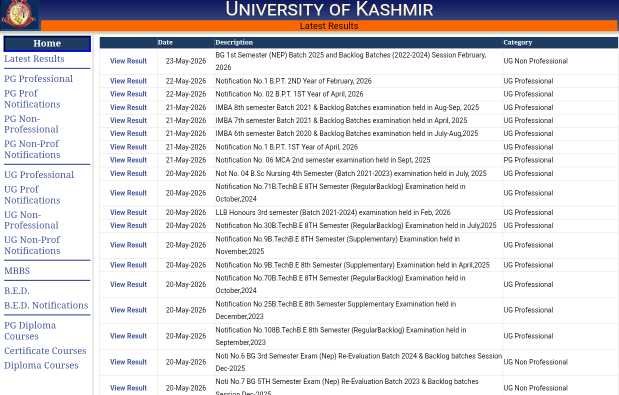
The University of Kashmir has officially declared several undergraduate and postgraduate examination results for various professional and non-professional courses conducted during 2025 and 2026. Students from different streams including BG, B.P.T, IMBA, MCA, Nursing, Engineering, and LLB can now check their results online through the university’s official result portal.

The latest results include semester examinations, backlog examinations, supplementary examinations, and re-evaluation notifications for different batches.

List of Declared Results

Results Declared on 23 May 2026

  • BG 1st Semester (NEP) Batch 2025 and Backlog Batches (2022–2024) Session February 2026 – UG Non-Professional

Results Declared on 22 May 2026

  • Notification No.1 B.P.T 2nd Year Examination February 2026 – UG Professional
  • Notification No.02 B.P.T 1st Year Examination April 2026 – UG Professional

Results Declared on 21 May 2026

  • IMBA 8th Semester Batch 2021 & Backlog Batches Examination held in Aug-Sep 2025
  • IMBA 7th Semester Batch 2021 & Backlog Batches Examination held in April 2025
  • IMBA 6th Semester Batch 2020 & Backlog Batches Examination held in July-Aug 2025
  • Notification No.1 B.P.T 1st Year Examination April 2026
  • Notification No.06 MCA 2nd Semester Examination held in Sept 2025

Results Declared on 20 May 2026

  • Notification No.04 B.Sc Nursing 4th Semester (Batch 2021–2023) Examination held in July 2025
  • Notification No.71 B.Tech/B.E 8th Semester (Regular/Backlog) Examination held in October 2024
  • LLB Honours 3rd Semester (Batch 2021–2024) Examination held in February 2026
  • Notification No.30 B.Tech/B.E 8th Semester (Regular/Backlog) Examination held in July 2025
  • Notification No.9 B.Tech/B.E 8th Semester (Supplementary) Examination held in November 2025
  • Notification No.9 B.Tech/B.E 8th Semester (Supplementary) Examination held in April 2025
  • Notification No.70 B.Tech/B.E 8th Semester (Regular/Backlog) Examination held in October 2024
  • Notification No.25 B.Tech/B.E 8th Semester Supplementary Examination held in December 2023
  • Notification No.108 B.Tech/B.E 8th Semester (Regular/Backlog) Examination held in September 2023
  • Notification No.6 BG 3rd Semester Exam (NEP) Re-Evaluation Batch 2024 & Backlog Batches Session Dec-2025

How to Check University of Kashmir Results Online

Students can check their examination results by visiting the official University of Kashmir result portal. Follow these simple steps:

  1. Visit the official result website.
  2. Select your examination/result notification.
  3. Enter your Roll Number or Registration Number.
  4. Click on the “View Result” option.
  5. Download and print the result for future reference.

Important Note for Students

Students are advised to carefully verify all details mentioned in their scorecards including:

  • Name
  • Roll Number
  • Registration Number
  • Subject-wise Marks
  • Result Status

In case of discrepancies, candidates should immediately contact their respective colleges or the university examination wing.

Official Result Portal

Students can directly check all latest results through the official University of Kashmir results portal below:

Click here

JKBOPEE Invites Online Applications for MSc. Technology Courses 2026 at SKIMS Soura Srinagar

0

The Jammu and Kashmir Board of Professional Entrance Examinations (JKBOPEE) has officially invited online applications for admission to various M.Sc. Technology Courses for the academic session 2026 at Sher-i-Kashmir Institute of Medical Sciences (SKIMS), Soura Srinagar. The notification, issued under reference number MSC-TECHNOLOGY-NN-066 dated 22-05-2026, provides important details regarding eligibility criteria, application procedure, entrance examination, counselling process, reservation policy, and other admission-related guidelines.

This latest notification has generated significant interest among aspiring candidates seeking specialized postgraduate education in medical technology and allied healthcare sciences in Jammu and Kashmir. SKIMS Soura is regarded as one of the premier medical institutes in the Union Territory and attracts students from across the region for its advanced academic programs, modern infrastructure, and quality medical training.

Candidates who are interested in pursuing M.Sc. Technology courses are advised to carefully review the official notification and complete the online application process within the stipulated dates.


Overview of JKBOPEE M.Sc. Technology Admission 2026

The M.Sc. Technology courses offered through JKBOPEE at SKIMS Soura provide students with advanced knowledge and technical expertise in various medical and diagnostic fields. These courses are designed to equip students with practical skills, laboratory training, research capabilities, and professional competence required in modern healthcare systems.

The admission process will be conducted through a Common Entrance Test (CET), which is organized by JKBOPEE. Eligible candidates must apply online through the official JKBOPEE portal and appear in the entrance examination to secure admission.

The courses are expected to cover various specialized disciplines related to medical sciences and healthcare technology, helping students build strong careers in hospitals, laboratories, research institutes, academic institutions, and healthcare organizations.


Importance of M.Sc. Technology Courses at SKIMS

SKIMS Soura Srinagar is one of the most reputed healthcare and medical education institutions in Jammu and Kashmir. The institute has consistently maintained high academic standards and offers excellent clinical exposure to students.

The M.Sc. Technology programs are particularly important because healthcare technology has become an essential component of modern medicine. Hospitals and diagnostic centres require highly trained professionals capable of operating sophisticated medical equipment, conducting advanced diagnostic procedures, and supporting patient care services.

Students enrolled in these programs receive:

  • Advanced theoretical education
  • Practical laboratory training
  • Clinical exposure
  • Research opportunities
  • Access to modern diagnostic equipment
  • Guidance from experienced faculty members

The courses prepare students for employment in:

  • Government hospitals
  • Private healthcare institutions
  • Diagnostic laboratories
  • Research centres
  • Academic institutions
  • Pharmaceutical industries
  • Public health organizations

Why Students Prefer SKIMS Soura

SKIMS has emerged as a top destination for higher medical education in Jammu and Kashmir because of several key advantages.

Academic Excellence

The institute is known for its strong academic environment and high-quality teaching standards. Faculty members at SKIMS include experienced doctors, researchers, technologists, and healthcare professionals.

Modern Infrastructure

The institution possesses advanced laboratories, modern diagnostic facilities, research centres, and technologically equipped classrooms that enhance the learning experience for students.

Clinical Exposure

Students benefit from direct clinical exposure through hospital-based training, allowing them to understand real-world medical practices and patient care systems.

Research Opportunities

M.Sc. Technology students often get opportunities to participate in research projects, academic seminars, workshops, and conferences that contribute to their professional development.

Career Prospects

Graduates from SKIMS programs are highly valued in healthcare sectors across India and abroad due to the institute’s reputation and rigorous training standards.


Role of JKBOPEE in Professional Admissions

The Jammu and Kashmir Board of Professional Entrance Examinations (JKBOPEE) plays a crucial role in conducting transparent and merit-based admissions for professional courses in the Union Territory.

The board is responsible for:

  • Conducting entrance examinations
  • Issuing notifications
  • Preparing merit lists
  • Organizing counselling
  • Allotting seats
  • Managing reservation policies
  • Ensuring fair admission procedures

JKBOPEE has developed a streamlined online application system that enables students to apply conveniently from any location.


Eligibility Criteria for M.Sc. Technology Courses 2026

Candidates aspiring to apply for the M.Sc. Technology programs must fulfill specific eligibility conditions prescribed by JKBOPEE and SKIMS.

Although candidates are advised to refer to the official notification for complete details, the general eligibility criteria usually include:

Educational Qualification

Applicants must possess a Bachelor’s degree in the relevant discipline from a recognized university or institution.

Relevant qualifications may include:

  • B.Sc. Medical Technology
  • B.Sc. Allied Health Sciences
  • BMLT
  • B.Sc. in related biological sciences
  • Equivalent recognized qualifications

Minimum Marks Requirement

Candidates are generally required to secure the minimum qualifying percentage in their undergraduate program as specified by the admission authority.

Domicile Requirements

Applicants may need to satisfy domicile requirements applicable to the Union Territory of Jammu and Kashmir or as specified in the notification.

Age Criteria

Candidates should fulfill the prescribed age conditions mentioned in the official admission brochure.


Online Application Process

JKBOPEE has introduced an online application mechanism that simplifies the admission process for students.

Candidates can complete the application process through the official JKBOPEE website.

Step-by-Step Application Procedure

Step 1: Visit the Official Website

Candidates should visit the official JKBOPEE portal and access the admission notification for M.Sc. Technology Courses 2026.

Step 2: Registration

Applicants must create an account using their valid email address and mobile number.

Step 3: Fill Application Form

Candidates should carefully enter all required details, including:

  • Personal information
  • Educational qualifications
  • Category details
  • Address
  • Contact information

Step 4: Upload Documents

Applicants are required to upload scanned copies of:

  • Passport-size photograph
  • Signature
  • Academic certificates
  • Domicile certificate
  • Category certificate (if applicable)

Step 5: Payment of Application Fee

Candidates need to pay the prescribed application fee through online payment modes.

Step 6: Final Submission

After verifying all entered information, applicants should submit the form and download the confirmation page for future reference.


Common Entrance Test (CET) Details

Admission to the M.Sc. Technology Courses will be based on performance in the Common Entrance Test conducted by JKBOPEE.

The entrance test is expected to evaluate candidates on various academic and subject-specific areas relevant to healthcare technology and allied sciences.

Examination Pattern

The examination pattern may include:

  • Multiple-choice questions
  • Subject-specific questions
  • General aptitude
  • Analytical reasoning
  • Basic science concepts

Candidates should prepare thoroughly according to the syllabus mentioned in the official information brochure.


Preparation Tips for JKBOPEE M.Sc. Technology Entrance Exam

Students preparing for the entrance examination should adopt a strategic preparation plan.

Understand the Syllabus

Carefully review the syllabus and identify important topics from undergraduate subjects.

Practice Previous Papers

Solving previous years’ question papers helps candidates understand the exam pattern and improve time management.

Focus on Core Subjects

Concentrate on:

  • Human anatomy
  • Physiology
  • Biochemistry
  • Pathology
  • Medical laboratory sciences
  • Diagnostic technology

Revise Regularly

Regular revision is essential for retaining important concepts and improving accuracy.

Mock Tests

Attempting mock tests can help candidates assess their preparation level and improve performance under exam conditions.


Reservation Policy

JKBOPEE generally follows reservation policies as prescribed by the Government of Jammu and Kashmir.

Seats may be reserved for categories such as:

  • Scheduled Castes (SC)
  • Scheduled Tribes (ST)
  • Reserved Backward Areas (RBA)
  • Economically Weaker Sections (EWS)
  • Other reserved categories

Candidates claiming reservation benefits must provide valid supporting documents during the admission process.


Counselling Process

After declaration of entrance examination results, JKBOPEE conducts counselling sessions for seat allotment.

Merit List Preparation

The merit list is prepared based on:

  • CET scores
  • Reservation criteria
  • Eligibility conditions

Choice Filling

Candidates may be required to submit preferences for available courses and institutions.

Seat Allotment

Seats are allotted based on merit rank, category, and availability of seats.

Document Verification

Candidates must present original documents during counselling and admission formalities.


Documents Required for Admission

Candidates should keep the following documents ready:

  • Entrance examination admit card
  • Rank card
  • Academic certificates
  • Marksheets
  • Domicile certificate
  • Category certificate
  • Date of birth certificate
  • Identity proof
  • Passport-size photographs

Failure to produce required documents may lead to cancellation of admission.


Career Opportunities After M.Sc. Technology

An M.Sc. Technology degree opens numerous career opportunities in the healthcare sector.

Hospital Sector

Graduates can work in:

  • Diagnostic laboratories
  • Radiology departments
  • Clinical laboratories
  • Intensive care units
  • Specialized medical departments

Research and Development

Students interested in research may pursue careers in:

  • Medical research institutes
  • Biotechnology firms
  • Pharmaceutical companies
  • Academic research organizations

Teaching Profession

Qualified graduates may join colleges and institutes as lecturers, instructors, or academic researchers.

Government Jobs

Various government departments recruit medical technologists through competitive examinations and recruitment processes.

International Opportunities

Healthcare professionals with advanced technical qualifications are in demand globally, especially in developed healthcare systems.


Growth of Allied Healthcare Sciences in India

The healthcare industry in India has witnessed rapid expansion over the past decade. This growth has increased demand for trained allied healthcare professionals.

Medical technology professionals now play an essential role in:

  • Disease diagnosis
  • Laboratory analysis
  • Imaging services
  • Patient monitoring
  • Healthcare management

As healthcare systems become more technologically advanced, demand for skilled professionals is expected to rise further.


Importance of Skilled Medical Technologists

Medical technologists are critical members of the healthcare workforce. They assist doctors and healthcare teams by performing accurate diagnostic procedures and maintaining laboratory standards.

Their responsibilities often include:

  • Conducting laboratory tests
  • Operating medical equipment
  • Maintaining diagnostic accuracy
  • Ensuring quality control
  • Assisting in patient diagnosis

Without skilled technologists, modern healthcare systems cannot function efficiently.


Advantages of Pursuing Postgraduate Medical Technology Courses

Students pursuing postgraduate education gain several advantages.

Advanced Knowledge

M.Sc. programs provide specialized expertise beyond undergraduate education.

Better Career Prospects

Postgraduate qualifications improve employability and salary prospects.

Research Skills

Students develop research and analytical skills necessary for scientific work.

Professional Recognition

Higher qualifications often lead to greater professional credibility and leadership opportunities.


Challenges Faced by Aspirants

While preparing for professional entrance examinations, students may face several challenges.

Competition

Admission to reputed institutions like SKIMS is highly competitive.

Limited Seats

The number of applicants often exceeds available seats.

Academic Pressure

Students must balance undergraduate completion with entrance preparation.

Lack of Guidance

Some aspirants struggle due to insufficient academic counselling and preparation resources.

However, with proper planning and dedication, students can successfully secure admission.


Digital Transformation in Admission Systems

JKBOPEE has significantly modernized its admission procedures through digital systems.

Online application portals have improved:

  • Transparency
  • Accessibility
  • Efficiency
  • Convenience

Students can now:

  • Register online
  • Upload documents
  • Pay fees digitally
  • Download admit cards
  • Check results online

This transformation has reduced administrative delays and enhanced the overall admission experience.


Importance of Reading Official Notifications Carefully

Candidates should always read official notifications thoroughly before applying.

Important information contained in notifications includes:

  • Eligibility conditions
  • Application deadlines
  • Examination schedules
  • Fee details
  • Reservation rules
  • Required documents

Ignoring instructions may result in application rejection or disqualification.


Expected Timeline for Admission Process

Although candidates should rely on official notifications for exact dates, the admission process generally includes:

  1. Release of notification
  2. Start of online applications
  3. Last date for submissions
  4. Admit card issuance
  5. Entrance examination
  6. Declaration of results
  7. Counselling process
  8. Seat allotment
  9. Admission confirmation

Students should regularly monitor the official JKBOPEE website for updates.


Importance of Healthcare Education in Jammu and Kashmir

The healthcare sector in Jammu and Kashmir has experienced steady development in recent years. Educational institutions such as SKIMS play a major role in producing trained healthcare professionals for the region.

Increasing demand for quality healthcare services has created a need for:

  • Skilled medical technologists
  • Laboratory experts
  • Diagnostic specialists
  • Allied healthcare professionals

Educational programs like M.Sc. Technology contribute significantly toward strengthening the healthcare infrastructure of the Union Territory.


Student Guidance and Counselling

Students applying for professional courses should seek proper academic guidance before selecting specializations.

Factors to consider include:

  • Personal interest
  • Career opportunities
  • Industry demand
  • Academic strengths
  • Future growth prospects

Choosing the right specialization can positively impact long-term career development.


Future Scope of Medical Technology

Medical technology continues to evolve rapidly due to scientific innovation and digital transformation.

Emerging technologies include:

  • Artificial intelligence in diagnostics
  • Molecular diagnostics
  • Robotic healthcare systems
  • Advanced imaging technologies
  • Telemedicine
  • Precision medicine

Professionals trained in modern medical technologies will remain in high demand in the future healthcare industry.

The JKBOPEE notification inviting online applications for M.Sc. Technology Courses 2026 at SKIMS Soura Srinagar represents a valuable opportunity for students aspiring to build careers in advanced healthcare sciences and medical technology.

With high-quality education, excellent infrastructure, clinical exposure, and strong career prospects, SKIMS continues to remain one of the most prestigious medical institutions in Jammu and Kashmir.

Candidates interested in applying should carefully review the official notification, verify eligibility criteria, complete the online application process on time, and begin preparing seriously for the Common Entrance Test.

The healthcare sector offers immense opportunities for qualified professionals, and pursuing postgraduate education in medical technology can open pathways toward rewarding and impactful careers.


Official PDF Notification

PDF Link: https://www.jkbopee.gov.in/Pdf/Downloader.ashx?nid=17696&type=n

Reference Notification:

NTA Extends UGC-NET June 2026 Registration Deadline; NEET-UG Refund Portal Activated

0

New Delhi: The National Testing Agency (NTA) on Saturday extended the last date for submission of applications for the UGC-NET June 2026 examination, along with revised timelines for fee payment and the correction window.

In a post on X, the official account of the National Testing Agency (NTA) shared, “Good news for UGC-NET June 2026 aspirants! NTA has extended the last date for application submission — responding to requests from students across the country.”

“New deadlines: Application form: 24 May (upto 11:50 PM) Fee payment: 24 May (upto 11:50 PM) Correction window: 26-28 May (upto 11:50 PM) If you haven’t applied yet — this is your last chance. No further extension will be given,” the post read.

The UGC NET, conducted by the NTA in Computer-Based Test (CBT) mode since December 2018, determines eligibility for Assistant Professorship and Junior Research Fellowship (JRF) in Indian universities and colleges. The award of JRF or eligibility for Assistant Professorship depends on the aggregate performance in Paper I and Paper II of the UGC NET.

Meanwhile, NTA has activated a dedicated facility on the NEET (UG)-2026 registration portal for candidates to submit their bank account details for the processing of examination fee refunds.

The agency has also informed that the deadline for submission of details is May 27, 2026 (till 11:50 pm).

The NTA said that the facility has been made available on the NEET-UG registration portal for all candidates eligible for the refund process. It added that candidates must log in using their credentials to access the refund link and submit their bank account details.

The notice shared on X read, “In continuation of the Public Notice dated 12.05.2026 regarding refund of examination fee for NEET (UG) candidates, the National Testing Agency (NTA) hereby informs all candidates that a dedicated facility has been made available on the NEET (UG) registration portal for submission of preferred bank account details for processing of fee refund.”–(ANI)

NCDC Core Committee Discusses Mandatory Montessori Training for Anganwadi, Preschool Teachers

NCDC Core Committee Discusses Mandatory Montessori Training for Anganwadi, Preschool Teachers

The National Child Development Council held a core committee meeting to discuss a resolution for mandatory Montessori teacher training certification for teachers in Anganwadi centers and pre-primary sections, including LKG, UKG, and pre-KG classes.

During the discussion, members stressed the need for trained teachers in early childhood education. They said children in Anganwadis need strong foundational learning at an early age.

Members pointed out that Montessori-trained teachers can offer activity-based and child-centered learning methods instead of focusing on basic care routines.

Participants noted that mandatory Montessori training would help teachers understand child development, communication skills, creativity, confidence building, and hands-on learning techniques.

Speakers also mentioned that trained teachers could aid in the overall development of children, covering social, emotional, moral, and cognitive growth.

They emphasized that early childhood education should be managed by certified and well-trained teachers, especially in Anganwadi and kindergarten sections. The discussion featured suggestions for the government to introduce stricter policies to ensure that only Montessori-trained teachers are hired in preschool and Anganwadi institutions.

Members added that activity-based and play-based teaching methods taught in Montessori training could strengthen foundational education and enhance the overall learning environment for children at the grassroots level.

The meeting ended with participants supporting the proposal and urging the government to consider making Montessori teacher training certification mandatory for Anganwadi and preschool teachers.