Saturday, July 4, 2026
Advertisementspot_img
Home Blog Page 148

JKSSB Declares Result/Score-Sheet for Junior Engineer (Electrical) Posts – Download PDF 

0

JKSSB Declares Result/Score-Sheet for Junior Engineer (Electrical) Posts – Download PDF

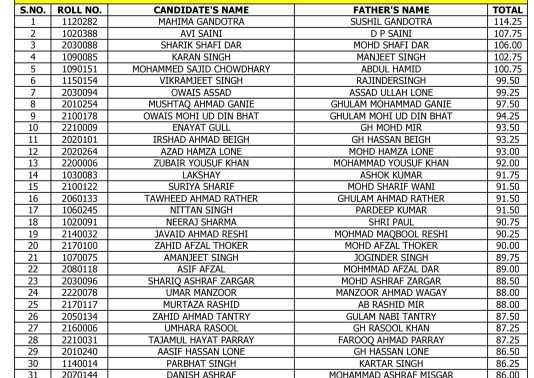
The Jammu & Kashmir Services Selection Board (JKSSB) has issued the result/score-sheet for the written examination conducted for the posts of Junior Engineer (Electrical) in the Power Development Department (PDD). The exam was held on 25 October 2025 under Advertisement No. 02 of 2025 (Items 02, 03, 04 & 05).
This notification dated 24 November 2025 officially publishes the result-score sheet (Annexure “A”) and gives important instructions for the next stages of the selection process.

Important Highlights

  • Exam Date: 25 October 2025 for JE (Electrical) posts.
  • Result Notification Date: 24 November 2025.
  • Vacancy/Advertisement: Recruitment notification for JE (Electrical) was under Advt. No. 02 of 2025 for the PDD.
  • Score-sheet Released: The board has released the score-sheet of all candidates who appeared in the examination, identified as Annexure “A”.
  • Next Stage – Document Verification (DV): The notification clarifies that mere appearing in the score-sheet does not guarantee being called for document verification; only those candidates falling in the “consideration zone” based on merit will be shortlisted.

Understanding What the Score-sheet Means

The release of the score-sheet is an important milestone for candidates, but it is not the final selection list. Instead, it lists the marks obtained by candidates in the written examination.
The key take-aways for aspirants:

  • Being listed in the result/score-sheet means you appeared in the exam and your marks have been published.
  • However, being listed does not mean you will necessarily be called for the next phase (document verification).
  • The Board will determine a merit-based “consideration zone”, and only candidates within that zone will be invited for DV.
  • The schedule, venue and list of documents for DV will be notified separately by JKSSB.

This distinction is explicitly spelled out in the notification.

What Candidates Should Do Now

  1. Download the PDF: Candidates should immediately download the score-sheet from the link above, or visit the JKSSB website under the Results section.
  2. Check Your Roll Number & Score: Look for your roll number in Annexure “A” and check the marks obtained.
  3. Stay Updated: Watch for the upcoming notification regarding document verification (DV) – including date, venue, list of eligible candidates, and required original documents.
  4. Organise Documents: Since DV is the next step, it is wise to keep all original certificates ready (educational/technical qualification, domicile, category certificate if applicable, identity proof, etc.).
  5. Be Prepared Mentally: Even if you have been listed, your DV eligibility depends on your position in the merit-list and available vacancies. Don’t assume automatic selection.

Some Context & Background

  • The JKSSB had earlier released the provisional answer key for this examination (JE Electrical), held on 25 October 2025. The answer key allowed candidates to file objections within a stipulated timeframe.
  • According to various exam-updates, the online application process for JE (Electrical) had commenced in early 2025, and the number of vacancies reported for the electrical discipline were in the range of ~292, under the same recruitment drive.

Why This Is Important

For candidates from the Union Territory of Jammu & Kashmir aspiring for government engineering posts, the JE (Electrical) recruitment through JKSSB represents a major opportunity. Given the technical nature of the post, it requires a valid Diploma or Degree in Electrical Engineering and other eligibility criteria. The release of the score-sheet allows transparency in the process and enables candidates to see their performance relative to norms.

For JKSSB and the PDD, publication of the result/score-sheet signals completion of the major examination phase and paves the way for next steps — document verification, final short‐listing and eventual appointment.

Key Points to Note

  • This result covers only the written examination stage, and does not mean final appointment.
  • The merit-based “consideration zone” will determine which candidates are called for DV.
  • Candidates from all categories (Open Merit, SC, ST, OBC, EWS etc) must check their eligibility and ranking.
  • The PDF includes roll numbers, candidate names (as per application), father’s name, and scores.
  • Candidates must monitor the official JKSSB portal for DV notification, cut-off marks, and further instructions.

Frequently Asked Questions (FAQs)

Q1: Is this the final selection list for JE (Electrical)?
A: No. This is the result/score-sheet of the written exam. Final selection will happen after DV and further process.
Q2: Does the publication of this score-sheet mean I am safe for appointment?
A: Not necessarily. Only candidates falling within the merit “consideration zone” will be called for DV; being listed does not guarantee being called.
Q3: Where can I download the PDF?
A: From the JKSSB official website under “Results” section or via the link provided above.
Q4: What documents do I need for DV?
A: Original qualification certificate (Diploma/Degree), mark sheets, domicile certificate, category certificate (if applicable), identity proof, photographs, and any other document as specified by JKSSB in the DV notification.
Q5: When will DV notification come?
A: JKSSB has not yet published the DV schedule in this notification. Candidates should check the board’s website regularly for updates.

Download PDF: Result/Score-sheet (Electrical) – 24 Nov 2025

Final Words

The release of the result/score-sheet for the JE (Electrical) recruitment by JKSSB is a crucial moment for many aspirants. While seeing your name and score is gratifying, it’s important to remember that this is one step in the selection process — the journey continues with document verification, merit ranking and final selection. Aspirants should stay vigilant, keep their documents ready and watch out for the next notification from JKSSB.

Congratulations to those who have scored well. For those awaiting the next phase, stay prepared and stay focused.

JKSSB Junior Engineer (Civil) Result 2025 Out: Check Marks, Download PDF

0

JKSSB Declares Written Examination Result for Junior Engineer (Civil) – Advt. No. 03 of 2025

The Jammu & Kashmir Services Selection Board (JKSSB) has officially released the result/score‐sheet of the written examination for the post of Junior Engineer (Civil) under Advt. No. 03 of 2025 (Items No. 06 & 07) for the Public Works (R&B) and Jal Shakti Departments. The result notification, dated 24 November 2025, makes the score‐sheet publicly available for candidates who appeared in the written test held on 2 November 2025.

Key Highlights

  • Exam Conducting Body: JKSSB, located at Muthi, Akhnoor Road, Jammu / Zum­Zam Complex, Rambagh, Srinagar.
  • Post: Junior Engineer (Civil) – Public Works (R&B) / Jal Shakti Departments.
  • Advertisement: Notification No. 03 of 2025.
  • Written Examination Date: 02 November 2025.
  • Result Notification Date: 24 November 2025.
  • The result is in the form of a score‐sheet (Annexure “A”) listing candidate roll numbers, names, father’s names and score achieved.
  • Importantly, the notification emphasises that mere figuring in the score-sheet does not entitle a candidate to be called for document verification or final selection. The Board will call candidates falling in the consideration zone on merit basis.

What the Notification Says

In its notification, JKSSB states:

“Mere figuring in the result/score-sheet shall not entitle a candidate to be called for document verification or figure in the select list and that he/she has to fulfil other eligibility conditions, as laid down and decision of the Board in this regard shall be final.”
“The Jammu & Kashmir Services Selection Board (JKSSB) will call candidates falling in the consideration zone, based on the merit obtained by them for Document Verification. The schedule for Document Verification shall be notified separately.”

This makes it clear that the score‐sheet is not the final merit list or selection list. It is a transparency move to show how many candidates appeared and how they scored; the next steps will follow for those shortlisted.

How to Download the Score‐Sheet

  1. Visit the official website of JKSSB at www.jkssb.nic.in.
  2. Navigate to the “Results” section.
  3. Look for the link titled “Result/Score‐sheet of Written Examination for the post of Junior Engineer (Civil) – regarding”.
  4. Click the link to download the PDF.
  5. Open the PDF and check your Roll Number, Name & Score under Annexure “A”.

For convenience, the direct link (as referenced in the notification) is:
https://jkssb.nic.in/Pdf/RESULT_CIVIL_24112025.pdf (Please verify on the official site for authenticity).

What Candidates Should Do Next

  • Check your name and score: Download the PDF and locate your roll number and details in Annexure “A”.
  • Note that this is only the score‐sheet: Listing here does not guarantee you a call for next stage; it just means you appeared and your marks are reflected.
  • Await the Board’s notification: JKSSB will separately issue a list of candidates invited for Document Verification (DV). This will be based on a “consideration zone” determined by merit and number of vacancies.
  • Prepare original documents: Those likely to be called should keep ready all required certificates: engineering diploma/degree, domicile, category certificate (if applicable), identity proof, etc.
  • Stay updated: Keep checking the official JKSSB website regularly for updated notifications, cut-offs, DV schedule, and final selection list.

Importance of this Recruitment Drive

The recruitment for Junior Engineer (Civil) holds major significance for aspiring engineers within the Union Territory of Jammu & Kashmir. As per the official Notification No. 03 of 2025, a total of 508 vacancies have been announced for the Civil engineering discipline — comprising 150 posts under Public Works (R&B) and 358 under Jal Shakti Department.

This provides a substantial opportunity for diploma/degree holders in civil engineering to secure a government job in a technical role, especially within UT structures.

Recruitment & Selection Overview

  • Advertisement: Notification No. 03 of 2025 for JE (Civil).
  • Eligibility: Candidates must have requisite engineering diploma or degree in civil engineering as specified, and domicile of J&K UT.
  • Selection Process: Written Examination → Document Verification → Final Selection. No interview for many posts.
  • Written Examination Format: An objective‐type paper with multiple choice questions, negative marking for wrong answers (0.25 marks) as per standard.
  • Merit & Consideration Zone: The Board will determine a cut‐off/consideration zone based on vacancies and scores attained; those above the zone will be invited for DV.

Why Release the Score‐Sheet Now?

Publishing the complete score‐sheet offers transparency: all candidates can see where they stand in terms of marks. It allows aspirants to know whether they are in contention for further rounds. It also helps avoid confusion about selections being arbitrary. By clearly stating that listing does not guarantee selection, the Board maintains procedural clarity.

What This Means for Aspirants

  • If your name appears in the PDF, congratulations — you have your score.
  • If you scored high (compared to peer scores in previous years or your estimate), you have a strong chance of moving into the next stage.
  • If your score is lower, this is still a learning point: you now know your performance level and can plan for future attempts or improvement.
  • Stay alert for the next stage notification — printouts, document verification calls, original certificates ready.
  • Check the official site regularly so you don’t miss any deadlines (for DV or final selection).

Sample Timeline

  • Notification released: 25 April 2025 (Online application window opened shortly thereafter).
  • Written Exam Date (Civil): 02 November 2025.
  • Result / Score‐sheet released: 24 November 2025.
  • Next stage (Document Verification) to be notified by JKSSB soon.

For Web Site Readers: Download and Print

We encourage all candidates and website readers to download the official PDF of the result from the JKSSB website (link above). Once downloaded:

  • Use Ctrl+F (or search) functionality to look up your Roll Number quickly.
  • Print a hard copy for your records, especially if you believe you may advance to the next stage.
  • Compare your score with past years (if available) to estimate chances of making the merit list.

Important Caveats & Notes

  • Inclusion in the score‐sheet does not equal selection — the selection will follow per merit and eligibility criteria.
  • The Board explicitly reserves the right to decide eligibility, to invite candidates in the consideration zone and rule out candidates who do not fulfil documentary or other eligibility conditions.
  • Keep in mind that category‐based reservations, tie-breaking rules, domicile requirements etc., may apply.
  • After DV, there may be further processes (medical, verification etc) before final appointment.

Final Word

For all aspiring Junior Engineers (Civil) in Jammu & Kashmir, this is a significant milestone. The release of the score‐sheet by JKSSB marks the conclusion of the written examination phase and provides clarity on where candidates stand. The next few weeks will determine who among them is invited for Document Verification and ultimately selected for appointment.

If you are one of the candidates, this is the time to stay alert, ensure your documents are ready, keep track of official notifications and, if shortlisted, be fully prepared for the next phase. For all those looking ahead, take this as a guide to the level required, plan accordingly for future attempts, and use this result as a reference point.

We congratulate all candidates who secured their names in the Mumbai—sorry, Jammu & Kashmir Services Selection Board’s result sheet, and wish you all the very best for the next stage of selection. Stay connected with the official site of JKSSB for timely updates and further instructions.


Download PDF (Official Score‐Sheet): RESULT_CIVIL_24112025.pdf

Fresh Winter Vacation 2025 Update — Check Here

0

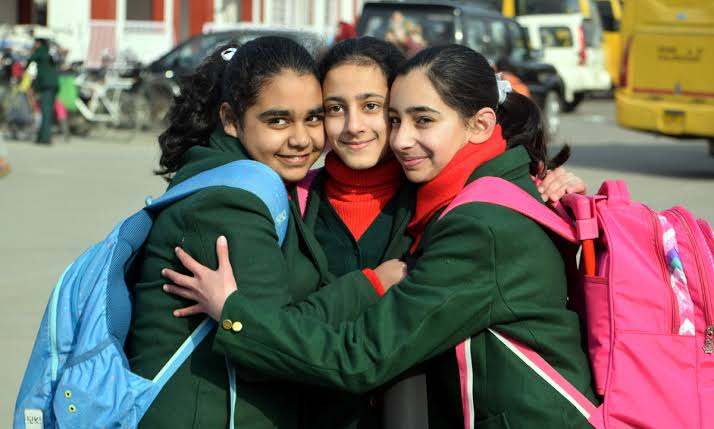
The government has decided to announce early winter vacations for the kindergarten classes.

Talking to Greater Kashmir, Minister for Education, Sakina Itoo said tomorrow (November 25) will be the last working day for students enrolled in kindergarten classes.

“I have discussed the matter with Director School Education Kashmir. Tomorrow will be the last working day for students of kindergarten classes,” Sakina Itoo told Greater Kashmir.

Advertisement

The decision comes in wake of the demand from parents for early announcement of winter vacation for kindergarten classes in view of the dip in weather conditions across Kashmir.

The demand comes days after the government announced that the winter vacations for classes up to 8th will commence from December first week.

“Temperature is already below normal. The time of mulling over a decision is over, they need to act now for primary kids sake. Think about kids with asthma and cold allergy. Going out right now is literally suicide for them,” said Asma, a parent from Srinagar.

Advertisement

The parents argued that the government should announce winter vacations for kindergarten classes in view of the prevailing cold weather.

Advertisement

“Entering a classroom which is centrally heated and then going out in the ground for morning and afternoon assemblies is dangerous for the small kids,” the parents said.

The parents said that continuing schools amid the prevailing weather was damaging and can prove fatal for the small school going children.

“The sunlight that we see in the afternoon is appealing and enticing to the eyes but it is not good for the general health,” the parents said.

Minister for Education also acknowledged the dip in weather conditions across Kashmir.

“Weather is very cold in Kashmir. Keeping in view the cold weather conditions, we have decided to close kindergarten classes early,” she told Greater Kashmir

Govt to Announce Early Winter Vacations; Tomorrow Last Working Day for Kindergarten: Sakina Itoo

0

The government has decided to announce early winter vacations for the kindergarten classes.

Talking to Greater Kashmir, Minister for Education, Sakina Itoo said tomorrow (November 25) will be the last working day for students enrolled in kindergarten classes.

“I have discussed the matter with Director School Education Kashmir. Tomorrow will be the last working day for students of kindergarten classes,” Sakina Itoo told Greater Kashmir.

The decision comes in wake of the demand from parents for early announcement of winter vacation for kindergarten classes in view of the dip in weather conditions across Kashmir.

The demand comes days after the government announced that the winter vacations for classes up to 8th will commence from December first week.

“Temperature is already below normal. The time of mulling over a decision is over, they need to act now for primary kids sake. Think about kids with asthma and cold allergy. Going out right now is literally suicide for them,” said Asma, a parent from Srinagar.

The parents argued that the government should announce winter vacations for kindergarten classes in view of the prevailing cold weather.

“Entering a classroom which is centrally heated and then going out in the ground for morning and afternoon assemblies is dangerous for the small kids,” the parents said.

The parents said that continuing schools amid the prevailing weather was damaging and can prove fatal for the small school going children.

“The sunlight that we see in the afternoon is appealing and enticing to the eyes but it is not good for the general health,” the parents said.

Minister for Education also acknowledged the dip in weather conditions across Kashmir.

“Weather is very cold in Kashmir. Keeping in view the cold weather conditions, we have decided to close kindergarten classes early,” she told Greater Kashmir

JKSSB Accounts Assistant Recruitment 2025-26: 600 Vacancies – Eligibility, Apply Online Dates & Full Details

0

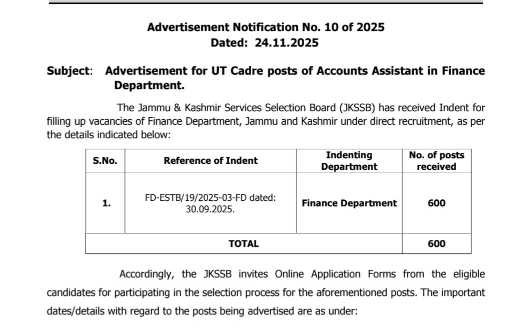
JKSSB Recruitment 2025: Apply Online for 600 Accounts Assistant Posts in Finance Department

The Jammu & Kashmir Services Selection Board (JKSSB) has released a major recruitment notification for 600 Accounts Assistant vacancies under the Finance Department of the Union Territory of J&K. The recruitment will be conducted under Advertisement Notification No. 10 of 2025, issued on 24 November 2025.

This is an excellent opportunity for graduates seeking a government job with an attractive pay scale and secure career in the Finance sector.

📄 Official PDF Link:
https://jkssb.nic.in/Pdf/Advt_10OF2025_24112025.pdf


🔹 Highlights – JKSSB Accounts Assistant Recruitment 2025

Particular Details
Recruiting Authority JKSSB
Department Finance Department (Accounts & Treasuries Organization)
Post Name Accounts Assistant
Total Vacancies 600
Job Location Jammu & Kashmir (UT cadre)
Pay Scale Level-5 (₹29,200 – ₹92,300)
Start Date to Apply 08 December 2025
Last Date to Apply 06 January 2026
Mode of Selection Written (OMR) Examination
Qualification Graduation in any stream
Application Mode Online


🧾 Total Number of Posts – Category-Wise Breakup

As per Annexure-A, the total number of posts is 600 distributed among different reservation categories:

Category Vacancies
Open Merit 240
SC 48
ST-1 60
ST-2 60
OBC 48
ALC/IB 24
RBA 60
EWS 60
Total 600

🧑‍🎓 Eligibility Criteria

Eligibility requirements must be fulfilled on or before the closing date of the online application form.

✔ Domicile

Only Domiciles of Jammu & Kashmir UT can apply. A valid domicile certificate must be uploaded with the application.

✔ Educational Qualification

  • Graduation in any stream from a recognized university
  • Minimum marks:
    • 50% for Open Merit
    • 45% for Reserved categories
  • Candidates with Post-Graduation (50% marks) or PhD are also eligible


✔ Age Limit (as on 01.01.2025)

Category Max Age Not Born Before Not Born After
Open Merit 40 01-01-1985 01-01-2007
SC / ST-1 / ST-2 / RBA / OBC / EWS / ALC-IB 43 01-01-1982 01-01-2007
PwBD 42 01-01-1983 01-01-2007
Ex-Servicemen 48 01-01-1977 01-01-2007


📝 Selection Process

Selection will be based only on performance in Written OMR-based Examination.
No interview / viva-voce.


🧠 Exam Pattern (Scheme of Examination)

  • Objective Type Multiple Choice Questions
  • English language only
  • Negative Marking: 0.25 marks for each wrong answer


📌 Detailed syllabus will be released separately on the JKSSB website.


🏢 Job Role & Pay Scale

  • Post Name: Accounts Assistant
  • Grade Pay Level: Level-5 (₹29,200 – ₹92,300)
  • Cadre: UT Cadre


Working under the Director General, Accounts & Treasuries Organization, selected candidates will manage financial record-keeping, budgeting, payment processing & treasury functions for government departments.


💰 Application Fee

Category Fee
SC / ST-1 / ST-2 / EWS / PwBD ₹500
Others ₹600
  • Fee once paid will not be refunded under any circumstances.
  • Payment via net banking / debit card / credit card only.

🗂 Document Verification

Shortlisted candidates must present original documents including:

  • Educational degrees
  • Domicile certificate
  • Reserved category certificates
  • Birth certificate
  • Government-issued Photo ID

🏃‍♂️ How to Apply Online?

📌 Online application procedure will be provided soon on www.jkssb.nic.in

General steps:

  1. Visit JKSSB official website ➝ www.jkssb.nic.in
  2. Register using Email & Mobile No.
  3. Fill accurate details
  4. Upload documents as per notification
  5. Pay application fee online
  6. Submit and take print-out for DV

Important Advice: Apply well before last date to avoid technical issues.


🎓 Reservations – Vertical & Horizontal

  • Reservations applied as per category-wise breakup issued by the Finance Department
  • Horizontal reservation applicable for:
    • Ex-Servicemen (ESM)
    • PwBD (Persons with Benchmark Disabilities)

Special benefits for PwBD candidates:

  • Scribe facility + 20 min per hour extra time
  • Candidate must arrange scribe & submit required certificates

🔔 Admit Card & Exam Centre

  • Admit card available 1 week before exam
  • Download from JKSSB website only
  • No physical admit card will be sent by post

⚠ Important Instructions for Applicants

Candidates must:

✔ Enter name, date of birth & parents’ names exactly as per Matriculation certificate
✔ Upload valid category/domicile certificates before last date
✔ Submit only one application per post
✔ Visit website regularly for updates
✔ Bring 2 latest passport-size photos and original Photo ID to exam centre

Violation or false information may lead to cancellation and legal action.


🎯 Why This Recruitment is Important?

  • Large number of government vacancies
  • Financial sector job security
  • Opportunity for graduates from any stream
  • Transparent written-only selection
  • Attractive salary & promotions under UT cadre

📌 Key Dates to Remember

Event Date
Opening of Application Form 08 December 2025
Last Date to Apply Online 06 January 2026
Admit Card 1 week before exam
Exam Date To be announced by JKSSB


Final Words

JKSSB Accounts Assistant Recruitment 2025 offers a golden opportunity for youth of J&K to secure a prestigious government job in the Finance Department. Candidates are advised to read the full notification, ensure eligibility, and apply on time.

📌 Download Official PDF
Detailed notification here

IGNOU Releases December 2025 Term-End Exam Hall Ticket – Direct Download Link Here

0

IGNOU December 2025 TEE Hall Ticket Released – Complete Guide for Students

The Indira Gandhi National Open University (IGNOU) has officially issued the hall ticket (admit card) for the December 2025 Term‐End Examination (TEE). All students registered for the December session are now eligible to download their hall tickets via the official website and portal. This article provides you with step-by-step instructions, key details to verify, exam-day guidelines, and preparation tips to ensure your day goes smoothly. We place special emphasis on the focus keyword: IGNOU December 2025 TEE Hall Ticket.


1. What You Need to Know About the December 2025 TEE Session

1.1 Overview of the Session

  • IGNOU’s December 2025 TEE is scheduled to be conducted from 1 December 2025 to 14 January 2026.
  • The exams cover a wide range of programmes: undergraduate (UG), postgraduate (PG), diploma, certificate, both via the ODL (Open & Distance Learning) and online modes.
  • The hall tickets for this session have been made available via two main access points: the official IGNOU website and the Samarth portal.

1.2 Why the Hall Ticket is Important

  • The hall ticket is your official entry pass to the examination centre. Without it you will not be permitted to sit for the exam.
  • It contains critical information: your name, enrolment number, programme/code, exam centre address, date & time of your papers and important instructions.
  • It also acts as a verification tool – the invigilator will match your hall ticket details with your photo ID. Failure to present both can result in denial of entry.

1.3 Important Dates & Deadlines

  • The online exam form submission for the December 2025 TEE was opened earlier; various extensions were given.
  • As per the latest announcement, the hall ticket link went live around 21 November 2025.
  • Note: If you submit your exam form or assignments late, or fail to meet eligibility, you may not receive the hall ticket in time. Always check your regional centre communications.

2. How to Download Your IGNOU December 2025 TEE Hall Ticket

2.1 Step-by-Step Download Instructions

Follow these steps carefully to download your hall ticket:

  1. Go to the official IGNOU website: www.ignou.ac.in
  2. Navigate to the “Announcements” or “News/Notifications” section.
  3. Look for the notification titled “Hall Ticket / Admit Card – for December 2025 Term-End Examination” and click on it.
  4. You will be redirected to the Samarth Portal or the hall ticket link page.
  5. Enter your Enrollment Number and Programme Code/Programme Name as required.
  6. Click “Submit” or “Get Admit Card”. Your hall ticket will appear on screen. Download it in PDF format.
  7. Print a hard copy of the hall ticket. Carry it on the exam day. It is advisable to also keep a soft copy for your records.

2.2 What to Do if You Face Issues

  • If the hall ticket link doesn’t work or shows an error: wait a few hours and try again (servers may be busy).
  • If your details (name, programme, centre) are incorrect: contact your IGNOU Regional Centre or Study Centre immediately.
  • If your enrolment number is not recognised: verify that you have submitted the exam form for the December 2025 TEE and that your data has been approved by the Student Registration Division (SRD).
  • Keep your login credentials, enrollment details and programme code handy for reference.

3. Verify the Details on Your Hall Ticket

It is vital to carefully check all information printed on your hall ticket. Mistakes can lead to confusion or denial of entry. Here are the key elements to verify:

  • Your Name: Make sure it is correct and matches your ID.
  • Your Enrollment Number: Should match your university records.
  • Programme Name & Code: Should reflect your course (UG / PG / Diploma / Certificate).
  • Exam Centre Address & Code: Ensure the venue is correct and is convenient for you.
  • Date & Time of your exam(s): Each paper may have different timings — verify carefully.
  • Photograph and Signature (if printed): Though not always mandatory, check if included, especially if required.
  • Instructions section at the bottom/back: Contains rules about what you can/cannot bring, reporting time, centre shift policy etc.
  • Print clarity: Make sure the PDF is legible when printed; unclear prints may cause issues.

If any information is incorrect, notify the university well before your exam date to get corrections done. Do not wait until the last moment.


4. Exam Day Instructions for IGNOU December 2025 TEE

Your hall ticket is just one part of your preparation. Equally important are the rules and guidelines you must follow on exam day to ensure smooth entry and writing. The university has issued detailed directions which every candidate must heed.

4.1 Mandatory Items to Carry

  • Hard copy print-out of the hall ticket (following the “IGNOU December 2025 TEE Hall Ticket” release).
  • A valid photo identity proof: Aadhaar Card, IGNOU ID card, PAN Card etc.
  • Stationery items as permitted: Usually a blue/black ball-point pen, ruler, eraser (if allowed). Check your specific paper instructions.
  • Extra copy of the hall ticket saved at home as backup.

4.2 Items Not Permitted / Key Prohibitions

  • Mobile phones, smart-watches, electronic gadgets are strictly prohibited inside the exam hall.
  • Bags, wallets, large personal items may not have storage provision at many centres — you are responsible for your belongings.
  • Parking may not be available inside/around exam centres — plan accordingly.
  • Any misconduct, use of unfair means, or breach of instructions can lead to disqualification or cancellation of the paper.

4.3 Reporting Time & Shift Timing

  • Arrive at least 30 minutes before your reporting time — this allows verification of hall ticket and ID.
  • According to official date sheet guidance, there are morning and afternoon/evening shifts (e.g., 10:00 AM–1:00 PM, 2:00 PM–5:00 PM) for many papers.
  • The exact time for your paper will be printed on the hall ticket and you should abide by it precisely.

4.4 Change of Examination Centre

  • IGNOU mentions that although students may opt for a preferred centre, due to seat constraints the university reserves the right to shift candidates to alternate centres under the same regional jurisdiction. Once allotted, the centre cannot be changed.
  • If you find your centre inconvenient after allotment, there is typically no recourse for change — plan your commute/travel accordingly.

4.5 At the Exam Centre – Dos and Don’ts

Dos:

  • Show your hall ticket and photo ID for verification.
  • Sit in your allocated seat; follow instructions of the centre superintendent.
  • Read the question paper carefully before attempting.
  • Keep calm and manage your time during the paper.
  • Use only permitted writing instruments and follow any specific paper rule (e.g., language, answer-book format).

Don’ts:

  • Don’t carry mobile phones or devices even if switched off؛ they may be confiscated.
  • Don’t wait until the last minute to reach the venue; late entry is often not permitted.
  • Do not leave question paper hall or attempt to take answer sheets/photos out of exam hall.
  • Avoid scribbling on the hall ticket or making any unauthorised marks.

4.6 Post-Exam Checklist

  • After finishing the paper, ensure you submit your answer sheet as required.
  • Do not discuss the paper outside the centre before official conclusion.
  • Retain your hall ticket until results are declared — it may be required for verification or re-sitting.
  • Check your next exam date in your subject schedule; sometimes papers are on successive days.

5. Preparation Checklist for Students Before Exam Day

While administrative readiness (hall ticket, venue, stationery) is crucial, you also need to ensure your academic and personal preparation is aligned. Here’s a handy checklist tailored for the December 2025 TEE.

5.1 Academic Preparation

  • Confirm you have completed submission of assignments, practicals, project reports or field work journals (if applicable) for December session. Note that some deadlines were extended.
  • Go through your syllabus and ensure all units/topics are covered.
  • Practice past year question papers or sample papers specific to your programme (UG/PG/diploma).
  • Focus on weaker areas first, then revise stronger areas.
  • Make short notes or flashcards for quick revision, especially for last-minute synopses.
  • Ensure you reference the date sheet and know your subject codes, paper numbers etc.

5.2 Administrative Preparation

  • Download and print the hall ticket well in advance — don’t wait until the night before.
  • Check your exam centre location: if it’s unfamiliar, visit a day earlier if possible.
  • Plan your travel and arrival time; account for traffic, parking or public transport delays.
  • Pack your bag the night before: hall ticket, ID, stationery, water bottle (if allowed), mask (if required).
  • Sleep well and eat a healthy meal before the exam day — your mindset and energy matter.

5.3 Mental Readiness

  • Read the exam instructions printed on your hall ticket once; awareness reduces anxiety.
  • Visualise yourself entering the centre, sitting for the paper, completing it confidently.
  • Manage your time during the paper: keep an eye on the clock, allocate time per section.
  • Stay calm if you face a tough question — mark it, move on, and return later if time permits.
  • Stay positive: your preparation and compliance with administrative rules can make a big difference.

6. FAQs – Common Questions about the IGNOU December 2025 TEE Hall Ticket

Q1. When was the IGNOU December 2025 TEE hall ticket released?
A1. The official notification states that the hall ticket link was activated around 21 November 2025.

Q2. Where can I download my hall ticket?
A2. On the official IGNOU website (ignou.ac.in) under Announcements/News or via the Samarth portal.

Q3. What if my name or exam centre is incorrect on the hall ticket?
A3. Immediately contact your regional centre or study centre and seek correction. Do not ignore the error as it may cause complications on exam day.

Q4. Can I change my exam centre after the hall ticket is issued?
A4. No, once the centre is allotted it cannot be changed. IGNOU reserves the right to shift candidates before allotment, but after allotment you must sit at the assigned venue.

Q5. What items are prohibited in the exam hall?
A5. Mobile phones, smart watches, electronic/digital devices, bags (if not permitted for storage), unauthorised stationery.

Q6. What if I lose my printed hall ticket on the day of the exam?
A6. Carry a printed copy and ideally keep a soft copy. If you lose the printed copy, you risk being denied entry — get a printout again from a cyber-café or regional centre if possible.


7. Why Adhering to Hall Ticket Instructions Matters

You might wonder, “why such emphasis on administrative details when I’ve studied hard for exams?” The reason:

  • University-level administrative compliance ensures your candidature is valid and recognised.
  • Arriving without a valid hall ticket or ID may result in non-admission to the exam, regardless of your preparation.
  • The exam centre rules (centre shift, storage of belongings, prohibited items) are binding and affect not just you but the entire cohort; following them ensures smooth conduct.
  • Mismanagement on your part (missing centre, wrong timing, no printout) can add stress, reduce performance, or lead to missed papers.

Thus, the term IGNOU December 2025 TEE Hall Ticket is not just a phrase—it’s a crucial document that bridges your preparation with the actual examination process.


8. Quick Checklist Summary

Before your exam day, tick off the following:

  • [ ] Have you downloaded and printed your hall ticket?
  • [ ] Have you checked the details (name, enrolment, programme, date/time, centre) on the hall ticket?
  • [ ] Do you have a valid photo ID proof?
  • [ ] Have you planned your travel to the exam centre and confirmed reporting time?
  • [ ] Are you aware of prohibited items and have you packed accordingly?
  • [ ] Have you completed assignments, submission obligations and checked your eligibility?
  • [ ] Have you revised key topics and made a last-minute revision strategy?
  • [ ] Are you mentally prepared with proper sleep and nutrition?

9. Final Words

The release of the IGNOU December 2025 TEE Hall Ticket marks a significant phase in your academic journey — your preparation meets the university’s administrative process. Now is the time to move seamlessly from preparation to execution: ensure your hall ticket is downloaded, verified, and printed; ensure you know your exam centre and time; ensure you follow the guidelines without fail.

Your hard work deserves a fair chance — let the hall ticket and instructions support that opportunity. Reach your exam centre with confidence, carry the document safely, follow the rules, and present your best self.

Good luck to all the learners of IGNOU appearing in the December 2025 TEE! Stay focused, stay calm, and make your exam day count.

J&K Power Tariff Hike Rumours Baseless, Says CM Omar Abdullah

0

No Proposal to Raise Power Tariff in J&K: CM Omar Abdullah

Says MBBS admissions based on merit only, seat allocation cannot be decided by religion

Anantnag, Nov 24: Chief Minister Omar Abdullah on Monday dismissed rumours about an increase in electricity charges in Jammu & Kashmir, asserting that the Government has neither discussed nor proposed any hike in power tariffs.

Speaking to reporters in Anantnag, the CM Omar as per news agency Kashmir News Corner — KNC said, “There is no move to hike electricity rates. I have no idea where these rumours originated. As the Power Minister as well, I can say with certainty that no such proposal has been discussed or placed before the government.”

Earlier in the day, Union Coal & Mines Minister G Kishan Reddy, the Chief Minister and Deputy CM Surinder Choudhary jointly launched the maiden e-auction of seven limestone mineral blocks in Anantnag, Rajouri, and Poonch — a major step under mining reforms of the MMDR Act, 2015.

Abdullah clarified that the allocation process of these blocks remains fully under the jurisdiction of the J&K administration. “These blocks are not being handed over arbitrarily, nor does the Centre control them. The Union Ministry of Mines is only assisting to ensure transparency and efficiency in allotment,” he said.

He added that limestone is crucial for cement manufacturing, and the Government intends to promote industrial units near the mining sites to create employment opportunities for local youth.

On seat allocation in Mata Vaishno devi University, CM Omar said that the law does not restrict entry based on religion. Referring to the Mata Vaishno Devi University Act, he said, “Where was it written that boys or girls of any particular religion would be excluded? Admission has always been merit-based.”

He stressed that any deviation from merit would require Supreme Court approval, adding that bringing religion into admission processes would violate constitutional safeguards. “If decisions start being made on the basis of religion, should social welfare schemes or policing follow the same pattern?” he asked.

Abdullah advised Leader of Opposition Sunil Sharma to re-examine the Assembly record, stressing that no clause allows seat distribution on religious lines. (KNC)

JKBOSE Class 12th Chemistry Question Paper Annual Regular 2025 PDF – Download Now (Jammu & Kashmir Winter Zone)

JKBOSE Class 12th Chemistry Question Paper Annual Regular 2025 PDF – Download Now (Jammu & Kashmir Winter Zone)

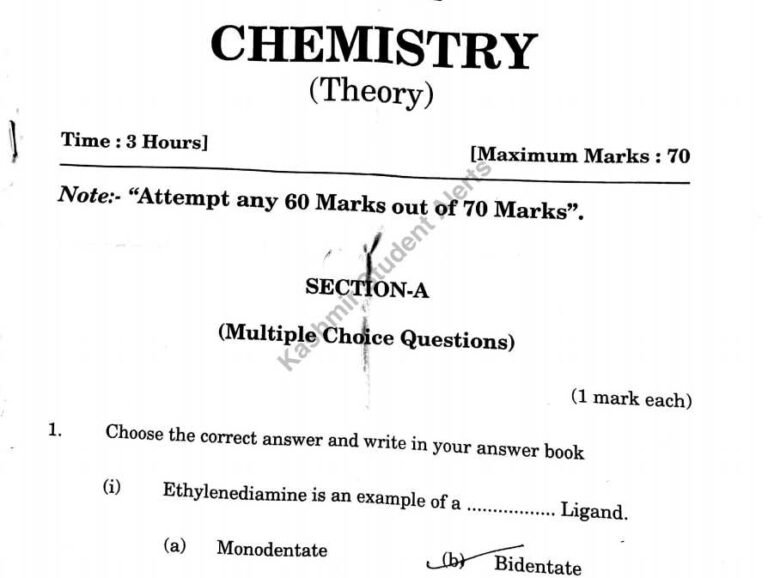
The Jammu & Kashmir Board of School Education (JKBOSE) successfully conducted Class 12th Chemistry Question Paper today under the Annual Regular 2025 session for winter zone areas of Jammu and Kashmir.

This is one of the most important subjects in the Science stream, especially for students aspiring for NEET, JEE, B.Sc. Chemistry, Pharmacy, and other professional courses.

Here, we are providing the official Chemistry Question Paper PDF download link, exam analysis, paper pattern, important questions, answer guidance, and expert reviews.


📥 Download JKBOSE Class 12th Chemistry Question Paper 2025 PDF

Students who appeared in today’s exam or those preparing for the upcoming JKBOSE Board exams can download the question paper from the link below:

👉 Download PDF:
https://kashmirstudentalerts.com/wp-content/uploads/2025/11/New-Doc-11-24-2025-15.441-1.pdf


🔍 JKBOSE Chemistry Exam 2025 – Key Highlights

Detail Information
Exam Board JKBOSE
Class 12th
Subject Chemistry
Session Annual Regular 2025
Date of Exam 24 November 2025
Zone Jammu & Kashmir Winter Zones
Paper Type Theory Examination
Time Duration 3 Hours
Maximum Marks 70

The paper carried a mix of MCQs, Short Answers & Long Questions, based on the updated JKBOSE syllabus.


📌 JKBOSE 12th Chemistry Paper Pattern 2025

The question paper was divided into three sections:

Section A – MCQs & Very Short Answers

  • 20 Questions × 1 mark = 20 Marks
  • Difficulty: Easy to moderate

Section B – Short Answer Questions

  • Concept-based numericals and reaction mechanisms
  • 3–4 marks each
  • Difficulty: Moderate to tricky

Section C – Long Answer Questions

  • In-depth theoretical & application-based topics
  • Difficulty: Moderate but lengthy

Students found physical chemistry numericals slightly challenging due to calculation steps.


🧪 Topics Covered in the Question Paper

Most questions were directly structured from NCERT Class 12 chapters:

Physical Chemistry Organic Chemistry Inorganic Chemistry
Electrochemistry Haloalkanes & Haloarenes Coordination Compounds
Chemical Kinetics Alcohols, Phenols & Ethers d & f Block Elements
Solutions Aldehydes, Ketones & Carboxylic Acids p-Block Elements
Surface Chemistry Biomolecules Metallurgy
Solid State Polymers General Principles & Extraction of Metals

Students reported that Organic Chemistry section was student-friendly but required clarity of reaction mechanisms.


🎯 Expected Marking Advantage for NCERT Readers

Students who focused strictly on: ✔ NCERT Examples
✔ NCERT Exercises
✔ Reaction Mechanisms
✔ Named Reactions
✔ Numerical Formulas

…will likely score 45+ marks easily.


📊 Overall Difficulty Level – Student Poll (Early Reactions)

Difficulty Level Percentage of Students
Easy 36%
Moderate 48%
Difficult 16%

Most candidates rated the paper moderate, but lengthier than expected.


📢 Student Reactions – What Students Said After the Exam?

Here are some common responses from students across Jammu & Kashmir winter zone:

✔ “Paper was NCERT-based and easy to attempt”
✔ “Organic section was very scoring”
✘ “Numerical questions required time and careful steps”
✘ “Section-C was a bit lengthy”

Almost all students agreed that proper time management was crucial.


🧠 Expert Analysis – Chemistry Teachers’ Review

Chemistry lecturers from Higher Secondary Schools in Kashmir shared the following observations:

  • Paper was balanced and student-friendly
  • Concept clarity was more important than memorization
  • Application-based questions tested analytical skills
  • No unfair or out-of-syllabus question appeared
  • Good scoring opportunity for NEET aspirants

Experts expect high pass percentages in Chemistry this year.


🏆 Chapter-Wise Weightage (Predicted for 2025)

Unit Expected Marks in Paper
Solutions 5 Marks
Electrochemistry 7 Marks
Chemical Kinetics 5 Marks
Surface Chemistry 4 Marks
d & f Block Elements 7 Marks
Coordination Compounds 6 Marks
Haloalkanes & Haloarenes 5 Marks
Alcohols, Phenols & Ethers 6 Marks
Aldehydes, Ketones & Carboxylic Acids 7 Marks
Biomolecules 5 Marks
Polymers 5 Marks
Chemistry in Everyday Life 3 Marks

🧾 Sample Questions from Today’s Paper

Some of the important types of questions asked today:

Q1. Define rate constant and give its SI unit.
Q2. Write IUPAC name of the compound:
CH₃ — CH₂ — CH₂ — Cl
Q3. State Faraday’s First Law of Electrolysis.
Q4. Explain the mechanism of nucleophilic substitution reaction in haloalkanes.
Q5. Write the structure of EDTA and its role as a ligand.

These questions focused on conceptual clarity rather than memory.


🧩 For Upcoming Students – How to Score 60+/70 in JKBOSE Chemistry?

Follow this strategy for your next examination:

Study Plan Benefit
Complete NCERT line-by-line 70% marks guaranteed
Practice numericals daily Improves speed & accuracy
Memorize all Named Reactions Helps in long answers
Create short notes per chapter Better revision before exam
Focus on Organic Chemistry Most scoring section

Tip: Revise each chapter at least 3 times before the exam date.


📚 JKBOSE Class 12 Chemistry Important Chapters for 2025 Exams

1️⃣ Electrochemistry
2️⃣ Chemical Kinetics
3️⃣ Coordination Compounds
4️⃣ Haloalkanes & Haloarenes
5️⃣ Alcohols, Phenols, and Ethers
6️⃣ Aldehydes & Ketones
7️⃣ d & f Block Elements
8️⃣ Biomolecules

Giving priority to these chapters boosts high scoring chances.


📝 Important Sample Papers & Study Material (Links)

We will soon provide:

  • JKBOSE Class 12 Chemistry Answer Key 2025
  • JKBOSE Previous Year Papers PDF
  • Model Test Papers with Solutions
  • MCQs for Practice
  • Chapter-Wise Notes

Bookmark this page for updates!


❄️ JKBOSE Winter Zone – What to Expect Next?

Upcoming core subject exam schedule:

Subject Expected Exam Date
Physics Soon after Chemistry
Biology Follows Physics
Mathematics Final subject in Science stream

JKBOSE has ensured smooth and systematic conduct of exams this year.


🔔 Final Conclusion

The JKBOSE Class 12th Chemistry Annual Regular 2025 question paper for the winter zone was:

⭐ NCERT-based
⭐ Balanced & student-friendly
⭐ Moderate difficulty
⭐ Lengthy but manageable
⭐ Scoring for well-prepared candidates

Students who practiced numericals + reaction mechanisms + NCERT examples will definitely score excellent marks.

📥 Download the Paper PDF (Already Provided):
Click here


📰 Stay Connected with Kashmir Student Alerts

For JKBOSE News, Admit Cards, Previous Papers, Answer Keys, & Results
➡ Visit Daily: Kashmir Student Alerts

Follow our Telegram, WhatsApp & YouTube channels for instant updates.

KVS and NVS Recruitment 2025 – A Complete Guide to 14,967 Teaching & Non-Teaching Vacancies

0

KVS and NVS Recruitment 2025 – A Complete Guide to 14,967 Teaching & Non-Teaching Vacancies

If you’re looking for a secure central government job in education, then the latest recruitment drive by the Kendriya Vidyalaya Sangathan (KVS) and the Navodaya Vidyalaya Samiti (NVS) is your chance. In 2025, the two bodies have opened up a massive opportunity – 14,967 vacancies across teaching and non-teaching posts. The application window begins mid-November and closes in early December 2025. This comprehensive article will cover everything you need to know: eligibility, posts, application process, timelines, selection method, salary highlights and preparation tips.


What is the Recruitment About?

The KVS and NVS Recruitment 2025 campaign invites eligible Indian citizens to apply for teaching (PRT, TGT, PGT, Principals, Vice-Principals) as well as non-teaching administrative, technical and support staff roles. According to the official bulletin:

  • The recruitment notification (No. 01/2025) was published by KVS on 13 November 2025.
  • The conducting body is the Central Board of Secondary Education (CBSE) on behalf of KVS & NVS.
  • Total vacancies: 14,967 across both organisations (KVS + NVS) for 2025.
  • The application window: 14 November 2025 to 4 December 2025.

In short: If you have educational qualifications such as B.Ed., M.Ed., or relevant subject-master’s degree (for teaching) or diploma/degree for non-teaching posts, this drive is highly relevant. Let’s dive into the details.


Vacancy Break-Up: Teaching & Non-Teaching Posts

Here’s a breakdown of the major categories and their respective vacancies as per available information.

Teaching Posts

  • Principals: 227 (KVS + NVS)
  • Vice-Principals: 58 (KVS)
  • Post Graduate Teachers (PGTs): ~2,978 (KVS + NVS)
  • Trained Graduate Teachers (TGTs): ~5,772 (KVS + NVS)
  • Primary Teachers (PRTs): 3,365 (KVS)

Non-Teaching Posts

  • Non-Teaching Vacancies: ~1,942 across KVS & NVS.

Organisational Split

According to details:

  • KVS: ~9,126 vacancies
  • NVS: ~5,841 vacancies

Why this matters: With nearly 15,000 posts, this recruitment drive is among the largest for central government schools in recent times, offering a significant window for aspirants looking to build a career in education.


Eligibility Criteria: Who Can Apply?

Educational Qualifications

Eligibility varies widely by post category:

  • Principal / Vice-Principal: Usually a Master’s degree with 50% marks, B.Ed. or integrated B.Ed.–M.Ed., plus requisite years of experience.
  • PGT: A master’s degree in the concerned subject (50% minimum), along with B.Ed. or an integrated PG course as specified.
  • TGT: Graduation with at least 50% and B.Ed., with subject-specialisation at graduation level.
  • PRT: Senior Secondary (Class XII) with 50% marks + Diploma (Elementary Education)/B.Ed. (Special Education)/Bachelor’s in Music/Performing Arts as specified.
  • Non-Teaching Posts: Varying qualification — from diploma/degree in relevant field or 12th standard depending on post.

Age Limit

  • Upper age limits vary by post— e.g., PRT usually around 30 years, TGT around 35 years, PGT 40 years.
  • Age is calculated as on a specified “reference date” (usually closing date of application).
  • Age relaxation as per Government of India norms for SC/ST/OBC/PH/Ex-Servicemen categories.

Other Key Criteria

  • Indian nationality (typically)
  • Good character, no major criminal record
  • Required experience (in some posts)
  • Ability to upload valid certificates, photograph, signature, category proof, etc.

Note: Always refer to the detailed notification (PDF) for exact eligibility for each post before applying.


Application Process: How to Apply

Step-by-Step Guide

  1. Visit the official websites:
    • KVS: kvsangathan.nic.in
    • NVS: navodaya.gov.in
    • CBSE recruitment portal (as may be integrated)
  2. Start the application from 14 November 2025.
  3. Last date for submission: 04 December 2025.
  4. Register using valid email ID and mobile number. Create login credentials.
  5. Fill in personal details, educational qualifications, experience (if any), category details, preferred post(s), etc.
  6. Upload scanned documents: recent passport-size photo, signature, identity proof, category certificate (if applicable), educational certificates.
  7. Pay the application fee (if applicable) through the prescribed online mode.
  8. Submit the form. Download/print the confirmation page and keep the registration number safe for future correspondence.

Application Fee

Fee details differ by post category (General/OBC vs SC/ST/PH) and will be specified in the notification. In previous similar drives, higher posts like Principals had higher fees while junior posts had lower fees.

Important Tips

  • Fill the correct post and subject carefully to avoid disqualification.
  • Ensure uploaded documents meet format & size specifications.
  • Pay the fee before the last date and keep transaction proof.
  • Check the “Preview” of the filled form carefully before final submission — modifications afterward may not be permitted.
  • Keep a hard copy or screenshot of the submitted form for your records.
  • Monitor official sites for any corrigendum or updates after submission.

Selection Process & Exam Pattern

Selection Stages

The recruitment is expected to follow multiple stages:

  • Computer-Based Test (CBT) / Written examination for respective post category.
  • Skill test / Demo teaching (for teaching posts) and interview (for higher posts).
  • Document verification of qualifications, category, age, etc.
  • Medical fitness certificate (where applicable).

Exam Dates & Schedule

  • Tier-I exam for KVS & NVS Recruitment 2025 scheduled for 10 and 11 January 2026.
  • Admit cards will be released in due course — candidates must check official portals regularly.

Exam Pattern (Indicative for Teaching Posts)

For example, for PGT/TGT posts under KVS:

  • Part I: General English, General Hindi, General Knowledge & Current Affairs, Reasoning Ability, Computer Literacy.
  • Part II: Perspectives on Education & Leadership.
  • Part III: Subject concerned (e.g., for PGT: main subject 100 marks)
  • Duration: 3 Hours, total ~180 marks for certain posts.

Note: The exact pattern may differ by post and organisation (KVS vs NVS) — always download the official syllabus and exam pattern from the notification PDF.


Salary & Career Growth

While specific pay scales for each post will be detailed in the notification, some indicative aspects include:

  • Pay levels as per the 7th CPC (Central Pay Commission) for teaching and non-teaching posts.
  • Additional allowances: Dearness Allowance (DA), House Rent Allowance (HRA), Transport Allowance, as per central government norms.
  • Teachers working in KVS/NVS benefit from central government job security, pension/benefits and transfers across locations (in many cases).
  • Career growth: For teaching staff, promotions to higher posts (TGT → PGT → Vice-Principal → Principal) may be available based on performance, experience and vacancies.

Why This Recruitment Is a Big Opportunity

  • Scale: Nearly 15,000 vacancies make it one of the largest teacher + non-teaching recruitment drives in central schools in recent years.
  • Central Government Affiliation: Jobs in KVS/NVS are part of central educational institutions, enjoying better infrastructure, pay and transfer benefits compared to many local boards.
  • Wide Range of Posts: From primary teachers (PRT) to administrative roles and senior academics (PGT, Principals) — multiple career entry points.
  • Nation-wide scope: Vacancies across multiple states and union territories offering flexibility in location.
  • Timing: With application window now open, this is prime time for aspirants to act, rather than wait for future drives.

Key Dates & Timeline Recap

Event Date
Notification Released 13 November 2025
Online Application Start 14 November 2025
Last Date to Apply 04 December 2025
Tier-1 Exam Dates 10 & 11 January 2026

Important: Make sure you apply before the deadline and keep monitoring the official portals for updates like admit card release, exam city allotment and corrigendum.


How to Prepare for the Exam: Strategy & Tips

Given the competitive nature of this recruitment, here’s how you can plan your preparation:

1. Download Notification & Syllabus

Start by downloading the official PDF from KVS or CBSE websites to know exactly the syllabus, exam pattern, subject-wise weightage, and post-specific criteria.

2. Understand the Post You Are Applying For

Whether PRT, TGT, PGT or non-teaching, each will have different prerequisites: subject knowledge, demo teaching, skill tests or technical aptitude. Tailor your preparation accordingly.

3. Build Core Competencies

  • For teaching posts:
    • Subject knowledge (your teaching subject)
    • Pedagogy & teaching methodology (especially for PGT/TGT)
    • General knowledge/current affairs
    • Reasoning, computer literacy, general English/Hindi
  • For non-teaching posts:
    • Relevant domain knowledge (office administration, engineering, finance, depending on post)
    • General aptitude, reasoning, basic computer skills

4. Practice Mock Tests & Previous Year Papers

Simulate exam conditions and get used to online CBT format. Time management is key.

5. Focus on Demo Teaching / Skill Test (for applicable posts)

For posts like PGT/TGT or principal/vice principal, there may be a demo teaching round or interview. Prepare by practising class scenarios, lesson plans and mock interviews.

6. Document Readiness

Keep all educational certificates, identity proofs, category certificates (if applicable), photographs, signatures and other documents ready in scanned format per the specification in the notification.

7. Stay Updated

Keep an eye on the official websites for any updates, changes to exam dates, corrections in forms, admit card issues etc.

8. Health & Location Planning

Since the exam centres may be spread across states and you may have to travel for document verification or further rounds, plan travel/health considerations early. Keep backups of login credentials and printouts.


FAQs – Frequently Asked Questions

Q1. Can I apply for multiple posts in this recruitment drive?
Yes, often candidates can apply for multiple posts (provided they meet eligibility for each). But check the notification – some posts may restrict to apply for one post or pay multiple fees.

Q2. Can final year students apply?
Usually, candidates must have passed the required qualification by the closing date of application. Final year may be eligible only if specified in notification — confirm carefully.

Q3. Will there be negative marking?
While earlier drives suggested “no negative marking” for some posts. Always check the notification for the specific post you apply for.

Q4. What if I belong to SC/ST/OBC/EWS?
You are eligible for age relaxation and fee concessions as per Govt. of India norms. Documentation must be valid and category certification must be uploaded.

Q5. Can I change my exam city or post after submission?
Typically no — once form is submitted and fee paid, modifications are not permitted. Choose carefully when applying.


Final Checklist Before You Hit Submit

✔ Read the notification fully (especially age, education, experience, post code, subject requirement)
✔ Verify eligibility for the exact post you wish to apply
✔ Have scanned copies of all documents ready (photo, signature, identity, category etc)
✔ Use a stable internet connection and apply well before the deadline to avoid last-minute glitches
✔ Pay the fee and keep the transaction receipt
✔ Print the final filled application form / take screenshot for records
✔ Mark upcoming dates (admit card release, exam date) in your calendar
✔ Start exam preparation early and keep monitoring the official portal for updates


Conclusion

If you’re looking for a meaningful career in education or administration within central government schools, the KVS and NVS Recruitment 2025 presents a golden opportunity. With 14,967 vacancies across teaching and non-teaching roles, the time to act is now.

Make sure you check the notification, apply on time (before 4 December 2025), and begin your preparation in earnest. With the right strategy and a clear roadmap, you can position yourself strongly for success

Intelligence Bureau Recruitment 2025: 394 MTS Vacancies – Salary Up to Rs 56,900

0

IB MTS Recruitment 2025 – Complete Guide: Eligibility, Selection, Salary & How to Apply

The Intelligence Bureau (IB), under the Ministry of Home Affairs (MHA), has kicked off a significant recruitment drive for the year 2025 for the post of Multi-Tasking Staff (MTS). With hundreds of vacancies, attractive pay and allowances, and an all-India posting potential, this opportunity is drawing strong interest from young job-seekers across the country.

In this comprehensive blog post we will cover everything you need to know about IB MTS Recruitment 2025: key highlights, eligibility criteria, selection process, salary and benefits, important dates, how to apply, exam pattern, preparation tips and frequently asked questions. By the end of this, you’ll be well-prepared to decide whether to apply and how to strategise your application.


1. Key Highlights of IB MTS Recruitment 2025

Here are the major points you should know at a glance:

  • The Intelligence Bureau has announced vacancies for Multi-Tasking Staff (General) (MTS) for this recruitment cycle.
  • The pay scale for successful candidates is Pay Level-1, with a monthly salary range of ₹18,000 to ₹56,900 plus allowances.
  • The application window is open from 22 November 2025 and closes on 14 December 2025 (11:59 pm).
  • Age limit: 18-25 years (with relaxation for reserved categories) as on the last date.
  • Educational qualification: Minimum Class 10 (matriculation) or its equivalent from a recognised board.
  • The selection process includes an online (MCQ) exam in Tier 1, followed by Tier 2 (qualifying nature) and document verification & medical.
  • Posting: Selected candidates may be liable for posting anywhere in India.

2. Eligibility Criteria – Who Can Apply?

Before you begin your application, ensure you satisfy the eligibility criteria. Let’s break it down.

2.1 Educational Qualification

You must have passed Class 10 (matriculation) or an equivalent qualification from a recognised board.
You also should possess the domicile certificate of the state against which you’re applying (as mentioned in the notification).

2.2 Age Limit

  • The minimum age: 18 years
  • The maximum age: 25 years as on the closing date (14 December 2025) for general category.
  • Relaxations for reserved categories:
    • SC/ST: 5 years
    • OBC: 3 years
    • Persons with Benchmark Disability (PwBD): Up to 10, 13 or 15 years depending on category.

2.3 Nationality / Citizenship

You must be an Indian national. (Standard requirement for central government recruitment)
To avoid rejection, verify any other domicile or state-specific requirement mentioned in the official notification.

2.4 Other Conditions

  • Physical fitness, character and antecedent verification will be required.
  • You should not have any disqualifying criminal record or pending prosecutions.
  • You must declare any previous service, if relevant.

3. Vacancy & Salary Details

3.1 Number of Vacancies

While initial reports mentioned 394 posts, more detailed breakdowns list 362 vacancies for MTS (General) in 2025.
State-wise vacancy distribution is also given in the notification (for example: Delhi/IB HQs has 108 posts among others).

3.2 Salary and Allowances

  • Pay Level 1 of the 7th CPC Pay Matrix: ₹18,000 to ₹56,900.
  • In addition to basic pay, selected candidates will get Central Government allowances, Special Security Allowance (SSA), and cash compensation for duty performed on holidays.
  • This makes the in-hand benefit significantly higher than basic pay alone.

4. Selection Process & Exam Pattern

Understanding how you’ll be selected helps in planning your preparation strategy.

4.1 Stage-wise Selection

  1. Tier-1 Online Exam (MCQ): 100 questions, 1 mark each, negative marking of ¼ mark for each wrong answer.
    Subjects include: General Awareness; Quantitative Aptitude / Numerical & Analytical Ability; Reasoning; English Language.
  2. Tier-2 Exam (Qualifying Nature): Score not considered for final merit — only for qualifying.
  3. Document Verification & Medical Examination: Once you clear tiers, you must submit required documents and pass a medical exam as specified.

4.2 Exam Pattern Details

  • Tier-1: 100 questions = 100 marks; time duration typically ~1 hour (confirm from official notice). Negative marking of 0.25 for each wrong answer.
  • Tier-2: Likely descriptive/qualifying (e.g., English comprehension) — check the notification for exact details. (In an article, Tier-2 is “qualifying in nature” and score not counted for final merit)

4.3 Syllabus & Topics to Cover

As per available information, for Tier-1 you’ll need to prepare:

  • General Awareness: Current affairs, static GK, general science, national/international events
  • Quantitative/Numerical & Analytical Ability: Basic arithmetic, number systems, data interpretation, logical numerical problems
  • Reasoning: Logical reasoning, analytical reasoning, puzzles, series, analogies
  • English Language: Basic vocabulary, comprehension, grammar, sentence structure

Since Tier-2 is qualifying, focus first on clearing Tier-1 with maximum marks, then polish Tier-2 accordingly.


5. How to Apply for IB MTS Recruitment 2025

Applying correctly is crucial. Mistakes in form-filling can lead to rejection.

5.1 Application Timeline

  • Start Date: 22 November 2025 (online registration)
  • Last Date: 14 December 2025 (11:59 PM)

5.2 Step-by-Step Application Guide

  1. Visit the official portal of the Ministry of Home Affairs (MHA) – or the link provided in the notification.
  2. Click on “Register” (if new) or login (if already registered).
  3. Fill basic personal details, contact information (email, mobile), choose state/centre of preference.
  4. Upload photograph and signature as per guidelines (size, format) – check instructions carefully.
  5. Select category (UR/OBC/SC/ST/EWS), pay applicable application fee (if required).
  6. Preview form and submit. Take printout / download pdf for future reference. Keep registration number and password safe.
  7. After submission, keep checking dashboard for updates — admit card release, exam centre, results etc.

5.3 Application Fee

According to one source, the application fee+processing charges are:

  • For General/OBC male: ₹650
  • Others (SC/ST, female, PwBD): ₹550 (processing charges only)

Always verify from the official PDF notification to confirm.


6. Tips & Strategy for Preparation

Since the competition will be intense and many factors matter, here are some recommended tips:

6.1 Timeline Management

  • With less than a month before the last date (and thereafter exam date) you must begin immediately.
  • Ensure you allocate regular study hours daily for each subject: e.g., 1 hour GK + 1 hour Quant + 1 hour Reasoning + 1 hour English.

6.2 Strengthen Basics

  • For Quantitative & Reasoning: Revisit arithmetic fundamentals (percentages, ratios, averages), practice ample problems.
  • For English: Brush up grammar, vocabulary, reading comprehension exercises.
  • For General Awareness: Daily current affairs (especially past 6-12 months), static GK (India/World), key events.

6.3 Practice with Mock Tests & Previous Papers

  • Attempt full-length previous years’ papers or model papers under timed conditions.
  • This trains you in time-management, identifies weak areas, and familiarises you with negative marking.
  • After each mock, analyse mistakes and revise accordingly.

6.4 Focus on Negative Marking

  • Each wrong answer deducts ¼ mark in Tier-1. So accuracy is crucial.
  • Skip questions you’re unsure of rather than guess blindly, unless you can eliminate options.

6.5 Revision & Short Notes

  • Maintain short notes for quick revision of formulas, vocabulary, logical reasoning tricks, current affairs.
  • Before the exam, go through these notes rather than attempting new topics.

6.6 Exam Day Strategy

  • Arrive early at exam centre, keep admit card, ID and other required documents ready.
  • Manage time: e.g., allocate ~1 minute per question (for 100 questions in say 60 minutes) but ensure leaving last 5-10 minutes to review flagged questions.
  • Don’t spend too much time on difficult questions — move on and return if time allows.

6.7 Health & Well-Being

  • Maintain a healthy routine: adequate sleep, balanced diet, short breaks during study.
  • Stay calm and confident; avoid excessive stress or last-minute cramming.

7. Common FAQs (Frequently Asked Questions)

Here are some common questions candidates often have — with answers:

Q1. Can I apply if I’m 26 years old?
A. The upper age limit is 25 years for general category as on the closing date. If you are beyond that and not eligible for relaxation, you cannot apply. (Reserved-category age relaxations apply as per rules)

Q2. Is the score of Tier-2 considered for final merit list?
A. According to the notification, Tier-2 is qualifying in nature and its score will not be counted for final merit list.

Q3. Can I choose my preferred exam city?
A. Yes, the form allows selecting a number of preferred exam centres. However, final allotment is at the discretion of IB and may depend on availability and your location.

Q4. Will I be posted in my home state only?
A. No guarantee of home-state posting. The job carries “all-India transfer liability” – you may be posted anywhere in India.

Q5. What happens if I fail the medical exam?
A. Failing in the medical examination or verification of character/antecedents would result in disqualification, even if you have cleared the exams and been found eligible otherwise.


8. Why This Recruitment Is Worth Considering

Let’s explore why applying to IB MTS Recruitment 2025 could be a smart career decision.

8.1 Prestige & Stability

Working with the Intelligence Bureau – one of India’s key internal security agencies – adds both prestige and national-service value.
Government jobs like these offer relative long-term stability, benefits, allowances, and defined service structure.

8.2 Attractive Pay & Allowances

Although entry level, the pay scale (₹18,000-56,900) plus allowances and SSA make the overall remuneration competitive for 10th-pass level candidates. A good entry point.
Additionally, government benefits (pension/retirement benefits) apply.

8.3 Scope for Growth

Though you start as MTS, there could be internal promotions, lateral shifts, training opportunities within central services.
Also being in such a reputable organisation enhances your profile.

8.4 Large Number of Vacancies

With over 300+ posts, the opportunity is substantial. It gives a relatively better chance compared to very rare postings.
If you are eligible and prepare well, the timeframe is limited — early action gives advantage.


9. Mistakes to Avoid When Applying / Preparing

To improve your chances, avoid these common errors:

  • Late submission: The portal closes at 11:59 PM on last date (14 Dec 2025) — avoid waiting until the last minute.
  • Incorrect details or category: Make sure you accurately fill your category, state domicile, educational qualification, etc. Mistakes may lead to rejection.
  • Poor document uploads: Follow format for photograph and signature (size, dimensions, file type).
  • Ignoring negative marking: Many candidates lose marks due to blind guessing. Be strategic.
  • Neglecting Tier-2: Even if it is qualifying in nature, ignoring it may cost you the final selection because not qualifying it may disqualify you.
  • Assuming easy competition: Many others will apply — treat it seriously and prepare diligently.

10. Timeline & Next Steps

Here’s a simplified timeline you should follow:

  1. Immediately: Check you satisfy eligibility (age, qualification, domicile).
  2. Within the next few days: Register online, pay fee, upload documents and submit form before deadline (14 Dec 2025).
  3. Parallelly: Begin preparation for Tier-1 exam – set daily schedule covering all four subjects.
  4. Two weeks before exam: Attempt mock tests, analyse, revise weaker areas.
  5. After Tier-1: If you clear Tier-1, prepare for Tier-2 (qualifying) and keep required documents ready for verification.
  6. Final stage: Clear document verification & medical examination to secure appointment.

If you are looking for a stable central government job, have passed Class 10, and are aged between 18-25 years (or eligible under category relaxation) then IB MTS Recruitment 2025 is a very promising opportunity. The salary, chances, and prestige combine to make this a strong option. However, success will depend on your timely application, correct form filling, focused exam preparation and smart strategy around the negative marking and exam pattern.

Start now, keep your goal clear, avoid procrastination, and give your best. With consistent effort, you can turn this opportunity into reality.