Monday, April 13, 2026
Advertisementspot_img
Home Blog Page 130

JKBOSE Class 10th Mathematics Question Paper 2025-26 (Download PDF)

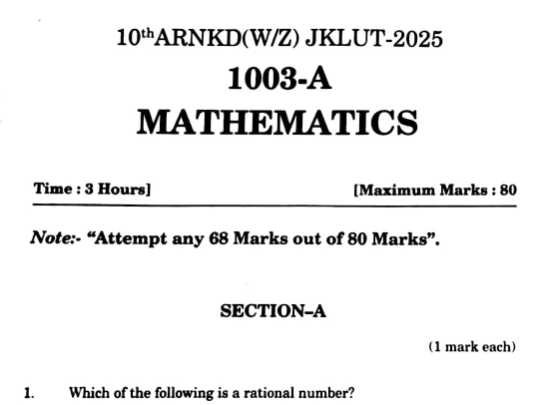
JKBOSE Class 10th Mathematics Question Paper 2025 (Session: October–November) – Download PDF, Exam Analysis, and Key Highlights

The Jammu and Kashmir Board of School Education (JKBOSE) successfully conducted the Class 10th Mathematics examination for the October–November 2025 session. Students across Jammu, Kashmir, and Ladakh divisions appeared for this crucial paper under tight supervision. The exam, which is a key determinant in students’ academic performance, followed the updated syllabus and question pattern prescribed by JKBOSE for the 2025 academic year.

In this article, we provide a complete overview of the JKBOSE Class 10th Mathematics Question Paper 2025, including the PDF download link, exam format, marking scheme, and a detailed section-wise analysis to help future candidates prepare effectively.


JKBOSE Class 10th Math Exam 2025 Overview

Particulars Details
Board Name Jammu and Kashmir Board of School Education (JKBOSE)
Class 10th
Subject Mathematics
Session October–November 2025
Exam Mode Offline (Pen and Paper)
Paper Type Descriptive and Objective Mix
Maximum Marks 100 Marks
Time Duration 3 Hours
Official Website jkbose.nic.in

JKBOSE Class 10th Mathematics Question Paper 2025 PDF Download

Students who appeared for the exam or are preparing for upcoming sessions can now download the complete question paper PDF for reference and practice.

This question paper helps students understand the latest question trends, important topics, and the difficulty level of the examination.


Exam Pattern and Marking Scheme

The JKBOSE Class 10th Mathematics paper for 2025 followed the latest pattern with a blend of theory-based and application-based questions. The paper was divided into three sections:

  1. Section A: Very Short Answer Questions (VSAQs) – 1 mark each
    • Simple numerical or conceptual questions
    • Total marks: 20
  2. Section B: Short Answer Questions (SAQs) – 2–3 marks each
    • Step-wise questions testing understanding and procedure
    • Total marks: 30
  3. Section C: Long Answer Questions (LAQs) – 4–6 marks each
    • Complex problems requiring detailed steps and reasoning
    • Total marks: 50

Overall, the paper carried 100 marks, with internal choice provided in most sections to help reduce stress among students.


Detailed Question Paper Analysis

The Mathematics question paper (Session Oct–Nov 2025) was balanced in terms of difficulty, offering a fair mix of easy, moderate, and challenging questions. Here’s a section-wise breakdown:

1. Algebra (20 Marks)

Topics like Quadratic Equations, Polynomials, and Arithmetic Progressions dominated this section.

  • Most students found the algebra questions straightforward.
  • A few tricky problems appeared in factorization and sum of roots.

2. Geometry (15 Marks)

Questions from Triangles, Circles, and Constructions were included.

  • One question involved proving similarity, which was slightly challenging.
  • Constructions carried 4 marks, requiring precision and neatness.

3. Trigonometry (15 Marks)

This section tested conceptual understanding through identities and height and distance problems.

  • The application-based trigonometry questions required strong formula recall.
  • Most students rated this section as moderate.

4. Mensuration (10 Marks)

Problems were based on Surface Area and Volume of Solids.

  • The question on frustum of a cone was a bit complex.
  • Students who practiced NCERT exercises found this manageable.

5. Statistics and Probability (10 Marks)

  • The mean, median, and mode problems were simple and scoring.
  • A basic probability question based on playing cards was included.
  • This section helped students gain quick marks.

6. Coordinate Geometry (10 Marks)

  • Focused on distance formula and area of triangles.
  • Easy for students who practiced examples from the textbook.

7. Linear Equations and Graphs (10 Marks)

  • Question asked to draw graph for given equations.
  • Marks were awarded for correct plotting and scaling.

Difficulty Level and Student Reactions

After the exam, most students rated the Math paper as moderate in difficulty.

  • 60% of the paper was directly from NCERT exercises and examples.
  • A few application-based questions required analytical thinking and multi-step solutions.
  • Students appreciated the balanced question paper, saying it allowed time for revision within the 3-hour limit.

Teachers also agreed that the 2025 paper was conceptually strong and aligned with the revised JKBOSE syllabus.


Tips for Future Students

If you’re preparing for the JKBOSE Class 10th Mathematics exam 2026, here are some proven tips based on this year’s paper:

  1. Focus on NCERT: 70–80% of questions come directly from the JKBOSE-prescribed NCERT textbook.
  2. Practice Previous Papers: Solving past year papers like the 2025 Math paper gives you a clear idea of exam trends.
  3. Understand Concepts, Don’t Memorize: Especially for Trigonometry, Algebra, and Geometry, concept clarity is key.
  4. Time Management: Allocate time per section — attempt easier ones first.
  5. Show Steps Clearly: Marks are given for logical steps, not just final answers.
  6. Work on Presentation: Neat diagrams and step-wise solving can fetch additional marks.

Importance of Solving Previous Year Papers

Practicing with question papers such as the JKBOSE Class 10th Math Question Paper 2025 helps students:

  • Familiarize with question formats and marking patterns
  • Identify high-weightage topics
  • Improve speed and accuracy
  • Build confidence for the actual exam

Students can also use this paper to conduct mock tests and self-evaluate their performance.


How to Download the JKBOSE Class 10th Math Paper 2025

You can easily download the question paper PDF below:

🔗 Download JKBOSE Class 10th Math Question Paper 2025 PDF (A Series)

Alternatively, visit the Kashmir Student Alerts website for more study materials, previous year papers, and JKBOSE updates

The JKBOSE Class 10th Mathematics Question Paper 2025 (Session: Oct–Nov) was well-structured, moderately difficult, and aligned with the official syllabus. It tested both conceptual understanding and practical application. Students who prepared systematically with NCERT-based revision found the paper straightforward and manageable.

For students appearing in 2026 and beyond, analyzing this paper can provide a significant advantage. Keep practicing, revise important formulas daily, and stay confident — success will surely follow!
Math Question paper (B Series)

JKBOSE Class 10th Revised Date Sheet 2025 (Kashmir Division): Updated Schedule, Subject-Wise Exam Dates, and Key Guidelines

0

JKBOSE Class 10th Revised Date Sheet 2025 (Kashmir Division): Updated Schedule, Subject-Wise Exam Dates, and Key Guidelines

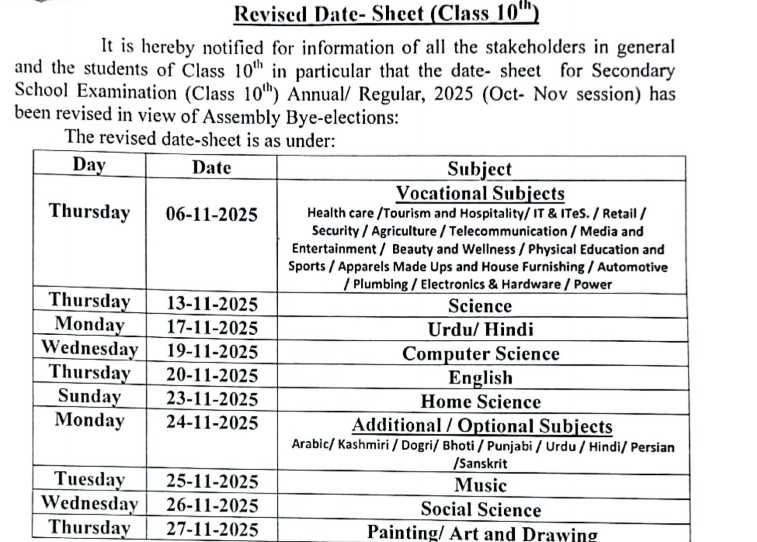
The Jammu and Kashmir Board of School Education (JKBOSE) has officially released the Revised Date Sheet for Class 10th Annual Regular Examination 2025 for the Kashmir Division. This update comes after the board rescheduled the examinations due to the upcoming Assembly Bye-elections in the region.

As per the revised schedule, the JKBOSE Class 10th exams will now begin from November 6, 2025, and conclude on November 27, 2025. The timing and centres notified earlier will remain unchanged. This announcement provides much-needed clarity for thousands of students preparing for their board exams this season.


JKBOSE Class 10th Revised Date Sheet 2025 – Overview

Here’s a detailed overview of the updated exam schedule for JKBOSE Class 10th students (Annual Regular 2025 session):

Day Date Subject
Thursday 06-11-2025 Vocational Subjects (Health Care, Tourism and Hospitality, Retail, Security, Agriculture, Telecommunication, Media & Entertainment, Beauty & Wellness, Physical Education, Sports, Apparel, Automotive, Power, Electronics & Hardware, Plumbing, etc.)
Thursday 13-11-2025 Science
Monday 17-11-2025 Urdu / Hindi
Wednesday 19-11-2025 Computer Science
Thursday 20-11-2025 English
Sunday 23-11-2025 Home Science
Monday 24-11-2025 Additional / Optional Subjects (Arabic, Kashmiri, Dogri, Bhoti, Punjabi, Urdu, Hindi, Persian, Sanskrit)
Tuesday 25-11-2025 Music
Wednesday 26-11-2025 Social Science
Thursday 27-11-2025 Painting / Art and Drawing

The JKBOSE Class 10th Date Sheet 2025 ensures proper spacing between core subjects like Science, English, and Social Science, allowing students to utilize sufficient time for revision and preparation.


Reason Behind the Revision

The JKBOSE clarified that the revision in the exam schedule was made in view of the Assembly Bye-elections taking place during the same period. Since several examination centres are located in government and educational institutions used for election duties, the adjustment ensures smooth conduct of both processes without logistical conflicts.

Importantly, the exam centres and timings already notified will remain unchanged. Only the dates have been shifted to accommodate the new circumstances.


Official Notification Details

The official circular issued by JKBOSE (Notification No. F(JSE-DS-I0 AR 25 JB /2025) dated 03-11-2025)** confirms the changes. It was signed by the Joint Secretary, Examination – JD, and distributed to all relevant officials, including:

  • District Education Commissioners of Kashmir Division
  • Director School Education, Kashmir
  • Director Academics, JKBOSE
  • Chief Education Officers of all districts
  • Media and information departments for public release

Students and schools are instructed to follow this revised date sheet strictly, as it supersedes any previously issued exam timetable for Class 10th (Annual Regular 2025 session).


Exam Day Guidelines for Students

JKBOSE has urged students to adhere to the following exam-day guidelines to ensure a smooth examination process:

  1. Reporting Time: Students must reach their examination centres at least 30 minutes before the scheduled start time.
  2. Admit Card: Carry your JKBOSE admit card 2025 without fail. Entry without an admit card is strictly prohibited.
  3. Stationery: Bring all necessary stationery, including pens, pencils, rulers, erasers, and a geometry box if needed. Sharing items is not allowed.
  4. Electronic Devices: Mobile phones, calculators, smartwatches, or any electronic gadgets are not permitted inside the exam hall.
  5. Uniform & ID: Wear proper school uniform and carry a valid school identity card for verification.
  6. Answer Sheet Instructions: Fill in your roll number and subject code carefully on the answer sheet.
  7. COVID/Health Safety (if applicable): Students feeling unwell should inform their school authorities immediately for further guidance.
  8. Discipline: Any malpractice or misbehavior may lead to strict disciplinary action or cancellation of the exam.

Preparation Tips for JKBOSE Class 10th Students

With less than a month left for the exams, here are some practical preparation tips to help you score well in the upcoming JKBOSE Class 10th Exams 2025:

1. Follow the Revised Timetable

Now that the revised schedule is out, update your study plan accordingly. Prioritize subjects like Science, English, and Social Science which carry more weightage.

2. Practice Previous Year Papers

Go through JKBOSE Class 10th previous year question papers to understand the exam pattern, marking scheme, and frequently asked topics.

3. Revise NCERT/JKBOSE Textbooks

Most of the questions are based directly on prescribed textbooks. Revise every chapter thoroughly, paying special attention to definitions, diagrams, and short notes.

4. Create Notes for Quick Revision

Prepare concise notes for each subject, especially formulas in Mathematics and Science, and important dates or events in Social Science.

5. Attempt Mock Tests

Take full-length mock tests under exam conditions to manage time effectively and reduce anxiety.

6. Rest and Health

Don’t compromise on sleep. A healthy mind performs better — maintain a balanced diet and regular rest routine.


How to Download JKBOSE Class 10th Revised Date Sheet 2025

Students can easily download the revised date sheet from the official website of JKBOSE by following these steps:

  1. Visit the official website: https://jkbose.nic.in
  2. Click on “Notifications” under the Kashmir Division section.
  3. Find the notice titled “Revised Date Sheet for Class 10th Annual Regular 2025 (Kashmir Division)”.
  4. Click on the PDF link to download the document.
  5. Save or print it for future reference.

Alternatively, students can check updates through their respective schools our local newspapers where the revised schedule has also been published.

JKBOSE Class 10th Revised Date Sheet 2025 (Kashmir Division): Updated Schedule, Subject-Wise Exam Dates, and Key Guidelines


Important Points to Remember

  • The examination centres and timings remain unchanged despite the revision.
  • The Science paper will now be held on November 13, 2025, instead of earlier scheduled date.
  • English — a major subject — is scheduled for November 20, 2025.
  • The final paper (Painting / Art & Drawing) concludes on November 27, 2025.
  • The JKBOSE Admit Card 2025 for Class 10th exams is expected to be released around the first week of November 2025.

JKBOSE’s Message to Students

The Jammu and Kashmir Board of School Education has urged students not to panic about the schedule change. The revision aims to avoid overlapping with election dates and ensure that exams are conducted smoothly and fairly.

The Board also appreciated the cooperation of schools, teachers, and parents during this adjustment and reaffirmed its commitment to maintaining transparency and efficiency in the examination process.


Conclusion

The JKBOSE Class 10th Revised Date Sheet 2025 serves as a crucial update for all students appearing in the Annual Regular (Kashmir Division) examinations. With exams set to start from November 6, 2025, students are advised to stay focused, maintain consistency in revision, and utilize the additional preparation time wisely.

For further updates, always refer to the official JKBOSE website (www.jkbose.nic.in) or follow Daily Spark News for timely educational alerts, exam analysis, and results.

NFC Recruitment 2025: Apply Online for 405 Apprentice Posts – Eligibility, Vacancies, Salary, and Selection Process

0

NFC Recruitment 2025: Apply Online for 405 Apprentice Posts – Eligibility, Vacancies, Salary, and Selection Process

The Nuclear Fuel Complex (NFC), a premier industrial unit under the Department of Atomic Energy (DAE), has released the NFC Recruitment 2025 notification for 405 Apprentice vacancies across multiple trades. This is a golden opportunity for candidates holding ITI and 10th pass qualifications to work in one of India’s most respected government organizations.

The official notification has been published on NFC’s website, and the application process has already started. Candidates are advised to read the full article below to understand eligibility criteria, important dates, trade-wise vacancies, salary structure, and the step-by-step application process.


Overview of NFC Recruitment 2025

Particulars Details
Organization Nuclear Fuel Complex (NFC)
Post Name Apprentice (Various Trades)
Total Vacancies 405
Mode of Application Online
Job Location Hyderabad
Application Start Date 28 October 2025
Last Date to Apply 15 November 2025
Official Website www.nfc.gov.in

Trade-Wise Vacancy Details

The NFC Recruitment 2025 notification lists 405 openings for apprentices under different trades. Below is the detailed trade-wise vacancy breakup:

Trade No. of Posts
Fitter 126
Turner 35
Electrician 53
Machinist 17
Chemical Plant Operator / Attendant Operator 23
Instrument Mechanic 19
Electronics Mechanic 24
Laboratory Assistant (Chemical Plant) 1
Motor Mechanic (Vehicle) 4
Draughtsman (Mechanical) 3
Computer Operator and Programming Assistant (COPA) 59
Diesel Mechanic 4
Carpenter 5
Plumber 5
Welder 26
Stenographer (English) 1

The wide range of trades ensures opportunities for candidates from various technical backgrounds.


Eligibility Criteria for NFC Recruitment 2025

Before applying, candidates must carefully review the eligibility requirements specified in the official notification.

Educational Qualification

  • Applicants must have passed Class 10th (SSC) or equivalent from a recognized board.
  • Candidates must also possess a valid ITI certificate in the relevant trade from a recognized institution.

Age Limit

  • Minimum Age: 18 years
  • Maximum Age: 25 years (as of the closing date of application)
  • Age relaxation applies as per government rules:
    • SC/ST: 5 years
    • OBC: 3 years
    • PwD: 10 years

Nationality

Only Indian citizens are eligible to apply for NFC Apprentice posts.


NFC Apprentice Salary / Stipend

Selected candidates will receive a monthly stipend as per government apprenticeship norms.

💰 Estimated Stipend: ₹9,600 – ₹10,560 per month

The stipend amount depends on the trade and the duration of the apprenticeship. Apart from the stipend, apprentices will gain valuable industrial exposure, training, and skill development under experienced professionals at NFC.


Selection Process for NFC Recruitment 2025

The selection process differs slightly depending on the trade.

  • For most trades: Candidates will be selected on the basis of merit in their ITI and 10th marks.
  • For Electrician trade: Candidates will have to appear for an interview.

If two candidates secure the same marks, the one with higher 10th-grade marks will be given preference.

Once shortlisted, candidates will be called for document verification before final selection.


Application Fees

As per the NFC Recruitment 2025 notification, there is no application fee for apprentice posts. Candidates can apply free of cost.


How to Apply Online for NFC Recruitment 2025

The application process for NFC Recruitment 2025 is fully online. Follow these steps carefully:

  1. Visit the Official Website – Go to www.nfc.gov.in.
  2. Find the Notification – Under the “Recruitment” or “Career” section, click on NFC Recruitment 2025 – Apprentice Posts.
  3. Read the Notification – Go through all details including eligibility, vacancies, and instructions.
  4. Click on ‘Apply Online’ – Fill in your personal, academic, and trade details carefully.
  5. Upload Documents – Attach scanned copies of required documents:
    • SSC / 10th mark sheet
    • ITI certificate
    • Caste certificate (if applicable)
    • Passport-size photo and signature
  6. Submit the Application – Review your details before final submission.
  7. Take a Printout – Keep a printout of the filled application form for reference.

Important Dates to Remember

Event Date
Notification Release Date 28 October 2025
Starting Date to Apply Online 28 October 2025
Last Date to Apply Online 15 November 2025
Result / Merit List To be announced

Key Benefits of Joining NFC as an Apprentice

Working as an apprentice at the Nuclear Fuel Complex offers several advantages:

  • Gain hands-on training in one of India’s top atomic energy establishments.
  • Get exposure to world-class machinery and production systems.
  • Earn a government-recognized apprenticeship certificate, boosting employability.
  • Competitive stipend during the training period.
  • Opportunity to build a career within government and PSU sectors after completion.

Documents Required for NFC Recruitment 2025 Application

Make sure the following documents are ready in scanned format (JPEG/PDF) before applying:

  • Recent passport-size photograph
  • Signature
  • Educational certificates (10th & ITI)
  • Category certificate (SC/ST/OBC/PwD, if applicable)
  • Aadhaar Card or any valid ID proof

Preparation Tips for NFC Apprentice Selection 2025

  1. Check eligibility early – Verify your trade and qualification.
  2. Keep digital documents ready – Avoid upload errors at the last moment.
  3. Submit before the deadline – Don’t wait until 15 November.
  4. Prepare for interview – Revise basic trade concepts and general awareness.
  5. Stay updated – Regularly check NFC’s website for updates on merit lists or interview dates.

About Nuclear Fuel Complex (NFC)

The Nuclear Fuel Complex, established in 1971 in Hyderabad, functions under the Department of Atomic Energy (DAE). It is responsible for the manufacturing of nuclear fuel assemblies, zirconium alloy cladding, and structural components for India’s nuclear reactors.

NFC is one of the most technologically advanced industrial units in India, and working here provides unparalleled exposure in nuclear and metallurgical engineering processes.


Why Apply for NFC Recruitment 2025

  • 405 government apprentice vacancies
  • No application fee
  • Multiple trades available for ITI-qualified candidates
  • Reputed government organization under DAE
  • Hands-on experience with cutting-edge nuclear fuel technologies

For candidates looking for stable, skill-oriented, and prestigious training in the technical domain, NFC Recruitment 2025 is an unmissable opportunity.


Conclusion

The NFC Recruitment 2025 drive for 405 Apprentice posts provides a perfect platform for young and skilled ITI candidates to kickstart their careers with one of India’s most reputed government establishments. With no application fees, a decent stipend, and exposure to the atomic energy sector, this is an ideal opportunity to gain experience and build a strong professional foundation.

Candidates must complete the online application process before 15 November 2025 through the official NFC website. Stay updated on upcoming merit lists and document verification schedules.

👉 Apply early, prepare well, and take a step toward a bright career with NFC!


Key Takeaways

  • Total Vacancies: 405
  • Eligibility: 10th + ITI
  • Application Mode: Online
  • Last Date: 15 November 2025
  • Focus Keyword: NFC Recruitment 2025
  • Stipend: ₹9,600 – ₹10,560 per month

Jammu & Kashmir Weather Update till 15 November 2025: Light Rain, Snow Predicted on Nov 4-5, Significant Temperature Drop Expected

0

Jammu & Kashmir Weather Update (03 Nov 2025): Light Rain, Snow Expected in Coming Days; Temperature to Drop from Nov 5

Jammu & Kashmir Weather Update: Forecast for November 2025

As per the latest bulletin issued by the Meteorological Centre Srinagar (MET Centre SRN), the weather in Jammu and Kashmir is expected to remain generally dry on November 3, 2025, with significant changes forecast for the next few days. The department has also issued an advisory for farmers and the general public, warning of possible rain, snowfall, and a sharp drop in temperature starting November 4 evening.


Detailed Weather Forecast

November 3, 2025 (Today)

The day will remain generally dry across both Kashmir and Jammu divisions. Pleasant daytime conditions are expected with partly sunny skies in most areas. No major weather activity is predicted for today, providing a brief calm before the upcoming wet spell.

November 4–5, 2025

The MET department has forecast generally cloudy conditions on November 4 and 5, with the possibility of a spell of light to moderate rain and light snowfall over higher reaches of the Kashmir Valley.

  • Kashmir Division: Rain/snow likely at many places, especially during the evening and night hours of November 4 extending into early morning of November 5.
  • Jammu Division: Scattered rainfall may occur at a few places, particularly in the northwestern and hilly districts.

Residents and travelers are advised to stay updated on local forecasts as the weather could affect road connectivity, especially on mountain passes like Zojila, Razdan Top, and Sinthan Top.

November 6–15, 2025

From November 6 onward, the weather is likely to turn mainly dry across the Union Territory. The MET Centre expects stable weather conditions to persist for about a week, which may help ease travel and outdoor activities. However, night temperatures are expected to remain low, particularly in the higher reaches of Kashmir and Ladakh regions.


Advisory from MET Centre Srinagar ⚠

The MET Centre has issued an important advisory for residents, farmers, and travelers in Jammu and Kashmir:

  • Thunderstorm, Lightning, and Gusty Winds (30–40 kmph) are expected at a few places during the evening of November 4.
  • 🌡️ Significant fall in both day and night temperatures from November 5 onwards at several places across J&K.
  • 🌾 Farmers are advised to suspend farm operations on November 4 to avoid potential damage due to wind and rainfall.

The department has also suggested that travelers and tourists remain cautious while visiting hilly or snow-prone areas during this period, as temporary disruptions are possible due to slippery roads and low visibility.


What Residents Can Expect

With a western disturbance likely to influence J&K weather from November 4, residents can expect:

  • Cloudy skies and mild rain in the valley plains.
  • Fresh snowfall in higher reaches such as Gulmarg, Sonamarg, Gurez, Pahalgam, and parts of Kupwara.
  • Cooler days and chilly nights starting November 5, signaling the early onset of winter-like conditions.

Farmers should take note of the advisory to protect standing crops and harvested produce, while travelers are advised to check latest road and flight updates before planning inter-district movement.


Temperature Outlook

According to the forecast, maximum temperatures are expected to drop by 4–6°C, while minimum temperatures may see a sharp dip of 3–5°C across Kashmir and parts of Jammu. Srinagar, which has been experiencing mild autumn weather, could witness night temperatures close to 2–3°C post-November 5.


Summary of Weather Pattern (3–15 November 2025)

Date Weather Condition Remarks
3 Nov Generally dry Pleasant weather
4–5 Nov Cloudy, rain/snow at some places Thunderstorms & gusty winds likely
6–15 Nov Generally dry Cold and clear conditions

Conclusion

The upcoming weather changes mark the transition from autumn to early winter across Jammu and Kashmir. While the dry spell has kept conditions calm so far, the approaching light rain and snowfall will bring much-needed moisture and a drop in temperature.

The MET Centre Srinagar continues to monitor the situation closely and urges residents to follow the official weather advisories for safety. Farmers, commuters, and tourists should stay informed through reliable sources like IMD updates and local weather bulletins.


Stay tuned for more daily weather updates and advisories from Jammu and Kashmir’s official MET sources.

CBSE Class 12 Board Exam 2026 Datesheet Released at cbse.gov.in — Complete Timetable, Subject-Wise Details, and Preparation Tips

CBSE Class 12 Board Exam 2026 Datesheet Released at cbse.gov.in — Complete Timetable, Subject-Wise Details, and Preparation Tips

The Central Board of Secondary Education (CBSE) has officially released the CBSE Class 12 Board Exam 2026 Datesheet on its official website, cbse.gov.in. The long-awaited timetable gives clarity to lakhs of students preparing for their final school board examinations.

According to the latest notice, the CBSE Class 12 exams will begin on February 17, 2026, and conclude on April 9, 2026. The detailed subject-wise schedule is now available for download from the official CBSE website.

This article covers the complete exam schedule, step-by-step instructions to check and download the datesheet, preparation strategies, and important guidelines for students, parents, and schools.


📢 Highlights of CBSE Class 12 Board Exam 2026 Datesheet

  • Exam Conducting Body: Central Board of Secondary Education (CBSE)
  • Exam Name: CBSE Class 12 Board Exam 2026
  • Session: Academic Year 2025–26
  • Exams Begin: February 17, 2026
  • Exams End: April 9, 2026
  • Official Website: www.cbse.gov.in
  • Status: Final Datesheet Released

The CBSE Class 12 timetable covers all major streams — Science, Commerce, Humanities, and Vocational — ensuring that there are adequate gaps between key subjects to allow students sufficient time for revision.


🗓️ CBSE Class 12 Board Exam 2026 Subject-Wise Timetable (Highlights)

While the complete timetable is available on the CBSE website, here’s an overview of key subjects:

Date Subject Stream
February 17, 2026 Entrepreneurship, Biotechnology, Shorthand Vocational
February 24, 2026 English Core, English Elective All Streams
March 3, 2026 Physics Science
March 5, 2026 Accountancy Commerce
March 8, 2026 History Humanities
March 12, 2026 Chemistry Science
March 14, 2026 Business Studies Commerce
March 17, 2026 Political Science Humanities
March 19, 2026 Mathematics / Applied Maths Science & Commerce
March 22, 2026 Economics Commerce & Humanities
March 28, 2026 Biology Science
April 2, 2026 Computer Science, Informatics Practices All Streams
April 9, 2026 Multimedia, Fashion Studies, Data Science Vocational

(Note: This is a summarized version; students must cross-check with the official CBSE PDF for full details and subject codes.)


🔍 How to Download CBSE Class 12 Datesheet 2026 from cbse.gov.in

Students can easily access the official timetable by following these steps:

  1. Visit the CBSE official website – www.cbse.gov.in.
  2. Click on the “Main Website” tab.
  3. Look for the “Latest @ CBSE” section or “Examinations” tab.
  4. Click on the link titled “CBSE Class 12 Board Exam 2026 Datesheet.”
  5. Download the PDF file and take a printout for reference.

💡 Tip: Keep a digital and printed copy handy and mark your subject exam dates on your calendar.


🧭 Why the Early Release of Datesheet Matters

CBSE’s decision to release the Class 12 2026 datesheet well in advance — almost four months before exams — has been widely appreciated by students and schools. The early notification helps:

  • 🕒 Structured Study Planning: Students can plan revision cycles and time management per subject.
  • 🧑‍🏫 Better Coordination for Schools: Institutions can schedule pre-boards, internal assessments, and practicals accordingly.
  • 🎯 Entrance Exam Balance: It gives aspirants adequate preparation time for national-level tests like JEE Main 2026 and NEET 2026 after boards.
  • 😌 Reduced Anxiety: Knowing the exact dates early helps minimize exam stress and uncertainty.

📘 CBSE Board Exam 2026 Guidelines for Students

To ensure fairness and smooth conduct, CBSE has reiterated important rules for all appearing students:

  1. Admit Cards: Must be downloaded from CBSE’s portal (via school login) once released in January 2026.
  2. Reporting Time: Students should reach exam centers at least 30–45 minutes before the scheduled start.
  3. Stationery: Carry pens, pencils, erasers, and required instruments — borrowing during exams is not allowed.
  4. Electronic Devices: Calculators, smartwatches, and mobile phones are strictly prohibited.
  5. Answer Sheet: Write legibly, leave space between answers, and use only blue/black ink.
  6. Uniform & ID: Follow your school uniform and carry your school ID and admit card every day.

🧩 CBSE Class 12 Board Exam 2026 Preparation Tips

Success in board exams depends on smart preparation, consistent practice, and a calm mindset. Here’s how to make the most of the next 100+ days:

1. Make a Realistic Study Schedule

Divide your syllabus into weekly targets. Allocate more time to subjects you find challenging. Maintain a balance between theory and problem-solving practice.

2. Use Official CBSE Study Material

Rely primarily on NCERT textbooks and CBSE sample papers. Avoid over-reliance on too many reference books that may confuse you.

3. Solve Previous Year Papers

Practicing past question papers helps you understand paper patterns, question trends, and time management.

4. Focus on Weak Areas

Analyze mock tests to identify topics you struggle with. Work on them early to avoid last-minute panic.

5. Revise Regularly

Revision is the key to retaining concepts. Dedicate the last few weeks to full-length tests and chapter-wise revision.

6. Maintain Physical and Mental Wellness

Adequate sleep, hydration, exercise, and short breaks enhance focus and reduce burnout.


🏫 For Teachers and Schools

Schools should align their pre-board and revision schedules with the official timetable. Teachers must ensure:

  • Students are aware of exam-day protocols.
  • Mock exams simulate real board conditions.
  • Answer writing, presentation, and time management are practiced regularly.

👨‍👩‍👧 Role of Parents During CBSE Board Exam 2026

Parents play a critical role during board season. Here’s how they can help:

  • Encourage balanced study habits and regular breaks.
  • Avoid pressuring children with comparisons or unrealistic expectations.
  • Provide nutritious meals and ensure adequate rest.
  • Stay positive and supportive — emotional stability is as important as academics.

🔔 Important CBSE Dates to Remember

Event Expected Date
Release of Class 12 Datesheet October 31, 2025
Admit Cards Issued January 2026
Practical Exams January–February 2026
Theory Exams February 17 – April 9, 2026
Result Declaration May 2026 (Tentative)

💬 Expert Advice for 2026 Batch Students

“Board exams are not just a test of knowledge but of consistency and confidence. Plan smartly, follow your timetable, and stay calm — success will follow.”
Academic Advisor, CBSE Regional Office Delhi


🏁 Final Thoughts

The release of the CBSE Class 12 Board Exam 2026 Datesheet marks the start of the final preparation phase for millions of students across India. This schedule provides not just exam dates but a roadmap toward achieving academic success.

Consistency, discipline, and positivity are the three pillars that will help you sail smoothly through the next few months.

All the best to every CBSE student preparing for the 2026 board examinations — study smart, stay confident, and remember: Your hard work today defines your tomorrow.

JKBOSE Class 10th Passing Marks 2025–26: Subject-Wise Marking Scheme, Minimum Qualifying Marks, and Assessment Details

0

JKBOSE Class 10th Passing Marks 2025–26 Out: Subject-Wise Maximum & Minimum Marks, Assessment Scheme Explained

The Jammu and Kashmir Board of School Education (JKBOSE) has officially released the maximum and minimum passing marks for the Class 10th Annual Regular Examination 2025–26. This applies to both Kashmir Division (Oct–Nov 2025) and Jammu Division Winter Zone students, as well as the Summer Zone students of Jammu Division (Feb–March 2026).

The latest notice from JKBOSE provides crucial updates regarding the scheme of assessment, subject-wise weightage, and minimum qualifying marks required for each subject. These details are vital for all students preparing for the upcoming Class 10th examinations in the 2025–26 academic session.

This article provides a detailed breakdown of the JKBOSE 10th passing marks, the new examination pattern, assessment criteria, and important preparation tips for students.


JKBOSE Class 10th Exam 2025–26 Overview

Board Name Jammu and Kashmir Board of School Education (JKBOSE)
Class 10th (Secondary School Examination)
Academic Session 2025–26
Zones Covered Kashmir Division, Winter Zone (Jammu), Summer Zone (Jammu)
Exam Sessions October–November 2025 (Kashmir/Winter Zone) and February–March 2026 (Summer Zone)
Official Website www.jkbose.nic.in

The JKBOSE notice ensures that all affiliated schools and students clearly understand how the total marks and minimum passing marks are calculated, following the updated syllabus and evaluation guidelines.


JKBOSE Class 10th Subject-Wise Marks Distribution 2025

According to the official notice, the total marks for each subject in the Class 10th examination are divided between Theory and Internal Assessment. Below is the detailed breakdown of marks and minimum pass requirements.

S.No Subject Total Marks Theory Marks (Max) Minimum Pass Marks (Theory) Internal Assessment (Max) Minimum Pass Marks (Internal)
1 General English 100 80 26 20 07
2 Mathematics 100 80 26 20 07
3 Urdu/Hindi 100 80 26 20 07
4 Science 100 80 26 20 07
5 Social Science 100 80 26 20 07

This structure means that students must secure at least 33% marks in both the theory and internal assessment components separately in each subject to qualify.


Understanding the JKBOSE Assessment Scheme

JKBOSE follows a balanced evaluation method, which combines theory exams and internal assessments.

1. Theory Examination (80 Marks)

  • Conducted by JKBOSE as a written examination.
  • Students must obtain a minimum of 26 marks out of 80 to pass.
  • The paper covers the prescribed syllabus according to the latest updates.

2. Internal Assessment (20 Marks)

  • Conducted by schools based on assignments, projects, and practical work.
  • Students must secure at least 7 marks out of 20 in internal evaluation.

3. Overall Pass Requirement

To pass a subject, a student must:

  • Score 33% or more in each subject overall.
  • Pass both theory and internal assessment separately.

Key Highlights of JKBOSE Class 10th Passing Criteria 2025

  1. Separate Passing in Theory and Internal:
    Students cannot compensate for failing in internal marks by scoring high in theory — both need passing scores individually.
  2. Uniform Assessment Policy:
    The same structure applies to Kashmir Division, Winter Zone, and Summer Zone students.
  3. Updated Syllabus Alignment:
    The pass marks follow the updated syllabi and revised courses of study, available on the official JKBOSE portal.
  4. Fair and Transparent Evaluation:
    Internal assessments will be conducted under the supervision of respective schools, ensuring fairness.
  5. Practical Component (for Science):
    For science subjects, practical exams and internal project work carry significant weightage, reinforcing practical understanding.

How to Check JKBOSE Class 10th Passing Marks 2025 Notice Online

Students can verify the official notice directly from the JKBOSE website using the following steps:

  1. Visit the official website: www.jkbose.nic.in
  2. Go to the “Latest Notifications” section.
  3. Look for the notice titled “Maximum and Minimum Pass Marks for Secondary School Examination (Class 10th)”.
  4. Download and read the PDF for complete subject-wise details.

The notice is available for both the Kashmir Division (Oct–Nov 2025) and Jammu Division (Feb–March 2026) sessions.


Tips for Students to Pass JKBOSE Class 10th Exam 2025–26

Passing the JKBOSE Class 10th exam requires a clear understanding of the syllabus and consistent preparation. Here are some expert tips:

  1. Follow the Latest Syllabus
    Study strictly as per the updated JKBOSE syllabus available on the official website. Avoid outdated materials.
  2. Focus on Internal Assessments
    Since internal marks play a crucial role, ensure all assignments, class tests, and projects are completed on time.
  3. Set a Daily Study Routine
    Divide subjects smartly and dedicate extra hours to difficult subjects like Mathematics and Science.
  4. Practice Previous Year Papers
    Go through previous JKBOSE Class 10th papers to understand question patterns and marking schemes.
  5. Attempt All Questions in Exam
    Even if unsure, write relevant points. Partial marks are often awarded for correct reasoning.
  6. Maintain Conceptual Clarity
    Instead of rote learning, focus on understanding the core concepts—especially in Science and Social Studies.
  7. Revise Regularly
    Consistent revision of formulas, dates, and definitions helps retain important information for exams.

JKBOSE Class 10th 2025 Important Dates (Tentative)

Event Kashmir/Winter Zone Jammu (Summer Zone)
Exam Form Submission July–August 2025 November–December 2025
Theory Exams October–November 2025 February–March 2026
Practical Exams Before Theory Papers Before Theory Papers
Result Declaration January 2026 May 2026

Official Statement

According to the JKBOSE notification:

“As per updated syllabi and courses of study for Secondary School (Class 10th) Examination, the scheme of assessment and weightage of marks for Annual, Regular Examination Session (Oct–Nov 2025) in case of Kashmir Division/Winter Zone areas of Jammu and for Summer Zone areas of Jammu Division for Annual Regular Examination Session (Feb–March 2026) is hereby notified.”

This means the same academic and marking standards will apply across all divisions under the JKBOSE framework, ensuring uniformity and transparency in student evaluation.


Conclusion

The JKBOSE Class 10th Passing Marks 2025–26 notification is a critical update for students, teachers, and parents. With a clear demarcation of theory and internal assessment marks, students now have a transparent roadmap to prepare effectively.

To qualify for promotion, students must focus equally on board theory exams and school-based internal assessments. Early preparation, discipline, and understanding of the latest pattern are key to success in the upcoming exams.

For more updates, visit the official JKBOSE website regularly and stay connected with trusted education news platforms for accurate and timely information.

NTA Clarifies: Calculators Not Allowed in JEE Main 2026 After Bulletin Error

0

NTA Clarifies: Calculators Not Allowed in JEE Main 2026 After Bulletin Error.

The National Testing Agency (NTA) has officially clarified that calculators will not be allowed in the upcoming JEE Main 2026 examination. This clarification comes after an unintentional error in the information bulletin mentioned the availability of an on-screen standard calculator during the exam. The notice caused confusion among lakhs of aspirants, but the NTA acted swiftly to correct the misunderstanding.

The agency confirmed that the inclusion of a calculator feature was merely a technical error carried over from its generic testing platform and does not apply to JEE Main. Aspirants are advised to prepare under no-calculator conditions to align with official rules.


Understanding the Error in the Bulletin

When the NTA released the JEE Main 2026 information bulletin, a particular line caught everyone’s attention — it mentioned that candidates would have access to an on-screen standard calculator during the Computer-Based Test (CBT).

This statement triggered widespread discussion on social media and coaching forums, as calculators have never been allowed in JEE Main or JEE Advanced. The inclusion seemed to mark a major change in exam policy — until the NTA clarified the situation.

In its public notice issued on November 3, 2025, the NTA stated:

“The on-screen calculator feature forms part of the generic test-conducting platform and does not apply to JEE (Main), as the use of calculators in any form is not permitted in this examination.”

The agency expressed regret for the “typographic error” and urged candidates to download the updated bulletin from the official NTA website (jeemain.nta.ac.in).


NTA’s Swift Clarification Restores Clarity

The correction came as a relief to many coaching institutes and students who had started speculating about changes in question patterns or calculation policies. The NTA’s prompt clarification ensures transparency and fairness among all candidates.

This incident also highlights the importance of careful proofreading and exam-specific communication, especially when a single line can influence preparation strategies for over 10 lakh students across India.


JEE Main 2026: Exam Overview

Before diving deeper into the implications of the clarification, here’s a quick recap of key details for JEE Main 2026:

  • Conducting Body: National Testing Agency (NTA)
  • Mode of Exam: Computer-Based Test (CBT)
  • Sessions: January 2026 (Session 1) and April 2026 (Session 2)
  • Number of Cities: 323 exam cities (increased from 284 last year)
  • Application Start Date: October 31, 2025
  • Official Website: jeemain.nta.ac.in

Why Calculators Are Not Allowed in JEE Main

The NTA’s decision to prohibit calculators is based on a few key principles:

1. Ensuring Fairness

Not all candidates have the same level of familiarity with calculators. Allowing them could lead to unequal advantages, undermining the uniformity of the test.

2. Testing Conceptual Understanding

JEE Main questions are designed to assess concept clarity, analytical ability, and problem-solving skills, not just numerical computation.

3. Preventing Misuse

Electronic devices, even basic calculators, can be modified or misused for unfair advantages. Banning them ensures exam integrity.

4. Maintaining Consistency

Calculators are also not permitted in JEE Advanced, the next level of the exam. Keeping JEE Main calculator-free ensures consistency between both tests.


Impact on Students and Preparation Strategy

The clarification affects the preparation approach of many candidates who might have relied on calculator-assisted mock tests after reading the initial bulletin.

Here’s what aspirants should focus on:

1. Strengthen Manual Calculation Skills

Without calculators, quick computation becomes crucial. Students must practice manual methods for:

  • Simplifying fractions and roots
  • Logarithmic and trigonometric values
  • Basic arithmetic and algebraic manipulation

2. Practice Without Digital Tools

All mock tests, practice papers, and sample questions should be solved without calculators to simulate real exam conditions.

3. Time Management

Manual calculations may consume more time. Focus on developing shortcuts, approximation methods, and formula memorization to save time during the exam.

4. Revise Key Mathematical Techniques

Brush up on:

  • BODMAS rules
  • Common logarithms
  • Square and cube shortcuts
  • Mental math tricks for ratios, percentages, and geometry

Reaction from Students and Coaching Experts

Following the clarification, several prominent coaching institutes such as Allen, FIITJEE, and Resonance welcomed the NTA’s decision. Experts agreed that JEE Main has always been designed for manual problem-solving, not calculator-based computation.

Many students also expressed relief, noting that the temporary confusion had led them to wonder if exam difficulty levels would rise due to complex numeric questions. With the rule now clearly stated, candidates can confidently return to traditional preparation methods.


Lessons Learned from the Bulletin Confusion

The NTA’s prompt response shows its commitment to transparency and fairness, but the incident also serves as a reminder that:

  1. Small errors in official documents can cause large-scale confusion.
  2. Aspirants should rely only on verified sources such as the NTA website or official notices.
  3. Media portals and educators must ensure that updates are verified before dissemination.

The error originated because the JEE Main test interface shares a common software platform with other exams (like CSIR NET), some of which allow calculators. The wording was mistakenly retained in the JEE Main bulletin template.


Key Takeaways for JEE Main 2026 Aspirants

No Calculators Allowed: Neither physical nor on-screen calculators will be available during JEE Main 2026.
Updated Bulletin: Download the corrected version from jeemain.nta.ac.in.
Prepare Manually: Focus on speed and accuracy in manual computations.
Stay Informed: Follow NTA’s official Twitter handle and press releases for further updates.
Session Dates: Session 1 – January 2026 | Session 2 – April 2026.


JEE Main 2026: Tips for Manual Calculation Mastery

If you want to excel without calculators, incorporate these techniques into your daily practice:

  1. Vedic Math Tricks – Learn multiplication and division shortcuts.
  2. Approximation Methods – For large numbers, approximate quickly while maintaining accuracy.
  3. Unit Conversion Practice – Master converting units manually to avoid errors in physics and chemistry.
  4. Timed Practice Sessions – Solve numerical questions under time pressure.
  5. Error Tracking – Identify and fix repetitive calculation mistakes.

Regular practice of these skills will help boost both accuracy and confidence.


Conclusion

The JEE Main 2026 calculator clarification from the NTA brings an end to the confusion that arose due to a typographic error in the exam bulletin. The agency’s quick correction reinstates transparency and ensures that every aspirant competes under the same fair conditions.

For students, the message is clear: prepare without calculators, master your manual calculation skills, and focus on conceptual learning. This small clarification serves as a big reminder that in competitive exams like JEE, accuracy, clarity, and practice are your best tools — not electronic devices.

As the January 2026 session approaches, aspirants should stay calm, stay updated, and focus on concept-based preparation. The path to success in JEE Main lies in discipline, strategy, and consistent effort.

India Women’s Cricket Team Creates History: BCCI Announces ₹51 Crore Reward After First-Ever World Cup Triumph

0

BCCI announces Rs 51 crore cash reward for ICC Women’s WC winning Team India

Mumbai: The Board of Control for Cricket in India (BCCI) secretary Devajit Saikia announced a cash prize of Rs 51 crore for the ICC Women’s World Cup-winning Team India.

Team India finally put the heartbreaks of the 2005 and 2017 World Cup finals behind them as they beat South Africa to secure their maiden world title across ODI and T20I formats.

Speaking to ANI, Saikia said, “In 1983, Kapil Dev brought about a new era and encouragement in cricket by making India win the World Cup. The same excitement and encouragement has been introduced by the women today. Harmanpreet Kaur and her team have not just won the trophy today, they have won the hearts of all Indians. They have paved the way for the next generation of women cricketers… Women’s cricket already reached its next level when our team defeated Australia in the semifinals…”

“Since Jay Shah took charge of the BCCI (serving as secretary of BCCI from 2019 to 2024), he has brought about many transformations in women’s cricket. Pay parity was also addressed.q Last month, ICC Chairman Jay Shah increased women’s prize money by 300 per cent. Earlier, the prize money was $2.88 million, and now it has been increased to $14 million. All these steps have greatly promoted women’s cricket. BCCI has also announced a reward prize of Rs 51 crores for the entire team- players, coaches, and support staff,” he added.

Coming to the match, South Africa won the toss and opted to bowl first. A century partnership between Smriti Mandhana (45 in 58 balls, with eight fours) and Shafali Verma kick-started things for India, followed by another 62-run stand between Shafali (87 in 78 balls, with seven fours and two sixes) and Jemimah Rodrigues (24 in 37 balls, with a four). India was at a fine platform of 166/2.

A 52-run stand between skipper Harmanpreet Kaur (20 in 29 balls, with two fours) and Deepti Sharma took India beyond the 200-run mark. A final flourish by Deepti (58 in 58 balls, with three fours and a six) and Richa Ghosh (34 in 24 balls, with three fours and two sixes) helped India reach 298/7 in their 50 overs.

Ayabonga Khaka (3/58) was the leading wicket-taker for SA.

During the run-chase, a fifty-run stand started things for SA, with Tazmin Brits (23 in 35 balls, with two fours and a six) being the first victim. Eventually, despite skipper Laura Wolvaardt’s dominance, the golden arms of Shafali Verma (2/36) and Shree Charani reduced SA to 148/5.

Wolvaardt had a 61-run stand for the sixth-wicket with Annerie Dercksen (37 in 35 balls, with a four and two sixes), which slowly started to rebuild pressure on India. Wolvaardt (101 in 98 balls, with 11 fours and a six) continued her red-hot form, bringing up her century after having registered 169 against England in the semifinal just a few days back. However, a game-changing spell from Deepti removed both set batters and had Proteas struggling at 221/8. She became the first Indian woman with a WC final four-fer. Deepti (5/39) eventually managed to convert it into a fiver, as India made history to win their maiden WC title by bundling out SA for 246 runs.–(ANI)

JKSSB Junior Engineer (Civil) Provisional Answer Key 2025 Released at jkssb.nic.in – Check OMR Answer Key PDF, Raise Objections

0

JKSSB Junior Engineer (Civil) Provisional Answer Key 2025 Released at jkssb.nic.in – Check OMR Answer Key PDF, Raise Objections

The Jammu and Kashmir Services Selection Board (JKSSB) has officially released the Provisional Answer Key for the Junior Engineer (Civil) OMR-based written examination conducted on 2nd November 2025.
The answer key is available on the official JKSSB website — jkssb.nic.in — for candidates who appeared in the recruitment exam for Public Works (R&B) and Jal Shakti Departments under Advertisement Notification No. 03 of 2025.

This key release allows candidates to evaluate their performance, estimate scores, and raise objections (if any) within the given timeframe.


JKSSB JE Civil Exam 2025 – Key Highlights

Particular Details
Conducting Body Jammu & Kashmir Services Selection Board (JKSSB)
Post Name Junior Engineer (Civil)
Departments Public Works (R&B) and Jal Shakti Department
Exam Mode OMR Based Written Examination
Exam Date 2nd November 2025
Answer Key Release Date 2nd November 2025
Official Website www.jkssb.nic.in
Advertisement Notification No. 03 of 2025
Status Provisional Answer Key Released
Objection Window 3rd to 5th November 2025 (working days only)

Direct Link to Download JKSSB JE Civil Answer Key 2025

Candidates can access the official Provisional Answer Key PDF through the direct link below:

👉 Click Here to Download JKSSB JE Civil Provisional Answer Key 2025 (PDF)


Details Mentioned in the JKSSB JE Answer Key PDF

The Provisional Answer Key document released by JKSSB includes:

  • Exam Name and Date
  • Department Details (R&B / Jal Shakti)
  • Series-wise Answers (Series A, B, C, and D)
  • Instructions for raising objections
  • Address and submission procedure for objections
  • Controller of Examinations signature and notice date

Candidates should cross-check their answers according to their question paper series to calculate their probable scores before the final result is announced.


How to Download JKSSB JE Civil Answer Key 2025

Follow these steps to download the JKSSB Junior Engineer Civil Answer Key 2025 from the official website:

  1. Visit the official JKSSB website – www.jkssb.nic.in
  2. On the homepage, click on the “Latest Notifications” section.
  3. Look for the link titled “Provisional Answer Key for OMR Based Written Examination for the Post of Junior Engineer (Civil) – 02.11.2025.”
  4. Click on the link to open the PDF file.
  5. Download and save the answer key PDF for future reference.

Alternatively, candidates can use this direct link:
🔗 JKSSB JE Civil Answer Key PDF 2025


How to Raise Objections to JKSSB JE Civil Answer Key

If candidates find any discrepancies in the provisional answer key, they can submit objections as per the following instructions mentioned in the official notice:

  • Mode of Submission: Offline only (hard copies)
  • Where to Submit:
    • Office of JKSSB, CPO Chowk, Panjtirthi, Jammu, or
    • Zamzam Building, Rambagh, Srinagar
  • Objection Period: Within three working days starting from 3rd November 2025
  • Fee: ₹200 per question (via demand draft)
  • Refund Policy: The amount will be refunded if the objection is found valid/correct.
  • Supporting Documents: Attach evidence or documentary proof supporting your claim.

Important Note: JKSSB will not accept online objections. Submissions must be made in person within the specified dates.


Official Notification Extract

According to the official notice signed by Reyaz Ahmad Malik (JKAS), Controller of Examinations, JKSSB, the Board stated:

“The provisional answer key of the OMR-based written examination for the post of Junior Engineer (Civil) held on 02.11.2025 has been uploaded for information of the candidates. Candidates having objections, if any, may submit them in the prescribed format within three working days along with documentary proof and a fee of ₹200 per question.”

It further adds that if objections are found valid, the Answer Key will be revised accordingly, and the revised key will apply to all candidates.


What Happens After the Provisional Answer Key?

Once JKSSB evaluates all objections, it will release the Final Answer Key on its website.
Key points include:

  • Only valid objections will lead to corrections.
  • The Final Answer Key will form the basis for result preparation.
  • No further challenges will be accepted after the final key.
  • The Result of JKSSB JE Civil 2025 will be declared soon after the final answer key publication.

Expected Cut-Off and Result Date

While JKSSB has not yet announced an official cut-off or result date, based on previous trends, candidates can expect:

  • Final Answer Key: Within 2–3 weeks after the objection window closes.
  • Result Declaration: Likely by late November or early December 2025.

The cut-off marks will vary depending on factors like:

  • Difficulty level of the exam
  • Number of vacancies
  • Candidate performance
  • Reservation category (OM, SC, ST, OBC, etc.)

Importance of Checking the JKSSB JE Civil Answer Key

  1. Self-Assessment: Helps candidates analyze their performance before results.
  2. Transparency: Ensures fairness in the examination process.
  3. Early Feedback: Gives candidates a chance to point out any discrepancies.
  4. Confidence Boost: Candidates can gauge their selection chances early.

About JKSSB

The Jammu & Kashmir Services Selection Board (JKSSB) is responsible for conducting recruitment exams for non-gazetted posts across various departments under the UT Government of Jammu & Kashmir.
It ensures transparent selection based on merit through written exams, interviews, and skill tests.


Steps After Result Declaration

After the declaration of results, qualified candidates will be called for:

  • Document Verification
  • Final Merit List Preparation
  • Appointment/Posting under the respective department

Candidates are advised to keep their admit cards, documents, and application forms ready for further stages.


Important Links


Conclusion

The release of the JKSSB Junior Engineer (Civil) Answer Key 2025 marks an important step in the recruitment process. Candidates should promptly check their answers, calculate their tentative scores, and file objections (if any) within the allowed timeframe.

Stay tuned to the official JKSSB website for further updates on the Final Answer Key, Cut-off, and Result Announcement.

Pre-Matric Scholarship Scheme for SC Students 2025-26: Eligibility, Benefits, and Application Process

0

Pre-Matric Scholarship Scheme for SC Students 2025-26: Eligibility, Benefits, and Application Process

Education plays a crucial role in shaping the future of every individual. However, many deserving students from disadvantaged backgrounds are often unable to continue their studies due to financial constraints. Recognizing this challenge, the Ministry of Social Justice and Empowerment, Government of India, has introduced several initiatives to provide equitable access to quality education for all.

One of the most impactful initiatives among these is the Pre-Matric Scholarships Scheme for Scheduled Castes (SCs) and Others for the Year 2025-26. This government-backed program aims to financially assist students from Scheduled Castes and marginalized groups, enabling them to pursue and complete their school education successfully.

In this comprehensive guide, we will explore every detail about the Pre-Matric Scholarship Scheme for SC Students 2025-26, including its objectives, eligibility criteria, scope, entitlements, required documents, and the online application process.


Overview of the Pre-Matric Scholarship Scheme 2025-26

The Department of Social Justice & Empowerment (DoSJE) under the Ministry of Social Justice and Empowerment, Government of India, has announced scholarships for students belonging to Scheduled Castes (SCs) and other disadvantaged groups to support their school education.

The scheme is divided into two major components:

Component 1: Pre-Matric Scholarship for SC Students

This component is exclusively for students belonging to the Scheduled Caste (SC) category who are studying in recognized schools in Classes IX and X.

Component 2: Pre-Matric Scholarship for Children of Parents/Guardians Engaged in Unclean and Hazardous Occupations

This part of the scheme is for children whose parents or guardians are engaged in unclean or hazardous occupations, ensuring that such students have access to educational opportunities irrespective of their family background.


Component 1: Pre-Matric Scholarship for SC Students

1. Eligibility Criteria

Students who wish to apply for this scholarship must fulfill the following conditions:

  • The applicant must belong to the Scheduled Caste (SC) category.
  • The annual income of parents or guardians should not exceed ₹2.50 lakh from all sources.
  • The student should be studying in Class IX or X in a recognized school.
  • The scholarship is designed to cover the poorest households and ensure that financial limitations do not hinder education.

2. Scope of the Scheme

  • The scheme supports students enrolled in recognized schools in India.
  • Applications are verified by the State Government or Union Territory Administration to ensure transparency.
  • The initiative primarily aims to provide educational opportunities to students from economically weaker and socially marginalized communities.

3. Entitlements (Scholarship Benefits)

Eligible students will receive the following benefits under this scheme:

  • Academic Allowance:
    • Day Scholars: ₹3,500 per annum
    • Hostellers: ₹7,000 per annum
  • Special Allowance for Divyang (Specially-Abled) Students: 10% extra allowance will be provided to students with disabilities.

This financial assistance helps students cover their educational expenses, including books, stationery, uniforms, and other essentials.


Component 2: Pre-Matric Scholarship for Children of Parents/Guardians Engaged in Unclean and Hazardous Occupations

1. Eligibility Criteria

This component targets children of individuals engaged in socially and economically vulnerable occupations. The eligibility details are as follows:

  • The student’s parents or guardians must be engaged in unclean and hazardous occupations such as manual scavenging, waste collection, etc.
  • No income limit applies to this category, ensuring that all eligible students benefit regardless of their family income.
  • The applicant must be studying in a recognized school from Class I to X.

2. Scope of the Scheme

  • Applicable to students enrolled in Classes I to X across recognized schools in India.
  • Applications will be verified and approved by the respective State Government or Union Territory Administration.
  • The scheme ensures coverage of the poorest households, uplifting students from marginalized backgrounds.

3. Entitlements (Scholarship Benefits)

Beneficiaries under this component receive the following assistance:

  • Academic Allowance:
    • Day Scholars: ₹3,500 per annum
    • Hostellers: ₹8,000 per annum
  • Divyang (Specially-Abled) Students: An additional 10% allowance is provided to ensure inclusivity and equal support.

This component ensures that children of those engaged in hazardous occupations are not deprived of education due to social or economic conditions.


Documents Required for Pre-Matric Scholarship Application

Students applying for the Pre-Matric Scholarship Scheme for SC Students 2025-26 must keep the following documents ready before starting the application process:

  1. Aadhaar Number (UID)
  2. Aadhaar-Linked Bank Account (for scholarship amount transfer)
  3. Valid Mobile Number (for OTP and communication)
  4. Income Certificate (showing annual income not exceeding ₹2.50 lakh for Component 1)
  5. Caste Certificate (issued by a competent authority)
  6. Previous Year’s Marksheet
  7. Bonafide Certificate from the current school

These documents are mandatory for both online registration and verification by the concerned authorities.


Application Process for Pre-Matric Scholarship Scheme 2025-26

Eligible students can apply for the scholarship through the official website of the Ministry of Social Justice and Empowerment or the National Scholarship Portal (NSP).

Follow the step-by-step guide below:

Step 1: Visit the Official Portal

  • Go to the official website: https://socialjustice.gov.in/schemes/23
  • Alternatively, you can apply through the National Scholarship Portal (NSP) at https://scholarships.gov.in.

Step 2: Register as a New User

  • Click on “New Registration” and fill in your details such as name, Aadhaar number, mobile number, email ID, and bank account information.
  • Create a unique username and password.

Step 3: Complete the Application Form

  • Log in using your credentials and select the Pre-Matric Scholarship Scheme for SC Students 2025-26.
  • Fill in all the required fields carefully, including educational details, family income, and school information.

Step 4: Upload Required Documents

  • Upload scanned copies of your Aadhaar card, income certificate, caste certificate, marksheet, and bank passbook.

Step 5: Submit the Application

  • Review all details before submitting the application.
  • Once submitted, print a copy of the acknowledgment slip for future reference.

Step 6: Verification by Authorities

  • The submitted applications are verified by the State Government/Union Territory Administration to ensure authenticity.
  • After verification, the scholarship amount is directly transferred to the student’s Aadhaar-seeded bank account.

Key Features of the Scholarship Scheme

  • Direct Benefit Transfer (DBT): The scholarship amount is directly credited to the student’s bank account linked with Aadhaar.
  • Nationwide Coverage: The scheme benefits students across all Indian states and Union Territories.
  • Inclusive Support: Special focus on Divyang (specially-abled) students with an extra 10% allowance.
  • Transparency: Applications are verified by state authorities to prevent misuse.
  • Educational Empowerment: Encourages school retention and reduces dropout rates among SC students.

Why the Scheme Matters

The Pre-Matric Scholarship Scheme for SC Students 2025-26 is more than just financial assistance — it’s a step toward social empowerment and educational equality.

Many students from disadvantaged groups are forced to leave school early due to financial constraints. This scheme ensures that such students receive the necessary support to continue their education, achieve their academic goals, and contribute positively to society.

By targeting students from Classes I to X, the scheme focuses on the foundational years of education, which are essential for building strong academic and personal growth.


Frequently Asked Questions (FAQs)

1. Who can apply for the Pre-Matric Scholarship Scheme for SC Students 2025-26?

Students belonging to the Scheduled Caste (SC) category and studying in Classes IX and X can apply, provided their family income does not exceed ₹2.50 lakh annually.

2. What is the scholarship amount under this scheme?

Day Scholars receive ₹3,500 per year, while Hostellers receive ₹7,000 per year. Divyang students receive an additional 10% allowance.

3. Is there an income limit for students whose parents are engaged in hazardous occupations?

No. There is no income limit for this category under Component 2 of the scheme.

4. How can I apply for the scholarship?

You can apply through the official Ministry website socialjustice.gov.in/schemes/23 or the National Scholarship Portal (NSP).

5. What documents are needed for application?

Applicants need Aadhaar, bank account details, caste certificate, income certificate, previous marksheet, and a valid mobile number.

6. When is the last date to apply?

The last date for application is generally announced by the respective State Governments/UTs. Students should check updates on the official website regularly.

The Pre-Matric Scholarship Scheme for SC Students 2025-26 is a vital initiative by the Government of India that emphasizes inclusive education and social upliftment. By offering financial assistance to SC students and those from disadvantaged families, the scheme aims to reduce dropout rates and empower young learners through education.

If you or someone you know is eligible, don’t miss this opportunity — apply today and take a step toward a brighter future.

For detailed eligibility and scheme guidelines, visit the official link:
👉 https://socialjustice.gov.in/schemes/23