Sunday, July 5, 2026
Advertisementspot_img
Home Blog Page 139

Fresh Weather Forecast for Jammu and Kashmir Until December 15 – Know the Details Here

0

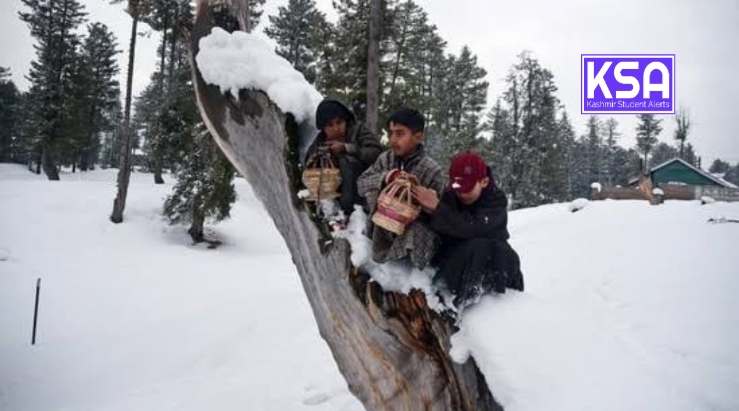
No major snowfall expected in Kashmir till mid-Dec; La Niña to weaken from January: Director MeT

Srinagar, Dec 02: Director Meteorological Centre Srinagar, Dr. Mukhtar Ahmad on Tuesday said that Kashmir valley is unlikely to witness any major snowfall until December 15.

Speaking to news agency Kashmir Indepth News Service, Mukhtar Ahmad said the overall weather pattern for early December remains largely dry.

“There is no major snowfall till December 15. Except for a few weak disturbances, we do not expect any significant snowfall activity,” he said.

The MeT Director also shared insights on the ongoing La Niña phase, which continues to influence global and regional weather patterns.

“La Niña is still in its active phase, but from January it will weaken. We expect it to go into a weaker phase as the winter progresses,” he noted.

Despite the absence of major snowfall, the Valley is reeling under intense cold conditions as night temperatures have dropped well below the freezing point across many areas.

Srinagar recorded a low of –2.5°C, slipping further from –1.9°C the previous night.Shopian remained the coldest location in the Valley at –5°C.

Qazigund, the gateway town to Kashmir, registered –2.4°C, while Kupwara in north Kashmir recorded — 3.1°C. Kokernag in south Kashmir reported a minimum of –0.6°C.

Tourist destinations such as Pahalgam and Gulmarg recorded –2.2°C and 0°C, respectively.

As the Valley moves deeper into winter, residents are preparing for harsher conditions in the coming weeks. MeT officials have advised the public to stay updated with regular forecasts.

“We are monitoring all systems closely. Any significant change in the weather pattern will be communicated promptly,” Dr. Mukhtar added.–(KINS)

SSC GD Constable Recruitment 2026: Apply Online for 25,487 Vacancies in BSF, CISF, CRPF & Other Forces

0

SSC GD 2026 Notification: A Golden Opportunity for 25,487 Constable, Rifleman & Sepoy Posts

The SSC has officially released the notification for “GD Constable / Rifleman / Sepoy 2026” recruitment — opening doors for a massive intake of candidates across India.

A total of 25,487 vacancies have been announced under this drive, making it one of the biggest recruitment campaigns for paramilitary / allied forces this year.

These posts include:

  • General-Duty (GD) Constable (for male/female)
  • Rifleman (GD) (for certain forces)
  • Sepoy (GD) (for certain forces)

The recruitment is for multiple central forces / agencies, including Border Security Force (BSF), Central Industrial Security Force (CISF), Central Reserve Police Force (CRPF), Indo-Tibetan Border Police (ITBP), Sashastra Seema Bal (SSB), Assam Rifles (AR — for Rifleman/GD), Secretariat Security Force (SSF), and in some cases other authorised organizations — depending on vacancy allocation.

For many young aspirants, especially class 10 pass candidates, this represents an attractive and reachable opportunity to join central armed forces or paramilitary — a stable, respected government job with a clear career pathway.


Why This Recruitment Matters — The Big Picture

• Huge Number of Vacancies

With more than 25 thousand posts (25,487), the 2026 drive is among the largest in recent years under SSC GD. For candidates across India — rural or urban, from small towns to metros — the volume itself expands chances of selection.

• Low Educational Barrier: 10th Pass Eligible

The minimum educational qualification is matriculation (Class 10) or equivalent from a recognised board — making this accessible to a wide segment of youth.

Young aspirants who may have discontinued formal education or enrolled only up to 10th standard now have a credible pathway to a government career.

• Promises of Government Job Stability, Respect & Career Growth

Constable / Rifleman / Sepoy positions in forces like BSF, CISF, CRPF, ITBP etc. come with job security, allowances, pension/retirement benefits (as per service norms), and structured career progression over time — offering more than just an initial salary.

For many, this may be the first step in a long-term career in India’s security or paramilitary services.

• National-level Opportunity — For All States & Regions

Because vacancies cover multiple forces across India, candidates from every state (including from Kerala, like you) can apply — provided they meet the eligibility criteria.

This nationwide nature democratizes access, allowing youth from less represented or remote regions equal opportunity.


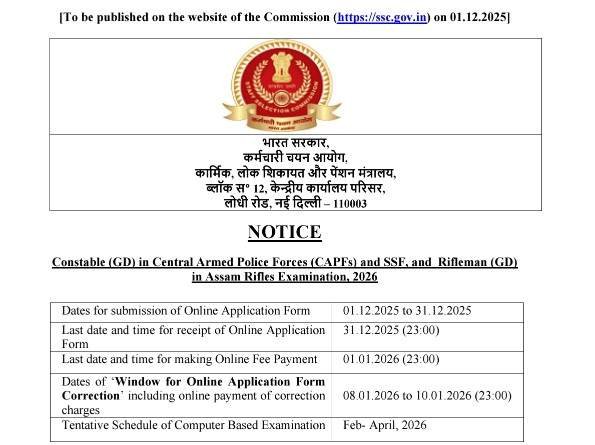
SSC GD 2026: Important Dates & Application Window

Below are the key timelines for the recruitment cycle (as per the 2026 notification).

Event Date / Period
Notification release & application start date 1 December 2025
Last date to submit online application 31 December 2025 (up to 11:00 PM)
Last date to pay application fee (if applicable) 1 January 2026
Correction window (if any mistakes in form) 8 – 10 January 2026
Tentative examination period (Computer-based) February – April 2026

Important Note: Applicants must not wait until the last moment to apply to avoid server overload or technical glitches. Fill the form early after verifying eligibility.


Who Is Eligible? — Eligibility Criteria

Educational Qualification

  • Must have passed Class 10 (Matriculation) or equivalent from a recognised board/university by the specified cut-off date.
  • Those still appearing in Class 10 exams (i.e. results not declared) are not eligible.

Age Limit

  • General Age: 18 to 23 years as on 1 January 2026.
  • Age relaxations are applicable for reserved categories per government norms (e.g. SC/ST, OBC, Ex-Servicemen, etc.).

Citizenship / Nationality

  • Must be a citizen of India (or meet specific domicile / residence criteria for certain posts, if mentioned).

Physical & Medical Standards

Given the nature of the job — in paramilitary / security forces — there are mandatory physical standards and fitness tests (PST, PET), followed by medical examination.

Details:

  • Height (minimum): Male – generally 170 cm; Female – generally 157 cm.
  • Chest (for males): Unexpanded 80 cm with at least 5 cm expansion (varies slightly for certain categories/regions).
  • Weight: Should be proportionate to height, age, and medical fitness (not fixed, depends on body proportion) as per PST guidelines.

Candidates must also meet basic medical standards — including vision, hearing, dental fitness. For example: eyesight standards (distant vision 6/6 in one eye and 6/9 in the other without glasses; no color blindness, night blindness or squint), hearing (able to hear whisper from 6 meters), dental health (minimum number of healthy teeth), no serious medical issues, etc.

Failing to meet physical or medical standards may lead to disqualification — even if the candidate clears the written exam.


Which Forces / Agencies & How Many Vacancies

The 25,487 vacancies are distributed among various central forces / agencies and include both male and female posts.

While the final force-wise vacancy break-up may vary (based on allocation by the Ministry/HQ), typical participating forces include:

  • BSF
  • CISF
  • CRPF
  • ITBP
  • SSB
  • AR (Assam Rifles — for Rifleman GD)
  • SSF (Secretariat Security Force)
  • Other authorised organisations/agencies as per notification (depending on state or role)

The vacancies include both male and female posts — enabling women to apply too.

Given the large number of vacancies, chances are high that many aspirants may secure a place — if they meet eligibility and prepare well.


Selection Process — What to Expect

The recruitment is not just about a written exam: selection involves multiple stages to ensure candidates meet educational, cognitive, physical, and medical standards.

Here’s the detailed flow:

1. Computer-Based Examination (CBE / CBT)

  • The first stage is an online computer-based written test.
  • The exam has 80 objective-type questions, total marks 160.
  • Exam duration is 1 hour (60 minutes) — requiring quick thinking and speed.
  • Negative marking applies: for each wrong answer, 0.25 marks will be deducted.
  • Subjects/Sections typically include:
    • General Intelligence & Reasoning
    • General Knowledge & General Awareness
    • Elementary Mathematics
    • English / Hindi (language)
  • Languages: Exam is usually held in English and Hindi — and in some cases regional languages (depending on centre).

Candidates clearing/qualifying in this CBT (i.e. clearing cut-offs) become eligible for the next stages.

2. Physical Standard Test (PST) & Physical Efficiency Test (PET)

After CBT, candidates are shortlisted for physical evaluation. This comprises two key parts:

  • Physical Standard Test (PST): Involves measurement of height, chest (for male), weight — ensuring candidates meet minimum physical standards as per their category/region.
  • Physical Efficiency Test (PET): A race / endurance test — for example: male candidates may need to run 5 km within 24 minutes (in general areas) to qualify. Women candidates have separate standards.

The PET / PST stage is qualifying in nature (i.e. you must only meet minimum standards) for short-listing; performance marks in PET/PST don’t contribute further to final merit list.

3. Medical Examination & Document Verification

Candidates who qualify PET/PST will undergo a Detailed Medical Examination (DME) — involving tests for vision (distant and near), hearing, dental health, general medical fitness (no serious ailments, no colour blindness/night blindness/squint for vision, good hearing, dental health, etc.).

Along with medical exam, original documents verification will be done (educational proofs, identity, domicile, category certificates if any, etc.).

Only after clearing medical fitness and verification will the candidate’s selection be confirmed and final merit list prepared (as per performance in CBT + qualifying physical & medical standards).


What is the Exam Pattern & Syllabus for CBT?

Given the competition and objective-type format, candidates must be thoroughly prepared. Below is a breakdown of the exam pattern and syllabus for 2026 (as per official release).

Exam Pattern (CBT)

  • Mode: Online Computer-Based Test (CBT) / Computer-Based Examination (CBE)
  • Number of Questions: 80 objective-type questions
  • Total Marks: 160
  • Duration: 1 hour (60 minutes)
  • Negative Marking: 0.25 marks for each incorrect/wrong answer

Syllabus / Sections

  • General Intelligence & Reasoning: Logical reasoning, analogies, series, coding-decoding, puzzles, etc.
  • General Knowledge & General Awareness: Current affairs (national & international), history, geography, polity, economics, general science, sports, awards, general events, etc.
  • Elementary Mathematics: Number system, percentages, averages, ratio-proportion, profit & loss, simple interest, time & work, time & distance, mensuration, basic algebra — as per standard school-level syllabus.
  • English / Hindi (Language): Grammar, comprehension, vocabulary, synonyms/antonyms, sentence formation, para jumbles, fill-in-the-blanks, basic writing/comprehension skills (short).

Important to note: Given the modest duration (1 hour) and negative marking, accuracy + speed + good time management will be critical for aspirants.


Application Process — Step-by-Step Guide

Here’s how interested candidates must proceed to apply for SSC GD 2026:

  1. Visit the official SSC website (usually https://ssc.gov.in) — look for the “Apply” / “Registration / Login” section under SSC GD Recruitment 2026.
  2. If you’re a new user — complete the One-Time Registration (OTR) by filling basic personal details: name, father’s name, gender, mobile, email, ID proof, etc.
  3. After registration, log in with your credentials, and fill out the application form: educational details, date of birth, caste/category, optional preferences (if any), choice of exam centre etc.
  4. Upload required documents — scanned photograph, signature, caste/category certificate (if applicable), educational certificate (10th pass certificate or marksheet), identity proof, etc.
  5. Pay the application fee (if applicable). Historically, general-category male candidates pay a nominal fee; certain categories (women, SC, ST, Ex-servicemen) are usually exempt.
  6. Take a printout of the completed application form and fee receipt for future reference.

Key Reminders

  • The last date to apply is 31 December 2025 (11:00 PM) — ensure you submit well before deadline.
  • Fee payment window typically extends slightly beyond application deadline (till 1 January 2026) — don’t delay fee payment.
  • Ensure that all information is accurate and documents are correct — mistakes or false information can lead to rejection at any stage (even later during physical or medical stage).
  • If selected, be prepared for physical/adaptation requirements, because capacities to work in rugged, remote or challenging terrains may be required (given the nature of some forces).

What Candidates Should Do NOW — Strategy & Preparation Plan

Given the volume of applicants expected, good preparation and timely action can make all the difference. Here’s a recommended plan for aspirants who intend to apply for SSC GD 2026.

1. Download & Read the Official Notification PDF

As soon as the notification is live on SSC’s website, download the PDF and read carefully: check eligibility criteria (age, education, domicile requirements), details of available posts/forces, physical/medical standards, special instructions (e.g. for NCC, handicapped, ex-servicemen), exam centre details, allowed languages, exam languages, etc. This ensures no last-minute surprises.

2. Gather Necessary Documents Early

Have ready the scanned copies of: matriculation (10th class) certificate/marksheet, identity proof (Aadhaar, passport, voter ID, etc.), caste certificate (if applicable), domicile certificate (if required), passport-size photograph & signature (as per specified dimensions), etc.

Delays in obtaining or scanning documents often cause mistakes that lead to rejections or hassles — better to prepare early.

3. Apply Online Early — Don’t Wait for Last Date

Given the likely surge in traffic near the deadline, applying early reduces risk of server overload, payment failures, or last-minute glitches. It also gives you buffer time to fix any errors before submission.

4. Build a Reliable Study Plan for CBT

Since the CBT is the first hurdle, and comprises objective-type MCQs with negative marking and short duration, you need to combine speed + accuracy. Here are quick pointers to prepare efficiently:

  • Break down syllabus: Reasoning, GK/GA, Maths, Language — assign weekly targets.
  • Use practice tests / mock papers — simulate actual exam conditions (80 questions, 60 minutes, negative marking) to improve speed & time management.
  • Revise basics: since the syllabus is mainly school-level maths and general awareness, brushing up on fundamentals can yield good returns.
  • Stay updated on current affairs — for GK/GA section.

5. Physical Fitness & Health Preparations — Early Start Helps

Given that PET/PST and medical examination are critical (even post-CBT), start building physical fitness: running, general stamina, endurance. Maintain healthy body proportions (height/weight), good vision & hearing, good dental and general health.

For candidates from Kerala (or any state), this is especially important because physical standards are non-negotiable.

6. Prepare for Documentation & Verification

Keep all original documents ready and well-organized for when shortlisted (after CBT). Also keep copies/backups. Ensure your identity proof address matches with domicile/residential proofs if applicable.


What This Recruitment Means for Aspirants from Kerala / South India

For candidates from Kerala (or other southern states), this recruitment drive presents a strong chance for central force employment even if they are far from their home state. Because SSC GD is a national-level recruitment — exam centres may be allotted nearer to home (depending on availability) — there’s equal footing.

Moreover, given that the educational requirement is only matriculation — a large number of young aspirants from smaller towns/villages (where higher education may not be feasible) get a real shot at central employment.

Also, the prospect of long-term career growth, stable income, allowances, and opportunity to serve in paramilitary or security forces may be appealing to many who wish to do more than just “office-type” jobs.

However, aspirants should be aware of the physical and medical requirements, and be genuinely prepared for a disciplined, demanding career — often requiring physical stamina, mental strength, and readiness to serve in challenging conditions (border areas, remote locations, high altitude, etc.).


Common FAQs: Clarifying Key Doubts

Q: Is matriculation (10th pass) enough to apply for SSC GD 2026?
A: Yes. The minimum required qualification is Class 10 or equivalent from a recognised board. Those who have passed the exam by the specified date (i.e. before or on cut-off) are eligible.

Q: What is the age limit?
A: 18 to 23 years as on 1 January 2026 for general candidates. Age relaxation is provided for reserved categories as per government norms.

Q: Can women apply for SSC GD 2026?
A: Yes. The recruitment includes female posts along with male. Both male and female candidates can apply if they meet eligibility criteria (education, age, physical standards as applicable).

Q: What is the exam pattern and syllabus for CBT?
A: The CBT (Computer-based written exam) will have 80 objective-type questions, total 160 marks, duration 1 hour, with negative marking (0.25 mark per wrong answer). Sections include Reasoning, General Knowledge & Awareness, Elementary Mathematics, and English/Hindi (language).

Q: What is the selection process?
A: Multi-stage:

  1. Computer-Based Exam (CBT)
  2. Physical Standard Test (PST) and Physical Efficiency Test (PET)
  3. Detailed Medical Examination (DME) + Document Verification
    Final selection depends on clearing all stages.

Q: When is the last date to apply?
A: 31 December 2025 (by 11:00 PM) is the last date to submit the online application. Fee payment window extends upto 1 January 2026.


What Next? — Action Plan for Aspiring Candidates

If you — or if you know someone — are eligible and planning to apply for SSC GD 2026, here’s a straightforward action checklist:

  1. Visit SSC website → download official notification PDF → read carefully.
  2. Gather all necessary documents (10th mark sheet/certificate, identity proof, photo, signature, caste/domicile certificate if applicable).
  3. Fill application form online well in advance — don’t wait for the last day.
  4. Pay application fee (if applicable) before deadline.
  5. Start revision & preparation for CBT: Focus on reasoning, general knowledge, maths fundamentals, language — emphasise speed + accuracy.
  6. Begin physical fitness regimen to meet PET/PST standards (especially if applying for paramilitary forces).
  7. Keep track of admit cards / notifications via SSC portal or email/SMS — sometimes admit cards are released only a few days before exam/physical test.
  8. Prepare originals and copies of documents for verification / medical test if shortlisted.
  9. Stay updated with official SSC announcements regarding exam date, admit cards, etc. Bookmark SSC’s website or set alerts.
  10. Have backup plans — often many apply; stay realistic but optimistic; simultaneously keep alternative career paths in view.

Final Thoughts

The SSC GD 2026 recruitment drive is a major opportunity for young, motivated and eligible aspirants — especially those with only matriculation or from modest backgrounds — to secure a stable career in India’s paramilitary / central security forces.

With 25,487 vacancies, the probability of selection is higher than smaller drives; but that also means competition will be intense. Success will depend not just on eligibility, but on timely application, smart preparation, physical fitness, and thorough compliance with standards at every stage — written, physical, and medical.

For aspirants from Kerala (or any other state), this is a golden window — but one that requires preparation, discipline, and commitment.

Detailed Notifications Here

JKBOPEE Admission Open: DNB (Broad Speciality) & Post-MBBS Diploma Courses – 2025

0

JKBOPEE Admission Open: DNB (Broad Speciality) & Post-MBBS Diploma Courses – 2025

The J&K BOPEE has issued a new notification inviting offline applications from eligible and willing NEET PG-2025 qualified in-service candidates / doctors of the Union Territories of Jammu & Kashmir and Ladakh for admission to Post-MBBS DNB (Broad Specialty) Seats and Post-MBBS Diploma Seats (Broad Speciality) for the academic year 2025.

📌 Who can apply?

To be eligible for admission under this notification, candidates must meet the following criteria:

  • Candidates should be in permanent service and serving in the Health & Medical Department of the UT of Jammu & Kashmir or Ladakh.
  • Must have qualified NEET PG-2025 conducted by the National Board of Examinations (NBE), and their names should appear in the merit list.
  • Should hold a valid NOC (No Objection Certificate) from the Administrative Department of Health & Medical Education, J&K / Ladakh, permitting appearance for NEET-PG 2025.
  • Must be a domicile of the UT of Jammu & Kashmir or Ladakh.

📝 Application Process & Required Documents

Eligible candidates are advised to submit their application forms physically, along with the following supporting documents:

  • Domicile Certificate of UT of J&K / Ladakh (for Ladakh UT candidates, ST certificate will be considered as domicile certificate).
  • Valid Reserved Category Certificate (wherever applicable), in compliance with prevailing governmental orders.
  • Any applicable Difficult Area Certificate (if required) as per regulations.
  • NOC / Permission from the competent/government authority for appearing/applying/counselling (for the year 2025).
  • NEET PG-2025 Score Card.

Candidates must submit their applications within the time window announced by BOPEE (check the PDF notification for exact dates).

⚠️ Note: Submission of application forms does not guarantee admission. Selection is subject to verification of credentials and eligibility.


✅ What you should know

  • After submission, the provisional merit list will be prepared and published by the Board. Final admission will be granted only after thorough verification of eligibility and documents.
  • Candidates from Ladakh who are selected may have to serve in Ladakh for a prescribed period — as per the undertaking mentioned in the notification.
  • No separate notification will be issued for seat matrix / counselling schedule. All updates will be made available on the official website of JK BOPEE.

🔗 Download Official Notification

Click here to view and download the PDF of the notification (Notification No. 187-BOPEE of 2025)

CM Approves JKAS Age Relaxation; Proposal Sent to LG for Final Nod, Aspirants Still Await Formal Order

0

JKAS Aspirants Left Guessing as Govt Yet to Issue Formal Age Relaxation Order

CM Has Approved Proposal, Sent to Raj Bhawan for LG’s Nod: NC Chief Spokesperson

Srinagar, Dec 02: Amid growing anxiety among JKAS aspirants, rulling National Conference Chief Spokesperson and MLA Tanvir Sadiq on Tuesday said that the Chief Minister has approved the much-awaited age relaxation proposal.

In a post on X, Tanvir Sadiq as per news agency JKNS wrote that the “@CM_JnK’s Secretariat has confirmed to me that Chief Minister @OmarAbdullah Sb has approved and forwarded the age relaxation.”

He added that the proposal has now been sent to the Raj Bhawan for its consent.

Meanwhile, aspirants said they are still awaiting a formal written order from the government, despite months of verbal assurances from top officials, including the Chief Minister and senior bureaucrats.

Aspirants said the matter has remained unresolved since June, when the process for the 2025 recruitment cycle began. They said they met officials multiple times in Srinagar and Jammu and were repeatedly assured that the age criteria would be relaxed for the upcoming JKAS examination.

“In June, officials in Srinagar told us the relaxation would be granted. Later in Jammu, senior officers again assured us it would be done soon,” an aspirant said.
He added that the last assurance came on November 4, when a senior government functionary told them the proposal would be placed before the cabinet within two days.

The aspirants said they also met Chief Minister Omar Abdullah recently, who told them that if his advisor had already committed to the relaxation, he would not deny it. “The CM advised us to stay focused on our studies and assured us the issue would be resolved.”

Aspirants also claimed that the Jammu and Kashmir Public Service Commission (JKPSC) delayed issuing admit cards for nearly two days after receiving verbal inputs that a decision might be announced. But with no directive from the government, the Commission finally released the admit cards on Monday evening. The JKAS preliminary examination is scheduled for December 7.

Currently, the upper age limit is 32 years for open category candidates and 37 for reserved categories. Aspirants are demanding that the limit be increased to 37 for open category and 40 for reserved categories, as allowed in previous relaxations. (JKNS)

University of Kashmir Invites Applications for Various Administrative & Non-Teaching Posts — December 2025 Recruitment Drive

University of Kashmir Invites Applications for Various Administrative & Non-Teaching Posts — December 2025 Recruitment Drive

The University of Kashmir (KU) has launched a large-scale recruitment drive, releasing a series of detailed advertisement notices on 2 December 2025. Through these notices, KU invites suitably qualified and motivated candidates to apply for several key non-teaching, administrative, and support posts across departments and campuses. These openings present an excellent opportunity for professionals from diverse backgrounds to join one of J&K’s premier higher-education institutions.

All vacancies have been notified under the “Jobs/Recruitment” section of KU’s official website.

Below is a summary of the various posts, along with guidance on application process, eligibility, and key highlights.


What’s New: Posts on Offer

On 2 December 2025, KU issued the following advertisement notices:

  • Advt. Notice No. 12 of 2025 — Post of Pharmacist
  • Advt. Notice No. 11 of 2025 — Posts of Museum Artist, Junior Museum Assistant, Landscape Development Officer, and Curator
  • Advt. Notice No. 10 of 2025 — Posts at Director-level for Physical Education & Sports, Institute of Technology (IOT), South Campus, Directorate of Internal Quality Assurance (DIQA), and Convocation Complex.
  • Advt. Notice No. 09 of 2025 — Posts of Controller of Examinations and Additional Controller of Examinations.

These positions cover a wide array of roles — from technical (pharmacy), creative/heritage (museum & landscape), managerial and administrative leadership, to examination oversight — reflecting the University’s intent to strengthen multiple institutional functions through this recruitment cycle.


Why This Recruitment Matters

  • Comprehensive Renewal & Expansion: By recruiting across such varied roles — technical, creative, administrative, and managerial — KU appears to be undertaking a holistic expansion and strengthening of its workforce capacity.
  • Opportunities Across Experience Levels: From support and technical staff to high-level administrative directors, the recruitment drive spans a broad spectrum of seniority, offering opportunities for both early-career and experienced professionals.
  • Diversified Roles Reflect Institutional Priorities: The inclusion of posts like Museum Artist and Landscape Development Officer hints at KU’s interest in heritage preservation, campus beautification and creating a vibrant campus environment. Administrative vacancies at director and controller levels suggest a push for stronger institutional governance and quality assurance.

What Interested Candidates Should Know: Application Process & Eligibility (General Guidance)

Based on past recruitment cycles and KU’s published process:

  • All applications must be submitted via KU’s official website under the “Jobs/Recruitment” section.
  • Applicants are typically required to register first (creating a username/password), using a valid email address and mobile number.
  • Educational qualifications and eligibility criteria vary by post. Applicants should carefully read the relevant advertisement notice. As with many KU recruitments, regular mode degrees from recognized institutions have been a common requirement.
  • Application fees — where applicable — and other instructions are specified in the detailed notification PDFs.

Because each post differs significantly in terms of role and eligibility (e.g., technical vs administrative), it is essential for candidates to go through the relevant PDF notice carefully before applying.


Tips / Best Practices for Applicants

When preparing your application and documents for KU recruitment, consider the following — these follow standard principles of effective job advertisements and applications.

  • Read the Notification Carefully: Note down essential details — post name, eligibility, age limits (if any), last date for applying, required documents, application fee and method.
  • Prepare Key Documents in Advance: Have scanned copies of academic certificates, identity proof, experience certificate (if applicable), and other relevant documents ready.
  • Follow the Application Instructions Exactly: Use the online portal, upload required documents, fill in all fields correctly, and pay fee (if applicable) — incomplete or incorrect applications can be rejected.
  • Double Check Before Submission: Review all information, especially contact details (email/mobile), qualification details — once submitted, corrections may not be allowed.
  • Apply Early — Avoid Last-Minute Rush: Given the high volume of applicants expected, applying early helps avoid technical glitches or delays.

What This Recruitment Means for the University

The latest recruitment drive indicates that KU is likely gearing up for:

  • Strengthening infrastructure and campus facilities (through posts like Landscape Development Officer, Museum Artist/Assistant).
  • Enhancing administrative and governance effectiveness (through Director-level appointments, Controllers of Examination).
  • Improving support services (through posts such as Pharmacist) — possibly for campus health services or associated facilities.
  • Overall institutional growth across academic, administrative, cultural, and physical-environment domains.

This broad-based hiring suggests KU is preparing for an expanded role, more activities, and perhaps new initiatives in heritage, campus development, student services, and quality assurance.


How to Stay Updated & Where to Check Notifications

All detailed advertisement notices, application forms, and updates are published on the official KU website under the “Jobs/Recruitment” section.

Given the variety of posts and their differing requirements, applicants are advised to revisit the website frequently, especially if applying for multiple positions.


Summary & Final Thoughts

With the publication of Advertisement Notices No. 09, 10, 11, and 12 of 2025, the University of Kashmir has opened up a wide array of opportunities — from technical support roles to high-level administrative positions — covering various aspects of university functioning. For prospective candidates, this recruitment drive offers a rare chance to join a leading academic institution in multiple capacities.

If you are considering applying, ensure you read the relevant notification carefully, meet the eligibility criteria, and submit your application via the official portal well in time. For KU, this recruitment appears to be a strategic move aimed at strengthening infrastructure, administrative effectiveness, and overall institutional growth.


Quick-links to the Official Advertisement Notices

Advertisement Notice Post(s) / Position(s) PDF Notice
Notice No. 12 of 2025 — Pharmacist Pharmacist Download PDF
Notice No. 11 of 2025 — Museum & Heritage Posts Museum Artist, Junior Museum Assistant, Landscape Development Officer, Curator Download PDF
Notice No. 10 of 2025 — Director-level Posts Director (Physical Education & Sports / IOT / South Campus / DIQA / Convocation Complex) Download PDF
Notice No. 09 of 2025 — Examination Posts Controller of Examinations, Additional Controller of Examinations Download PDF


Govt Constitutes Committee to formulate transfer policy for Regularised ReT teachers

0

Govt Constitutes Committee to formulate transfer policy for Regularised ReT teachers

Committee to submit draft policy within 2 months

Srinagar, Dec 02: The Jammu and Kashmir Government on Tuesday ordered the constitution of a high-level committee to formulate a comprehensive and uniform transfer policy for Regularized Rehbar-e-Taleem Teachers (RReTs) across the Union Territory.

In a Government Order No. 687-(JK) Edu of 2025, issued by Ram Niwas Sharma (IAS), Secretary to the Government, School Education Department as per news agency JKNS, the committee has been tasked with examining all issues related to transfers, postings and adjustments of RReTs and proposing a transparent and student-centric policy.

According to the order, the committee will be headed by the Special Secretary to the Government, School Education Department, and will include, Additional Secretary to the Government, School Education Department (MAB). Joint Director (Central) Kashmir, School Education Department. Joint Director Jammu, School Education Department. Deputy Secretary (U), School Education Department Member Secretary. Under Secretary (T), School Education Department.

The order stated that the terms of Reference (ToR), is Study existing norms governing RReT transfers, it reads.

Propose a uniform, need-based and student-focused transfer policy ensuring transparency, staff rationalization and administrative efficiency. Examine feasibility of periodic transfers, hardship postings and tenure-based placements for RReTs.

The committee has been directed to submit a detailed report along with a draft transfer policy within two months. It may also co-opt additional members if necessary. (JKNS)

Kashmir University Bars Staff From Sharing University Content on Social Media Without Approval

Kashmir University Bars Staff From Sharing University Content on Social Media Without Approval

Srinagar, Dec 2: The General Administration of the University of Kashmir has issued a formal directive restraining employees from posting, sharing, or circulating any University-related content on social media platforms without authorisation.

The order, issued through Circular No. F (Social Media Policy) GA/KU/25 dated December 2, states that the administration has taken serious note of “unprofessional conduct” by certain employees who have been posting University affairs online without approval.

The circular makes it mandatory for all teaching and non-teaching staff to strictly adhere to the Social Media Policy notified by the General Administration Department, Government of Jammu and Kashmir vide Order No. 1646-GAD of 2017.

It further warns that any violation will attract disciplinary action under the relevant service and conduct rules without further notice.

In a separate instruction, officers and faculty members have been directed to consult the Media Advisor at the University’s Public Relations Centre before sharing any information with media outlets.

The order has been issued as a continuation of an earlier circular dated July 29, 2022, indicating that the University is tightening oversight over public communication by its employees.

Copies of the circular have been forwarded to Deans, Heads of Departments, the Controller of Examinations, Hostel Provosts, the Chief Proctor, the Vice-Chancellor’s Secretariat, senior administrators and all sections of the Registry and Examination wing for implementation.

University officials said the circular is meant to regulate public communication and ensure that institutional information is released only through authorised channels. [KNT]

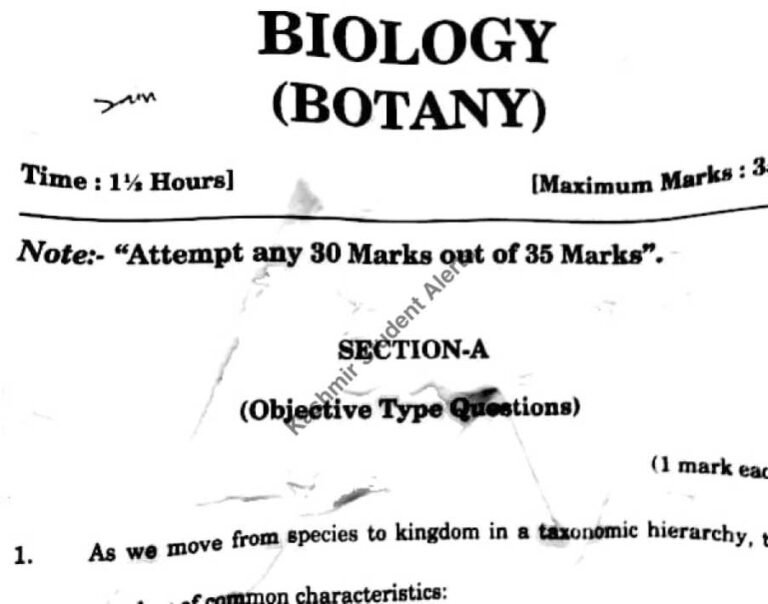
JKBOSE Class 11th Biology Question Paper – Annual Regular 2025 | Download PDF

JKBOSE Today’s Class 11th Biology Question Paper – Annual Regular 2025 | Download PDF

The Jammu and Kashmir Board of School Education (JKBOSE) is currently conducting the Annual Regular Examination 2025 for Class 11th students across the Union Territory of Jammu & Kashmir and Ladakh. Among the most important papers for the science stream is Biology, which holds great significance for students aspiring for careers in medical and life-sciences fields.

On this examination day, students appeared for the Class 11 Biology Paper, which included questions from the entire prescribed syllabus such as Diversity of Living Organisms, Structural Organisation in Plants and Animals, Human Physiology, Plant Physiology, Cell Structure and Function, and Biomolecules.

For the benefit of students, teachers, and future aspirants, we are sharing the JKBOSE Class 11 Biology Question Paper 2025 (Annual Regular) in PDF format. Candidates can download it using the link provided below and use it to analyse question trends and prepare better for further assessments and the upcoming Class 12th examinations.


Exam Overview – JKBOSE Class 11 Biology 2025

Particular Details
Board Jammu & Kashmir Board of School Education (JKBOSE)
Class 11th
Subject Biology
Exam Session Annual Regular 2025
Category Question Paper
Mode Offline, Pen-Paper
Total Marks 70 (Theory)
Time Duration 3 Hours
PDF Availability Yes

The paper was set as per the latest JKBOSE syllabus and blueprint, ensuring balanced coverage from NCERT-based Biology chapters.


Breakdown of JKBOSE Biology Paper Pattern 2025

The Class 11 Biology question paper typically includes:

  • Section A: Objective / MCQs / Very Short (1 mark each)
  • Section B: Short Answer Questions (2–3 marks each)
  • Section C: Long Answer / Descriptive Questions (5 marks each)
  • Diagram-based questions
  • Reasoning and concept-based questions

The overall nature of the paper this year was student-friendly with a fair mix of:

✔️ Conceptual questions
✔️ NCERT examples and diagrams
✔️ Application-based reasoning questions
✔️ Questions from Plant & Human Physiology

Students who focused on core NCERT exercises should find the paper moderate to easy.


Topics Covered in Class 11 Biology Paper 2025

The question paper included concepts from the following major units:

1️⃣ Diversity in the Living World

  • Kingdom classification
  • Taxonomic hierarchy
  • Biological nomenclature
  • Viruses and viroids

2️⃣ Cell Structure and Functions

  • Prokaryotic and Eukaryotic cells
  • Cell cycle and division
  • Organelles: nucleus, mitochondria, ribosomes, etc.

3️⃣ Structural Organisation in Animals & Plants

  • Animal tissue types
  • Morphology of flowering plants
  • Anatomy of dicot and monocot stems

4️⃣ Plant Physiology

  • Photosynthesis
  • Respiration in plants
  • Growth and development
  • Mineral nutrition

5️⃣ Human Physiology

  • Digestion and absorption
  • Breathing and respiration
  • Body fluids and circulation
  • Locomotion and movement
  • Biomolecules

Difficulty Level Analysis – Student Review

Based on feedback gathered from appearing candidates:

Section Difficulty Level
MCQs Easy to Moderate
Short Answers Moderate; needed conceptual clarity
Long Answers Moderate; diagram support needed
Overall Difficulty Moderate
  • Students found Plant Physiology slightly challenging.
  • Human Physiology questions were mostly easy and directly from NCERT text.
  • Diagram-based questions included neuron structure and monocot root anatomy.

Why Download the Biology Question Paper PDF?

This PDF is highly beneficial for:

✔️ Board exam practice
✔️ Identifying most-asked topics
✔️ Time management during writing
✔️ Understanding JKBOSE question framing
✔️ Preparation of mock tests and assignments

Future students can use it as a model question paper to evaluate their preparation level.


Expected Answer Writing Strategy for High Marks

To score full marks in JKBOSE Biology:

  • Write neat, labelled diagrams
  • Give definitions + examples + diagrams wherever applicable
  • Stick to NCERT terminology
  • Highlight key terms using underlining
  • Structure answers in bullet points

Students should practice previous year papers along with this one to improve consistency.


Tips for Class 11 Biology Students (Remaining Papers & Final Exams)

📌 Follow NCERT thoroughly
📌 Prepare short notes for each chapter
📌 Practice diagrams regularly
📌 Revise after every 2–3 chapters
📌 Solve past papers for speed and accuracy

Biology is scoring when the writing style is clear, concise, and diagram-rich.


Upcoming JKBOSE Class 11 Exam Schedule 2025

Students are advised to keep checking updates from:

  • Schools
  • JKBOSE Official Website
  • Local educational news portals

We will continue uploading the latest papers for all subjects including Chemistry, Physics, English, and Additional subjects.

The JKBOSE Class 11 Biology Question Paper 2025 was well-balanced with a clear focus on NCERT-based concepts. Students with good conceptual understanding found it manageable and achievable. The availability of the question paper PDF is a great resource for those preparing for upcoming exams or future batches planning ahead.

We encourage students to download the paper and begin detailed analysis chapter-wise. Consistent revision and practice will ensure strong performance in Class 12 and upcoming medical entrance exams like NEET.


📌 Stay Updated!

We will keep uploading:

✔️ All JKBOSE Class 11 Question Papers
✔️ Answer Solutions (Coming Soon)
✔️ Model Papers & Notes
✔️ Result updates & study resources

Bookmark our site and enable notifications to never miss an important update.

📥 Download JKBOSE Class 11 Biology Question Paper 2025 – PDF

Students can download the official scanned copy from the link below:

🔗 PDF Download Link:
Click here

IGNOU Opens January 2026 Re-Registration for ODL & Online Programmes

0

IGNOU Opens January 2026 Re-Registration for ODL & Online Programmes

The Indira Gandhi National Open University (IGNOU) has officially opened its re-registration portal for the January 2026 session, inviting all continuing students of its Open and Distance Learning (ODL) and online programmes to renew their enrolment for the upcoming semester or academic year.

Whether you are pursuing an undergraduate degree, a postgraduate course, or a diploma via IGNOU’s online or distance-education mode — this re-registration is mandatory to continue your studies seamlessly. Here’s everything you need to know.


Who Needs to Re-Register

  • The re-registration call is only for existing IGNOU students — those already enrolled in ODL or online courses.
  • Fresh applicants or those seeking admission for the first time should use the “Fresh Admission” process instead of re-registration.
  • The re-registration applies across a broad array of programmes — from undergraduate to postgraduate, including courses such as BA, BCA, BCom, BBA, BSc, MA, MBA, MSc, MCA, MCom and more, depending on availability.

In short: if you are continuing with your existing IGNOU course via ODL/online mode, you must re-register.


Important Dates — What to Know

  • The re-registration window opened on 1 December 2025.
  • The last date to complete re-registration is 15 January 2026.
  • Students are strongly advised not to wait until the eleventh hour — early application helps avoid portal congestion, payment delays or other technical issues.

Why Re-Registration Is Crucial

Completing re-registration ensures that:

  • You remain formally enrolled in your course and are eligible to receive study materials, assignments, notifications, and updates.
  • You are allowed to sit for term-end examinations and continue to the next semester or academic year without disruption.
  • You avoid potential delays or complications that may arise from lapsed registration — which can affect access to resources, exam eligibility, or continuation of the programme.

In effect, re-registration acts as a “permission slip” to carry forward your academic journey at IGNOU.


Step-by-Step Guide to Re-Register — How to Do It Online

IGNOU’s re-registration process is fully online via its dedicated portal. Here’s how to complete it:

  1. Visit the Official Portal
    Go to IGNOU’s website at ignou.ac.in. Under the “Register Online” menu, locate and click on the “Re-Registration” link.
  2. Log In or Register (if new to portal)
    • If you have already used the re-registration portal earlier, log in with your existing username and password.
    • If you are logging in for the first time, click “New Registration,” fill in your details (mobile number, email etc.), and complete the registration. You will receive credentials via SMS or email.
  3. Select Programme / Courses
    Once logged in, pick the courses or electives you wish to continue in the next semester/year. It’s important to refer to your Programme Guide carefully—selecting incorrect courses could lead to delays or academic complications.
  4. Acknowledge Declaration
    Review all the details, read the declaration carefully, then tick the declaration checkbox before proceeding.
  5. Pay the Re-Registration Fee
    • Complete the fee payment online using accepted modes: debit/credit card, net banking or UPI (including apps such as BHIM).
    • For international students under IGNOU’s International Division, payment options may vary depending on region.
  6. Submit and Save Confirmation
    After payment, submit the form. Download and save a copy of the confirmation receipt — this serves as proof of re-registration and may be needed for future reference.
  7. Troubleshooting / Support
    If you face issues — e.g., OTP not received, forgotten password/username — IGNOU advises contacting your Regional Centre for assistance with account reset or updating mobile/email.

Fee Structure & Payment: What to Keep in Mind

  • IGNOU’s re-registration fee is nominal — sources suggest that the fee is modest (often around ₹200 for many programmes) but this may vary by course.
  • Payment must be completed online. IGNOU strictly cautions users not to share sensitive payment details like OTPs or card information.
  • If a payment doesn’t reflect immediately, students are advised to wait for some time rather than retry and risk duplicate payment. In case of duplicate payment, IGNOU indicates that extra payment may be refunded.

Common Mistakes to Avoid — Tips for Smooth Re-Registration

  • Selecting wrong courses or electives — always refer to your Programme Guide for the list of valid courses and combinations. Mistakes may delay your academic progression.
  • Procrastinating till the last minute — heavy traffic near the deadline may cause portal slow-downs or payment gateway failures. Submit early.
  • Using shared computers, cyber-cafés or agents — if someone else fills the form or makes payment on your behalf, ensure every detail (course selection, payment status) is correct, and keep all receipts.
  • Ignoring receipt download — always save or print the confirmation page and payment receipt. These may be required later for verification or in case of disputes.

What IGNOU Students Should Do — A Checklist

✔️ Task ✅ Action Item
1. Check your eligibility Confirm that you are an existing IGNOU ODL/online student who needs re-registration.
2. Log in to portal Visit ignou.ac.in → Register Online → Re-Registration (or onlinerr.ignou.ac.in).
3. Review your programme guide Ensure correct course/subject selection for continuing your programme.
4. Update contact details (if needed) Make sure your mobile number and email are current before submission.
5. Pay re-registration fee Use secure payment mode: debit/credit card, net banking or UPI.
6. Submit & download receipt Save PDF or take screenshot of confirmation page for your records.
7. Check for confirmation Wait for official confirmation via email/SMS from IGNOU.
8. Contact support if needed For login/payment issues, reach out to your IGNOU Regional Centre.

What Happens If You Don’t Re-Register On Time?

Failing to re-register by the deadline could lead to:

  • Suspension of access to study materials, assignments and other resources.
  • Ineligibility for term-end examinations.
  • Delay or interruption in continuation of the course — you may have to re-apply or face a gap in your academic session.
  • Possible complications if you want to resume studies later — re-admission or fresh admission may become necessary.

Therefore, timely re-registration is not just a formality; it’s essential for uninterrupted academic progress at IGNOU.


Important Notes & Recommendations for Students

  • Read official instructions carefully: Always refer to official circulars or notifications on the IGNOU portal before selecting courses or paying fees.
  • Use your own devices and payment methods: Avoid using public or shared devices or agents — this helps prevent errors or misuse of sensitive data.
  • Keep proof of registration: A confirmation receipt can be vital for future reference or in case of disputes.
  • Ensure contact details are up to date: All official communication — exam updates, study material dispatch, notices — are often sent via email or SMS. Wrong contact info might mean missed updates.
  • Seek help early if needed: For login issues, payment trouble or doubts about course selection — reach out to your IGNOU Regional Centre sooner rather than later.

The Bigger Picture: What Re-Registration Means for IGNOU Students

With the re-registration window open, IGNOU is once again enabling its thousands of students across India — and internationally — to continue their educational journey uninterrupted. For many working professionals, distance-learners, and people balancing work or personal commitments, IGNOU remains a vital avenue to obtain degrees and credentials through flexible and accessible education.

Re-registration is a small administrative act, but its timely completion ensures that students don’t lose time, access to resources, or crucial opportunities like examinations or study material dispatch.

For students in remote areas, rural regions, or with demanding schedules, staying alert to re-registration announcements and deadlines is especially important. IGNOU’s decision to keep the process fully digital helps — but that only works if you take action on time.


Final Thoughts

If you are an IGNOU student enrolled in ODL or online courses, do not delay — re-register as soon as possible. The re-registration window for January 2026 is open now, and the deadline is near: 15 January 2026.

Completing re-registration on time ensures:

  • uninterrupted continuation of your course;
  • access to study materials, assignments and exams;
  • proper credit progression to next semester/year; and
  • peace of mind without administrative hiccups.

So, log in to the【 official IGNOU portal (ignou.ac.in) → Register Online → Re-Registration】today, select your courses carefully, pay the fee securely, submit the form — and save your confirmation.

Your IGNOU journey depends on it — don’t leave it to chance.

JKBOSE Class 11th Political Science Question Paper 2025 – Annual Regular | Download PDF

JKBOSE Class 11th Political Science Question Paper 2025 – Annual Regular | Download PDF

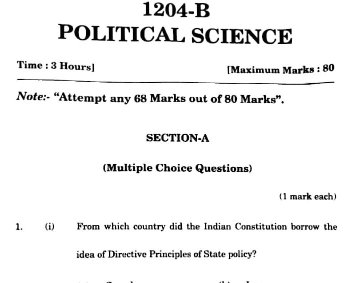
The Jammu and Kashmir Board of School Education (JKBOSE) has successfully conducted the Class 11th Annual Regular 2025 Political Science Examination in the Union Territory of Jammu & Kashmir. Students who appeared in the examination from Hard/GSH zones or Soft zones and those preparing for the upcoming exam sessions can now access today’s Class 11th Political Science Question Paper on this page.

We have provided the complete question paper pattern, sections, and a direct PDF download link so that JKBOSE students can practice effectively and understand the latest question style followed by the Board.


📥 Download JKBOSE 11th Political Science Question Paper 2025 (PDF)

Click the link below to download the complete question paper in PDF format

The uploaded paper includes all sections such as MCQs, Very Short, Short, and Long Answer Questions.


📝 Examination Overview

  • Subject: Political Science
  • Class: 11th
  • Board: JKBOSE
  • Session: Annual Regular 2025
  • Total Marks: 80
  • Time Allowed: 3 Hours
  • Attempt Rule: Attempt any 68 marks out of 80 marks according to paper instructions.

The question paper booklet number printed is 1204-B, applicable for JK UT centers.


📌 JKBOSE Class 11th Political Science Paper Pattern 2025

The question paper is divided into five sections:

Section Type of Questions Marks per Q No. of Qs Total Marks
A MCQs 1 10 10
B Very Short Answers 2 10 20
C Short Answers 4 7 28
D Passage-based Questions 2 3 6
E Long Answers 6 2 out of 3 12

➡️ Total Paper Marks: 80


📍 Section-Wise Breakdown of Today’s Questions

✔️ SECTION-A: Multiple Choice Questions

(10 Questions × 1 Mark)

Some MCQs from the paper were:

  • “From which country did the Indian Constitution borrow the concept of Directive Principles of State Policy?”
    Options: Canada, Ireland, Japan, England
  • “Who is known as the father of Modern Politics?”
    Options include Aristotle, Plato, Rousseau, Mill
  • “India is a _____ State?”
    Secular / Hindu / Muslim / Sikh

Most questions tested Constitutional philosophy, Judiciary, Local Government & Secularism.


✔️ SECTION-B: Very Short Answer Questions (2 Marks each)

Students were asked to answer any 10. Some questions included:

  • Why do we need Constitution?
  • Write two objectives of the Indian Constitution.
  • What is Economic Justice?
  • What is the meaning of Secularism in India?

These questions encourage point-wise and conceptual answers.


✔️ SECTION-C: Short Answer Questions (4 Marks each)

Examples:

  • Differences between Fundamental Rights and Directive Principles
  • Four main features of the Executive of India
  • Obstacles in the path of good citizenship
  • Meaning of Nationalism

Students needed to provide structured answers with examples.


✔️ SECTION-D: Passage-Based Questions (2 marks each)

A passage on Federalism was provided, explaining:

  • Division of power between Centre and States
  • Decentralization principle
  • Autonomy to regional governments

Questions required comprehension-based responses.


✔️ SECTION-E: Long Answer Questions (6 Marks each)

Students were to attempt any two out of three:

  • Origin and functions of Election Commission
  • Electoral reforms suggestions
  • “Liberty is meaningless without Equality” — explain
  • Equality: dimensions and importance
  • What is liberty? Explain positive liberty
  • Relationship between Economic and Political Liberty

These questions tested deep analysis and political theory understanding.


📚 Key Topics Covered in Paper

This Political Science paper included questions from:

Unit Topics
Constitution Fundamental Rights, DPSPs, Preamble, Executive
Political Theory Liberty, Equality, Secularism, Justice
Government Structure Panchayati Raj, Federalism
Citizenship Values Duties, Participation, Good governance
Institutions Election Commission, Lok Sabha

Thus, students needed a complete understanding of both theoretical and constitutional concepts.


🎯 How This Question Paper Helps Future Aspirants

This paper acts as a perfect practice tool if you are preparing for:

✔️ JKBOSE Class 11 & 12 Political Science
✔️ UPSC / JKPSC foundation concepts
✔️ CUET & Entrance exams
✔️ Competitive exams based on Constitution & Polity


🧠 Tips to Score High in Political Science

  1. Learn definitions clearly
  2. Include articles, examples & diagrams
  3. Practice writing answers in structured format
  4. Study previous year papers — question pattern often repeats
  5. Focus on core topics: Rights, Secularism, Equality, Federalism

Time management and neat presentation play a key role.


📌 JKBOSE 11th Result & Important Updates

Students can keep visiting our platform for:

📌 Class 11 Result Updates
📌 Date Sheet for Upcoming Exams
📌 Study Material / Notes / Previous Papers
📌 Latest JKBOSE Circulars & Notifications

Stay tuned for regular updates for both Jammu & Kashmir regions.


🖇️ Final Download Link

👉 JKBOSE 11th Political Science Question Paper 2025 PDF
Click here

The JKBOSE Class 11th Political Science Annual Regular 2025 question paper maintained a balanced level of difficulty. Students who thoroughly studied textbook concepts and political theory fundamentals would have found the exam moderately easy.

This paper will be extremely beneficial for future exam aspirants to understand the latest exam pattern, marking scheme, and important topics.