Saturday, June 27, 2026
Advertisementspot_img
Home Blog Page 586

Jobs at Voluntary Medicare Society and Amco Automobiles Pvt. Ltd, check vacancies

0

Job at Voluntary Medicare Society and Amco Automobiles Pvt. Ltd

Voluntary Medicare Society, a renowned organization dedicated to the rehabilitation of physically, mentally, visually, speech, and hearing challenged individuals, is urgently seeking qualified candidates for several positions. Located adjacent to SKIMS Medical College in Srinagar, the society is looking for passionate individuals to join their team. The available positions are:

Project Coordinator
Number of Posts: 1
Eligibility: MSW/BSW with relevant work experience

Special Educator
Number of Posts: 1
Eligibility: B.Ed Special Education; experienced candidates will be preferred

Occupational Therapist
Number of Posts: 1
Eligibility: Masters/Bachelors in Occupational Therapy

Sweeper
Number of Posts: 1
Eligibility: Minimum 8th pass

Rehab Therapist
Number of Posts: 1
Eligibility: BRT/DRT with relevant work experience; freshers can also apply

Interested candidates can drop their resumes personally at VMS Bemina during office hours (10:00 a.m. to 4:00 p.m.) or email them to vmsjk1@gmail.com. The last date for submission is July 21, 2024. Preference will be given to persons with disabilities. Shortlisted candidates will be contacted for interviews via email or call.

For more information, contact: +919541786821

Jobs at Voluntary Medicare Society and Amco Automobiles Pvt. Ltd, check vacancies

Amco Automobiles Pvt. Ltd.
Amco Automobiles Pvt. Ltd., an authorized distributor of Ashoka Leyland India Ltd., is urgently seeking Marketing Executives for the districts of Kulgam, Bandipora, Kupwara, and Baramulla. This is an excellent opportunity for both experienced candidates and freshers.

Position: Marketing Executive
Locations: Kulgam, Bandipora, Kupwara, and Baramulla
Eligibility: Experienced candidates will be preferred; freshers are welcome
Salary: Negotiable

Interested candidates can send their CVs to jobs@ksesrinagar.com or WhatsApp them to 8899824763.

CSIR NET 2024: Exam City Slips Released – Download Here

0

CSIR NET 2024: Exam City Slips Released – Download Here

To download the Joint CSIR-UGC NET Exam City Slip 2024, candidates will need to enter their Application Number and Date of Birth.

The National Testing Agency, NTA, has released the advance exam city intimation slips for the Joint CSIR-UGC NET Exam 2024. Candidates who will be appearing for the examination can download the exam city slips from the official website at csirnet.nta.ac.in.

To download the exam city slip, candidates will need to enter their Application Number and Date of Birth as log in credentials.

DIRECT LINK TO DOWNLOAD CSIR NET EXAM CITY SLIP 2024

It may be mentioned here that the examination is scheduled to be conducted from July 25 to July 27, 2024. The exam will be held for three hours – from 9 am to 12 pm. For a some papers, the exam will be held from 3 pm to 6 pm.

Candidates must note that the exam city slip should not be confused with the admit card. The CSIR NET hall tickets will be released soon by the NTA on its official website.

Also read: JKSSB Constable Recruitment 2024 for 4002 Posts Apply Online

Notably, the examination was scheduled to be held from June 25 to June 27, but was postponed. The NTA had issued a press release wherein it had announced that the exam was postponed due to unavoidable circumstances and logistical issues, adding that the new exam dates will be shared later in the official website.

The postponed of the examination came amid the controversies surrounding a slew of crucial entrance examinations including the NEET UG 2024 and UGC NET 2024.

About the exam

The Joint CSIR-UGC NET exam determines eligibility for Junior Research Fellowship (JRF) and Lectureship (LS)/Assistant Professor roles in Indian universities and colleges. Applications for the test are invited online twice a year through nationwide press notifications, according to the Ministry of Education website.

Also read: FMGE June 2024 result announced at natboard.edu.in, direct link to check

JOINT CSIR-UGC NET 2024: How to download exam city slip:

  1. Visit the official website at csirnet.nta.ac.in.
  2. On the home page, click on the Joint CSIR UGC NET Exam City link.
  3. Enter Application Number and Date of Birth on the log in page.
  4. Check the exam city slip displayed on the screen.
  5. Download and print a copy of the same for future reference.

For more details, visit the official website.

UPSC Mains 2024: Comprehensive GS Paper Strategies and Trend Analysis

UPSC Mains Exam 2024: Subject-wise strategy for GS papers, expert analysis of trends emerging from past exams

A proper planning is a must if you are preparing for the UPSC civil services main exam. The General Studies and Essay paper carries a big chunk of total marks.

The Civil Services Main Examination 2024 will start on September 20. Candidates who have passed the civil services preliminary examination 2024 must be preparing for the mains examination with full intensity.

The mains exam plays a vital role in the final ranks UPSC aspirants get, ultimately deciding which service he/she will get.

A proper planning is a must if you are preparing for the UPSC civil services main examination. The General Studies and Essay paper carries a big chunk of the total marks in the UPSC mains examination.

In this article, UPSC civil services aspirants will get to know the strategy to prepare for the civil services mains examination as provided by experts from the Rau’s IAS Study Circle. The focus of this article is on the preparation for General Studies papers.

As per experts, unlike the Preliminary exam, the main exam has a well-delineated syllabus which has remained unchanged since it was introduced in 2013. So they feel that excelling in Mains can be assured with thorough preparation and practice.

Highlights based on close analysis of mains exam papers of the past by experts:

1. Largely follow the syllabus: Barring a few years, when random questions have appeared, most of the questions in the main papers have been by the syllabus prescribed by the UPSC.

2. Based on Predictable themes: Questions in the UPSC mains follow a pattern, and we can predict broad themes. If somebody has prepared for the exam smartly, he/she should know the topics. Given no time constraint, he/she will be able to write a good answer to the questions asked.

3. Preparation and Practice cause the difference: What brings the difference in the marks of aspirants in the Mains exam is the hard work and preparation they have put in. Since the questions are predictable and stick to primarily contemporary issues related to the UPSC mains syllabus, the preparation and practice of answer writing bring about differences in the marks fetched by aspirants.

Read Also JKSSB Constable Recruitment 2024 for 4002 Posts Apply Online

UPSC Civil Services Main Exam 2024: Last date to fill DAF I, link here

Subject wise strategy:

● History (GS Paper 1):

○ History has a comprehensive syllabus covering India’s Art & Culture, Modern Indian History, Modern World History & India’s Post-Independence History. However, a quick glance at questions asked by UPSC reveals that the focus of UPSC has been Art & Culture and Modern Indian History, with relatively less focus on other sections like Post-Independence History and World History. Therefore, students should focus on these areas by going through important Art, Architecture and Literature from Ancient to Modern Times and mains aspects of Modern History. Most sources used by students in prelims for these sections are still relevant for this section.

● Geography (GS Paper 1) and Disaster Management (GS-Paper 3):

○ Geography: The focus of geography has been on important geographical phenomena of climatology, climate change, oceanography, the evolution of the earth and geomorphology. Some questions are also asked from industrial locations and distribution of resources. This section can be prepared well by going through NCERTs, PYQs and current affairs developments in geography and related fields. While writing answers, try to incorporate diagrams, maps and specific examples to substantiate which will help you fetch higher marks.

Read Also RRB Recruitment 2024: Check Vacancies, Eligibility Criteria, Important dates

○ Disaster Management: Every year, one or two questions about disaster management and related issues are asked. Students should prepare for key disasters like cyclones, earthquakes, droughts, heat waves, and floods. The guidelines published by NDMA and the NCERTs are one good source for preparing these topics.

In pics: Candidates appear for UPSC Civil Services Prelims exam 2024

● Indian Society (GS Paper 1) and Social Justice (GS-Paper 2):

 Indian Society: Questions from the Indian Society section focus on salient features of Indian society such as Caste, Class, language, religions, urbanisation, and issues related to vulnerable sections such as women, scheduled tribes and scheduled castes. The focus should be on these elements’ current status, dynamism, and inter-relationships. One good way to prepare for this section is from sociology NCERTs of Class XI and Class XII, PYQs and notes of coaching institutions. Answers in this section should be enriched with examples, case studies, and some data to be substantiated.

○ Social Justice: Questions from the social justice section often focus on policy and legislation for vulnerable sections, development sectors such as health, education, and nutrition, and the workings of government schemes and their review. For this, students need to focus on important legislation related to children, women, old age, health, education, etc. For this, it is important to keep abreast of current affairs.

 Polity & Governance (GS Paper 2): Most questions from the Polity & Governance section are around issues of our constitution, such as various constitutional offices of governor, speaker, Parliament, centre-state relations, working and review of our judiciary, bureaucracy and fundamental rights. Students should have a good basic understanding of what they use while preparing for Prelims, and some evaluation, analysis and suggestions, which can be collated from various committee reports such as Second ARC, Law Commission Reports, NCRWC, etc.

● International Relations (GS Paper 2) & Internal Security (GS-Paper 3):

○ Four questions come from the International Relations section, with one on India’s foreign relations with a neighbouring or an important country such as China, USA, Russia, etc. This can be prepared by effectively following current affairs.

UPSC CSE Mains 2024: Check out the syllabus for History as optional subject

○ However, some static questions from this section are on international organisations and India’s diaspora, which are a bit static in nature. These can be prepared from notes, the Ministry of External Affairs website, and current developments from newspapers.

● Indian Economy & Agriculture in GS Paper 3:

○ Macroeconomics: This requires focusing on macroeconomic indicators, fiscal policy, monetary policy and broader issues in the Indian economy. The answers in this section should have focus on data and committee reports to substantiate better.

○ Agriculture: Agriculture section has high weightage which focuses on key challenges, trends and developments in the Indian Agricultural sector. For this one very good resource is reports of government committees like Ashok Dalwai Committee report on Doubling of Farming Income, Swaminathan Committee Reports, current policy developments in the agricultural sector. Students can prepare these using following current affairs and policy developments in the agricultural sector.

○ Infrastructure: Here the students should focus on issues related to Roadways, Railways, Ports, Airports etc. and their financing such as PPP etc. Focus should be on government initiatives and its assessment. This topic can include data, maps and diagrams to better enhance answer writing.

● Environment in GS Paper 3: About 3-4 questions come from environment and related issues such as biodiversity, conservation, India’s and global policies to address climate change, pollution and Environmental Impact Assessment. Most questions on these issues focus on the basic concepts and current developments related to the above aspects particularly policies and legislations etc. Focus should be current developments, examples, statistics and static concepts of environment from newspapers, monthly magazines etc.

 Science & Technology in GS Paper 3: Science & Technology section is dynamic in nature. However, what students need to prepare is to know what a technology is, its key applications in various fields; related regulatory and other challenges and suggestions to improve the situation. Students need to prepare these items with examples for various technologies and developments from the field of Indian science and technology.

 Ethics, Integrity & Aptitude in GS Paper 4: This paper demands good conceptual understanding of key ethical concepts like integrity, transparency, governance etc. with their applications, concerns and ways to bring them about in governance structures of India. Focus should be on also understanding the key philosophical positions and ethical theories in the field. There are many good textbooks to prepare for this paper, however, one thing that needs to be emphasised is the diligent preparation of topics from Previous Year Questions asked by UPSC.

So, what should the aspirants do?

1. Analyse past trends of GS Mains Paper and the weightage UPSC accords to them: For example, the history syllabus of the exam is very large. It is actually similar to the History Optional syllabus. However, the number of questions asked from say world history and post-independence history topics have been very limited. Students should therefore spend time while preparing for the Mains exam according to the respective weightage of topics in the exam.

2. Prepare important themes: Without memorisation & quick recall getting good marks in the exam is very difficult. Analysis of the past papers will give us an idea of the important themes that we have to prepare for the coming exam. We need to prepare comprehensive analysis, points and examples on these topics and memorise them, to produce the best answers on the topics. This will help us write the best answer in the limited time we have.

3. Do smart work along with hard work: The word limit for mains answers is between 150 or 250 words answers. Many students, while preparing for the exam, tend to think that they will become scholars of the subject while preparing for the GS syllabus. This often leads them to waste their time and effort, with the result that they neither become scholars nor do they achieve their goal of getting into Civil Services. Our target while preparing for this exam is to qualify for civil services and we need to prepare according to the demand of the exam.

4. Answer Writing Practice: Practice makes the perfect answers and hence maximum marks, this is the mantra of success in the mains exam. In the Mains Exam on an average, aspirants are expected to attempt 20 questions on disparate topics in 180 minutes. This is a very demanding task.

Students in order to write this quantum, should have a habit of writing this amount. Regular answer writing on its own or under the guidance of a coaching institution is advisable. Also, answer writing will expose us to the shortcomings in our preparation.

5. Write after preparation: In order to get maximum benefit of answer writing, start writing answers after reading the material for the subject. For example, before writing a test, try and revise the topic from the study materials you have collected. This will give you confidence while writing the test. Also, however, marks you score in the tests, ask your examiner for what more could have been done by you in the answer, so that you get those one or two extra marks. These one or two extra marks in each question will make all the difference in whether you are in the list or not.

6. Being optional ready: The scoring pattern in the mains exams reveal that most aspirants score in a band of 370-440 in the four GS papers. However, there is a wide difference in the marks students score in their optional subjects. Optional subjects have large syllabus and cannot be prepared in a small window. Ideally a student should have adequate preparation when he is appearing for the Prelims. The period between prelims and mains should be dedicated to revision, answer writing practice and mastering the Previous Year Questions asked by UPSC. This will help students score around 300 marks which is what top ranks score.

7. Prepare for Essay and Ethics: The Essay paper and Ethics paper together account for 500 marks. If we analyse the actual and maximum marks fetched by students in these papers, we will find that top rankers tend to score much higher in these papers. However, average aspirants tend to discount these papers and do not accord enough time in preparing for them. Ethics & Essay papers are very predictable and doable, if we put in effort the reward will be very high. Therefore, Aspirants should focus on them.

8. Take feedback and improve: Most students when they start writing mains answers are not able to write good answers. It is here that the role of good mentorship kicks in. A good mentor can analyse your answers and give personalised suggestions which students can incorporate in their answer writing styles and improve their marks.


Should Summer Vacation Be Extended? Here’s What Weather Forecasts Suggest

0

Should Summer Vacation Be Extended? Here’s What Weather Forecasts Suggest

Due to the presence of a weak Western Disturbance, there is a possibility of rains in a few areas on 18 July. Even if rains don’t occur, temperatures are still expected to come down tomorrow.

But what about afterwards?
From 19 July onwards temperatures are expected to rise again and may peak around Saturday & Saturday – reaching 34°C.

The current forecasts are also suggesting possibility of cloudy weather, along with the possibility of a monsoon shower in between during the next week. Thus, keeping the day temperatures below 33 – 34°C.

So, should Summer Vacations be Extended?
No, it will probably be not a right call to extend summer break. Temperature of 34°C or even 35°C is common during summers and can occur even in August and sometimes even in September. But, every time, we can’t declare summer breaks.
We should rather get used to such temperatures and the government should also work on upgrading infrastructure of schools like installing of 1 Fan at least in every classroom.

Read Also Summer vacation 2024 Extension Fresh Update, read details here

We should also follow some of these precautionary measures:
1. Drink plenty of water, even if one doesn’t feel thirsty.
2. Dress in lightweight, loose-fitting clothes.
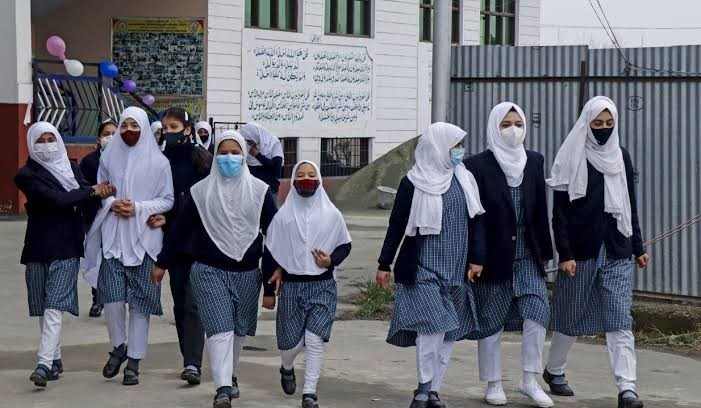
3. Wear light colored clothes. Color of uniforms should be white or any other light colored uniforms. Dark clothes like black, dark blue, dark green can absorb more heat. While as, colors like white reflect heat.
4. Morning assemblies should be skipped during the heatwave days. The same goes for outdoor games. Indoor games should be preferred.
5. Apply sunscreen with a high SPF to protect skin from harmful UV rays.
6. Avoid hot or heavy foods that can increase the body temperature.

Regards; Kashmir weather

Parents Urge Schools to Extend Summer Break Amid Heatwave Crisis

Parents Urge Schools to Extend Summer Break Amid Heatwave Crisis

Srinagar, July 16: With no respite in the scorching heat across Kashmir, the demand for an extension in summer vacation is growing stronger as parents across various districts are demanding that school authorities give a few days’ extension to the vacation until the weather gets better and young students have some respite.

As the summer vacation for schools is ending on Wednesday, the parents said that they want a few more days of summer break for their children.

“There has been no respite in the scorching heat for weeks now, and if there is no major change in weather, the government should ensure that students get a few more days off. If the students suffer amid heat in classrooms, they won’t be able to study well, and in such circumstances, some respite should be given to them,” said Ashiq Ahmad, a parent.

Many netizens took to social media demanding that schools extend the summer vacation for a few more days.

Read Also Summer vacation 2024 Extension Fresh Update, read details here

Some even pointed out that authorities had kept the school opening date in the middle of the week and said that it would have been better to keep it from Monday, which would have given students respite from the heatwave conditions for some more days.

“I can’t understand why the school opening date has been kept in the middle of the week. Why not have it from Monday, July 22. Nothing is planned here. The announcement of vacations is like rocket science for the department. This entire week we will see temperatures above normal. Why have vacations then just for formality when these are not serving the purpose,” posted Nasir Ali Khan, an RJ on Facebook.

The concerned parents also said that there was no respite in temperatures, and even the summer vacation for colleges was announced from July 15 to July 24.

“So, as per the government, the summers are too harsh for college-going students but okay for the younger students. There should be some logic behind the vacation, and these should serve some purpose. Amid the heat, students faint and have other health complications in schools, and authorities should consider that too,” said another parent.

Last week, Director School Education Kashmir Tasaduq Hussain Mir said that the decision to extend the summer vacation for schools would depend on the advisory issued by the Meteorological Department (MeT).

However, the concerned parents said that since there was no respite in the heatwave, the authorities should consider extending the summer vacation for school-going children — (GK)

Ehsaas Foundation Sets Up Camp at Zadibal Srinagar, Distributes Refreshments Among Shia Mourners on Youm-e-Ashura

0

Ehsaas Foundation Sets Up Camp at Zadibal Srinagar, Distributes Refreshments Among Shia Mourners on Youm-e-Ashura

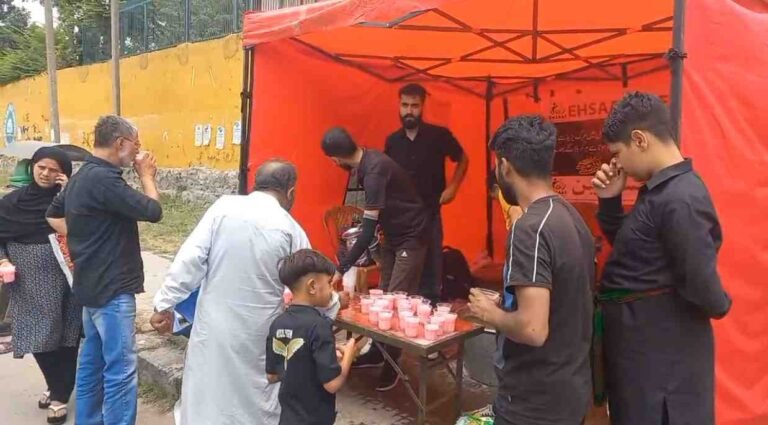
Srinagar, July 17: As a gesture of solidarity and support, the non-profit organization Ehsaas Foundation set up a camp at Zadibal, Srinagar, to distribute refreshments among Shia mourners observing Youm-e-Ashura.

The initiative aimed to provide comfort and support to the participants during the significant religious event.

Burhan Nazir, the co-founder of Ehsaas Foundation, expressed his sentiments about the initiative, stating, our organization is dedicated to providing assistance and comfort to the community during important events like Youm-e-Ashura. We believe in supporting the mourners who come out in large numbers to commemorate the sacrifice of Imam Hussain and his companions.

Malik Zahoor, the founder and senior member of the organization, also highlighted the importance of such initiatives. “It is our duty to stand with our brothers and sisters during these solemn occasions. By providing refreshments, we aim to ease their physical burden and show our solidarity with their spiritual journey,” Zahoor said.

Lastly, the camp, strategically located at Zadibal, a central hub for Shia processions in Srinagar, witnessed a steady flow of mourners. The volunteers from Ehsaas Foundation distributed water, beverages to ensure that the participants remained hydrated and energized throughout the day.

Summer vacation 2024 Extension Fresh Update, read details here

0

No extension in summer vacation: SED

Asks students to resume classwork from July-18; Issues cleanness advisory to be followed on schools reopening day

Srinagar, Jul 16 (KNO): School Education Department Tuesday clarified that there will be no extension in summer vacation and subsequently ordered students to resume classes from July-18.

According to the news agency—Kashmir News Observer (KNO), SED on microblogging site X said, “All Schools (Govt. & Private recognized) shall be re-opened on 18.7.2024, after summer vacations across the UT.”(SIC)

It also ordered the Chief Education Officers, Zonal Education Officers and HoIs to follow the cleanness advisory.

Advisory to HOIs…

Cleanliness: Ensure that all premises, including classrooms, corridors, and common areas, are thoroughly cleaned.

Pay special attention towards clean toilets, ensuring these are hygienic and well-maintained.

Clean and disinfect water tanks to ensure safe drinking water.

Ensure rooftops are free of debris and dirt.

Grass Cutting: Trim and maintain lawns and grounds to provide a neat and safe environment to students.

Removal of Junks and Debris: Clear any junk, waste, or debris from the school premises to maintain a clean and clutter-free environment.

Removal of Stagnant Water: Identity and remove any stagnant water to prevent the breeding of mosquitoes and other pests.

Plugging of Water Leakages: Inspect the premises for any water leakages and ensure they are promptly repaired to avoid water wastage and potential damage to the infrastructure.

SED said in an advisory said, “These measures are crucial to provide a safe, clean, and conducive environment for students as they return to school.”

Earlier on June 30, SED announced summer break for all schools falling in winter zones from July-08 to July-17—(KNO)

Higher Education Department Considers Policy for Private Universities in J&K

Higher Edu Deptt mulls ‘Private University Policy’ for establishment of Pvt Universities in JK

Principal Secretary of department acknowledged of working on drafting the policy

Srinagar, Jul 15 (KNO): The Jammu and Kashmir Higher Education Department is drafting a ‘Private University Policy’ for establishing the private universities in the region.

Top officials of the department informed the news agency—Kashmir News Observer (KNO), that it was in contact with all stakeholders for the clearance of all the related issues.

“In order to send a concrete proposal to the Ministry of Education (Mo) and to invite the private players to establish the universities, we are holding discussions regularly with all concerned stakeholders and we are seeking suggestions from them,” the official said.

He further said that the policy will be sent to various concerned departments for suggestions and discussions, including Finance, Law, Revenue, Industry, and Planning.

The policy draft, as per official sources, will address crucial issues such as land allotment and obtaining necessary permissions for setting up universities. Once finalized, the draft will be presented for approval at the Administrative Council meeting.

As per the official sources, the policy will include provisions for reserving seats for local youth, providing scholarships to needy students, and other relevant issues to promote education within Jammu and Kashmir. “This initiative is expected to be instrumental in attracting investors and enhancing the educational infrastructure in the region.”

Meanwhile Principal Secretary Higher Education Department, Alok Kumar acknowledged that it was working on drafting the private university policy.

“Yes we are working on drafting the private university policy. However, I cannot share further details in this regard as of now,” he said.

Pertinently, KNO in February-2024 reported that in Jammu and Kashmir only 15 percent of higher education students prefer to study in private unaided and aided colleges.

The official documents in this regard had revealed that the enrolment of private and government colleges based on actual response in a survey states that there were a total of 2,13,213 students enrolled in private and government colleges of Jammu and Kashmir.

Among the total number of enrolled students, 23,580 were enrolled in private unaided colleges, 4038 in private aided.

However, in comparison to the private colleges, the official figures reveal that in government colleges across Jammu and Kashmir, at least 1,85,595 students were enrolled.

Besides, the documents state that there were a total of 337 private and government colleges functioning in Jammu and Kashmir.

The survey based on actual response received from the sampled stakeholders reveals that a total of 127 private unaided, 21 aided, and 189 government colleges were functioning in Jammu and Kashmir—(KNO)

No Extension in Summer Vacation: SED Directs Students to Resume Classes on July 18

0

No extension in summer vacation: SED

Asks students to resume classwork from July-18; Issues cleanness advisory to be followed on schools reopening day

Srinagar, Jul 16 (KNO): School Education Department Tuesday clarified that there will be no extension in summer vacation and subsequently ordered students to resume classes from July-18.

According to the news agency—Kashmir News Observer (KNO), SED on microblogging site X said, “All Schools (Govt. & Private recognized) shall be re-opened on 18.7.2024, after summer vacations across the UT.”(SIC)

It also ordered the Chief Education Officers, Zonal Education Officers and HoIs to follow the cleanness advisory.

Advisory to HOIs…

Cleanliness: Ensure that all premises, including classrooms, corridors, and common areas, are thoroughly cleaned.

Pay special attention towards clean toilets, ensuring these are hygienic and well-maintained.

Clean and disinfect water tanks to ensure safe drinking water.

Ensure rooftops are free of debris and dirt.

Grass Cutting: Trim and maintain lawns and grounds to provide a neat and safe environment to students.

Removal of Junks and Debris: Clear any junk, waste, or debris from the school premises to maintain a clean and clutter-free environment.

Removal of Stagnant Water: Identity and remove any stagnant water to prevent the breeding of mosquitoes and other pests.

Plugging of Water Leakages: Inspect the premises for any water leakages and ensure they are promptly repaired to avoid water wastage and potential damage to the infrastructure.

SED said in an advisory said, “These measures are crucial to provide a safe, clean, and conducive environment for students as they return to school.”

Earlier on June 30, SED announced summer break for all schools falling in winter zones from July-08 to July-17—(KNO)

Patwari Arrested by ACB in Srinagar for Accepting Rs 40,000 Bribe

0

ACB arrests Patwari for accepting bribe of Rs 40k in Sgr

Srinagar, Jul 16 (KNO): Anti-Corruption Bureau (ACB) on Tuesday said to have trapped and arrested Patwari Halqa Chanapora, Srinagar while demanding and accepting bribe of Rs 40,000 for issuance of Revenue extracts.

A spokesman in a statement issued to the news agency—Kashmir News Observer (KNO), said that Jammu and Kashmir Anti Corruption Bureau received a written complaint wherein it was alleged that Patwari Halqa Chanapora Srinagar, Farooq Ahmad Bhat, resident of Bugam Chadoora is demanding Rs 40,000 as bribe for issuance of revenue extracts in respect of his residential house alongwith 15 marlas land situated at Ghurdawara Lane Chanapora Srinagar which he has sold out, for which he had applied Online at Patwari Halqa Chanapora Srinagar before 15 days.

“The complainant stated that he is against the bribe and approached before Anti Corruption Bureau ACB Srinagar for taking legal action against the accused public servants under law. On receipt of the complaint the discreet verification was conducted, which confirms the demand by the public servant concerned and accordingly, a case under FIR number 17/2024 under section 7 PC Act 1988 was registered in this Bureau and investigation was taken up,” the statement said.

During the course of investigation a trap team constituted, the statement reads, adding that the team laid a successful trap and caught the accused public servant Farooq Ahmad Bhat R/o Bugam Chadoora, Patwari Halqa Chanapora red-handed while demanding and accepting the bribe amount of Rs 40,000 from the complainant at Patwar Halqa Chanapora.

During personal search of the accused Patwari including other items, cash amount of Rs 35,000 was also recovered and seized in the instant case. He was arrested on the spot, the statement reads, adding that further investigation of the instant case is going on—(KNO)