Thursday, April 30, 2026
Advertisementspot_img
Home Blog Page 677

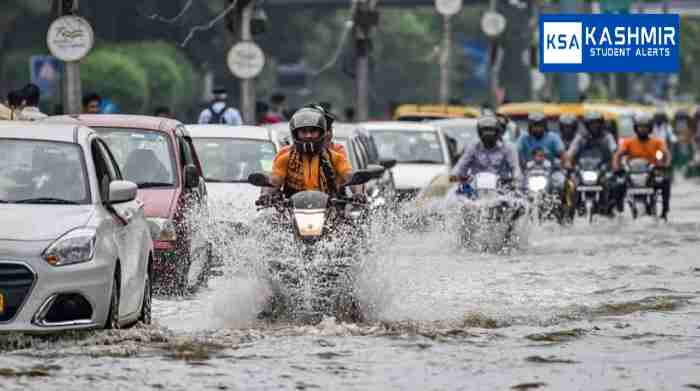
Mercury Rises in J&K Nights; Met Predicts Calm Weather Till March 27

0

Night temp rises, MeT says ‘no significant’ weather activity expected in J&K till March 27

Srinagar, Mar 24(GNS): While weatherman ruled out any significant weather activity till March 27 evening, night temperature recorded an increase with mercury settling above sub-zero level in Jammu and Kashmir including Gulmarg and Pahalgam on Sunday.

A meteorological department official here told GNS that Srinagar recorded a minimum of 10.2°C against 6.5°C on the previous night and it was above normal by 5.2°C for the summer capital of JK for this time of the year.

Qazigund recorded a minimum of 6.8°C against 5.8°C on the previous night and it was 3.1°C above normal for the gateway town of Kashmir, he said.

Pahalgam recorded a low of 3.6°C against minus 1.1°C on the previous night and it was 3.2°C above normal for the famous resort in south Kashmir.

Kokernag, also in south Kashmir, recorded a minimum of 7.7°C against 5.6°C on the previous night and it was 4.4°C above normal, the official said.

Kupwara town recorded a low of 8.1°C against 5.6°C on the previous night and it was 4.9°C above normal there, the official said.

Gulmarg recorded a low of 1.4°C against minus 2.5°C on the previous night and it was above normal by 3.0°C for the world famous skiing resort in north Kashmir’s Baramulla district.

Jammu, he said, recorded a minimum of 17.2°C and it was above normal by 1.7°C for the winter capital of J&K.

Banihal recorded a low of 9.0°C, Batote 10.0°C and Bhaderwah 9.0°C, he said.

With regard to the forecast for next 24 hours, he said, mainly dry weather is expected with possibility of very light rain/TS at one or two places over the higher reaches of Jammu and Kashmir.

“Overall, no significant weather activity is expected till March 27 evening,” he said, adding, “From March 27 evening to March 28, generally cloudy weather with light rain/snow is expected (higher reaches) at many places.”

From March 29, he said, partly cloudy weather with light rain/snow is expected at isolated places.

From March 30-31, he said, partly to generally cloudy weather with intermittent light rain/snow is expected at a few places. (GNS)

3826 Posts, NRRMS Recruitment 2024 Application form, Eligibility, Last Date

0

3826 Posts, NRRMS Recruitment 2024 Application form, Eligibility, Last Date

NRRMS Recruitment 2024: The NRRMS (National Rural Recreation Mission Society) is inviting applications for filling up multiple vacancies under several positions. The positions will be filled under the National Rural Recreational Mission Society. Further, this comes under the project of Madhya Pradesh’s Deendayal Upadhyay rural Infrastructure Development.

A total of 3825 posts will be filled up under this recruitment drive. Interested candidates can check their eligibility and apply online. Notably, the last date for submission of online applications is April 05, 2024. For further details, check below:

Important Dates for NRRMS Recruitment 2024

  • Starting date for submission of online application: March 16, 2024
  • Closing date for submission of online application: April 05, 2024

Vacant Posts for NRRMS Recruitment 2024

  • District Project Officer: 52 vacant posts
  • Accounts Officer: 08 vacant posts
  • Technical Assistant: 110 vacant posts
  • Data Manager: 213 vacant posts
  • MIS Manager: 318 vacant posts
  • MIS Assistant: 517 vacant posts
  • Multi Tasking Official: 479 vacant posts
  • Computer Operator: 717 vacant posts
  • Field Coordinator: 698 vacant posts
  • Facilitators: 613 vacant posts

Application fee for NRRMS Recruitment 2024

  • For candidates belonging to General/ OBC/ MOBC categories: Rs 350
  • For candidates belonging to SC/ ST categories: Rs 250
  • For candidates belonging to BPL category: Rs 250

Read Also: NVS Recruitment 2024 for non-teaching posts Application form

Selection Process

The final list of selected candidates will be prepared based on the following: Written Test and a Computer Proficiency Test.

Pay Scale

  • District Project Officer: Rs 31,760
  • Accounts Officer: Rs 27,450
  • Technical Assistant: Rs 25,750
  • Data Manager: Rs 23,350
  • MIS Manager: Rs 21,650
  • MIS Assistant: Rs 19,650
  • Multi Tasking Official: Rs 18,450
  • Computer Operator: Rs 18,250
  • Field Coordinator: Rs 18,250
  • Facilitators: Rs 17,750

How to Apply

  • Interested and eligible candidates need to visit the official website at www.nrrms.com
  • From there, they need to click on the link that reads “NRRMS Recruitment 2024.”
  • Provide the required details as per instructions.
  • Upload documents as per requirement and submit your application.
  • Candidates are advised to keep a printout of the application for future references.

IIT, IISc Admissions via GATE 2024: Category-Specific Cut-Offs for All Subjects

0

IIT, IISc Admissions via GATE 2024: Category-Specific Cut-Offs for All Subjects

The result of the examination was released earlier this month and now, the institute has announced cut-off marks for the different subjects.

Indian Institute of Science (IISc) Bangalore has announced cut-off marks of the Graduate Aptitude Test in Engineering or GATE 2024. The result of the examination was released earlier this month and now, the institute has announced cut-off marks for the different subjects.

Candidates who have scored equal to or more that the cut-pff marks for their categories will be eligible to apply for admission to Indian Institutes of Technology (IITs), the Indian Institute of Science (IISc) and other user institutions. GATE scores is also used by PSUs in their recruitment processes.

Also read: GATE 2024: From jobs in top PSUs to admission in top-tier universities, here’s what you can do with your score

GATE 2024: Category and subject-wise cut-off marks:

Paper Code Test Paper No. Candidates Registered No. Candidates Appeared Cut-off (GEN) Cut-off
(OBC-NCL/EWS)
Cut-off (SC/ST/PwD)
AE Aerospace Engineering 6931 5255 33.3 29.9 22.1
AG Agricultural Engineering 2777 2362 25 22.5 16.6
AR Architecture and Planning 11450 9080 41.5 37.3 27.6
BM Biomedical Engineering 2345 1860 25 22.5 16.6
BT Biotechnology 21210 17078 38.9 35 25.9
CE Civil Engineering 108136 85869 28.3 25.4 18.8
CH Chemical Engineering 16930 13937 25 22.5 16.6
CS Computer Science and Information Technology 152652 123967 27.6 24.8 18.4
CY Chemistry 35382 26825 25.2 22.6 16.7
DA Data Science and Artificial Intelligence 52493 39210 37.1 33.3 24.7
EC Electronics and Communication Engineering 78157 63092 25 22.5 16.6
EE Electrical Engineering 73728 59599 25.7 23.1 17.1
ES Environmental Science and Engineering 8847 6445 37.9 34.1 25.2
EY Ecology and Evolution 3336 2359 35.8 32.2 23.8
GE Geomatics Engineering 3238 2491 41.1 36.9 27.4
GG1 Geology and Geophysics (Geology) 7154 5574 42 37.8 28
GG2 Geology and Geophysics (Geophysics) 1037 822 49 44.1 32.6
IN Instrumentation Engineering 12451 9900 32.7 29.4 21.8
MA Mathematics 17617 13425 25 22.5 16.6
ME Mechanical Engineering 83114 65546 28.6 25.7 19
MN Mining Engineering 8515 7046 25 22.5 16.6
MT Metallurgical Engineering 3858 3111 41 36.9 27.3
NM Naval Architecture and Marine Engineering 517 361 25.1 22.5 16.7
PE Petroleum Engineering 2146 1770 42.6 38.3 28.4
PH Physics 26475 20258 32 28.8 21.3
PI Production and Industrial Engineering 4915 3725 30.5 27.4 20.3
ST Statistics 2663 1694 26.6 23.9 17.7
TF Textile Engineering and Fibre Science 1765 1422 28.1 25.2 18.7
XE Engineering Sciences 14941 11261 36.2 32.5 24.1
XH-C1 Humanities and Social Sciences (Economics) 3748 2721 37 33.3 24.6
XH-C2 Humanities and Social Sciences (English) 5488 3900 48 43.2 32
XH-C3 Humanities and Social Sciences (Linguistics) 368 277 49.7 44.7 33.1
XH-C4 Humanities and Social Sciences (Philosophy) 513 340 39.3 35.3 26.1
XH-C5 Humanities and Social Sciences (Psychology) 4872 3415 52.7 47.4 35.1
XH-C6 Humanities and Social Sciences (Sociology) 1566 1020 36 32.4 24
XL Life Sciences 44904 36275 29.3 26.3 19.5

UPSC NDA Exam 2024: Syllabus, Pattern, and Selection Process Overview

0

UPSC NDA exam: Key points about the written test and the SSB interview

The Union Public Service Commission (UPSC) conducts the entrance examination for the National Defence Academy and the Naval Academy (UPSC NDA) twice every year. The UPSC NDA & NA 1 examination 2024 will be held on April 21 for admission to the Army, Navy and Air Force wings of the NDA; and for the Naval Academy course.

The exam will fill 400 vacancies, of which 208 are for the Army, 42 are for the Navy, and 122 are for the Air Force wings of the NDA and 30 are for the Naval Academy under the 10+2 Cadet entry scheme.

Understanding the scheme and the process is the most important part of preparing for any examination. With the first NDA entrance examination of 2024 approaching, here is a detailed look at the exam pattern, syllabus and selection process.

UPSC NDA exam scheme & selection process

  • The NDA exam has two stages – a written examination and an interview round (SSB test). A merit list of the written test will be prepared by the commission and shortlisted ones will appear for the SSB test.
  • The written examination has two papers of 150 minutes each – Mathematics (300 marks) and General Ability Test (600 marks).
  • The SSB interview (intelligence and personality test) has two stages and carries 900 marks. Only those who clear stage 1 can appear for the stage 2 examination.
  • For admission to the Air Force course, candidates will have to additionally qualify for the Computerised Pilot Selection System (CPSS).

Read Also: NVS Recruitment 2024 for non-teaching posts Application form

UPSC NDA & NA 2024: Syllabus

Paper 1 (Mathematics)

Algebra Concept of set, operations on sets, Venn diagrams.

De Morgan laws, Cartesian product, relation, equivalence relation.

Representation of real numbers on a line.

Complex numbers—basic properties, modulus, argument, cube roots of unity.

Binary system of numbers.

Conversion of a number in decimal system to binary system and vice-versa.

Arithmetic, Geometric and Harmonic progressions.

Quadratic equations with real coefficients.

Solution of linear inequations of two variables by graphs.

Permutation and Combination.

Binomial theorem and its applications.

Logarithms and their applications

MATRICES AND DETERMINANTS Types of matrices, operations on matrices.

Determinant of a matrix, basic properties of determinants.

Adjoint and inverse of a square matrix, Applications-Solution of a system of linear equations in two or three unknowns by Cramer’s rule and by Matrix Method.

TRIGONOMETRY Angles and their measures in degrees and in radians.

Trigonometrical ratios.

Trigonometric identities Sum and difference formulae.

Multiple and Sub-multiple angles.

Inverse trigonometric functions.

Applications-Height and distance, properties of triangles.

ANALYTICAL GEOMETRY OF TWO AND THREE DIMENSIONS Rectangular Cartesian Coordinate system.

Distance formula.

Equation of a line in various forms.

Angle between two lines.

Distance of a point from a line.

Equation of a circle in standard and in general form.

Standard forms of parabola, ellipse and hyperbola.

Eccentricity and axis of a conic.

Point in a three dimensional space, distance between two points.

Direction Cosines and direction ratios.

Equation two points.

Direction Cosines and direction ratios.

Equation of a plane and a line in various forms.

Angle between two lines and angle between two planes.

Equation of a sphere.

DIFFERENTIAL CALCULUS Concept of a real valued function–domain, range and graph of a function.

Composite functions, one to one, onto and inverse functions.

Notion of limit, Standard limits—examples. Continuity of functions—examples, algebraic operations on continuous functions.

Derivative of function at a point, geometrical and physical interpretation of a derivative—applications.

Derivatives of sum, product and quotient of functions, derivative of a function with respect to another function, derivative of a composite function.

Second order derivatives.

Increasing and decreasing functions.

Application of derivatives in problems of maxima and minima.

INTEGRAL CALCULUS AND DIFFERENTIAL EQUATIONS Integration as inverse of differentiation, integration by substitution and by parts, standard integrals involving algebraic expressions, trigonometric, exponential and hyperbolic functions.

Evaluation of definite integrals—determination of areas of plane regions bounded by curves—applications.

Definition of order and degree of a differential equation, formation of a differential equation by examples.

General and particular solution of a differential equations, solution of first order and first degree differential equations of various types—examples.

Application in problems of growth and decay.

VECTOR ALGEBRA Vectors in two and three dimensions, magnitude and direction of a vector.

Unit and null vectors, addition of vectors, scalar multiplication of a vector, scalar product or dot product of two vectors.

Vector product or cross product of two vectors. Applications—work done by a force and moment of a force and in geometrical problems.

STATISTICS AND PROBABILITY Statistics : Classification of data, Frequency distribution, cumulative frequency distribution—examples. Graphical representation—Histogram, Pie Chart, frequency polygon— examples.

Measures of Central tendency—Mean, median and mode.

Variance and standard deviation—determination and comparison.

Correlation and regression.

Probability : Random experiment, outcomes and associated sample space, events, mutually exclusive and exhaustive events, impossible and certain events.

Union and Intersection of events.

Complementary, elementary and composite events. Definition of probability—classical and statistical—examples.

Elementary theorems on probability—simple problems. Conditional probability, Bayes’ theorem—simple problems.

Random variable as function on a sample space.

Binomial distribution, examples of random experiments giving rise to Binominal distribution.

Paper 2 (General Ability Test)

Part A: ENGLISH (200 marks) The English part of the question paper will test the candidates’ understanding of English and workman-like use of words. T

he syllabus covers various aspects: Grammar and usage, vocabulary, comprehension and cohesion in extended text to test the candidate’s proficiency in English.

Part B: GENERAL KNOWLEDGE (400 marks) This part will cover Physics, Chemistry, General Science, Social Studies, Geography and Current Events.
PHYSICS Physical Properties and States of Matter, Mass, Weight, Volume, Density and Specific Gravity, Principle of Archimedes, Pressure Barometer.

Motion of objects, Velocity and Acceleration, Newton’s Laws of Motion, Force and Momentum, Parallelogram of Forces, Stability and Equilibrium of bodies, Gravitation, elementary ideas of work, Power and Energy.

Effects of Heat, Measurement of Temperature and Heat, change of State and Latent Heat, Modes of transference of Heat.

Sound waves and their properties, Simple musical instruments. Rectilinear propagation of Light, Reflection and refraction.

Spherical mirrors and Lenses, Human Eye.

Natural and Artificial Magnets, Properties of a Magnet, Earth as a Magnet. Static and Current Electricity, conductors and Nonconductors, Ohm’s Law, Simple Electrical Circuits, Heating, Lighting and Magnetic effects of Current, Measurement of Electrical Power, Primary and Secondary Cells, Use of X-Rays.

General Principles in the working of the following: Simple Pendulum, Simple Pulleys, Siphon, Levers, Balloon, Pumps, Hydrometer, Pressure Cooker, Thermos Flask, Gramophone, Telegraphs, Telephone, Periscope, Telescope, Microscope, Mariner’s Compass; Lightening Conductors, Safety Fuses.

CHEMISTRY Physical and Chemical changes.

Elements, Mixtures and Compounds, Symbols, Formulae and simple Chemical Equations, Law of Chemical Combination (excluding problems).

Properties of Air and Water.

Preparation and Properties of Hydrogen, Oxygen, Nitrogen and Carbondioxide, Oxidation and Reduction.

Acids, bases and salts.

Carbon—different forms.

Fertilizers—Natural and Artificial.

Material used in the preparation of substances like Soap, Glass, Ink, Paper, Cement, Paints, Safety Matches and Gun-Powder.

Elementary ideas about the structure of Atom, Atomic Equivalent and Molecular Weights, Valency

GENERAL SCIENCE Difference between the living and non-living.

Basis of Life—Cells, Protoplasms and Tissues.

Growth and Reproduction in Plants and Animals.

Elementary knowledge of Human Body and its important organs.

Common Epidemics, their causes and prevention.

Food—Source of Energy for man.

Constituents of food, Balanced Diet.

The Solar System—Meteors and Comets, Eclipses.

Achievements of Eminent Scientists.

HISTORY, FREEDOM MOVEMENT, etc. A broad survey of Indian History, with emphasis on Culture and Civilisation.

Freedom Movement in India.

Elementary study of Indian Constitution and Administration.

Elementary knowledge of Five Year Plans of India.

Panchayati Raj, Co-operatives and Community Development.

Bhoodan, Sarvodaya, National Integration and Welfare State, Basic Teachings of Mahatma Gandhi.

Forces shaping the modern world; Renaissance, Exploration and Discovery; War of American Independence.

French Revolution, Industrial Revolution and Russian Revolution.

Impact of Science and Technology on Society.

Concept of one World, United Nations, Panchsheel, Democracy, Socialism and Communism.

Role of India in the present world.

GEOGRAPHY The Earth, its shape and size.

Lattitudes and Longitudes, Concept of time.

International Date Line.

Movements of Earth and their effects.

Origin of Earth.

Rocks and their classification; Weathering—Mechanical and Chemical, Earthquakes and Volcanoes.

Ocean Currents and Tides Atmosphere and its composition; Temperature and Atmospheric Pressure, Planetary Winds, Cyclones and Anti-cyclones; Humidity; Condensation and Precipitation; Types of Climate, Major Natural regions of the World.

Regional Geography of India—Climate, Natural vegetation.

Mineral and Power resources; location and distribution of agricultural and Industrial activities.

Important Sea ports and main sea, land and air routes of India.

Main items of Imports and Exports of India.

CURRENT EVENTS Knowledge of Important events that have happened in India and the world in the recent years.

Prominent personalities—both Indian and international including those connected with cultural activities and sports.

Out of the maximum marks assigned to part ‘B’ of this paper, sections A, B, C, D and E will carry approximately 25%, 15%, 10%, 20%, 20% and 10% weightage, respectively.

Intelligence and Personality Test

Stage 1 Officer Intelligence Rating (OIR) tests

Picture Perception and Description Test (PP&DT).

The candidates will be shortlisted based on combination of performance in OIR Test and PP&DT.

Stage 2 Interview, Group Testing Officer Tasks, Psychology Tests and the Conference.

UPSC NDA exam: Important points about written test

  • There will be negative marking in the objective-type papers. One-third (0.33) of the total marks assigned to the question will be deducted for wrong answers.
  • For writing and marking answers in the answer sheet, candidates must use black ball pens only. Pens with any other colour, pencil or ink pen are not allowed.
  • Any omission/mistake/discrepancy in encoding/filling of details in the OMR answer sheet, especially roll number and test booklet series code, will result in the rejection of the answer sheet.
  • Banned items: Mobile phone, pager, any electronic equipment, programmable device, storage media like pen drive, smart watches etc., camera, Bluetooth devices or any other equipment or related accessories capable of communication. Violation of the rule will result in disciplinary action, including a ban from future examinations.
  • Candidates have been advised not to bring these banned items or any other valuable items to the exam venue as the commission will make no safe-keeping arrangements.
  • Items allowed: Clipboard or hardboard, a good quality black ball pen. The invigilator will supply Answer Sheet and sheet for rough work.

UPSC NDA exam: Important points about the SSB interview

  • The personality of a candidate will be assessed by three different assessors: the Interviewing Officer (IO), Group Testing Officer (GTO) and the Psychologist.
  • There will be no separate weightage for each test. Assessors will allot the marks after taking into consideration the performance of the candidate holistically in all the tests. All these have equal weightage.
  • The various tests of IO, GTO and Psych have been designed to bring out the presence/absence of officer-like qualities and their trainability in a candidate.

Registration for CUET-2024 for Admission to Undergraduate Programmes Offered by Degree Colleges in Jammu and Kashmir

0

Registration for CUET-2024 for Admission to Undergraduate Programmes Offered by Degree Colleges in Jammu and Kashmir

The Office of the Nodal Principal, Kashmir Division Colleges, Amar Singh College Srinagar has issued a notice regarding the registration for CUET-2024 for admission to undergraduate programmes offered by degree colleges in Jammu and Kashmir.

Key Points

  • The Common University Entrance Test (CUET)-2024 is mandatory for admission in Undergraduate Programmes offered by most of the Degree Colleges of Jammu and Kashmir.
  • The registration process for CUET-2024 has already commenced and you need to register by 26th of March 2024.
  • The exam will be conducted by the National Testing Agency (NTA).
  • Students who are appearing in Class 12th exam or have passed it and are desirous of seeking admission in Degree Colleges of UT of Jammu and Kashmir are eligible to apply.

Registration for CUET-2024 for Admission to Undergraduate Programmes Offered by Degree Colleges in Jammu and Kashmir

How to Register

  • Visit the NTA website at https://nta.ac.in/Cuetexam
  • Read the instructions, procedure, and Information Bulletin carefully before you start filling the Application Form.
  • Identify the College/s offering the programme you want to pursue. Visit the website of the University to which the College is affiliated and download its programme eligibility chart.
  • After checking the eligibility of programme/s you intend to pursue in a College, you need to see the subjects necessary for you to qualify in CUET examination and fill the CUET examination form accordingly.
  • After Successful Registration complete your Application form by entering details pertaining to Quota, Qualification, University & Programme, Test Paper/Subject Selection, Preferred Examination Centre Details, Upload Documents.

Important Dates

  • Online Submission of Application Form: 27 February to 26 March 2024 (up to 11:50 P.M.)
  • Last date of successful transaction of fee through Credit/Debit Card/NetBanking/UPI: 26 March 2024 (up to 11:50 PM.)
  • Correction in Particulars: 28 March to 29 March 2024 (Upto 11:50 P.M.)
  • Announcement of the City of Examination: 30 April 2024 onwards
  • Downloading Admit Cards from the NTA website: The second week of May 2024
  • Date of Examination: Between 15 May 2024 and 31 May 2024
  • Declaration of Result on the NTA website: 30 June 2024

For more information, please refer to the full notice.

Traffic plan and Advisory for march 25

0

TRAFFIC POLICE HEADQUARTERS, J&K, JAMMU/SRINAGAR

1. From 23-03-2024, 1700 hrs. to 24-03-2024, 1700 hrs., there was slow movement

observed on NH-44 due to breakdown of 06 HMVs and single lane traffic at Dalwas, Mehad, Panthyal, Nachiana, Shalgarhi etc. and poor surface condition of road at many

places between Nashri and NAVYUG Tunnel.

2. Passengers/LMVs operators are advised to prefer journey on Jammu-Srinagar

NHW during day time. Please avoid journey during night hours as apprehension of

shooting stones between Ramban and Banihal.

3. Load carrier (HMV/LMV) Operators carrying fresh perishable/live stock are advised to load their vehicle as per advisory issued by Traffic Police Headquarters time to time as there is single lane traffic and poor condition of road at Dalwas, Panthyal, Nachlana, Shalgarhi etc. on Jammu Srinagar NHW.

4. HMVs Operators/Owners are requested to desist from overloading and carry sufficient fuel during journey on Jammu-Srinagar NHW. It is further requested that vehicle owners must double check the fitness of their vehicles and carry sufficient fuel before undertaking journey on Jammu-Srinagar NHW

5. HMVs with only 06 and 10 tyres shall be allowed to ply through Dhar road.

TRAFFIC PLAN & ADVISORY FOR 25-03-2024:-

Jammu-Srinagar NHW (NH-44) Subject to fair weather and good road condition, LMVs Passenger/Private Cars shall be allowed from both sides on Jammu-Srinagar NHW viz Jammu towards Srinagar and vice- versa. However, HMVs shall be managed on regulated manner after assessing the road condition.

Cut off timing for LMVs in view of single road at Dalwas:- (subject to change depending on road condition) from Nagrota (Jammu) 0600 hrs to 1100 hrs from Jakheni (Udhampur) 0700 hrs to 1200 hrs & from NAVYUG Tunnel (Qazigund side) 0600 hrs to 1100 hrs No Vehicle shall be allowed after cut off timing.

SFs Convoy Movement:-

Security Forces are advised/requested not to ply against advisory/traffic plan in view of possible traffic congestion because of narrow carriage way between Nashree and Banihal on Jammu-Srinagar NHW. Tomorrow they may ply from Srinagar towards Jammu after confirming the status of NHW from TCU Ramban.

SSG ROAD

Subject to fair weather and good road condition (after getting green signal from Road maintenance agencies), only one way traffic for LMVs (Load carrier) from Srinagar towards Kargil shall be allowed on Srinagar-Sonamarg-Gumari road. These vehicles shall be allowed from Sonamarg at 0930 hrs upto 1300 hrs. Motorists are advised to carry anti-skid chain to gain more grip on the slippery road. No vehicle shall be allowed without anti skid chain/after cut off timing. No movement of passenger vehicle shall be allowed on SSG Road till the road is fully operational.

Mughal Road:-

Mughal road is still blocked due to snow accumulation.

Bhaderwah-Chamba road:-

Bhaderwah-Chamba road is still blocked due to snow accumulation.

Kishtwar- Sinthan-Anantnag NH-244:-

Kishtwar-Sinthan-Anantnag road is still blocked due to snow accumulation.

ADVISORY:-

People are advised to undertake journey on NH-44 only after confirming status of the road from Traffic control units as under:-

Jammu (0191-2459048, 0191-2740550, 9419147732, 103)

Srinagar (0194-2450022, 2485396, 18001807091, 103)

Ramban (9419993745, 1800-180-7043) Udhampur (8491928625) PCR Kishtwar (9906154100) for status of Sinthan Road.

Global Bags is looking for an Offset Printer Operator

0

Global Bags is looking for an Offset Printer Operator

This black and white poster advertises a job opening for an Offset Printer Operator at Global Bags, a manufacturer of non-woven products with customized printing. The company’s contact information is listed on the poster, including three phone numbers.

The job title “Offset Printer Operator” suggests that the successful candidate will be responsible for operating an offset printing machine. Offset printing is a widely used printing technique in which the inked image is transferred from a plate to a rubber blanket, and then to the printing surface. Offset presses are ideal for printing large quantities of materials, such as brochures, magazines, and posters.

In order to be successful as an Offset Printer Operator, you will need to have experience operating an offset printing machine. You should also be familiar with the printing process, from pre-press to finishing. Pre-press refers to the steps that take place before printing begins, such as design and layout. Finishing refers to the processes that take place after printing is complete, such as binding and trimming.

If you are interested in learning more about this job opening, you can contact Global Bags at the phone numbers listed on the poster.

Global Bags is looking for an Offset Printer Operator

JKBOSE Revised Date Announced for Class 12th Physical Education Paper

0

JKBOSE Revised Date Announced for Class 12th Physical Education Paper

The Jammu and Kashmir Board of School Education (JKBOSE) has announced a revised date for the Physical Education paper of Class 12th for the 2024 annual regular examination in the soft zone areas of the UT of Jammu and Kashmir.

The examination, which was earlier cancelled vide notification No: F(Acad-C)/PP/PED/AR/Exam/2024 dated: 20-03-2024, will now be held on March 30, 2024.

The time and venue of the examination will remain the same as per the original schedule.

Here’s a summary of the important details:

  • Revised date for Physical Education exam: March 30, 2024
  • Applicable for: Class 12th, Soft Zone Areas of Jammu and Kashmir
  • Examination body: Jammu and Kashmir Board of School Education (JKBOSE)

Read Also: Download JKBOSE 11th Model Papers 2024

It is recommended that students appearing for the exam refer to their admit cards for the exact time and venue of the examination. They can also contact their respective schools or the JKBOSE helpline for any further clarification.

JKSSB Important Update Regarding patwari examination

JKSSB Important Update Regarding patwari examination

0

Suspension of NIC Services Impacts Admit Card Downloads for Patwari (Urdu Paper) Written Exam

Attention all candidates preparing for the upcoming Patwari (Urdu Paper) written exam on March 31, 2024! Due to scheduled maintenance, all National Informatics Centre (NIC) services are currently suspended until 8 AM tomorrow. This suspension directly impacts the ability to download admit cards through the usual channels.

Candidates are advised to take note of this temporary disruption and make necessary arrangements to access their admit cards. To ensure smooth participation in the examination process, we recommend downloading your admit card promptly via an alternative link provided by the examination authorities.

To access your admit card, please visit ssbjk.com/admitcard/ and follow the instructions provided. By doing so, you can obtain essential details such as exam venue, timing, and other relevant information necessary for your participation.

For further inquiries or assistance, please refer to the official communication channels provided by the examination authorities. Thank you for your attention, and we wish you the best of luck in your upcoming examination.

Government Instructs All DCs, SSPs & HODs To Grant Leave To JKAS Candidates Appearing in Mains Exam 2023

0

Government Instructs All DCs, SSPs & HODs To Grant Leave To JKAS Candidates Appearing in Mains Exam 2023

Srinagar, Mar 24 (GNS): Government of Jammu and Kashmir on Sunday instructed all Deputy Commissioners, Senior Superintendents of Police and respective Heads of Departments to grant leave to candidates intending to appear in JKAS Mains Exams 2023.

“Representations have been received from various in-service candidates who are not being granted leave to appear in the Combined Competitive (Mains) Examination, 2023, which is scheduled to take place w.e.f 26.03.2024 to 03.04.2024, in view of their engagement in various assignments including election related duties,” remarked a communique by Deputy Secretary to the Government Akshay Rajan to all Deputy Commissioners, Senior Superintendents of Police and Heads of Departments, a copy of which lies with GNS.

“The matter has been examined and it has been desired to advise all the Deputy Commissioners/SSsP and HODs to allow the in-service candidates wishing to appear in the said examination, subject to sanction of leave.”

“Accordingly, I am directed to request you to kindly permit the in-service candidates, working under your administrative control, to appear in the Combined Competitive (Mains) Examination-2023, which is scheduled from 26.03.2024 to 03.04.2034”, reads the communique further. (GNS)