Wednesday, April 22, 2026
Advertisementspot_img
Home Blog Page 120

RRB Group D Admit Card 2025 Live: Check Exam City & Download Hall Ticket

0

Railway RRB Group D Admit Card 2025: The Railway Recruitment Board (RRB) has released the Group D admit card/call letter today, November 24 for the examination scheduled to be conducted from November 27, 2025 to December 6, 2025. Candidates who have applied for the exam can check and download the admit card on the official board website rrbcd.gov.in.The city slip was released on November 19, 2025.

RRB Group D Exam: How To Download Admit Card?

Visit the official website rrbcd.gov.in. On the homepage, click on “Group D Admit Card (Level 1)”. Enter your registration number and date of birth and the admit card will be downloaded. Save it to take it to the examination centre.

The examination covers multiple subjects to assess a candidate’s suitability for the post. These subjects include Mathematics, General Intelligence and Reasoning, General Science, and General Awareness and Current Affairs.

What Are Minimum Marks Required To Clear Group D Exam?

  • UR: 40 per cent
  • EWS: 40 per cent
  • OBC (Non-Creamy Layer): 30 per cent
  • SC: 30 per cent
  • ST: 30 per cent

The CBT exam will be conducted for 90 minutes and will consist of 100 questions. Candidates will receive one mark for every correct answer, while one-third of a mark will be deducted for each incorrect response.

RRB Group D Recruitment: Over 1 Crore Applications

Group D remains one of the largest recruitment exams in India, with RRB confirming that over 1.08 crore candidates applied for the Group D posts under CEN 08/2024. The Mumbai region received the highest number of applications at 15,59,100 (15.59 lakh). A total of 32,438 vacancies have been announced across various regions.

The Group D examination is conducted to fill several roles such as Track Maintainer Grade-IV, Assistant Pointsman, and various technical positions in departments including Electrical, Mechanical, and Signal & Telecommunication.

Download Link – “RRB Group D 2025 Exam Admit Card Download Link

CBSE to Announce CTET December 2025 Notification Soon – Everything You Need to Know

CTET December 2025: Registration Notification Expected Soon

The Central Board of Secondary Education (CBSE) is set to release the registration notification for the December 2025 session of the Central Teacher Eligibility Test (CTET) in the coming days.

Key Dates & Exam Details

  • The 21st edition of CTET will be conducted on Sunday, 8 February 2026, for both Paper-I and Paper-II.
  • The exam will cover 20 languages and will be held across 132 cities nationwide.
  • The official notification will include the detailed Information Bulletin covering syllabus, exam cities, eligibility criteria, exam fee, and other relevant information.

Eligibility Criteria

Candidates aiming to apply must meet the following criteria:

  • For Primary Stage (Classes I–V): Senior Secondary (or equivalent) with at least 50% marks and either completed or currently appearing in the final year of a two-year Diploma in Elementary Education.
  • For Upper Primary Stage (Classes VI–VIII): A Bachelor’s degree (or equivalent) and either completed or currently appearing in the final year of a two-year Diploma in Elementary Education.
  • Minimum age requirement: 18 years.

How to Apply

Once the notification is live, applicants should follow these steps:

  1. Visit the official CTET website (typically ctet.nic.in) and click on the link for “CTET December 2025”.
  2. Register by creating an account and filling in required personal information.
  3. Enter personal details, select preferred exam cities, upload necessary documents.
  4. Pay the examination fee through online payment methods.
  5. Download and keep safe the confirmation page for future reference.

Why This Exam Matters

The CTET is a national-level eligibility test conducted by CBSE and serves as a key qualification for appointment as teachers in central government schools such as the Kendriya Vidyalaya Sangathan (KVS), Navodaya Vidyalaya Samiti (NVS), as well as other CBSE-affiliated institutions.
Qualifying CTET is often a mandatory step for teaching positions in many states and central-administered schools, thereby enhancing career prospects significantly.

What Aspirants Should Do Now

  • Start gathering required documents: educational certificates, identity proof, photographs, etc.
  • Keep checking the official CTET website and notifications for exact registration dates and deadlines.
  • Begin reviewing the syllabus for either Paper-I (Primary stage) or Paper-II (Upper Primary stage), or both if applicable.
  • Choose preferred exam cities early as popular centres fill quickly.
  • Budget time for application fee payment, downloading confirmation, and printing required confirmations.

Nikon Scholarship Program 2025–26: Apply Online & Get Up to INR 1,00,000 for Photography Courses

0

📸 Nikon Scholarship Program 2025–26: Apply Online & Get Up to INR 1,00,000 for Photography Courses

Photography is more than just capturing a moment — it’s art, storytelling, and a powerful form of visual communication. In today’s digital era, photography has become a promising career option with immense demand in journalism, media, advertising, entertainment, weddings, wildlife exploration, social media influencing, and more.

However, pursuing a professional photography course can be expensive for students from underprivileged families. Understanding this financial challenge, Nikon India Private Limited has launched the Nikon Scholarship Program 2025–26 to help passionate photographers pursue certified training without worrying about cost.

This CSR initiative aims to support talented students by providing financial assistance up to INR 1,00,000, allowing them to learn and grow in the photography industry.

If you have the creative spark and dream of becoming a professional photographer, this scholarship could be your launchpad!


🎯 What is the Nikon Scholarship Program 2025–26?

The Nikon Scholarship Program 2025-26 is an initiative by Nikon India under its Corporate Social Responsibility (CSR) to strengthen creative education in India. It offers financial support to students from economically weaker backgrounds who are currently enrolled in a professional photography course of 3 months or longer.

Many talented youngsters discontinue their dreams due to financial limitations — this program ensures money doesn’t come in the way of passion and creativity.


🏆 Scholarship Benefits

✔️ Scholarship amount up to INR 1,00,000

✔️ Financial support based on the actual course fee submitted

✔️ Freedom to join the photography institute of your choice (meeting eligibility criteria)

✔️ Career-enhancing opportunity with professional training

This scholarship is a golden opportunity for budding photographers who want to build a strong foundation in technical, creative, and commercial aspects of photography.


🔍 Eligibility Criteria for Nikon Scholarship Program 2025–26

Before applying, make sure you meet the following eligibility requirements:

Requirement Description
Nationality Must be an Indian citizen
Education Must have passed Class 12
Course Requirement Enrolled in a Photography-related course (3 months or more)
Family Income Annual income ≤ INR 6,00,000
Exclusions Children of employees of Nikon India Pvt Ltd & Buddy4Study are not eligible

If you tick all these boxes — you’re eligible to apply!


📅 Important Dates

Event Details
Last Date to Apply 28 November 2025
Application Mode Online Only

📌 Apply as early as possible to avoid last-minute issues.


📝 Documents Required

Make sure to keep these documents ready before starting the application:

  • Class 12 mark sheet
  • Admission proof / Current course enrollment certificate
  • Fee structure document issued by institute
  • Family income certificate / IT return / salary slip
  • Government ID — Aadhaar/Voter ID/etc.
  • Passport-size photograph
  • Bank account details of the student
  • Any other document requested during verification

📌 All documents must be clear and valid.


🌐 How to Apply Online for Nikon Scholarship Program 2025-26?

Applying is very easy through the trusted Buddy4Study scholarship platform. Just follow these steps:

  1. Visit the scholarship portal link:
    👉 Short URL: www.b4s.in/ksty/NIKON13
  2. Click Apply Now
  3. Log in using your registered mobile/email
    (New users can sign up using Google/Mobile OTP)
  4. Fill in the required personal, academic & course details
  5. Upload documents carefully
  6. Submit your application and download the acknowledgment receipt

🎯 Pro Tip: Double-check your documents before submission to avoid rejection.


🎨 Why Choose Photography as a Career?

Photography is one of the few careers where passion meets profession. With digital growth, the demand for trained photographers is rising rapidly.

Here are some trending photography careers:

  • Wedding & Event Photographer
  • Fashion Photographer
  • Wildlife Photographer
  • Travel Photographer
  • Product Photography for E-Commerce
  • Journalism & Media Photography
  • Drone/Aerial Photographer
  • Film & Cinematography
  • Social Media Content Creator

Salaries vary from INR 25,000 to 2 lakh/month depending on skills, experience, and specialization.

Nikon’s scholarship ensures that financial struggle doesn’t stop creative minds from entering these booming industries.


🤝 Nikon’s Commitment to Talent Development

Nikon has always been a pioneer in promoting photography culture through:

  • Training workshops
  • Photo contests
  • Professional development programs
  • Scholarships for young learners

This scholarship is part of their commitment to enhance skills, creativity, and entrepreneurship among India’s youth.


🔑 Key Features of Nikon Scholarship Program 2025–26

Feature Benefit
CSR Initiative Supports underprivileged students
Wide Course Acceptance Any professional photography course (≥3 months)
Maximum Reward Financial support up to INR 1 lakh
Transparent Selection Based on eligibility + verification
Nationwide Program Students from across India can apply

📌 Selection Process

The selection will take place in the following stages:

  1. Application Screening — Checking eligibility and information accuracy
  2. Document Verification — Cross-checking provided documents
  3. Final Shortlist — Merit + financial background considered
  4. Scholarship Disbursement — Based on actual course fee details

🎯 Selection is competitive — make sure your application stands out!


🌍 Who Can Benefit Most From This Scholarship?

The program is ideal for:

✔️ Students dreaming of becoming professional photographers
✔️ Those who cannot afford expensive courses
✔️ Passionate individuals wanting creative careers
✔️ Students from economically weaker households

If your heart beats for photography — here’s your chance to shine.


🧠 Tips for a Successful Application

  • Provide accurate family income details
  • Use a valid and active mobile/email for future communication
  • Upload clear and legible documents
  • Write a strong statement describing:
    • Your passion for photography
    • Future career goals
    • Why you deserve the scholarship

A well-explained application increases your selection chances.


🧩 Why Nikon Scholarship Program 2025–26 Matters?

India has no shortage of creative youth — but many lack financial means. This scholarship helps bridge that gap and encourages:

  • Creative empowerment
  • Education accessibility
  • Skill-based employment
  • Growth of the photography industry

By supporting one student, Nikon indirectly contributes to countless impactful visual stories!


📍 QR Code for Quick Access

Students can directly scan the QR Code available in the official scholarship notice to reach the application page.


🔄 Quick Overview (Summary Table)

Parameter Details
Scholarship Name Nikon Scholarship Program 2025–26
Launched By Nikon India Private Limited
Support Based On Actual course fee
Reward Up to INR 1,00,000
Course Requirement Photography course ≥ 3 months
Eligibility Class 12 passed + Income ≤ INR 6 lakh
Mode of Application Online
Deadline 28 November 2025
Apply Link www.b4s.in/ksty/NIKON13

📣 Final Words: Apply Today and Capture Your Dreams!

Photography gives us the power to freeze time, evoke emotions, and tell unforgettable stories. If you believe in your talent and want to build a professional photography career, the Nikon Scholarship Program 2025–26 can help you take that important step.

🎯 Don’t wait — applications are already open!
🎯 Limited time — Last Date: 28 November 2025

👉 Apply now: www.b4s.in/ksty/NIKON13

Let your creativity shine — your camera could be your key to the future! 📷✨

Indian Army Sports Quota Recruitment 2025: Apply for Havildar & Naib Subedar Posts

0

Indian Army Sports Quota Recruitment 2025 – How to Join as Havildar or Naib Subedar

The spotlight is firmly on the upcoming recruitment drive by the Indian Army under the sports quota, offering a golden opportunity for talented athletes to join the defence forces. The Indian Army Sports Quota Recruitment 2025 for Direct Entry Havildar and Naib Subedar (Sports) is now open for unmarried male and female Indian citizens who meet the eligibility criteria. This blog will walk you through everything you need to know: eligibility, disciplines, physical standards, process, tips and more.


What is the Army Sports Quota & Why It Matters

The Army sports quota is a special recruitment channel designed to admit outstanding sportspersons into the Indian Army under the ranks of Havildar and Naib Subedar. The aim: to combine sporting excellence and defence service. The recruitment you’re reading about—Indian Army Sports Quota Recruitment 2025—is one such intake.

Key benefits

  • You get direct entry into respected ranks (Havildar / Naib Subedar) without starting from the lowest soldiers’ ranks.
  • Service in the Indian Army brings not just salary but full benefits: allowances, pension (depending on tenure), ECHS / CSD facilities, promotion opportunities.
  • As a sportsperson, you gain a stable career path combined with your sporting credentials.
  • National prestige and structured discipline: joining the Army gives you opportunities beyond sport.

Overview of Indian Army Sports Quota Recruitment 2025

Here’s a snapshot of the major details for this intake.

Item Details
Organisation Indian Army – Army Sports Control Board
Posts Direct Entry Havildar & Naib Subedar (Sports)
Intake number 05/2025
Application mode Offline (by post only)
Last date to apply 15 December 2025, 1700 hrs
Minimum qualification Matriculation (10th pass) from a recognised board
Age limit 17½ to 25 years (born between 31 March 2001 and 1 April 2008)
Gender & marital status Both male and female unmarried candidates eligible
Sports quota Applicants must have relevant sports achievements after a specific date

Detailed Eligibility Criteria

To ensure your application is valid, you must fulfil each of the eligibility criteria. Let’s break them down.

Educational qualification

  • You must have passed Matriculation (10th class) from a recognised board.
  • For open-school certificates, additional conditions apply (such as countersigning by EO/DEO).

Age criteria

  • The age range is 17½ to 25 years as per the intake block.
  • For this intake: only those born between 31 March 2001 and 1 April 2008 (both dates inclusive) will be eligible.

Marital status & nationality

  • Only unmarried male and female candidates can apply.
  • You must be a citizen of India.

Sports credentials – the core part

Because this is sports quota recruitment, your sporting achievements are the primary filter. There are separate criteria for Havildar (Sports) and Naib Subedar (Sports).

For Havildar (Sports)

  • For individual events: Must have been a medallist while representing a State in a national championship OR have represented India internationally.
  • For team events: Must have represented the State or India in a national/international competition.
  • Medal-winning in games such as Khelo India Games, Youth Games, University Games is also acceptable.

For Naib Subedar (Sports)

  • Winner of any medal in a World Championship, Asian Championship, Asian Games, Commonwealth Games, or World Cup.
  • Should have represented India twice in Asian Games/Commonwealth Games/World Cup or once in the Olympics.

Sporting disciplines

The Army has an extensive list of 23+ disciplines for this intake. Some examples:

  • Athletics (track & field) – many events: 100 m, 200 m, high jump, pole vault, javelin throw etc.
  • Archery – men compound & recurve.
  • Basketball (men) – specific positions.
  • Boxing, Fencing, Hockey, Handball, Judo, Kayaking & Canoeing, Kabaddi, Karate, Rowing, Swimming, Sailing, Shooting, Taekwondo, Volleyball, Wushu, Weightlifting, Wrestling.
  • Note: “Exceptional talent apart from above” may also be eligible.

Physical & Medical Standards

Meeting the physical and medical benchmarks is non-negotiable. Here’s what you must pay attention to.

Minimum height & regional criteria (for male candidates)

The minimum height varies by region:

  • Western Himalayas (J&K, HP, Punjab Hill, Garhwal, Kumaon): 163 cm
  • Eastern Himalayas: 160 cm
  • Western Plains (Punjab, Haryana, Chandigarh, Delhi, Rajasthan, Western UP): 170 cm
  • Eastern Plains (Eastern UP, Bihar, West Bengal, Jharkhand, Odisha): 169 cm
  • Central Plains: 168 cm
  • Southern Plains: 166 cm
  • Gorkhas / Ladakhis: 157 cm

Physical Fitness Test (PFT)

  • For men: e.g., 1.6 km run in approximately 5 min 45 sec + other agility tests.
  • For women: Minimum height ~162 cm in some regions + fitness test like 1.6 km run in ~8 mins, long jump, high jump.

Medical examination

  • Full medical fitness as per Army standard (no major deformities, eye/vision norms, flat foot etc).
  • The selection trial document emphasises: “Physical & Medical Standards — as per Service norms.”

The Selection Process: Step-by-Step

Understanding how selection unfolds helps you prepare strategically.

  1. Application submission (by post)
    • Download form from official site, fill correctly, affix photo, sign, attach documents.
    • The envelope should clearly mention: “APPLICATION FOR THE POST OF DIRECT ENTRY HAVILDAR/NAIB SUBEDAR (SPORTS) INTAKE 05/2025”.
  2. Short-listing based on sports achievements
    • Candidates whose sporting credentials match or exceed the criteria will be shortlisted for trials.
  3. Physical Fitness Test (PFT) & Physical Standards Test (PST)
    • Will be conducted at the selection centre. You must meet the height, run time, jump tests etc.
  4. Skill Test in your sport discipline
    • You will be tested in the sport you applied under. Performance here is crucial.
  5. Document verification
    • Original certificates (educational, sports, identity, domicile, unmarried certificate, etc) will be verified.
  6. Medical Examination
    • Final fitness check by Army Medical Team.
  7. Final Merit List & Offer of Enrolment
    • Based on your overall performance in all phases + vacancies in your sport discipline. The Army may keep some flexibility depending on requirement.

Application – How to Apply (Offline)

Since the mode is offline by post only, here are the steps and tips:

Steps

  • Visit the official website: joinindianarmy.nic.in.
  • Download the application form (A4 size).
  • Print the form, fill in BLOCK CAPITAL letters to avoid confusion.
  • Affix recent passport size colour photograph (white background recommended) and sign/thumb-impression.
  • Attach self-attested photocopies of:
    • Matriculation certificate / other educational qualification
    • Sports certificates (achievements from 01 October 2023 onwards for this intake)
    • Aadhaar / identity proof
    • Unmarried certificate
    • Domicile certificate
  • Put it in an envelope addressed to:
    Directorate of PT & Sports  
    General Staff Branch  
    IHQ of MoD (Army)  
    Room No 747 ‘A’-Wing  
    Sena Bhawan  
    PO New Delhi – 110011  
    ``` 44  
    
  • Write on top of the envelope: “APPLICATION FOR THE POST OF DIRECT ENTRY HAVILDAR/NAIB SUBEDAR (SPORTS) INTAKE 05/2025”.
  • Ensure your application reaches on or before 15 December 2025 (1700 hrs). Postal delays will not be entertained.

Important Tips

  • Do not leave any column blank – if not applicable write “NA”.
  • No cutting/over-writing – clean form only.
  • Submit only one application – multiple submissions will lead to rejection.
  • Keep 20 recent passport size ID photos ready (some trial centres may ask).
  • Keep original certificates ready for when you are called for the trials.

Salary, Benefits & Career Progression

One major advantage of this recruitment channel is the payoff — both immediate and long-term.

Salary & allowances

  • For both Havildar and Naib Subedar (Sports) the pay & allowances are same as serving regular Army personnel in those ranks under the Army Pay Rules 2017 (and amendments).
  • Benefits include: Dearness Allowance (DA), House Rent Allowance (HRA) / Basic Housing, Transport Allowance, Canteen Stores Department (CSD) facilities, medical cover for self & dependents.
  • On retirement, you may have access to pension (depending on tenure and post) and Ex-Servicemen status (ESM) for government/veteran benefits.

Career progression

  • You enter as Havildar/Naib Subedar – starting at a higher level than recruits.
  • With good performance, you can be promoted up to ranks like Subedar/Senior Subedar/Subedar Major (for JCOs).
  • For sportspersons who excel, there may be opportunities to go for commissioning (though this requires fulfilling additional criteria).
  • You also earn veteran benefits, which are helpful even after your active service ends.

Why This Opportunity Is Unique – For Athletes & Aspirants

If you’re a sportsperson considering this path, here’s what makes the Indian Army Sports Quota Recruitment 2025 compelling.

  • Dual career path: You don’t give up your sport; instead you channel it into a stable service career.
  • Recognition for achievement: Your sporting excellence is your gateway, not traditional exams.
  • Nation-building role: You’re not just playing sport – you’re representing the nation, and then serving it.
  • Structured discipline and resources: The Army gives you access to fitness, training, infrastructure, medical facilities – all valuable for both your sport and service.
  • Long-term security: Unlike short-term sport careers, joining the Army gives you stability, benefits, and a lifetime record.

Common Mistakes & How to Avoid Them

Here are typical pitfalls candidates make — and how you can steer clear:

  • Missing the deadline: Offline applications rely on postal services. Apply well in advance.
  • Sporting credentials outdated: For this intake, achievements from 01 October 2023 onwards (for many disciplines) are considered. Ensure your certificates are recent.
  • Incorrect height/physical standards: Many get rejected because they assume general norms instead of region-specific minimums. Read carefully.
  • Incomplete application or wrong attachment list: Missing science in sports requisites or not affixing the photo/signature can lead to automatic rejection.
  • Applying in more than one sport or duplicating applications: Only one application per candidate; don’t duplicate.
  • Weak performance in sport test or physical fitness: Prepare your sport discipline and the PFTs in advance.
  • Ignoring instructions on envelope labelling or address: This is a common cause of rejection in offline mode.

Preparation Checklist – For Serious Candidates

Here’s a ready checklist to work through. Tick off each item.

Item
[ ] I meet the age criteria (17½–25 years) and satisfy the DOB block.
[ ] I have passed Matriculation (10th) from a recognised board.
[ ] I am unmarried (or will be unmarried as required) and an Indian citizen.
[ ] I have sport achievements in the specified list (or exceptional talent) dated on/after 01 October 2023 as required.
[ ] My height / physical standards meet the region-specific minimums.
[ ] I can run 1.6 km (or equivalent) in the defined time and perform required physical tests.
[ ] I have gathered all supporting certificates: educational, sport, identity, domicile, unmarried status, etc.
[ ] I have filled the application correctly (capital letters, photograph, signature, no cutting/overwriting).
[ ] I have affixed the photograph, thumb impression, signed it and attached self-attested copies.
[ ] I have written clearly on the envelope: “APPLICATION FOR THE POST OF DIRECT ENTRY HAVILDAR/NAIB SUBEDAR (SPORTS) INTAKE 05/2025”.
[ ] I will send the application well before 15 December 2025, 1700 hrs, via registered/trackable postal mode.
[ ] I am preparing for the physical fitness & sports trial (training schedule, nutrition, recovery, mental preparation).
[ ] I have budgeted for any travel / stay during trial period (since no travel allowance is paid).

Frequently Asked Questions (FAQs)

Q1. Can women apply?
Yes — both unmarried male and female candidates are eligible under this recruitment.

Q2. Is there an application fee?
No, there is no application fee for this intake.

Q3. What if my sport is not listed in the 23 disciplines?
The official notice states that “exceptional talent apart from the above mentioned event/position/category may also apply”. So if you have credible high-level achievements in another sport, you may be considered.

Q4. Can I apply online?
No — for this recruitment the application is offline/post only. Direct online submission is not accepted.

Q5. How many vacancies are available?
The exact number has not been publicly disclosed in the notification quoted. The intake is “multiple posts (as per requirement)”.

Q6. Does my sporting achievement have to be after 01 Oct 2023?
Yes, for this intake the eligibility mentions sports achievement from 01 October 2023 or after (in many sources).


Pro Tips to Boost Your Chances

  • Maintain updated and verifiable sport certificates: Ensure your medals, representations, team participation are documented and officially signed.
  • Focus on sport-specific training plus general fitness: The Army will look at your performance under stress, not just your listing.
  • Work on your physical fitness early: Run times, jumps, endurance will matter.
  • ** Understand your sport’s role in the Army context**: The Army sometimes gives preference based on vacancies in specific sports.
  • Keep all documents clean, organised and ready for verification: Original certificates will be needed at trials.
  • Stay disciplined: Being a candidate means adopting the Army ethos early: punctuality, presentation, no foul behaviour.
  • Be ready for travel & stay during selection: Since trials may be held in a city away from your home, plan for lodging, nutrition, stay.
  • Monitor the official website / email for call-up: The Army may send call letters for your trial; keep your contact details updated.

What Happens After Selection?

Once your name appears in the final merit list and you accept the offer of enrolment, you will begin your training and induction into the Indian Army as either a Havildar (Sports) or Naib Subedar (Sports). You will be subject to the Hindu calendar for intake, training schedules, uniform issuance etc.

Your performance as an athlete will continue to be considered. The Army supports athletic excellence, and you may be posted in units where your sporting discipline is encouraged. With time and good conduct, you may have promotions, opportunities for representation, and avenue for higher leadership.


Summary & Final Thoughts

The Indian Army Sports Quota Recruitment 2025 is a significant opportunity for sportspersons in India who are looking to combine their athletic talent with a meaningful service career. If you meet the criteria (education, age, sports achievements, physical standards) and are willing to put in the effort, this path can set you on a stable, respected and rewarding journey.

Remember: the selection is competitive, and each year many apply. Excellence in sport is your key differentiator. Start preparing early, stay organised, follow instructions down to the last detail, and ensure you meet deadlines. The reward: you become part of the Indian Army, you carry both your sporting legacy and your service legacy together.


Suggested SEO Meta-Tags

Title Tag: Indian Army Sports Quota Recruitment 2025 – Apply for Havildar & Naib Subedar (Sports)
Meta Description: Apply offline for Indian Army Sports Quota Recruitment 2025 (Intake 05/2025) for Havildar & Naib Subedar (Sports). Read eligibility, sports disciplines, application process, benefits & tips.
Focus Keyword: Indian Army Sports Quota Recruitment 2025
LSI Keywords: Army sports quota 2025, Havildar sports quota Indian Army, Naib Subedar sports quota Army, Indian Army sports recruitment intake 05/2025, apply for Army sports quota 2025
H1: Indian Army Sports Quota Recruitment 2025 – How to Join as Havildar or Naib Subedar
H2s:

  • What is the Army Sports Quota & Why It Matters
  • Overview of Indian Army Sports Quota Recruitment 2025
  • Detailed Eligibility Criteria
  • Physical & Medical Standards
  • The Selection Process: Step-by-Step
  • Application – How to Apply (Offline)
  • Salary, Benefits & Career Progression
  • Why This Opportunity Is Unique – For Athletes & Aspirants
  • Common Mistakes & How to Avoid Them
  • Preparation Checklist – For Serious Candidates
  • Frequently Asked Questions (FAQs)
  • Pro Tips to Boost Your Chances
  • What Happens After Selection?
  • Summary & Final Thoughts

Use the focus keyword naturally throughout the content (around 1–1.5% density is good), include internal links (if you have relevant pages on your site) and external authoritative links (like to the official Indian Army site). Also include alt-text for any images, e.g., “Indian Army sports quota recruitment 2025 athletes physical fitness test”

Guru Institute of Paramedical Science Recruitment 2025: Apply for Principal, Professor & Associate Professor Posts

0

Guru Institute of Paramedical Science Recruitment 2025: Apply for Principal, Professor & Associate Professor Posts in Sopore

Guru Institute of Paramedical Science (GIPS), Sopore – 193201 has issued an official recruitment notification inviting applications from eligible candidates for various teaching and leadership positions at the institute. Aspirants fulfilling the required qualifications and experience can apply for the following posts:

Available Job Positions

The vacancies are announced for highly qualified and experienced faculty in the paramedical education sector. The posts include:


1️⃣ Principal

  • Qualification: MD / MS / M.Sc
  • Experience: 15 years (including 12 years of teaching experience)
  • Strong academic leadership and administrative skills are essential for the role.

2️⃣ Professor

  • Qualification: MD / M.Sc / Ph.D
  • Experience: 15 years
  • Candidates must possess advanced subject knowledge and a proven teaching background.

3️⃣ Associate Professor

  • Qualification: MD / M.Sc in:
    • Microbiology
    • Biochemistry
    • Pathology
  • Experience: Minimum 7 years in teaching or relevant field

How to Apply

Eligible applicants are required to send their resume along with all supporting documents to the official email ID provided below:

📧 Email: gipss2011@gmail.com
📞 Contact Number: 7006680467

Address: Near Guru Hospital, Opposite New Colony, Sopore, Jammu & Kashmir – 193201


About GIPS Sopore

Guru Institute of Paramedical Science is known for delivering quality education in the field of paramedical sciences in North Kashmir. The institute aims to strengthen healthcare education by hiring experienced professionals committed to excellence in teaching and learning.


Important Note

  • The selection will be based on eligibility and merit.
  • Applicants must ensure all requisite documents are submitted along with the resume.
  • Early submission is advised as positions may be filled on a rolling basis.

If you are a skilled medical educator looking to contribute to paramedical education and training in Jammu & Kashmir, then Guru Institute of Paramedical Science Recruitment 2025 presents an excellent career opportunity. Eligible candidates are encouraged to apply at the earliest.

JKBOSE Class 10th & 12th Important Notification 2025

0

JKBOSE Class 10th & 12th Exam Instructions 2025: Complete Guidelines for Students & Supervisory Staff

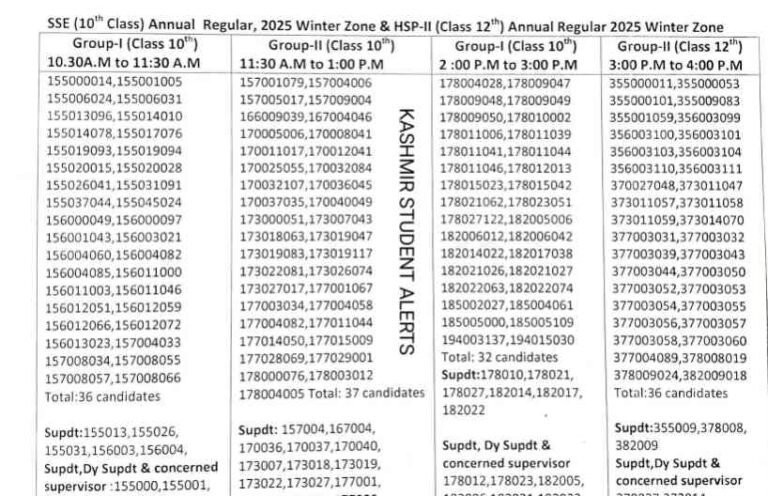
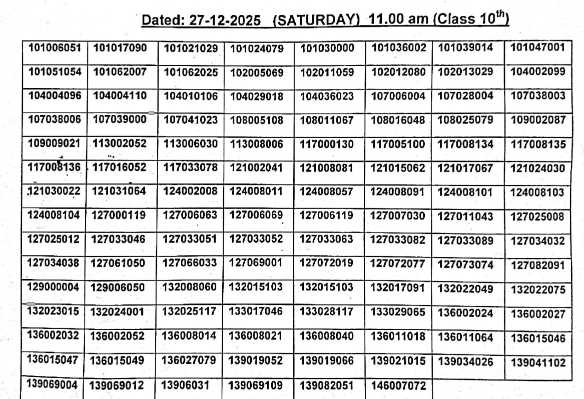
The Jammu and Kashmir Board of School Education (JKBOSE) has issued important examination guidelines for the upcoming October–November 2025 Annual Regular Exams for classes 10th, 11th, and 12th in Kashmir Division, including District Kargil. These instructions focus on ensuring smooth, fair, and transparent Board examinations without inconvenience to students or evaluation staff.

In this detailed article, we break down each instruction, its purpose, and what both students and school authorities must strictly follow according to the official JKBOSE circular dated 19-11-2025.

Whether you are appearing in Class 10th, Class 12th, or part of the examination staff — this guide will help you fully understand all the rules that must be followed in the examination halls.


🔹 Why Are These JKBOSE Exam Instructions Important?

JKBOSE conducts one of the largest school examinations in Jammu and Kashmir. Maintaining:

  • Confidentiality of question papers
  • Discipline in exam halls
  • Prevention of unfair means
  • Smooth evaluation and delivery of answer sheets

…is critical to deliver merit-based education.

These rules not only ensure a standardized process across the state but also guarantee a safe and distraction-free atmosphere for examinees.


🔹 Who Must Follow the JKBOSE Exam Instructions 2025?

These instructions are issued mainly for:

✔ Superintendents

✔ Deputy Superintendents

✔ Assistant Superintendents

✔ Invigilators

✔ Other Supervisory Staff

However, several points apply directly to students, especially regarding hall entry rules and answer sheet information.


📝 Detailed JKBOSE Class 10th & 12th Exam Instructions 2025

Below are the instructions as prescribed by the Board — explained in simple language for easy understanding:


🔹 1️⃣ Strict Adherence to JKBOSE Date Sheet

Superintendents must follow the date sheet daily and collect confidential exam material accordingly.

📌 Purpose:
To avoid any premature opening or misuse of confidential question papers.


🔹 2️⃣ Reporting Time: One Hour Before Exam

All supervisory staff must be present at least one hour before the exam starts.

📌 Purpose:
To set up seating arrangements, receive confidential material, and ensure timely commencement of exams.


🔹 3️⃣ Mandatory Admit Card and ID Verification

Before any student enters the examination hall, the staff must:

✔ Verify Admit Card
✔ Verify ID (School ID or Government ID)

📌 Purpose:
To prevent impersonation and unauthorized entry.

➡️ Students must carry their admit cards every day.
If not, entry will be denied.


🔹 4️⃣ Maintain Silence and a Distraction-Free Environment

Examination staff must ensure:

  • No noise or disturbance near examination zones
  • Continuous patrol but not intrusive
  • Immediate action if cheating is suspected

📌 Purpose:
To provide students with full concentration while maintaining security.


🔹 5️⃣ Ensure Correct Roll Number & Series on Answer Scripts

Supervisory staff must check that students:

  • 👉 Write correct Roll Number
  • 👉 Write correct Series Number
  • 👉 Fill required personal details correctly

📌 Purpose:
Incorrect details can lead to evaluation errors or result delays.

➡️ Students should double-check before submitting answer sheets.


🔹 6️⃣ Answer Sheets Must Be Packed Subject-Wise (Not Roll-No Wise)

Answer sheets should be:

✔ Packed by subject series-wise
✔ Securely sealed
✔ Delivered/consigned as instructed

📌 Purpose:
For easy evaluation and prevention of misplacement or tampering.


🔹 7️⃣ Immediate Reporting of Any Irregularity

If supervisors notice:

  • Cheating
  • Mismanagement
  • Missing material
  • Unrest or discipline issues

They must inform authorities without delay.

📌 Purpose:
Prevent escalation and maintain fairness.


🏫 JKBOSE Internal Distribution List (Who Received the Circular?)

The notification was distributed to:

  1. Joint Secretary Secrecy (KD)
  2. Deputy Secretary Secrecy (KD)
  3. Assistant Secretary Examination (KD)
  4. PS to Secretary/PA Chairman
  5. All Heads of Sub/Branch Offices Kashmir Division
  6. Assistant Secretary ITSS for uploading instructions on the official website
  7. Concerned File

🎯 What Do These Instructions Mean for Students?

Even though the circular is primarily meant for the exam staff, students must note:

✔ Bring Admit Card & ID Daily

No excuses are accepted at JKBOSE centers.

✔ Reach Center 30–40 Minutes Earlier

Late entry may be refused.

✔ Fill Answer Sheet Details Correctly

Wrong Roll No. = Result problems later!

✔ No Cheating or Malpractice

Severe strictness is already observed.

✔ Stay Calm and Focused

Environment will be fully controlled inside centers.


❗Important: No Wrong Handling of Confidential Material

Exam materials will be collected only from Police Stations daily based on the date sheet.

📌 Meaning:
Question papers remain fully confidential till the moment they are opened in the exam hall.


🔐 How JKBOSE Maintains Exam Fairness

These guidelines help ensure:

Exam Security Measures Purpose
Confidential papers from police stations No leakage
Entry checks No impersonation
Invigilator monitoring No unfair means
Series-wise packing Smooth evaluation
Early reporting Timely exams

Such procedures align Kashmir Division exams with other major education boards in India.


🧑‍🎓 Advice for Students Appearing in JKBOSE Exams 2025

To help the students further, here are some expert tips for JKBOSE Class 10th & 12th Board Exams:


📍 Before the Exam

  • Keep a checklist: Admit Card + ID + Stationery + Transparent Pen Box
  • Sleep well the night before
  • Revise diagrams, formulas, maps, definitions

📍 During the Exam

  • Read question paper carefully
  • Answer high scoring/long answers first
  • Maintain clean handwriting and proper spacing
  • Draw margins on answer sheets

📍 After the Exam

  • Do not discuss too much with friends — stay focused for the next exam
  • Reach home early and revise for the next subject

🔍 Digital Reforms: JKBOSE Likely to Enhance Monitoring

Over recent years, JKBOSE has strengthened:

  • CCTV surveillance in exam centers
  • Anti-malpractice squads
  • Secure digital databases for results
  • Online admit card & answer sheet records

These developments prove that the Board is working toward modernized and corruption-free examinations.


📰 Latest News on JKBOSE Board Exams 2025

As per recent updates:

  • Date sheets for Secondary (10th) and Higher Secondary (12th) exams are released center-wise for the Kashmir region.
  • Practical exam schedules will be announced separately.
  • Evaluation centers are being upgraded for faster result processing.

📌 Students should keep checking the JKBOSE official website regularly.


📌 Follow Rules = No Stress

The JKBOSE Class 10th & 12th Exam Instructions 2025 ensure:

✨ Fairness
✨ Security
✨ Smooth execution
✨ Better evaluation
✨ Zero malpractice tolerance

👩‍🏫 Supervisory staff must enforce these rules correctly.
👨‍🎓 Students must obey them strictly.

A disciplined examination environment benefits everyone — especially those who genuinely work hard.


📍 Quick Summary for Students

Requirement Mandatory
Admit Card ✔ Yes
ID Proof ✔ Yes
Roll No. & Series on Answer Sheet ✔ Must
Early Reporting ✔ Required
Cheating Attempts ❌ Strict Penalty

Director warns private schools violating norms, safeguarding parents by regulating fee structures under government rules

0

Director Education Warns of Action Against Schools Violating Government Norms

Srinagar, Nov 23: Director School Education Kashmir Naseer Ahmed Wani on Sunday said that strict action will be taken against private schools that violate government norms. Speaking to reporters, he said both government and private institutions are meant to impart education, and no school will be allowed to operate according to its own will.

Wani said education must remain affordable and transparent, adding that the department will not permit any practices that burden parents or violate approved regulations. He said the Fee Fixation and Regulation Committee has been monitoring and regulating the fee structure of private schools to ensure compliance with established guidelines.

“Private schools that violate government norms will face action. Both private and government schools are here to impart education. Education should be affordable and private schools will not be allowed to do anything on will,” Wani said.

He appealed to parents to approach the Fee Fixation Committee if they have any grievance regarding fee structure or related matters. He said the committee has been set up precisely to address such concerns and ensure fairness in the system.

The director said the department remains committed to safeguarding the interests of students and parents while ensuring that schools function within the framework laid down by the government. [KNT]

Higher Education Reform Bill to be Tabled in Parliament as Major Shift Likely

0

Higher-Education Overhaul: India Spearheads Single Regulator Reform

New Delhi – In a bold move set to reshape the higher-education landscape, the Government of India is preparing to introduce the Higher Education Commission of India (HECI) Bill, 2025 during the upcoming Winter Session of Parliament (beginning December 1, 2025). This legislation aims to replace multiple regulatory bodies with a single, unified regulator — marking one of the most significant reforms of the higher-education sector in recent decades.


The Shift in Focus: From Fragmentation to Unity

Currently, India’s higher-education system is overseen by multiple bodies with overlapping functions. The University Grants Commission (UGC) governs non-technical universities; the All India Council for Technical Education (AICTE) regulates technical institutions; and the National Council for Teacher Education (NCTE) sets norms for teacher-education programmes.

Under the proposed Bill, these three bodies (and possibly other overlapping regulatory functions) would be subsumed under the new Higher Education Commission of India (HECI). The aim: simplify governance, strengthen quality assurance and avoid duplication of oversight.

Despite the consolidation, certain domains — notably medical and legal education — are slated to remain outside the new regulator’s remit, continuing under their respective specialised statutory bodies.


What the Bill Seeks to Do

The draft of the HECI Bill outlines several core functions:

  • Regulation: Setting standards for institutions, programmes and governance.
  • Accreditation: Ensuring institutions meet defined quality benchmarks.
  • Academic standard-setting: Curriculum design, learning outcomes and professional benchmarks.
  • (In some descriptions) Funding oversight: Some reports say funding will be part of the framework, although the Ministry of Education appears to retain the funding vertical in many accounts.

However, government briefing notes clarify that the Bill calls for a separation of functions: regulation/accreditation/standards under HECI, while funding decisions remain with the administrative ministry.

In short, the new structure aims to ensure that institutions are regulated fairly and consistently, while leaving resource allocation to governmental discretion — thereby reducing conflicts of interest and clarifying accountability.


Why This Reform Now?

The impetus for reform comes in large part from the National Education Policy 2020 (NEP-2020), which recommended a “complete overhaul” of India’s higher-education-regulatory system. The policy argued that the existing fragmented system hampered innovation, institutional autonomy and global competitiveness of Indian universities.

Moreover, stakeholders have long pointed out that overlapping jurisdictions, redundant approvals and inconsistent standards have limited the ambitions of India’s university system — especially as the country seeks to become a global higher-education hub.

The current government has pushed this agenda more vigorously since 2021, with renewed committees, consultations and drafts culminating in the upcoming Bill.


What It Means for Institutions and Students

For higher-education institutions (HEIs) and students, the reform could bring several potential benefits:

  • Streamlined approvals & clearer regulatory pathways: Institutions may face fewer bureaucratic hurdles and faster decision-making.
  • Improved global recognition of Indian degrees: A unified regulator and accreditation regime may enhance international credibility of Indian institutions.
  • Greater institutional autonomy: By separating regulation from funding, institutions may gain more freedom for research, innovation and collaboration.
  • More consistent quality standards: With one regulator, discrepancies between technical, non-technical and teacher-education domains may reduce — leading to more uniform quality.

However, with opportunity come risks:

  • Centralisation concerns: Some analysts fear that merging multiple bodies into one may reduce domain-specific expertise and institutional flexibility.
  • Implementation challenge: Transitioning hundreds of universities and thousands of colleges into a new regulatory architecture is complex, and disruption risks exist.
  • Autonomy vs oversight balance: Ensuring that institutional autonomy is preserved while enforcing standards will be a delicate balancing act.

Timeline & Next Steps

The Bill is listed for introduction in the Winter Session of Parliament, starting December 1, 2025. Once introduced, it will undergo the usual parliamentary processes: first reading, possibly committee review, amendments and eventual passage (either in this session or later).

Prior drafts date back to 2018, when a draft titled the “Higher Education Commission of India (Repeal of UGC Act)” was circulated for public consultation. That earlier attempt did not advance fully, but the fresh momentum under the current government has brought the initiative to this stage.

In the meantime, the education ministry has constituted committees tasked with integrating data from UGC/AICTE/NCTE, designing institutional frameworks for the new regulator, and aligning them with the NEP’s goals.


Sector Stakeholders React

While the reform has broad support for rationalising the regulatory architecture, reactions from stakeholders reflect cautious optimism:

  • Many vice-chancellors and institutional heads welcome the promise of simplified regulation and unified standards — especially for institutions navigating multiple approvals.
  • Some teacher-training bodies and technical-education institutions have expressed concerns about losing specialised voice or oversight when being subsumed under a broad regulator.
  • Education-policy analysts underline the importance of safeguarding institutional autonomy, avoiding one-size-fits-all regulation, and guaranteeing that the transition does not result in undue disruptions for students.

Looking Ahead: What to Watch For

As the HECI Bill moves through Parliament and eventually into implementation, key factors to monitor include:

  • Scope of the regulator: How the Bill defines which institutions and programmes fall under HECI’s purview (e.g., exclusions of medical/law institutions).
  • Funding linkages: Whether the separation of regulatory and funding functions actually translates into institutional autonomy.
  • Accreditation mechanisms: How the new body sets, monitors and enforces quality benchmarks across diverse institutions.
  • Transition safeguards: Measures to ensure that students currently enrolled are not adversely affected by regulatory change.
  • State-centre coordination: Education being a concurrent subject, how state institutions’ roles interplay with the new federal regulator.
  • International benchmarking: How Indian institutions will leverage the reform to enhance global partnerships, research output and rankings.

Conclusion

The forthcoming HECI Bill offers a landmark opportunity to redefine India’s higher-education governance — responding to decades-old structural challenges by creating a unified regulator, clarifying roles and potentially accelerating institutional innovation. If implemented effectively, the reform could strengthen the country’s ambition to emerge as a global education hub and raise the bar for academic excellence.

Yet, the success of such an ambitious reform will hinge on thoughtful implementation, inclusive stakeholder engagement and safeguarding institutional diversity. The journey from fragmented regulation to streamlined excellence begins now — and the choices made in the coming months will determine how well Indian higher education thrives in the decades ahead.

Education Desk

How to Join the Indian Army Aviation Corps in 2025: Eligibility & Training Guide

0

How to Join the Indian Army Aviation Corps in 2025: Eligibility & Training Guide

For young aspirants who dream of flying high while serving the nation, the Indian Army Aviation Corps offers one of the most prestigious military careers. The Corps supports the Army through vital aerial operations including transport, surveillance, reconnaissance, casualty evacuation, and high-altitude missions. If you are planning to join in 2025, this guide will help you understand eligibility, entry process, and training details.

Importance of the Army Aviation Corps

The Corps plays a crucial role in the Indian Army’s operations across diverse environments such as mountains, deserts, dense forests, and conflict zones. It operates helicopters as well as Remotely Piloted Aircraft Systems (RPAS/UAVs) and conducts missions ranging from disaster relief to counter-terrorism operations.

Serving in the Aviation Corps is not just a job — it is a challenging and honorable responsibility directly contributing to national security.


Eligibility Criteria to Join Army Aviation Corps

One cannot join the Army Aviation Corps directly from civilians. First, you must become a commissioned officer in the Indian Army.

Key Eligibility Requirements:

  • Must be a commissioned officer in the Indian Army
  • Must volunteer for the Aviation Corps after commissioning
  • Must meet strict aviation medical standards including vision and physical fitness
  • Must have a strong academic and training performance
  • May require clearing flying aptitude tests such as CPSS/PABT for pilot roles

Only officers who pass all medical and aptitude qualifications are inducted into the aviation wing.


How to Become an Officer Before Joining Aviation

To become eligible to volunteer for Army Aviation, you must join the Army as an officer through one of these entries:

After Class 12

  • National Defence Academy (NDA)

After Graduation

  • Combined Defence Services Exam (CDS)
  • Technical Entry Schemes for engineering students
  • University Entry Scheme for final-year engineering candidates
  • NCC Special Entry
  • Short Service Commission (SSC) for both men and women

After successfully completing the training and becoming an officer, you can apply for Army Aviation.


Training at Combat Army Aviation Training School (CATS)

Selected officers undergo special aviation training at the Combat Army Aviation Training School in Nashik, Maharashtra.

What training includes:

  • Basic helicopter flying training
  • Aerial combat and tactical flying missions
  • High-altitude flight operations in tough terrain
  • Simulator-based training on advanced aircraft systems
  • RPAS/UAV handling for selected officers
  • Courses for specialization and combat aviation roles

After successful completion, officers earn their Aviation Wings and join operational aviation units across India.


Career Roles in Army Aviation Corps

The Corps offers exciting and diverse operational roles:

  • Pilot of utility and combat helicopters
  • RPAS/UAV operator and mission commander
  • Participation in rescue, relief, and tactical operations
  • Deployments in remote and high-risk zones
  • Opportunity for instructional and leadership positions in aviation units

It is a path filled with adventure, responsibility, and honor.


Tips for Aspirants

  • Maintain excellent health and fitness from an early stage
  • Focus on eye-vision care, as medical standards are strict
  • Build leadership qualities and strong discipline during officer training
  • Study aviation basics to boost aptitude and interest
  • Be mentally prepared for challenging military assignments

Final Thoughts

Joining the Indian Army Aviation Corps in 2025 demands determination, physical toughness, high morale, and a strong sense of duty. While the path is long — from entering the Army as an officer to earning your aviation badge — the reward is one of the most respected roles in the Indian Armed Forces.

If you are passionate, disciplined, and ready to dedicate yourself to the country, the Army Aviation Corps offers a remarkable career in the sky.

No Major Weather Activity Expected in J&K Till Mid-December: Sonam Lotus

0

No Major Weather Activity Expected in J&K Till Mid-December: Sonam Lotus

Srinagar, Nov 23, KNT: Meteorologist Sonam Lotus today said that Jammu and Kashmir is unlikely to witness any major weather activity until December 15, adding that the prevailing dry spell is expected to continue across the region. He said that temperatures will dip further in the coming days, intensifying the ongoing cold wave, particularly in the Valley.

Speaking to Kashmir News Trust, Lotus said that the current atmospheric conditions indicate a prolonged period of dry and stable weather with no major precipitation in sight. He added that although skies will largely remain clear, mornings and evenings will turn colder as minimum temperatures continue to fall.

“It will remain dry and clear,” he said. “But the cold will intensify in the mornings and evenings. The minimum temperature may go down further, possibly touching minus three to four degrees.”

The deepening chill has already pushed locals to stock up on heating appliances and winter essentials. Calm nights and cloudless skies have allowed temperatures to drop sharply, while frost formation has increased in several upper areas.

Lotus clarified that while light snowfall may become possible after mid-December, there is no indication of any significant or widespread snowfall during the early winter period. “After mid-December, there are chances of snowfall,” he said. “But there is no forecast of any good snowfall in December.”

He added that long-range weather outlooks remain uncertain, though current data shows no approaching system capable of bringing major snowfall to Jammu, Kashmir, or Ladakh in the coming weeks. [KNT]