Monday, April 13, 2026
Advertisementspot_img
Home Blog Page 120

JKBOSE Class 10th Science Question Paper 2025 — Download PDF

0

JKBOSE Class 10th Science Question Paper 2025 – Winter Zone | Exam Held on 13 November 2025 | Download PDF

The Jammu and Kashmir Board of School Education (JKBOSE) successfully conducted the Class 10th Science Examination for Winter Zone districts on 13 November 2025. The Science paper is considered one of the most important subjects for students in Class 10, and having access to the original JKBOSE Class 10th Science Question Paper 2025 can significantly help future aspirants prepare better.

To support students of upcoming batches, teachers, and coaching institutions, we have provided the complete insights, chapter-wise weightage, difficulty level, and the official Science question paper PDF from the 2025 Winter Zone exam.

This detailed article covers:

  • JKBOSE 10th Science Exam 2025 Highlights
  • Paper Pattern & Section-wise Marks
  • Chapter-wise Marks Distribution
  • Difficulty Level & Important Observations
  • Expected Trends for JKBOSE 10th Science Exam 2026
  • How This Question Paper Helps Future Students
  • Previous Year Comparison
  • Expert Tips & Strategy for Scoring 90+ Marks

This guide is designed to help students prepare confidently and perform their best in future JKBOSE exams.


1. Overview – JKBOSE Class 10th Science Exam 2025 (Winter Zone)

The Winter Zone of Jammu & Kashmir includes districts where schools follow the winter academic schedule, and Class 10 board exams are traditionally conducted in November.

The Science paper 2025 was held smoothly on:

  • Exam Date: 13 November 2025
  • Paper Code: As per JKBOSE format
  • Total Marks: 80 (theory)
  • Time Duration: 3 hours
  • Practical/IA: 20 Marks

Science as a subject combines conceptual understanding, diagrams, numerical ability, and application-based reasoning. JKBOSE has been gradually shifting toward competency-based questions, aligning with NEP guidelines, and this paper reflected that trend.


2. JKBOSE Class 10th Science Question Paper 2025 – Structure & Pattern

The question paper followed the structure that JKBOSE has used in recent years.

Total Sections in the Paper

The paper was divided into the following sections:

  • Section A – MCQs / Very Short Answer Questions (1 mark each)
  • Section B – Short Answer Questions (2 marks each)
  • Section C – Long Answer / Application-Based Questions (3–5 marks)
  • Section D – Diagram/Case Study-based Questions

Distribution of Marks

Section Type of Questions Marks
A MCQs, Fill in the blanks, True/False 20 marks
B Short Answer Type 24 marks
C Long Answer Type 20 marks
D Case Study & Diagram-based 16 marks
Total 80 marks

3. Chapter-Wise Weightage Based on the 2025 Science Paper

Here is the estimated weightage based on the 2025 Winter Zone question paper:

Physics Chapters

Chapter Weightage
Light – Reflection & Refraction 8 marks
Human Eye and Colourful World 4 marks
Electricity 6 marks
Magnetic Effects of Electric Current 4 marks

Chemistry Chapters

Chapter Weightage
Chemical Reactions & Equations 5 marks
Acids, Bases and Salts 4 marks
Metals & Non-metals 5 marks
Carbon & Its Compounds 6 marks

Biology Chapters

Chapter Weightage
Life Processes 8 marks
Control & Coordination 4 marks
How Do Organisms Reproduce? 6 marks
Heredity & Evolution 4 marks
Our Environment 4 marks

This distribution can guide 2026 and later batch students in deciding study priorities.


4. Difficulty Level Analysis – Science Question Paper 2025

Student feedback from Winter Zone districts such as Kupwara, Baramulla, Poonch, and Kulgam indicates:

Overall Difficulty: Moderate

Physics Section

  • Moderate difficulty
  • Numericals from Electricity were straightforward
  • Diagram-based questions from Light chapter

Chemistry Section

  • Easiest portion of the paper
  • Questions were direct and NCERT-based
  • Acid-base reaction questions were simple

Biology Section

  • Moderate to lengthy
  • Life Processes questions needed detailed writing
  • Reproduction chapter had a 5-mark long answer

Most Scoring Chapters

  • Acids, Bases and Salts
  • Metals and Non-metals
  • Life Processes
  • Light

Challenging Sections for Students

  • Case study questions
  • Diagram-based questions
  • Heredity numerical (Punnett square type)

5. Why This Question Paper Is Important for Future Students

Having access to this question paper is extremely helpful because:

1. Helps Understand Trends

JKBOSE tends to repeat patterns, not exact questions. Observing trends helps prepare smarter.

2. Improves Answer Writing Skills

Science answers require diagrams, steps, definitions, and labelling accuracy.

3. Boosts Confidence

Knowing previous papers removes the exam fear and builds familiarity.

4. Helps Predict Important Chapters

The question paper shows which chapters JKBOSE focuses on.

5. Useful for Mock Tests and Practice

Teachers and students can use this paper for:

  • Daily practice
  • Pre-board preparation
  • Solving under timed conditions

6. Direct Download – JKBOSE Class 10 Science Question Paper 2025 PDF

You can download the original scanned question paper from the link below:

If the link does not open immediately, try downloading using Chrome or Firefox browser.


7. Section-by-Section Breakdown of the 2025 Science Question Paper

Below is a detailed explanation of what type of questions appeared.


Section A – MCQs / Objective Questions (20 Marks)

This section contained:

  • MCQs based on Light, Life Processes, Metals, Environment
  • Fill in the blanks related to chemical reactions
  • True/False questions
  • Match the following
  • Diagram interpretation

This was the most scoring section for prepared students.


Section B – Short Answer Questions (24 Marks)

Included questions like:

  • Write chemical equations
  • Define terms such as:
    • Homologous series
    • Magnetic field lines
    • Amphoteric substances
  • Short numericals from electricity
  • Organs involved in digestion or respiration

Students needed to write concise and accurate answers.


Section C – Long Answer Questions (20 Marks)

Examples:

  • Ray diagrams of image formation in a concave mirror
  • Explanation of saponification reaction
  • Binary fission vs budding
  • Problems based on Ohm’s law

These questions required detailed explanation and diagrams.


Section D – Case Study & Diagram-Based (16 Marks)

Case study questions were based on:

  • Environmental issues
  • Human eye defects
  • Genetics and heredity

Diagram-based questions included:

  • Labelled diagram of nephron
  • Refractive index ray diagrams
  • Structure of a flower

8. Expected Trends for JKBOSE Class 10th Science Exam 2026

Based on the 2025 pattern, future trends may include:

✔ More competency-based questions

✔ More case studies

✔ Higher weightage to diagrams

✔ Application-based numericals

✔ Situational and real-life examples

Students preparing for 2026 should:

  • Practice NCERT thoroughly
  • Master diagrams from Biology & Physics
  • Solve previous year papers from 2022–2025
  • Attempt at least 10 model papers

9. Tips to Score 90+ Marks in JKBOSE 10th Science Exam

Here are expert preparation strategies:

1. Stick to NCERT

Almost 90% of questions are strictly from NCERT.

2. Study High-Weight Chapters First

Biology: Life Processes
Chemistry: Carbon compounds
Physics: Light + Electricity

3. Practice numericals daily

Focus on formulas and units.

4. Draw clean, labelled diagrams

Even if you’re unsure, a well-drawn diagram fetches partial marks.

5. Solve last 5 year papers

Including the provided 2025 paper.

6. Make conceptual notes

Flowcharts, bullet points, keywords.

7. Attempt the paper neatly

Teachers give better marks for structured answers.


10. Previous Year Comparison (2022–2025)

Year Difficulty Level New Pattern Used Competency Questions
2022 Easy No Low
2023 Moderate Yes Medium
2024 Moderate to Hard Yes Medium
2025 Moderate Strong YES High

JKBOSE is moving toward a more analytical approach, similar to CBSE patterns.

 JKBOSE Class 10th Science Question Paper 2025 Overview

The JKBOSE Class 10th Science Question Paper 2025 (Winter Zone) was well-balanced and aligned with the NCERT syllabus. Students who appeared for the exam found the paper moderately easy, with some tricky case study and diagram questions.

Future students can benefit immensely from solving this question paper as part of their exam preparation. It provides clarity on:

  • Chapter-wise weightage
  • Types of questions asked
  • Paper structure
  • Important diagrams
  • Expected difficulty level

Don’t forget to download the official question paper for practice.

👉 Download PDF:
Click here
Cabinet Secretariat Recruitment 2025: Notification, Eligibility, Vacancy, Application Form

0

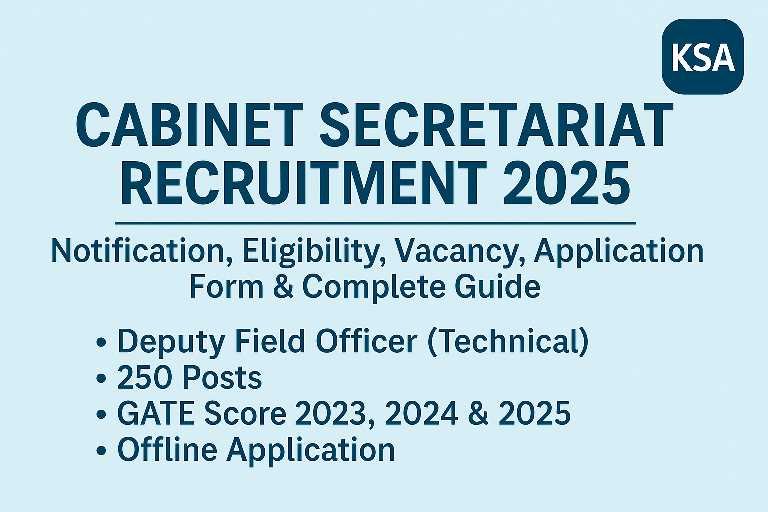
Cabinet Secretariat Recruitment 2025: Notification, Eligibility, Vacancy, Application Form & Complete Guide

Government technical jobs in India hold great prestige and offer stable career opportunities for engineering graduates and science postgraduates. One of the most sought-after notifications every year is the Cabinet Secretariat Recruitment, known for its competitive selection process and excellent career growth. The newly released Cabinet Secretariat Recruitment 2025 notification invites applications for 250 posts of Deputy Field Officer (Technical) through GATE score-based shortlisting.

This comprehensive guide covers complete details including eligibility, age limit, educational qualifications, vacancy distribution, selection process, important dates, application method, documents required, and preparation tips.
If you are a GATE-qualified candidate looking for a central government technical job, this recruitment is an excellent opportunity.


About Cabinet Secretariat Recruitment 2025

The Cabinet Secretariat of India has released Advertisement No. 02/2025 for the post of Deputy Field Officer (Technical). The recruitment will be conducted entirely based on GATE 2023, GATE 2024, or GATE 2025 scores, followed by a personal interview.

This recruitment is direct, with postings likely in New Delhi or under central government establishments. It is an excellent opportunity for those seeking a role that involves technical operations, analysis, data interpretation, and field assignments.

Highlights of Cabinet Secretariat Recruitment 2025

Particular Details
Organization Cabinet Secretariat, Government of India
Post Name Deputy Field Officer (Technical)
Advertisement No. 02/2025
Total Vacancies 250
Mode of Application Offline
GATE Score Valid GATE 2023, 2024, or 2025
Selection Process GATE Score + Interview
Last Date to Apply 14 December 2025
Application Fee NIL
Posting Location Delhi / Central Govt establishments

Cabinet Secretariat DFO Technical Vacancy 2025 – Category-wise Breakdown

The 250 vacancies are distributed across several technical domains. Below is the detailed subject-wise vacancy distribution:

Vacancy Details

  • Computer Science / IT (CS/IT): 124 Posts
  • Data Science / Artificial Intelligence (DA): 10 Posts
  • Electronics & Communication / Telecommunication (EC): 95 Posts
  • Civil Engineering (CE): 2 Posts
  • Mechanical Engineering (ME): 2 Posts
  • Physics (PH): 6 Posts
  • Chemistry (CY): 4 Posts
  • Mathematics (MA): 2 Posts
  • Statistics (ST): 2 Posts
  • Geology / Geophysics (GG): 3 Posts

This distribution clearly shows a high demand for CS/IT and Electronics-related fields, followed by other science and engineering disciplines.


Eligibility Criteria for Cabinet Secretariat Recruitment 2025

Understanding the eligibility criteria is crucial for ensuring successful application. Below are the detailed requirements:

1. Educational Qualification

Candidates must have any of the following:

  • B.E. / B.Tech degree in relevant engineering disciplines
    OR
  • Master’s degree (M.Sc.) in relevant science/technical subjects

Branches accepted include:

  • Computer Science / IT
  • Data Science
  • Artificial Intelligence
  • Electronics & Communication
  • Telecommunication
  • Civil Engineering
  • Mechanical Engineering
  • Physics
  • Chemistry
  • Mathematics
  • Statistics
  • Geology / Geophysics

Additionally:

A valid GATE score is mandatory

GATE scores accepted:

  • GATE 2023
  • GATE 2024
  • GATE 2025

Candidates must provide the GATE scorecard while applying.


2. Age Limit

  • Maximum Age: 30 years (as of 14 December 2025)

Age Relaxation

Category Relaxation
SC / ST 5 years
OBC 3 years
PwBD As per Govt rules
Ex-Servicemen As per norms

Cabinet Secretariat Recruitment 2025 Selection Process

The recruitment is conducted in two stages:

Stage 1 – GATE Score Shortlisting

Candidates will be shortlisted based on their normalized GATE score. The higher your score, the better your chances of being called for the interview.

Stage 2 – Personal Interview

Shortlisted candidates will be called for a technical-cum-personal interview conducted by the Cabinet Secretariat.

The final merit list will be prepared based on:

  • GATE Score
  • Interview Performance
  • Verification of documents

No written examination will be conducted.


Cabinet Secretariat Recruitment 2025 – Salary Structure

The post of Deputy Field Officer (Technical) offers an attractive central government salary.

Though the exact pay structure varies as per central government rules, typically the salary includes:

  • Basic Pay
  • Dearness Allowance
  • House Rent Allowance
  • Transport Allowance
  • Special Allowances

Total Estimated Salary (Approx): ₹65,000 – ₹80,000 per month
(Varies based on location and revised central government rules.)


How to Apply for Cabinet Secretariat Recruitment 2025 (Offline Method)

The application process is completely offline. Follow these step-by-step instructions:


Step-by-Step Application Process

Step 1: Download the Application Form

The application form is available in the official notification PDF.
Candidates must print it on an A4-size sheet and fill it neatly.


Step 2: Attach Required Documents

Self-attested photocopies of the following documents must be attached:

  • 10th certificate (for age proof)
  • 12th marksheet
  • B.E./B.Tech or M.Sc. degree certificate
  • All semester/year-wise marksheets
  • Valid GATE scorecard (2023/ 2024/ 2025)
  • Caste certificate (if applicable)
  • PwBD certificate (if applicable)
  • Ex-servicemen certificate (if applicable)
  • Passport-size photographs
  • Government ID proof

Step 3: Prepare the Envelope

Write clearly on the envelope:

“Application for the post of Deputy Field Officer (Technical) – 2025”


Step 4: Send the Application via Ordinary Post

Applications must be sent ONLY through Ordinary Post to the following address:

Post Bag No. 001, Lodhi Road Head Post Office, New Delhi – 110003


Step 5: Keep Proof of Dispatch

Always retain the post office receipt as proof.


Important Dates – Cabinet Secretariat DFO Technical Recruitment 2025

Event Date
Notification Release Date 13 November 2025
Last Date to Apply 14 December 2025
Interview Shortlist Release To be notified
Interview Date To be announced
Final Merit List After interviews

Candidates must ensure their application reaches the address before the deadline.


Why You Should Apply – Key Benefits

Here are the main reasons why the Cabinet Secretariat Recruitment 2025 is a great opportunity:

✔️ Central Government Job

Offers job security, growth, and excellent benefits.

✔️ No Application Fee

Free for all categories.

✔️ GATE-Based Recruitment

Transparent and merit-based selection.

✔️ Multiple Branches Eligible

Engineering + Science background candidates can apply.

✔️ 250 Vacancies

Large number of opportunities compared to many technical central government posts.

✔️ Early Career Opportunity

Fresh graduates with a valid GATE score can apply.


Preparation Tips for Interview

After shortlisting through GATE score, the key challenge is the interview. Here are the best preparation strategies:

1. Revise Core Technical Subjects

Interview panels focus on:

  • Data structures
  • Algorithms
  • Electronics fundamentals
  • Communication systems
  • Physics/chemistry basics
  • Engineering mathematics
  • Branch-specific concepts

2. Be Clear About Your GATE Paper

You must confidently discuss:

  • Why you chose your GATE paper
  • Your preparation strategy
  • Your rank and score
  • Key topics you mastered

3. Prepare Project & Internship Details

Brush up on:

  • Final year project
  • Research work
  • Technical internships
  • Tools and languages you used

4. Improve Communication Skills

Since the role is sensitive and technical, clarity in communication is needed.

5. Stay Updated with Scientific & Technical Developments

Questions often touch upon:

  • AI, ML trends
  • IT & cybersecurity
  • Electronics advancements
  • Data processing & GIS concepts
  • Scientific developments

Common Mistakes to Avoid

  • Incorrectly filled application form
  • Missing documents
  • Attaching non-self-attested copies
  • Not meeting the age criteria
  • Submitting after the last date
  • Not preparing for the interview

Ensure your application is complete and accurate before posting.


FAQs – Cabinet Secretariat Recruitment 2025

1. What is the last date to apply?

14 December 2025

2. Is the application online or offline?

Offline only.

3. Is GATE mandatory?

Yes. GATE 2023, 2024, or 2025 scores are accepted.

4. How many vacancies are there?

250 vacancies across engineering and science streams.

5. What is the age limit?

Maximum 30 years, with relaxations as per rules.

6. What is the selection process?

GATE score → Interview → Document Verification.

7. Is there an application fee?

No. Application is free of cost.

The Cabinet Secretariat Recruitment 2025 is one of the best central government opportunities for engineering and science graduates. With 250 vacancies and transparent GATE-based shortlisting, it is a golden chance for candidates seeking a prestigious government role.

If you have a valid GATE score and meet the eligibility criteria, you should definitely apply before the last date. Ensure your application is complete, gather all mandatory documents, and prepare well for the interview.

KVS and NVS Recruitment 2025: Complete Guide to Vacancies, Eligibility, Application Process & Selection Criteria

0

KVS and NVS Recruitment 2025: Complete Guide to Vacancies, Eligibility, Application Process & Selection Criteria


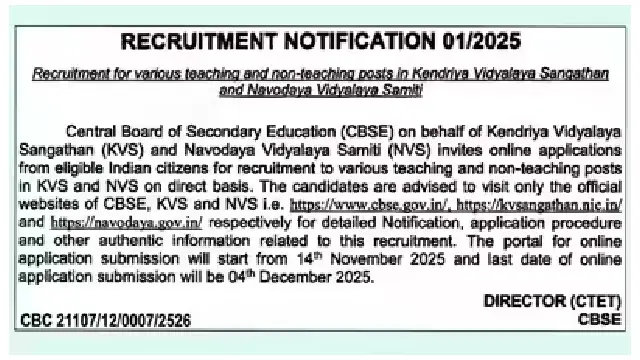
The education sector in India has received a major boost with the announcement of the KVS and NVS Recruitment 2025, one of the biggest recruitment drives for teaching and non-teaching posts under the Ministry of Education. Kendriya Vidyalaya Sangathan (KVS) and Navodaya Vidyalaya Samiti (NVS) are two of the most prestigious central government school networks in India, and every year lakhs of candidates eagerly wait for vacancies to open.

This year, the recruitment process is even more exciting because of the large number of expected vacancies, the short-notice announcement, and the golden opportunity for teachers and administrative staff seeking central-government jobs.

Table of Contents

  1. Introduction to KVS & NVS
  2. Why KVS and NVS Recruitment 2025 Is Important
  3. Highlights of KVS and NVS Recruitment 2025
  4. Post-Wise Vacancy Details
  5. Eligibility Criteria (Age, Education, Experience)
  6. Application Process – Step-by-Step
  7. Exam Pattern & Syllabus (Teaching + Non-Teaching)
  8. Selection Process Overview
  9. Salary Structure & Benefits
  10. Preparation Strategy for KVS & NVS 2025
  11. Important Documents Required
  12. Mistakes to Avoid During Application
  13. FAQs
  14. Final Thoughts

1. Introduction to KVS and NVS

Before diving into the recruitment details, let us understand the two institutions:

KVS (Kendriya Vidyalaya Sangathan)

  • Founded to provide quality education to the wards of central government employees.
  • Operates more than 1,200 schools across India.
  • Known for excellent academic results, uniform curriculum, and well-structured recruitment.

NVS (Navodaya Vidyalaya Samiti)

  • Established to provide modern quality education to talented students, mainly from rural backgrounds.
  • Operates 650+ residential schools, providing free education (including food & lodging).
  • Highly reputed for producing outstanding academic performers.

A job in these schools means:

  • Central Government Pay
  • Job Stability
  • National Posting Opportunities
  • Growth & Promotions
  • High Respect in Society

This is why the KVS and NVS Recruitment 2025 is among the most awaited government job announcements.


2. Why KVS and NVS Recruitment 2025 Matters

The 2025 recruitment cycle is crucial for several reasons:

A. Massive Vacancies

Both KVS and NVS are facing staff shortages due to expansion and retirements. As a result, thousands of teaching and non-teaching posts are expected to be filled this year.

B. Opportunities for Freshers & Experienced Professionals

Whether you are:

  • A newly graduated B.Ed candidate,
  • CTET-qualified teacher, or
  • An administrative professional…

…this recruitment offers opportunities at multiple levels.

C. Central Government Benefits

Employees enjoy:

  • 7th Pay Commission salary
  • House Rent Allowance
  • Medical Facilities
  • Pension (NPS)
  • Transfer options

D. High Career Growth

Teachers can grow from: PRT → TGT → PGT → Vice Principal → Principal → Deputy Commissioner

Administrative posts also offer structured growth.


3. Key Highlights of KVS and NVS Recruitment 2025

Below is a snapshot of expected highlights:

Feature Details
Recruiting Body KVS & NVS (Under Ministry of Education)
Post Types PRT, TGT, PGT, Principal, VP, Librarian, JSA, SSA, Steno, etc.
Total Vacancies Expected 12,000+ combined
Application Mode Online
Exam Mode Computer-Based Test (CBT)
Job Type Central Government
Posting Nationwide

4. Post-Wise Expected Vacancies

Teaching Posts

  • PGT (Post Graduate Teacher) – All subjects
  • TGT (Trained Graduate Teacher) – All subjects
  • PRT (Primary Teacher)
  • Principal & Vice Principal
  • Music Teacher / Art Teacher / PET

Non-Teaching Posts

  • Librarian
  • Junior Secretariat Assistant (JSA)
  • Senior Secretariat Assistant (SSA)
  • Stenographer
  • Lab Attendant
  • Staff Nurse
  • Mess Helper (NVS)

Vacancies are expected to be large because of the teacher shortage in both organisations.


5. Eligibility Criteria (Detailed)

Eligibility varies depending on the post. Below is a simplified breakdown:


A. Age Limit

Post Age Limit
PRT Up to 30 years
TGT Up to 35 years
PGT Up to 40 years
Principal Up to 50 years
Librarian Up to 35 years
JSA / SSA 27–30 years

Age relaxation:

  • SC/ST: +5 years
  • OBC: +3 years
  • PH: +10 years

B. Educational Qualification

PRT

  • 12th + D.El.Ed / JBT
  • OR Graduation + B.Ed
  • CTET qualification preferred

TGT

  • Graduation with B.Ed
  • CTET Paper 2 qualified

PGT

  • Post-graduation in relevant subject
  • B.Ed mandatory

Non-Teaching

  • Varies (Graduate / Diploma / Computer knowledge)

6. How to Apply for KVS and NVS Recruitment 2025: Step-by-Step

Follow these steps to apply without mistakes:

Step 1: Visit Official Websites

Step 2: Download Notification PDF

Read eligibility, post details and exam pattern carefully.

Step 3: Register Online

Enter:

  • Name
  • Mobile
  • Email
  • Aadhaar / ID proof details

Step 4: Fill Application Form

Add:

  • Personal details
  • Educational qualifications
  • Category
  • CTET status
  • Preferences

Step 5: Upload Documents

Ensure correct format:

  • Photo
  • Signature
  • Certificates
  • CTET proof

Step 6: Pay Fees (if applicable)

Step 7: Submit Form & Download Confirmation

Always keep a copy for future use.


7. Exam Pattern & Syllabus

Here is the general pattern for major posts.


A. PRT / TGT / PGT Exam Pattern

Section Questions Marks
General English 10 10
General Hindi 10 10
Reasoning 10 10
General Awareness 10 10
Teaching Aptitude 20 20
Subject Knowledge 80 80
Total 140 140

B. Non-Teaching Exam Pattern

Section Questions
Reasoning 25
Quantitative Aptitude 25
English Language 25
Computer Literacy 25

Syllabus Highlights

  • Child Development & Pedagogy
  • Indian Education Policy 2020 (NEP)
  • Environmental Studies (PRT)
  • Mathematics / Science / Social Science (TGT)
  • Advanced domain topics (PGT)

8. Selection Process

Selection involves:

1. Computer-Based Test (CBT)

Objective-type exam held nationwide.

2. Skill Test (If applicable)

  • Stenography test
  • Computer typing
  • Practical teaching demo

3. Interview / Personality Test

Mainly for:

  • PGT
  • TGT
  • Principal / VP

4. Document Verification

5. Medical Fitness Test

Successful candidates join on a probation period of 2 years.


9. Salary Structure & Benefits

Teaching Posts

Post Salary (Approx)
PRT ₹35,000–₹50,000
TGT ₹45,000–₹60,000
PGT ₹55,000–₹75,000
Principal ₹1,00,000+

Non-Teaching Posts

Post Salary
JSA ₹25,000–₹35,000
SSA ₹30,000–₹45,000
Librarian ₹45,000–₹60,000

Perks:

  • HRA
  • Transport Allowance
  • Medical Facilities
  • Pension (NPS)
  • Paid Leaves
  • Free accommodation in some NVS schools

10. Preparation Strategy

For Teaching Posts

  • Master subject knowledge
  • Study NCERT books for TGT/PRT
  • Practice pedagogy and child psychology
  • Solve previous year papers
  • Attend mock tests regularly

For Non-Teaching Posts

  • Strengthen general aptitude
  • Improve computer typing
  • Study administrative procedures

General Tips

  • Make a daily schedule
  • Revise regularly
  • Follow official updates
  • Stay consistent and calm

11. Documents Required

  • Aadhaar / ID proof
  • Education certificates
  • CTET certificate (if required)
  • Category certificate
  • Photograph & signature

12. Mistakes to Avoid

  • Incorrect photo/signature upload
  • Applying for wrong post
  • Filling wrong category
  • Missing deadlines
  • Using unofficial websites

13. Frequently Asked Questions (FAQs)

1. Is CTET mandatory for KVS and NVS Recruitment 2025?

For PRT/TGT – Yes, mostly required
For PGT – Often not required

2. Can freshers apply?

Yes, freshers can apply for PRT, TGT, PGT and clerical posts.

3. What is the selection process?

CBT → Skill Test → Interview → Document Verification

4. Are postings transferable?

Yes, candidates may be posted anywhere in India.

5. What is the age limit?

Varies from 30–50 years depending on the post.


14. Final Thoughts

The KVS and NVS Recruitment 2025 is an incredible opportunity for lakhs of aspirants seeking stable, prestigious and rewarding teaching or administrative jobs in central government schools. With excellent salaries, strong career growth, and national postings, this recruitment drive is expected to witness a huge number of applications.

If you are serious about securing a post, start preparing early, stay updated with official notifications, and ensure your documents are ready well before the application window opens.

AISSEE 2026 Correction Window: What You Must Know for All India Sainik School Entrance Examination 2026

0

AISSEE 2026 Correction Window: What You Must Know for All India Sainik School Entrance Examination 2026

The examination season for aspirants of the prestigious Sainik Schools Society is in full swing and one particularly important update demands your attention: the “AISSEE 2026 correction window” has now opened. If you or your child has applied for the entrance exam into Classes 6 or 9 for the academic session 2026-27, this article brings you a complete guide — what the correction window means, how to use it, what you can and cannot change, and how to maximise your chances of a smooth admission process.


1. What is AISSEE 2026? A quick recap

Before diving into the correction window specifics, let’s set the scene.

  • The All India Sainik School Entrance Examination (AISSEE) 2026 is organised by the National Testing Agency (NTA) for admissions into Classes 6 and 9 in Sainik Schools and newly approved Sainik Schools across India.
  • For the 2026 cycle, the exam date has been scheduled for 18 January 2026.
  • These schools are residential, CBSE-affiliated, and aim to prepare students for entry into institutions like the National Defence Academy.

Why is this important? Because the competition is high, the forms and data need to be accurate, and missing the correction window can cost you.


2. What is the “correction window”? Understanding the facility

When you submit your application form for AISSEE 2026, you enter the key details about the candidate: name, date of birth, class applying for, category, medium of instruction, exam city preferences, etc. After submission, often candidates realise errors — maybe a typo in the class code, a wrong medium of instruction selected, or an exam city with less connectivity.

To mitigate this, NTA provides the application correction window — a limited time period during which certain fields in the already-submitted form can be edited. The purpose: give candidates a chance to fix bona fide mistakes and ensure the form data aligns with official records and logistics.

For AISSEE 2026:

  • The correction window has been officially published by NTA.
  • According to sources, it opens from 12 November 2025 and runs up to 14 November 2025.
  • The NDTV article reports the window ends on 14 November 2025.

In short: if you miss this window, you cannot change certain key details of your application.


3. Editable vs Non-editable Fields: What you can and cannot change

Understanding which fields can be edited and which cannot is critical. Incorrect assumptions can cause last-minute panic or worse — disqualification.

✅ Editable Fields

According to the official NTA notice and news reports, the following fields are editable during the correction window:

  • Category and sub-category (General / OBC / SC / ST)
  • The class you’re applying for (Class 6 or Class 9)
  • Medium of instruction (for Class 6 especially)
  • Photograph and signature uploads (in case of low-resolution or wrong photo)
  • Examination city preferences (within the same State or Union Territory)
  • Date of Birth certificate field (i.e., the certificate date of birth)

❌ Non-Editable Fields

These fields cannot be changed once you’ve submitted the application and the correction window closes:

  • Candidate’s name
  • Parent/guardian’s name
  • Mobile number and email ID (used for communication)
  • Gender
  • Address

Pro Tip: If you think you’ve made mistakes in non-editable fields (e.g., name spelling), contact the NTA or the respective Sainik School as soon as possible. They may offer assistance, but no guarantee.


4. Why is the correction window so important?

You might ask — is it really worth focusing on this window? The answer: yes. Here’s why:

  • Avoids last-minute surprises: A wrong exam city can mean long travel, higher costs or even missing the exam centre.
  • Ensures eligibility: If you choose incorrect category or class, you may be disqualified or lose your seat.
  • Proper records for admission & scholarship: Sainik Schools often provide benefits for defence/ex-servicemen category, and mismatches can hamper verification.
  • Reduces stress: Knowing that your form is error-free gives you confidence to focus on exam preparation.

Thus, effectively leveraging the correction window can make a tangible difference in your AISSEE 2026 journey.


5. Step-by-step: How to use the correction window for AISSEE 2026

Here is a detailed walk-through of the process to access and utilise the correction window.

  1. Visit the official website: Go to exams.nta.nic.in — the official NTA portal.
  2. Find the AISSEE 2026 section: On the homepage, locate the “Sainik School” or “AISSEE 2026” link.
  3. Login: Enter your application number and password as used during registration.
  4. Access correction window: Click on the “Correction” link. The editable fields list will appear.
  5. Make corrections carefully: Change only the fields that are allowed; double-check spelling, codes, etc.
  6. Upload revised documents (if required): If the photograph/signature was blurry or didn’t match specifications, replace it.
  7. Submit and download the corrected form: Once done, save or download the revised form for your record.
  8. Keep the confirmation/printout safe: It will help during later stages such as admit card issuance, counselling, etc.

Important Note: After submission, edits cannot be undone. So inspect everything one final time.


6. Timeline & Important Dates for AISSEE 2026

Here are the key dates you should keep in mind:

Event Date
Registration window for AISSEE 2026 Opened (as per earlier notification)
Correction window opens ~12 November 2025
Correction window closes 14 November 2025
Exam date (AISSEE 2026) 18 January 2026

Tip: Set personal reminders well in advance. Many candidates miss simple deadlines because of overlapping exams or events.


7. Frequently Asked Questions (FAQs) about the correction window

Q1. Can I change my exam city to a city in another state?

No. You can only change the exam city within the same State or Union Territory as per the notification.

Q2. Can I change my mobile number or email ID in the correction window?

No. These fields are non-editable and must be correctly entered at initial submission.

Q3. What if I missed the correction window?

You cannot modify eligible fields after the window closes. In such cases, keep all original proofs ready, contact NTA or the Sainik School authority for guidance, and prepare with the originally submitted data.

Q4. Does correcting the form incur extra fee?

Usually, the correction window does not require paying extra fee — it’s part of the original submission process. However, always check official notification for any specification.

Q5. Will changing the class (6 or 9) in the correction window affect my eligibility?

Yes. Since the syllabus and structure differ for Class 6 and Class 9, ensure the class you choose aligns with your age eligibility and academic background.


8. Tips to avoid mistakes in the correction process

  • Use a desktop/laptop rather than mobile for making corrections, for better view and upload clarity.
  • Keep scanned copies of photo and signature in advance (correct size & format).
  • Maintain a checklist of fields to verify: category, medium, class, exam city, photograph, signature.
  • Cross-verify Category certificate, DOB certificate details before editing.
  • After correction, download and save a PDF screenshot of final form for your records.
  • Remain vigilant while editing — once changes are submitted, you cannot revert them.

9. The bigger picture: Why Sainik Schools matter

The Sainik School system holds a prestigious place in India’s education landscape. Some reasons why getting the form right matters even more:

  • Holistic development: These schools emphasise discipline, physical fitness, academics and leadership.
  • Path to defence services: Many alumni go on to join the National Defence Academy (NDA) and other defence academies.
  • Residential setup: Staying on-campus fosters peer learning, structured routine and robust mentoring.
  • New schools expanding reach: For 2026, additional Sainik Schools have been added.

Hence, the admission process must be approached with as much seriousness as the exam itself.


10. What next after you’ve corrected the form? Prepare for AISSEE 2026

Once you’ve secured that your form is error-free and properly submitted, the next phase begins: exam preparation. Here are a few pointers:

  • Get the syllabus: For Class 6 the exam pattern is typically 300 marks, comprising Language, Mathematics, Intelligence & General Knowledge.
  • Mock tests & past papers: Practising previous years’ papers helps you gain familiarity with the pattern and speed.
  • Time management: The OMR format demands quick decision-making; allocate time for each section accordingly.
  • Revision schedule: Create a plan for final 4-6 weeks where you focus on weak areas, mock tests, and revisiting key concepts.
  • Stay healthy: Balanced diet, good sleep, and light exercise help maintain focus.

11. Common pitfalls and how to avoid them

  • Pitfall: Uploading incorrect photo or signature format.
    Solution: Follow NTA specifications (size, format, background) and preview the upload.
  • Pitfall: Selecting exam city without checking connectivity or distance.
    Solution: Choose centre that’s reasonably accessible from your residence — factor in travel time, stay if required.
  • Pitfall: Leaving category/sub-category blank or incorrect.
    Solution: Verify your category certificate ahead of editing window.
  • Pitfall: Ignoring non-editable fields assuming they can be changed later.
    Solution: Be extremely careful at first submission; double-check every detail.
  • Pitfall: Panic after missing correction window.
    Solution: If missed, immediately contact authority; meanwhile focus on revision and ensure all other stages are well-managed.

12. Final words: Don’t overlook the AISSEE 2026 correction window

In competitive exams like AISSEE 2026, every detail counts. From selecting the correct class and medium to uploading a clean photograph and choosing an exam city that works for you — the little things add up. The correction window is your safety net, but only if you use it timely and wisely.

Make the most of it: log in, correct what’s required, and move onto preparation with confidence. The hard work you do now — both in form accuracy and exam prep — will pay dividends when exam day arrives.

Santoor Scholarship Program 2025-26: Eligibility, Benefits, Application Process & Last Date (Full Guide)

0

Santoor Scholarship Program 2025-26: Eligibility, Benefits, Application Process & Last Date (Full Guide)

The Santoor Scholarship Program 2025-26 is one of India’s most impactful scholarship initiatives dedicated to empowering young women from underprivileged backgrounds. Launched by Wipro Consumer Care and Wipro Cares, this scholarship has helped thousands of girls pursue higher education and build meaningful careers. The 2025-26 cycle continues this mission by offering financial support to eligible female students in Andhra Pradesh and Maharashtra who want to pursue full-time undergraduate studies.

This detailed guide covers eligibility, benefits, documents required, online application process, last date, selection criteria, and everything you need to know before applying. If you are a first-year undergraduate student or the parent of a girl child planning higher education, this article is a must-read.


📌 What is the Santoor Scholarship Program 2025-26?

The Santoor Scholarship Program is a prestigious initiative aimed at supporting young women from disadvantaged families who have completed their education in government schools. The goal is to encourage them to continue their studies after Class 12 by offering a fixed financial grant that can ease the burden of college expenses.

For the academic year 2025-26, the scholarship is open only to students from:

  • Andhra Pradesh
  • Maharashtra

Eligible candidates must be enrolled in the first year of any full-time undergraduate course in recognized institutions within these states.

The scholarship aims to address financial barriers and promote accessible education for deserving girls, especially those from rural and economically weaker backgrounds.


🎯 Objectives of the Santoor Scholarship Program

The scholarship revolves around three major objectives:

  1. Promote Women’s Education
    Encouraging girls to pursue higher education and reduce dropout rates after Class 10 and 12.
  2. Support Disadvantaged Families
    Many economically backward families discontinue girls’ education after schooling; this scholarship aims to break that cycle.
  3. Empower Rural Communities
    By focusing on government school students, the program strengthens the educational structure in rural and semi-urban regions.

📍 States Eligible for the Scholarship

For the 2025-26 cycle, the scholarship is applicable to:

  • Andhra Pradesh
  • Maharashtra

Applicants must have completed schooling (Class 10 & 12) from government institutions in these states.


✔ Santoor Scholarship Program 2025-26: Eligibility Criteria

To apply for the Santoor Scholarship 2025-26, the applicant must meet all the eligibility requirements below:

1️⃣ Gender Requirement

  • Only female students are eligible.

2️⃣ Education Background

  • Must have completed Class 10 from a local government school.
  • Must have completed Class 12 during 2024-25 from a government school/junior college.
  • Must have taken admission into the first year of a full-time undergraduate degree program in 2025-26.

3️⃣ Eligible Courses

Any full-time undergraduate course, including but not limited to:

  • BA
  • BSc
  • BCom
  • BBA
  • BCA
  • BSW
  • Nursing
  • Professional degrees (where applicable)

4️⃣ Family/Employment Restrictions

Children of employees working in:

  • Wipro
  • Wipro Consumer Care
  • Buddy4Study
  • Santoor

are not eligible.

5️⃣ Income Criteria

Although no specific income limit is officially mentioned, preference is given to:

  • Students from economically weaker families
  • Students from rural or disadvantaged backgrounds

🏆 Scholarship Benefits & Rewards

The Santoor Scholarship Program 2025-26 offers:

💰 One-Time Financial Support: INR 30,000

  • A fixed ₹30,000 scholarship amount.
  • Awarded once per selected candidate.
  • Can be used for:
    • Admission fees
    • College tuition
    • Books and study material
    • Transportation
    • Any other academic need

This support helps reduce the financial burden many girls face when pursuing higher education.


📅 Last Date to Apply for Santoor Scholarship 2025-26

🗓 Application Deadline: 16 November 2025

Students are advised to apply well before the last date to avoid last-minute issues.


🖥 Application Mode: Online Only

The application must be submitted through the official Buddy4Study portal.

Short Application Link:

👉 www.b4s.in/ksty/SWS8


📌 Official QR Code for Scholarship Application

Students can scan this QR code for instant access to the application form:
https://dle9eg0t055l3.cloudfront.net/static/images/scho-media/santoor-scholarship-program-2025-261759739609.png


🗂 Documents Required for Santoor Scholarship Program 2025-26

Applicants should keep the following documents ready:

  • Passport-size photograph
  • Class 10 mark sheet (from a government school)
  • Class 12 mark sheet (from a government school/junior college)
  • Admission proof / Bonafide certificate of current course
  • College fee receipt (if available)
  • Aadhaar card or government ID
  • Bank account details (student’s name preferred)
  • Address proof (ration card/voter ID/Aadhaar)
  • Income certificate (optional but recommended)
  • Caste certificate (if applicable)

Make sure all documents are clear and properly scanned.


📥 Step-by-Step Guide: How to Apply Online

Follow these steps to apply for the Santoor Scholarship Program 2025-26:


Step 1: Visit the Official Link

Go to: www.b4s.in/ksty/SWS8


Step 2: Register on Buddy4Study

  • Sign up using your mobile number, email ID, or Google account.
  • Complete your profile with basic details.

Step 3: Search for “Santoor Scholarship Program 2025-26”

You can find it in the list of active scholarships.


Step 4: Click on “Apply Now”

This opens the scholarship application form.


Step 5: Fill in Academic & Personal Information

  • Your name
  • Date of birth
  • Class 10 & 12 school details
  • Marks obtained
  • Admission details of current UG course

Step 6: Upload Required Documents

Ensure all files are clear and readable.


Step 7: Review the Application

Double-check all information before submission.


Step 8: Submit the Application

After submission, download the acknowledgment for future reference.


📊 Selection Process for Santoor Scholarship Program 2025-26

Selection is based on the following criteria:

1️⃣ Academic Performance

Students with strong academic records are prioritized.

2️⃣ Socio-Economic Background

Preference is given to:

  • Economically weaker families
  • Rural backgrounds
  • Government school students

3️⃣ Course Selection

Girls pursuing professional, academic, or job-oriented courses are encouraged.

4️⃣ Verification of Documents

All submitted documents undergo strict verification.

5️⃣ Final Shortlisting

The final list of selected candidates is published after verification and screening.


📬 Scholarship Disbursement

Once selected, the scholarship amount is transferred directly to the student’s bank account via:

  • NEFT / Bank Transfer

Students must ensure their bank details are correct.


✨ Why the Santoor Scholarship Program Matters

Education is the foundation for social and economic transformation. Many young women in India, despite having great potential, are forced to discontinue their education due to financial constraints. The Santoor Scholarship Program bridges this gap by:

  • Supporting their dreams
  • Reducing dropout rates
  • Encouraging higher education
  • Promoting self-reliance among women

Over the years, the program has created success stories of girls who have gone on to become teachers, healthcare professionals, social workers, engineers, and more.


📢 Tips to Increase Your Chances of Selection

  1. Ensure all documents are genuine and error-free.
  2. Submit clear scanned copies of certificates and ID proofs.
  3. Maintain accuracy while filling academic details.
  4. Apply early rather than waiting for the last date.
  5. Choose a course that aligns with your long-term goals.

🧩 Common Mistakes to Avoid

  • Entering incorrect bank details
  • Uploading unclear or blurred documents
  • Using someone else’s phone/email
  • Providing incomplete educational history
  • Missing the application deadline

🙋 FAQs About Santoor Scholarship Program 2025-26

1. Can students from private schools apply?

❌ No. Only government school students (Class 10 and 12) are eligible.

2. Can students from other states apply?

❌ No. Only students from Andhra Pradesh and Maharashtra can apply.

3. Is the scholarship renewable every year?

❌ No. It is a one-time scholarship of ₹30,000.

4. Can diploma students apply?

The applicant must be enrolled in a full-time undergraduate degree.

5. How will I know if I am selected?

Selected candidates will be notified via:

  • Email
  • SMS
  • Buddy4Study dashboard

📝 Conclusion: Why You Should Apply for the Santoor Scholarship Program 2025-26

The Santoor Scholarship Program 2025-26 is a golden opportunity for young women who want to pursue higher education but face financial challenges. With a straightforward application process, clear eligibility criteria, and a meaningful reward of ₹30,000, this scholarship can help shape your academic and professional career.

If you are a first-year undergraduate girl student from Andhra Pradesh or Maharashtra, this scholarship is designed specifically for you. Don’t wait—apply before the 16 November 2025 deadline and give your career a stronger foundation.

Edu Minister Sakina Itoo orders crackdown on overpriced textbooks, warns private schools and bookshops of stern action

0

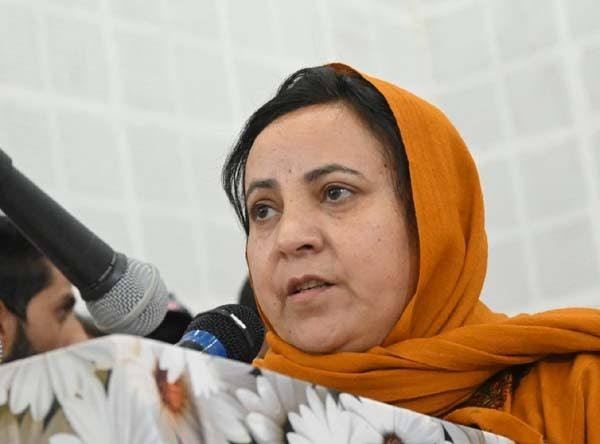
Srinagar, Nov 13: Taking serious note of public outrage over the sale of overpriced textbooks prescribed by private schools, the J&K Education Minister, Sakina Itoo, on Tuesday directed all Chief Education Officers (CEOs) to conduct routine inspections and take strict action against schools and bookshops found selling textbooks at exorbitant rates.

Chairing a high-level review meeting of the School Education Department (SED) in Srinagar, the minister termed the unregulated sale of private publishers’ books “unacceptable” and directed the officers to ensure transparency in textbook sales and adherence to prescribed curriculum guidelines.

“Routine checks must be carried out at schools and bookshops, and immediate action should be taken against anyone involved in selling textbooks on inflated prices,” Itoo said, instructing the CEOs and Director School Education Kashmir (DSEK) to issue a detailed order specifying the curriculum and textbooks to be followed by all institutions.

The meeting was attended by DSEK Naseer Ahmad Wani, Joint Directors, all district CEOs, and other senior officials of the department.

During the session, the minister reviewed key operational areas including academic performance, infrastructure development, teacher deployment, and timely distribution of textbooks and learning materials.

“Timely availability of books and supplies is crucial to maintaining the academic calendar and ensuring that no student is left behind,” the minister emphasized, while calling for improved coordination between divisional and district offices to ensure transparent and efficient book distribution.

She also directed CEOs to monitor coaching centres across Kashmir and initiate action against unregistered ones operating without approval.

Highlighting the importance of accountability and teacher performance, Sakina Itoo called for regular capacity-building and training programs to enhance teaching quality and ensure effective classroom engagement.

“The government is fully committed to improving the quality of education and ensuring a fair, transparent, and student-friendly learning environment across Jammu and Kashmir,” she said.

The DSEK and other officers briefed the minister on ongoing academic progress, infrastructure status, and measures being taken to streamline textbook availability across the region. (JKNS)

POSHAN Project Ramhall Recruitment 2025: Apply for Anganwadi Helper (AWH) Post – Eligibility, Application Form & Full Details

0

POSHAN Project Ramhall Recruitment 2025: Apply for Anganwadi Helper (AWH) Post – Eligibility, Application Form & Full Details

The Government of Jammu & Kashmir has released the latest Advertisement Notice No. 01 of 2025 for the recruitment of Sahayika (Anganwadi Helper) under the POSHAN Project Ramhall Villagam. This recruitment drive is a significant opportunity for eligible women candidates belonging to the local area who wish to contribute to community development and child welfare through the Anganwadi system.

This article provides a complete, detailed, and SEO-optimized overview of the official notification, including eligibility criteria, vacancy details, application form, selection process, important dates, document requirements, and more. If you are looking to apply for the Anganwadi Helper post in POSHAN Project Ramhall, read this full guide carefully.


Introduction: Empowering Women Through Anganwadi Recruitment in J&K

The Anganwadi system plays a crucial role in the welfare of children, women, and marginalized communities across India. In Jammu & Kashmir, the POSHAN Abhiyaan (formerly ICDS) is responsible for running Anganwadi Centres and offering essential services such as supplementary nutrition, non-formal preschool education, health and wellness initiatives, and community support for women.

The latest notification for POSHAN Project Ramhall Recruitment 2025 focuses exclusively on the engagement of one Anganwadi Helper (AWH) for the Amergard – A Anganwadi Centre, located in Amergard Malikpora. The recruitment follows the updated guidelines issued by the Government of J&K and the Social Welfare Department.

This job offers women candidates a chance to secure an important role in their own locality, supporting early childhood care and development.


POSHAN Project Ramhall Recruitment 2025 – Overview

Department Office of the Child Development Project Officer, POSHAN Project Ramhall Villagam
Post Name Anganwadi Helper (AWH)
Total Vacancies 01
Advertisement Number 01 of 2025
Release Date 06 November 2025
Project Name POSHAN Project Ramhall Villagam
Type of Engagement Honorarium basis
Location Amergard – A Anganwadi Centre

Official Notification Reference

The advertisement is issued in accordance with:

  1. Government Order No. 222-JK (SWD) of 2022
  2. Government Order No. 103-JK (SWD) of 2023
  3. Government communication No. SWD-CDS/322/2023-26 dated 24.08.2023
  4. Verification letter No. MD/POSHAN/Estt/2025/23915-207 dated 20-08-2025

These references establish the eligibility, recruitment rules, and verification procedures for Anganwadi Helpers across J&K.


Vacancy Details – POSHAN Project Ramhall Recruitment 2025

As per Annexure B, the post-wise vacancy detail is:

S.No AWC Name Ward No. Panchayat / MC Ward Post Name Total Posts
01 Amergard – A 01 Amergard Malikpora Sahayika (Anganwadi Helper) 01

This vacancy is restricted ONLY to eligible female candidates belonging to the local ward.


Important Dates (As per Notification)

Event Date
Start of submission of application 12-11-2025
Last date for submission of application 25-11-2025 (up to 4:00 PM)

Applications must be submitted strictly in the prescribed format given in Annexure-A.


Eligibility Criteria for Anganwadi Helper – POSHAN Ramhall Recruitment 2025

The eligibility conditions clearly define who can apply and under what circumstances. These norms ensure transparency and fairness in selecting the right helper for the community.

1. Locality Requirement

The selection is strictly limited to candidates belonging to the electoral ward where the Anganwadi Centre is located.

This means only women from Amergard Malikpora, Ward 01, can apply.


2. Gender & Age Limit

  • Only female candidates are eligible.
  • Age between 18–37 years, calculated as on 01-01-2025.

3. Domicile Requirement

The candidate must be:

  • A domicile of the Union Territory of Jammu & Kashmir.

4. Minimum Educational Qualification

  • Minimum qualification: 8th class pass
  • Maximum qualification: 12th class pass

If a 10th pass or 12th pass candidate applies, preference rules apply only if:

  • She belongs to the poorest household, or
  • No equal candidate with 8th pass qualification is available.

5. Marital Status Preference

Preference is given to:

  • Widow
  • Destitute
  • Divorced women

Provided their household has no adult earning member.


6. Married / Unmarried Candidate Preference

  • If all factors are equal, preference goes to a married woman from the same ward.
  • In the absence of eligible married candidates, an unmarried woman may be considered.

POSHAN Project Ramhall Application Form – Annexure A

The notification includes a full application form requiring details such as:

  • Name & parentage
  • Residential address
  • Ward number
  • Date of birth
  • Contact details
  • Economic status (PHH / BPL / AAY etc.)
  • Marital status
  • Academic qualification
  • Document list
  • Applicant’s signature & date
  • Passport-size photograph attested by a gazetted officer

Candidates must fill in all sections clearly and attach genuine documents.


Documents Required for POSHAN Ramhall Recruitment 2025

At the time of Document Verification, candidates must produce:

Mandatory Documents

  1. Domicile Certificate
  2. Date of Birth Certificate
  3. Academic Qualification Marksheets and Certificates
  4. Aadhaar Card or other valid Photo ID
  5. Recent passport-size photographs
  6. Category / Economic status certificate (PHH / BPL / AAY)
  7. Widow / Destitute / Divorce Certificate (if applicable)
  8. Proof of Ward residence (Panchayat records)

Additional Documents

  • Affidavit declaring authenticity of information
  • Any certificate requested by the committee during verification

Failure to provide genuine documents may lead to cancellation of candidature.


Selection Procedure for Anganwadi Helper (AWH)

The selection process involves the following stages:

1. Scrutiny of Applications

The committee verifies:

  • Eligibility
  • Educational qualification
  • Locality (Ward level)
  • Supporting documents

2. Merit-Based Selection

Selection is based on:

  • Marks obtained in 8th standard
  • In rare cases, if vacancies cannot be filled, 10th-class marks may be considered

Preference is given to:

  • Candidates from poor households
  • Widows / destitute women
  • Married women within the same ward

3. Document Verification

Shortlisted candidates must appear in person with:

  • Original documents
  • Self-attested photocopies

Failure to appear leads to disqualification.


4. Final Selection List

After successful verification, the committee will prepare a final selection list and notify candidates accordingly.


Honorarium for Anganwadi Helper (AWH) – What to Expect

The honorarium paid to Anganwadi Helpers in J&K generally aligns with POSHAN Abhiyaan financial norms. Although the exact amount is not specified in the advertisement, Anganwadi Helpers in J&K typically receive:

Approximate Monthly Honorarium

  • ₹2,000 – ₹3,000 (may vary based on district norms)

Additional incentives may be provided under different schemes or tasks.


Why Apply for Anganwadi Helper Post?

Becoming an Anganwadi Helper is not just a job—it is a service to the community. Benefits include:

Stable honorarium
Local posting – near home
Helping children and women in your locality
Government-regulated engagement
Opportunity for social impact
Respect and recognition in the community


How to Apply for POSHAN Project Ramhall Recruitment 2025 – Step-by-Step Guide

Follow these simple steps to apply correctly:


STEP 1: Get the Application Form

Download or collect the form from:

  • CDPO Office Ramhall Villagam
    OR
  • From the official notification (Annexure A)

Paste a passport-size photograph, attested by a Gazetted officer.


STEP 2: Fill in All Details Carefully

Include:

  • Name
  • Address
  • Panchayat/ward
  • Educational info
  • Age
  • Contact details
  • Marital status
  • Economic category

STEP 3: Attach Required Documents

Attach self-attested copies, including:

  • Domicile
  • DOB certificate
  • Academic records
  • Economic category proof
  • Residence certificate

STEP 4: Submit the Application

Submit the filled form at:

**Office of the Child Development Project Officer,

POSHAN Project Ramhall Villagam**

Before: 25-11-2025, 4:00 PM

Keep a photocopy for personal reference.


Important Rules & Conditions

Candidates must pay attention to the following:

✔ Provide only genuine documents

If any information is found incorrect, the candidature will be cancelled.

✔ No incomplete forms will be accepted

Ensure all sections are filled.

✔ Bring original documents at verification

Mandatory for final selection.

✔ Only female Ward residents eligible

No exceptions.

The POSHAN Project Ramhall Recruitment 2025 provides a meaningful opportunity for eligible women in Amergard Malikpora (Ward 01) to join the Anganwadi system as a Sahayika (Anganwadi Helper). With simple eligibility criteria, a transparent selection process, and a socially impactful role, this recruitment is ideal for women seeking community-oriented engagement.

Candidates must apply before the deadline and ensure all documents are accurate and complete.

If you belong to the eligible ward and meet the criteria, don’t miss this opportunity.

WCL Apprentices Recruitment 2025: Apply Online for 1,213 Apprentice Posts – Complete Details

0

WCL Apprentices Recruitment 2025: Apply Online for 1,213 Apprentice Posts – Complete Details

Western Coalfields Limited (WCL), one of the eight subsidiary companies of Coal India Limited (CIL) under the Ministry of Coal, Government of India, has officially released the WCL Apprentices Recruitment 2025 notification. The recruitment drive offers 1,213 apprentice posts across various trades and disciplines — from ITI and Diploma holders to Graduate Engineers.

This recruitment aims to provide skill training opportunities to young aspirants in technical and trade disciplines related to coal mining operations. Candidates who have completed their technical education and are looking to gain industrial experience in a reputed PSU can apply for these apprenticeship positions online.

In this detailed blog, we will cover WCL Apprentice eligibility criteria, vacancy details, salary, application process, selection procedure, important dates, and useful links to help you easily apply for the opportunity.


About Western Coalfields Limited (WCL)

Western Coalfields Limited (WCL) is headquartered in Nagpur, Maharashtra, and operates in the states of Maharashtra and Madhya Pradesh. It plays a significant role in India’s energy sector by producing high-quality coal used in power generation and industrial sectors.

WCL is committed to developing a skilled workforce through apprenticeship programs. These programs are aligned with the Apprentices Act, 1961, offering technical graduates and ITI holders a chance to gain hands-on experience under expert guidance.


WCL Apprentices Recruitment 2025 Overview

Particulars Details
Organization Name Western Coalfields Limited (WCL)
Post Name Apprentice (Graduate, Technician, ITI & Security Guard)
Total Vacancies 1,213
Advertisement Number WCL/HRD/Apprentice/Notification/2025-26/51
Application Mode Online
Start Date to Apply 17 November 2025
Last Date to Apply 30 November 2025
Official Website https://www.westerncoal.in
Training Duration 12 Months
Job Location Maharashtra & Madhya Pradesh

WCL Apprentice Vacancy 2025 – Category & Trade-wise Distribution

Western Coalfields Limited has released 1,213 total vacancies, distributed across Graduate Apprentices, Technician Apprentices, ITI Trade Apprentices, and Security Guards.

1. Graduate Apprentice (Mining Engineering)

  • Total Vacancies: 101
  • Eligibility: B.E/B.Tech in Mining Engineering

2. Technician Apprentice (Mining & Mine Surveying)

  • Total Vacancies: 215
  • Eligibility: Diploma in Mining or Mine Surveying

3. ITI Trade Apprenticeship (Various Trades)

This is the largest category of openings, inviting candidates with ITI certification in relevant trades.

Trade Name No. of Posts
Fitter 255
Electrician 275
Turner 22
Machinist 25
Welder (Gas & Electric) 40
Wireman 20
Surveyor 25
Mechanic Diesel 35
Draughtsman (Civil) 20
Pump Operator cum Mechanic 25
Stenographer (English) 10
Stenographer (Hindi) 15
COPA (Computer Operator and Programming Assistant) 35
Total ITI Trade Apprentices 807

4. Security Guard (Optional Trade)

  • Vacancies: 90
  • Eligibility: 10th Pass

Grand Total: 1,213 Apprenticeship Positions


WCL Apprentice Salary 2025 (Stipend Details)

WCL provides a monthly stipend to apprentices as per the Apprenticeship Rules and Government of India norms:

Apprentice Type Monthly Stipend (Approx.)
Graduate Apprentice ₹12,300
Technician Apprentice ₹10,900
ITI Trade Apprentice ₹10,560 – ₹11,040
Security Guard (Optional) ₹8,200

💡 Note: Apprentices are not employees of WCL. They are trainees under the Apprentices Act, and the stipend is paid only during the training period.


WCL Apprentices Eligibility Criteria 2025

To apply for the WCL Apprentices Recruitment 2025, candidates must satisfy the following educational qualification, age limit, and other requirements.

Educational Qualification

Post Type Educational Qualification Required
Graduate Apprentice Full-time B.E/B.Tech in Mining Engineering from a recognized university
Technician Apprentice Diploma in Mining / Mine Surveying from a recognized institution
ITI Trade Apprentice Matriculation / 10+2 + ITI Certificate in respective trade (NCVT/SCVT approved)
Security Guard Minimum 10th Pass from recognized board

Age Limit (as on 01 August 2025)

  • Minimum Age: 18 Years
  • Maximum Age: 26 Years
  • Age Relaxation:
    • OBC (NCL): +3 Years
    • SC/ST: +5 Years
    • PwD Candidates: +10 Years

⚠️ Candidates should have been born between 02 August 1999 and 02 August 2007.


WCL Apprentices Selection Process 2025

The selection process for WCL Apprentice Recruitment 2025 will be based purely on merit and verification of documents.

Selection Steps:

  1. Online Application Screening – Based on details provided in the form.
  2. Merit List Preparation – Based on marks obtained in the qualifying examination (ITI/Diploma/Degree).
  3. Document Verification – Original certificates to be produced for verification.
  4. Medical Examination – Final step before training begins.

📋 There will be no written test or interview. Selection will be merit-based.


Documents Required for WCL Apprentice Application

Applicants should keep the following documents ready before applying:

  • Recent passport-size photograph (JPEG format)
  • Signature (JPEG format)
  • Matriculation certificate (Age proof)
  • Educational qualification certificates (ITI/Diploma/Degree)
  • Caste/Category certificate (if applicable)
  • PwD certificate (if applicable)
  • Aadhaar card / valid ID proof
  • NATS/NAPS Registration ID

How to Apply for WCL Apprentices Recruitment 2025

The application process for WCL Apprentice 2025 is completely online. Follow these step-by-step instructions:

Step-by-Step Process

  1. Visit the official WCL website:
    Go to www.westerncoal.in.
  2. Navigate to Career Section:
    On the homepage, click on “Career → Apprentice Recruitment 2025”.
  3. Read the Notification Carefully:
    Download and read the official WCL Apprenticeship Notification (Advt. No. WCL/HRD/Apprentice/2025-26/51).
  4. Register on NATS/NAPS Portal:
  5. Fill the Online Application Form:
    Enter your name, date of birth, educational details, and upload the required documents.
  6. Submit the Form:
    Review all details carefully and submit your application.
  7. Save a Copy:
    Take a printout or save a digital copy of the confirmation page for future reference.

Important Dates

Event Date
Notification Release Date 10 November 2025
Starting Date of Online Application 17 November 2025
Last Date to Apply 30 November 2025
Document Verification December 2025
Training Commencement January 2026 (Tentative)

WCL Apprenticeship 2025 – Key Areas of Posting

Apprentices will be placed across different WCL areas and mines in Maharashtra and Madhya Pradesh, including:

  • Nagpur Area
  • Ballarpur Area
  • Majri Area
  • Wani North Area
  • Chandrapur Area
  • Pathakhera Area
  • Kanhan Area
  • Umrer Area
  • Pench Area

Each area includes a mix of mechanical, electrical, and mining-based apprenticeship roles.


WCL Apprenticeship Benefits

Pursuing an apprenticeship with Western Coalfields Limited offers numerous advantages:

Hands-on Industry Training – Work directly with experienced engineers and technicians.
Government-recognized Certificate – Upon successful completion, receive an apprenticeship certificate under the Apprentices Act, 1961.
Monthly Stipend – Get paid while you learn.
Skill Development – Acquire core skills in mining, mechanical, and electrical trades.
Employment Opportunities – Apprenticeship enhances your chances of being absorbed in PSUs or private industries.


Important Instructions for Applicants

  • Candidates can apply only for one trade or discipline.
  • Multiple applications may result in disqualification.
  • All educational qualifications should be from recognized institutions.
  • The information entered in the application form cannot be changed later.
  • Incomplete applications will be rejected.
  • Keep checking the WCL official website for updates on merit lists and document verification.

Direct Links

  • 🔗 Official Notification PDF: Download Here
  • 🔗 WCL Official Website: www.westerncoal.in
  • 🔗 Apply Online for NATS (Graduate/Diploma): https://nats.education.gov.in
  • 🔗 Apply Online for NAPS (ITI): https://www.apprenticeshipindia.gov.in

FAQs – WCL Apprentices Recruitment 2025

Q1. What is the last date to apply for WCL Apprentices Recruitment 2025?
👉 The last date to apply online is 30 November 2025.

Q2. How many vacancies are announced by WCL?
👉 A total of 1,213 vacancies are available for Graduate, Diploma, ITI, and Security Guard apprentices.

Q3. Is there any exam for WCL Apprentice recruitment?
👉 No. The selection will be based on merit in the qualifying examination and document verification.

Q4. Can I apply for more than one trade?
👉 No. Multiple applications from the same candidate will be rejected.

Q5. What is the stipend offered during the training?
👉 The stipend ranges from ₹8,200 to ₹12,300 per month depending on the apprenticeship type.

Q6. Which states are covered under WCL recruitment?
👉 The recruitment covers Maharashtra and Madhya Pradesh mining areas.

The WCL Apprentices Recruitment 2025 is an excellent opportunity for engineering graduates, diploma holders, and ITI pass-outs to gain valuable industrial experience in India’s leading coal mining PSU. The merit-based selection process, decent stipend, and skill-building exposure make this apprenticeship an ideal start for a technical career.

If you’re eligible, apply early between 17th and 30th November 2025 to avoid last-minute issues. Ensure your documents are updated and your NATS/NAPS registration is valid.

 JKPSC Important Updates 2025: Written Test Results, Answer Keys, and Selections for Lecturer, Assistant Director & Medical College Posts Released

0

 JKPSC Important Updates 2025: Written Test Results, Answer Keys, and Selections for Lecturer, Assistant Director & Medical College Posts Released

JKPSC Important Updates 2025 — Jammu and Kashmir Public Service Commission (JKPSC) has released written test results, final answer keys, and representation disposal notices for Lecturer, Assistant Director, and Gazetted vacancies in various departments. Get all official PDF links and complete details here.

The Jammu and Kashmir Public Service Commission (JKPSC) has issued a series of crucial updates regarding multiple recruitment examinations conducted across various departments including the School Education Department, Health and Medical Education Department, and Science & Technology Department.

These notifications include the declaration of written test results, final answer keys, and disposal of representations for posts such as Lecturer (Geology, Dogri, Statistics, Sanskrit, Punjabi, Hindi, Kashmiri) and Assistant Director (Technical Cadre).

If you have appeared for any JKPSC exam recently, this article provides you with direct links to official PDFs, results, and key highlights from each notification.


🔹 1. JKPSC Lecturer (Geology, Dogri, Statistics, Sanskrit & Punjabi) Result Declared

Notification Title:
Conduct of Written Test for filling up of the posts of Lecturer (Geology, Dogri, Statistics, Sanskrit and Punjabi) in the School Education Department – Declaration of Result of Written Test reg.

Official PDF Link: Download Here

Overview:

JKPSC has officially declared the written test results for Lecturer posts in multiple subjects under the School Education Department. The examination was conducted earlier in 2025, and candidates who participated can now check their results from the official JKPSC website.

Subjects Covered:

  • Geology
  • Dogri
  • Statistics
  • Sanskrit
  • Punjabi

Key Highlights:

  • The written examination results determine candidates’ eligibility for the next stage, which may include interview/document verification.
  • JKPSC emphasized that only those candidates who have qualified the written test will be shortlisted for further process.
  • The merit list is based on candidate performance in the written test conducted under JKPSC norms.

Next Steps:

Candidates are advised to regularly visit www.jkpsc.nic.in for updates regarding the interview schedule and further selection process.


🔹 2. JKPSC Final Answer Key — Lecturer (Geology, Dogri, Statistics, Sanskrit & Punjabi)

Notification Title:
Conduct of Written Test for filling up of the posts of Lecturer (Geology, Dogri, Statistics, Sanskrit and Punjabi) in the School Education Department – Disposal of Representations and Issuance of Final Answer Key thereof.

Official PDF Link: Download Here

Key Details:

  • JKPSC released the final answer key after carefully reviewing all the representations received from candidates.
  • Changes, if any, have been incorporated in the final version.
  • No further objections will be entertained after this stage.

Why It Matters:

The final answer key ensures transparency and fairness in the evaluation process. Candidates can now cross-check their responses with the official key to estimate their scores.


🔹 3. JKPSC Lecturer (Kashmiri & Hindi) Result Declared

Notification Title:
Filling up of the posts of Lecturer (Kashmiri, Hindi) in the School Education Department – Declaration of Result of Written Test reg.

Official PDF Link: Download Here

Overview:

The Jammu and Kashmir Public Service Commission has also declared the written test results for Lecturer (Kashmiri) and Lecturer (Hindi) positions. These results mark the completion of the written exam phase for these posts.

Highlights:

  • The result PDF lists roll numbers of candidates who have successfully cleared the exam.
  • Shortlisted candidates will be called for the next phase soon.
  • JKPSC thanked candidates for their patience and participation in the recruitment process.

Next Steps:

Qualified candidates should keep their documents and certificates ready for the verification process. Updates regarding interviews or viva-voce will be uploaded soon.


🔹 4. JKPSC Final Answer Key — Lecturer (Kashmiri & Hindi)

Notification Title:
Conduct of Written Test for filling up of the posts of Lecturer (Kashmiri, Hindi) in the School Education Department – Disposal of Representations and Issuance of Final Answer Key thereof.

Official PDF Link: Download Here

Highlights:

  • JKPSC reviewed all objections submitted by candidates.
  • The final answer key has been issued and is now binding for evaluation.
  • This ensures all candidates are assessed using the same uniform criteria.

🔹 5. JKPSC Medical College & SKIMS Gazetted Vacancies — Result Declared

Notification Title:
Filling up of Gazetted vacancies in various Govt. Medical Colleges and SKIMS, Soura, Srinagar in Health and Medical Education Department – Result of Written Test reg.

Official PDF Link: Download Here

Overview:

JKPSC conducted examinations to fill Gazetted-level posts in various Government Medical Colleges and SKIMS, Soura, Srinagar under the Health and Medical Education Department.

The commission has now declared the written test results for these posts.

Departments Covered:

  • Government Medical Colleges (GMCs)
  • SKIMS, Soura
  • Health and Medical Education Department

Key Points:

  • Only candidates who scored above the cutoff have been shortlisted.
  • The next stage of selection may include interview or skill assessment, depending on the post.
  • Candidates can check their roll numbers in the official result PDF.

🔹 6. JKPSC Final Answer Key — Medical College & SKIMS Gazetted Vacancies

Notification Title:
Written Examination for filling up of Gazetted vacancies in various Govt. Medical Colleges and SKIMS, Soura, Srinagar in Health and Medical Education Department – Disposal of Representations and Issuance of Final Answer Key thereof.

Official PDF Link: Download Here

Key Information:

  • JKPSC addressed all objections raised by candidates against the provisional answer key.
  • After detailed review and expert consultation, the final answer key has been released.
  • This final key will be the basis for calculating results and preparing the merit list.

🔹 7. JKPSC Assistant Director (Technical Cadre) & District S&T Coordinator — Result Declared

Notification Title:
Filling up of the post of Assistant Director (Technical Cadre) and District S and T Coordinator (Technical Cadre) in J and K Science and Technology Department – Result of Written Test reg.

Official PDF Link: Download Here

Overview:

JKPSC has released results for Assistant Director (Technical Cadre) and District Science & Technology Coordinator positions under the J&K Science and Technology Department.

Highlights:

  • The written test results are now officially available.
  • Candidates who qualified will proceed to the next stage as per the JKPSC selection guidelines.
  • The commission emphasized that merit will strictly be determined on the basis of the written examination and other prescribed parameters.

🔹 8. JKPSC Final Answer Key — Assistant Director (Technical Cadre) & District S&T Coordinator

Notification Title:
Conduct of Written Test for the post of Assistant Director (Technical Cadre) and District S and T Coordinator (Technical Cadre) in J and K Science and Technology Department – Disposal of Representations and Issuance of Final Answer Key thereof.

Official PDF Link: Download Here

Highlights:

  • All objections submitted by candidates have been reviewed.
  • The final answer key has been published and will guide the evaluation process.
  • Candidates can verify their responses and performance accuracy using the key.

📌 Summary of All JKPSC Updates (November 2025)

Department Post Name Update Type PDF Link
School Education Lecturer (Geology, Dogri, Statistics, Sanskrit, Punjabi) Result View PDF
School Education Lecturer (Geology, Dogri, Statistics, Sanskrit, Punjabi) Final Answer Key View PDF
School Education Lecturer (Kashmiri, Hindi) Result View PDF
School Education Lecturer (Kashmiri, Hindi) Final Answer Key View PDF
Health & Medical Education Gazetted Vacancies in GMCs & SKIMS Result View PDF
Health & Medical Education Gazetted Vacancies in GMCs & SKIMS Final Answer Key View PDF
Science & Technology Assistant Director (Technical) & District S&T Coordinator Result View PDF
Science & Technology Assistant Director (Technical) & District S&T Coordinator Final Answer Key View PDF

📅 Next Steps for Candidates

  1. Check your results using the official PDF links above.
  2. Download and save your result for future reference.
  3. Stay updated on the interview schedule or document verification process.
  4. Keep your academic and category certificates ready.
  5. Follow the JKPSC website and official notifications regularly for future updates.

🗓️ About JKPSC

The Jammu and Kashmir Public Service Commission (JKPSC) is responsible for conducting civil services and departmental recruitment examinations in the Union Territory. It ensures transparent, merit-based selection for various Gazetted and Non-Gazetted posts.

Official Website: 🔗 https://jkpsc.nic.in

The release of these multiple notifications by JKPSC on November 12, 2025, signifies the completion of major evaluation stages for several important examinations across departments. Candidates are advised to verify their results through official links and prepare for the upcoming selection stages.

These updates bring clarity and transparency to the recruitment process, ensuring that deserving candidates are fairly assessed and appointed to various posts across Jammu and Kashmir’s government institutions.

Sakeena Itoo Assesses Fee Fixation and Regulation Issues of Private Schools Across Jammu and Kashmir

0

Sakeena Itoo assesses various issues on fee fixation, regulation of Private Schools across J&K

SRINAGAR, NOVEMBER 12: Minister for Education, Social Welfare, Health and Medical Education, Sakeena Itoo today chaired a meeting at Civil Secretariat here to assess the issues related to fee fixation and regulation of Private Schools across Jammu and Kashmir.

The meeting was attended by Secretary School Education department, Ram Niwas Sharma; Director School Education Kashmir, Naseer Ahmad Wani; Secretary JKBOSE, Ghulam Hassan Sheikh; Director School Education Jammu, Dr. Naseem Javaid; Director Finance School Education department, Administrative Officer Fee Fixation and Regulation Committee (FFRC), and other concerned officers, either in person or through video conferencing.
During the meeting, the Minister held detailed deliberations on range of issues concerning fee fixation, regulation, and operational transparency of private educational institutions across the Jammu and Kashmir.

The Minister emphasized that education is a social responsibility and reiterated the government’s commitment to ensuring that no student is deprived of learning opportunities due to unreasonable fee structures. She directed the officers to strictly enforce existing guidelines and strengthen monitoring mechanisms to prevent arbitrary fee hikes and other regulatory violations.

Recognizing the vital role of private schools in supplementing the public education system, the Minister called for greater transparency in fee disclosure, adherence to approved structures, and timely redressal of grievances from parents and students.

The Minister also stressed the importance of constructive engagement between the government, school managements, and parent associations, advocating for a collaborative approach in shaping a fair and sustainable educational ecosystem across Jammu and Kashmir.

While reviewing other issues, the Minister issued strict instructions to CEOs to check unregulated selling of school textbooks by private schools through various agencies on exorbitant rates. She directed the CEOs to conduct routine checks on schools as well as book shops and take stringent against schools and book shops involved in selling textbooks on exorbitant rates.

She also instructed the Director School Education to issue a detailed order regarding curriculum/textbooks to be followed by schools and make each CEO to implement that order in letter and spirit. She asked the CEOs to take appropriate action against schools violating this order.

The Minister also directed the CEOs to establish suitable grievance redressal mechanism for dealing with complaints related to fee structure of schools as well as increased textbook prices.

She also directed the officers to develop a fully dynamic website on a government server to enable online applications, fee data submission, and transparent public access to approved fee structures.

She also asked them to develop evidence-based recommendations for periodic fee revision mechanisms to ensure affordability and sustainability in private education.