Saturday, June 13, 2026
Advertisementspot_img
Home Blog Page 8

NEET UG 2026 Paper Leak: Father Paid Rs 10 Lakh for Son’s Access, Student Scored Only 107 Out of 720, Says CBI

0

NEET UG 2026 Paper Leak: The Central Bureau of Investigation (CBI) probe into the NEET-UG 2026 paper leak case has brought Rajasthan’s Sikar district under intense scrutiny. The agency has arrested three people in connection with the case. According to officials, the accused allegedly procured a “guess” paper closely resembling the NEET question paper and supplied it to coaching hubs, from where it was further circulated. The three arrested individuals, brothers Dinesh and Mangilal Biwal, and Mangilal’s eldest son Vikas, belong to the same family.

CBI Searches For Accused’s Son Rishi Bival

The CBI is also searching for Rishi Bival, son of accused Dinesh Bival, as he allegedly had access to the leaked question paper before the examination. Rishi does not appear to have cleared the test.

According to investigators, Dinesh Bival allegedly paid nearly Rs 10 lakh in Sikar to obtain the leaked paper for his son. However, despite the alleged advance access, Rishi reportedly scored only 107 marks out of 720 in NEET. Officials said he is currently at large.

Sources associated with the investigation said Dinesh allegedly admitted during questioning that he had procured the paper for Rishi.

Weak Academic Performance

During scrutiny, it emerged that he had also performed poorly in board examinations. He passed Class 10 with around 44 per cent marks and secured a second division in Class 12. Investigators also found that he required grace marks to clear the Class 12 examination.

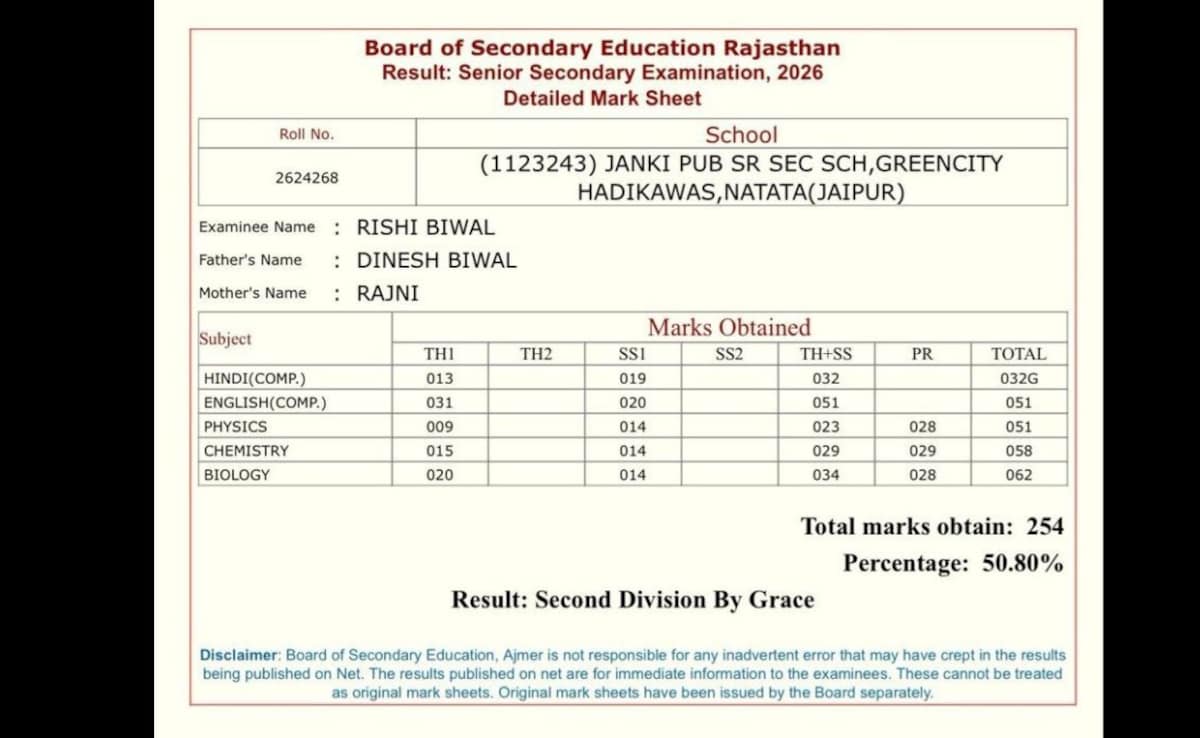
According to a marksheet that emerged during the investigation, Rishi Bival secured a second division with 50.80 per cent marks in the Class 12 Rajasthan Board of Secondary Education (RBSE) Senior Secondary Examination 2026, reportedly with the help of grace marks.

Latest and Breaking News on NDTV

The marksheet shows that he scored 254 marks out of 500. Subject-wise, he scored 32 in Hindi, 51 in English, 51 in Physics, 58 in Chemistry, and 62 in Biology. His theory scores in Physics and Chemistry were notably low.

Despite this, the family was preparing him for the medical entrance examination.

Sikar Flat Used As Coordination Centre: Probe

Officials also identified a flat in Sikar that was allegedly being used as a coordination centre for distributing papers and managing communication with candidates. Investigators said some members of the network acted as couriers, physically delivering leaked material to candidates. Dinesh Bival and certain family members are suspected of playing such a role.

Wider Network Under CBI Scanner

The CBI has reportedly identified nearly 150 students who may have links to the network and are currently under scrutiny.

(With inputs from IANS)

Kashmir University Answer Keys 2026 Released for Integrated Programmes – Check Here

The University of Kashmir has officially released the answer keys for various Integrated Programmes Entrance Tests 2026 conducted for admission into different professional and academic courses. Candidates who appeared in the entrance examinations can now check and download the provisional answer keys from the official university website.

The answer keys were released on 17 May 2026 and include entrance examinations conducted for the following programmes:

  • 5-Year Integrated Masters in Mass Communication & Journalism
  • 5-Year Integrated Masters in Data Science & Artificial Intelligence
  • 5-Year Integrated BA-LL.B Programme

The release of answer keys allows students to cross-check their responses and estimate their probable scores before the declaration of final results.


Kashmir University Answer Keys 2026 Overview

Particulars Details
University Name University of Kashmir
Exam Type Integrated Programmes Entrance Test 2026
Courses Covered Mass Communication, Data Science & AI, BA-LL.B
Answer Key Release Date 17 May 2026
Status Released
Official Website Kashmir University
Mode of Availability Online

Courses for Which Answer Keys Have Been Released

The university has uploaded provisional answer keys for multiple integrated programmes. Students who participated in the entrance examinations can access the answer keys directly through the official portal.

1. 5-Year Integrated Masters in Mass Communication & Journalism

The Integrated Masters Programme in Mass Communication & Journalism is among the most sought-after professional courses offered by Kashmir University. The course focuses on journalism, media studies, broadcasting, public relations, digital communication, and multimedia storytelling.

Candidates who appeared in the entrance test can now compare their answers with the official provisional key to evaluate their performance.

Key Highlights of the Programme

  • 5-year integrated postgraduate degree
  • Focus on journalism and mass media
  • Training in digital and electronic media
  • Career opportunities in television, print, radio, and online journalism

2. 5-Year Integrated Masters in Data Science & Artificial Intelligence

The Integrated Masters Programme in Data Science & Artificial Intelligence is designed for students interested in emerging technologies such as machine learning, big data analytics, AI systems, and computational sciences.

This programme has gained significant popularity due to the rising demand for AI professionals across industries.

Major Areas Covered in the Programme

  • Artificial Intelligence
  • Machine Learning
  • Data Analytics
  • Python Programming
  • Big Data Technologies
  • Deep Learning
  • Data Visualization

Students who took the entrance examination can now use the answer key to estimate their marks and analyze their chances of admission.


3. 5-Year Integrated BA-LL.B Programme

The Integrated BA-LL.B Programme is a professional law course combining humanities subjects with legal education. It prepares students for careers in litigation, judiciary, legal consultancy, civil services, and corporate law.

The answer key released by Kashmir University helps law aspirants review their attempted questions and calculate expected scores.

Benefits of the BA-LL.B Programme

  • Integrated law degree after Class 12
  • Exposure to constitutional and criminal law
  • Career opportunities in judiciary and legal practice
  • Foundation for civil services and higher legal studies

Importance of Kashmir University Answer Keys

The release of answer keys is an important step in the admission and evaluation process. It provides transparency and helps students understand their expected performance in the entrance examinations.

Benefits of Checking the Answer Keys

1. Estimate Your Score

Students can compare their marked responses with the official answers and calculate tentative scores before results are declared.

2. Identify Mistakes

Candidates can analyze incorrect responses and understand areas where they need improvement.

3. Raise Objections if Necessary

If students find discrepancies in any answer, they may get an opportunity to submit objections or representations within the prescribed timeline.

4. Reduce Anxiety

Checking the answer keys helps candidates get a rough idea about their admission chances and reduces uncertainty.


How to Download Kashmir University Answer Keys 2026

Candidates can follow the steps below to access the answer keys online:

  1. Visit the official Kashmir University website
  2. Open the Answer Key section
  3. Select the relevant integrated programme
  4. Click on the answer key link
  5. Download the PDF file
  6. Compare your responses carefully

Students are advised to keep a copy of the answer key for future reference.


Expected Next Steps After Release of Answer Keys

After releasing provisional answer keys, Kashmir University is expected to follow the standard admission process which generally includes:

  • Inviting objections (if applicable)
  • Reviewing representations submitted by candidates
  • Releasing final answer keys
  • Declaring entrance examination results
  • Publishing merit lists
  • Conducting counselling and admission formalities

Candidates should regularly visit the university website for the latest updates regarding results and admissions.


Kashmir University Integrated Programmes Admission Process

The integrated programmes offered by Kashmir University attract thousands of students every year due to quality education and career-oriented curriculum.

Admission Procedure

The admission process generally involves:

  • Submission of online application forms
  • Entrance examination
  • Publication of answer keys
  • Declaration of results
  • Merit-based selection
  • Document verification
  • Final admission

The entrance examination plays a crucial role in determining eligibility for admission into these prestigious programmes.


Why Students Prefer Kashmir University Integrated Programmes

The University of Kashmir is one of the leading educational institutions in Jammu & Kashmir and offers a wide range of integrated courses.

Key Advantages

Academic Excellence

The university is known for experienced faculty and strong academic standards.

Professional Courses

Integrated programmes combine undergraduate and postgraduate studies in a streamlined manner.

Better Career Opportunities

Students gain early specialization and professional exposure.

Modern Curriculum

Courses such as Data Science & Artificial Intelligence are designed according to current industry demands.

Research and Innovation

Students get opportunities for research projects, internships, and practical training.


Career Opportunities After These Programmes

Mass Communication & Journalism

Graduates can work as:

  • Journalists
  • News Anchors
  • Content Writers
  • Digital Media Experts
  • Public Relations Officers
  • Media Researchers

Data Science & Artificial Intelligence

Career options include:

  • Data Scientist
  • AI Engineer
  • Machine Learning Expert
  • Data Analyst
  • Software Developer
  • Business Intelligence Analyst

BA-LL.B

Law graduates may pursue careers as:

  • Advocates
  • Legal Advisors
  • Corporate Lawyers
  • Judicial Officers
  • Civil Services Aspirants
  • Legal Researchers

Important Instructions for Candidates

Students are advised to carefully verify all answers while checking the provisional answer keys. In case of any discrepancy, candidates should follow official university instructions regarding objections or clarifications.

Applicants should also:

  • Keep their admit cards safe
  • Monitor official notifications regularly
  • Prepare necessary documents for counselling
  • Stay updated regarding result dates

Kashmir University: A Premier Educational Institution

Established in 1948, the University of Kashmir is one of the oldest and most prestigious universities in the region. The university offers undergraduate, postgraduate, integrated, diploma, and doctoral programmes across multiple disciplines.

Over the years, Kashmir University has become a preferred destination for students seeking quality higher education in fields such as science, technology, humanities, journalism, law, management, and social sciences.

The release of the Kashmir University Answer Keys 2026 for Integrated Programmes marks an important update for students aspiring to secure admission in professional and career-oriented courses. Candidates who appeared in the entrance tests for Mass Communication & Journalism, Data Science & Artificial Intelligence, and BA-LL.B should download the answer keys immediately and evaluate their performance.

Students are advised to regularly check the official university website for further announcements regarding objections, final answer keys, results, and admission schedules.


Official Link

Click here

NHAI Deputy Manager (Technical) Recruitment 2026: Apply Online for 60 Posts Through GATE 2026

0

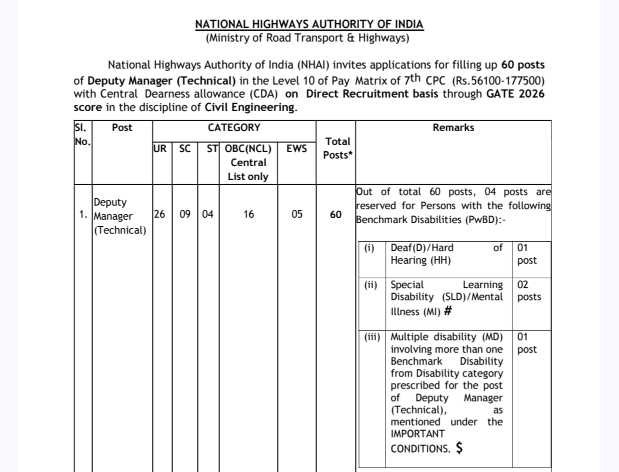
The National Highways Authority of India has officially released the NHAI Deputy Manager (Technical) Recruitment 2026 notification for 60 vacancies. Candidates holding a Bachelor’s Degree in Civil Engineering and possessing a valid GATE 2026 score can apply online for this prestigious government job opportunity. The recruitment will be conducted on a direct recruitment basis, and selected candidates will receive an attractive salary under Level 10 of the 7th CPC Pay Matrix.

This recruitment drive offers an excellent opportunity for engineering graduates who aspire to work in the infrastructure and highway development sector under the Government of India. Interested and eligible candidates can submit their applications online before the last date.


Focus Keyword

NHAI Deputy Manager Recruitment 2026


About NHAI

National Highways Authority of India is an autonomous agency under the Ministry of Road Transport and Highways, Government of India. It is responsible for the development, maintenance, and management of national highways across the country.

Working with NHAI is considered highly prestigious due to its contribution to India’s infrastructure growth and development. Candidates selected for the Deputy Manager (Technical) post will get the opportunity to work on some of the country’s biggest highway and expressway projects.


NHAI Deputy Manager Recruitment 2026 Overview

Particulars Details
Organization National Highways Authority of India (NHAI)
Post Name Deputy Manager (Technical)
Total Vacancies 60
Recruitment Type Direct Recruitment
Selection Basis GATE 2026 Score
Discipline Civil Engineering
Pay Scale Level 10 (Rs. 56,100 – 1,77,500)
Application Mode Online
Job Location Across India
Official Authority Ministry of Road Transport & Highways


Total Vacancies and Category-Wise Distribution

NHAI has announced a total of 60 vacancies for the post of Deputy Manager (Technical). The category-wise distribution is as follows:

Category Vacancies
UR 26
SC 09
ST 04
OBC (NCL) 16
EWS 05
Total 60

Additionally, some vacancies are reserved for Persons with Benchmark Disabilities (PwBD).


Salary Structure

Candidates selected for the post of Deputy Manager (Technical) will receive salary under Level 10 of the 7th CPC Pay Matrix.

Pay Scale:

Rs. 56,100 – Rs. 1,77,500

Apart from the basic pay, selected candidates will also receive:

  • Dearness Allowance (DA)
  • House Rent Allowance (HRA)
  • Medical Facilities
  • Transport Allowance
  • Pension Benefits
  • Leave Benefits
  • Other Government Perks

This makes the NHAI Deputy Manager post one of the most attractive engineering government jobs in India.


Educational Qualification

To apply for the NHAI Deputy Manager Recruitment 2026, candidates must fulfill the following educational qualification:

  • Bachelor’s Degree in Civil Engineering from a recognized University or Institute.

Candidates whose final results are pending as of the last date of application can also apply. However, they must submit their final/provisional degree certificate to NHAI before 31 August 2026.


Age Limit

The maximum age limit for applicants is:

Maximum Age:

30 Years

Age relaxation will be provided according to Government of India rules.


Age Relaxation Details

Category Relaxation
SC/ST 5 Years
OBC 3 Years
PwBD General 10 Years
PwBD OBC 13 Years
PwBD SC/ST 15 Years
Ex-Servicemen 5 Years


Important Dates

Event Date
Starting Date of Online Application 15 May 2026
Last Date to Apply Online 15 June 2026
Application Closing Time 6:00 PM


Selection Process

The selection process for NHAI Deputy Manager Recruitment 2026 will be completely based on:

Valid GATE 2026 Score

Candidates must appear in GATE 2026 in the Civil Engineering discipline. Based on the score obtained in GATE 2026, candidates will be shortlisted for further recruitment procedures.

No separate written examination will be conducted by NHAI.


Service Bond Details

Selected candidates will be required to sign a service bond of:

Rs. 5 Lakh Bond for 3 Years

Candidates must serve NHAI for a minimum period of three years from the date of joining. If a candidate resigns before completion of the bond period, they will have to pay Rs. 5 lakh to NHAI.


Reservation Policy

NHAI follows reservation policies as per Government of India norms.

Candidates belonging to:

  • SC
  • ST
  • OBC-NCL
  • EWS
  • PwBD
  • Ex-Servicemen

can avail reservation benefits by submitting valid certificates.

OBC-NCL certificates should be issued during FY 2026-27 on or after 1 April 2026.


PwBD Reservation Details

The following disability categories are eligible for the Deputy Manager (Technical) post:

  • Deaf/Hard of Hearing
  • One Arm
  • One Leg
  • Dwarfism
  • Acid Attack Victims
  • Special Learning Disability
  • Mental Illness
  • Multiple Disabilities

Candidates should possess at least 40% disability certified by a competent authority.


Documents Required for Online Application

Candidates need to upload the following documents during online application:

  • Passport Size Photograph
  • Signature
  • Class 10 Certificate
  • Caste Certificate (if applicable)
  • Degree/Provisional Certificate
  • GATE 2026 Scorecard
  • PwBD Certificate (if applicable)


How to Apply Online for NHAI Deputy Manager Recruitment 2026

Candidates can apply online by following these steps:

  1. Visit the official NHAI website.
  2. Navigate to Recruitment Section.
  3. Click on Deputy Manager (Technical) Recruitment 2026.
  4. Register using valid email and mobile number.
  5. Fill the online application form carefully.
  6. Upload all required documents.
  7. Verify details before final submission.
  8. Submit the application form.
  9. Download and print the application acknowledgement form.


Important Instructions for Candidates

Candidates are advised to carefully read the official notification before applying. Important instructions include:

  • Only online applications will be accepted.
  • Multiple applications may lead to rejection of earlier forms.
  • Candidates must provide active email IDs.
  • NHAI reserves the right to modify or cancel the recruitment process.
  • Incorrect or false information may lead to cancellation of candidature.
  • Candidates must be willing to serve anywhere in India.


Why You Should Apply for NHAI Recruitment 2026

There are several reasons why engineering graduates should not miss this opportunity:

1. Prestigious Government Job

NHAI is one of India’s top infrastructure organizations.

2. Attractive Salary

The Level 10 pay scale offers excellent salary growth and allowances.

3. Career Growth

Employees receive opportunities to work on major national projects.

4. Job Security

Government jobs provide long-term stability and benefits.

5. Nationwide Exposure

Employees can work on major highway and expressway projects across India.


Preparation Tips for GATE 2026 Aspirants

Since recruitment is based entirely on GATE 2026 scores, candidates should focus on:

  • Strengthening Civil Engineering concepts
  • Solving previous year GATE papers
  • Practicing mock tests regularly
  • Improving time management
  • Revising important formulas
  • Focusing on high-weightage subjects

A good GATE score significantly increases the chances of selection.


Career Opportunities After Joining NHAI

After joining NHAI as Deputy Manager (Technical), candidates can gain experience in:

  • Highway Planning
  • Road Design
  • Infrastructure Development
  • Project Monitoring
  • Contract Management
  • Public Infrastructure Execution

Promotions and departmental growth opportunities are also available.


Work Profile of Deputy Manager (Technical)

The responsibilities of a Deputy Manager (Technical) include:

  • Supervising highway construction projects
  • Monitoring infrastructure development
  • Coordinating with contractors and consultants
  • Ensuring quality standards
  • Preparing technical reports
  • Managing project execution timelines

The role provides both technical exposure and administrative experience.


Key Highlights of NHAI Recruitment 2026

  • 60 vacancies announced
  • Recruitment through GATE 2026
  • Attractive Level 10 salary
  • Government engineering job
  • Civil Engineering candidates eligible
  • Online application mode
  • All India service liability
  • Excellent career growth opportunities

Frequently Asked Questions (FAQs)

What is the last date to apply for NHAI Deputy Manager Recruitment 2026?

The last date to apply online is 15 June 2026.

How many vacancies are available?

A total of 60 vacancies have been announced.

What is the required qualification?

Candidates must possess a Bachelor’s Degree in Civil Engineering.

What is the age limit?

The upper age limit is 30 years.

What is the selection process?

Selection will be based on GATE 2026 score.

Is there any service bond?

Yes, selected candidates must serve NHAI for at least 3 years.

What is the salary?

The salary ranges from Rs. 56,100 to Rs. 1,77,500 under Level 10.

The NHAI Deputy Manager Recruitment 2026 is an outstanding opportunity for Civil Engineering graduates seeking a secure and prestigious government career. With excellent salary packages, career growth opportunities, and recruitment through GATE 2026, this notification is expected to attract thousands of aspirants from across India.

Candidates are advised to start preparing seriously for GATE 2026 and complete the online application process before the deadline. Since recruitment is entirely merit-based through GATE scores, strong preparation can significantly improve selection chances.

Interested candidates should carefully read the official notification and ensure all required documents are uploaded correctly during the online application process.


PDF Notification Link

Detailed Notifications Here

NALCO Non-Executive Recruitment 2026: Apply Online for 268 Posts, Eligibility, Salary, Selection Process and Complete Details

0

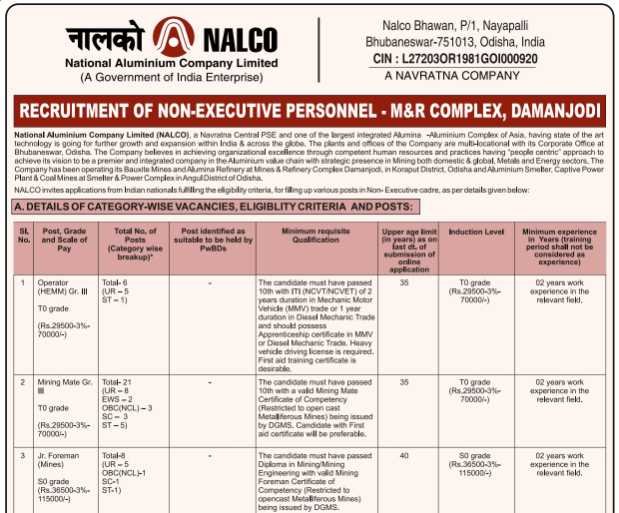
National Aluminium Company Limited (NALCO), one of India’s leading Navratna Public Sector Undertakings under the Ministry of Mines, Government of India, has officially announced the NALCO Non-Executive Recruitment 2026 notification for 268 vacancies across various technical and operational posts. This recruitment drive has generated significant attention among ITI holders, diploma candidates, B.Sc graduates, mining professionals, and technical job aspirants across the country.

The recruitment notification includes posts such as Operator, Technician, Mining Mate, Junior Foreman, SUPT (JOT), Instrumentation Technician, Laboratory Technician, Electrical Technician, Fitter, and several other non-executive positions. Interested candidates will be able to apply online through the official NALCO recruitment portal from 21 May 2026 to 10 June 2026.

NALCO is widely recognized for offering stable government-sector employment, excellent salary structures, career growth opportunities, industrial exposure, and long-term job security. Candidates looking for PSU jobs in 2026 should carefully read the complete details regarding eligibility criteria, vacancy distribution, age limit, educational qualification, salary, application procedure, and selection process before applying.


About NALCO

National Aluminium Company Limited is one of India’s largest integrated bauxite-alumina-aluminium-power complexes. Established in 1981, NALCO operates under the Ministry of Mines, Government of India and holds Navratna status among Central Public Sector Enterprises (CPSEs).

The company has major operational units at:

  • Damanjodi, Odisha
  • Angul, Odisha
  • Corporate Office in Bhubaneswar

NALCO is known for:

  • High employee benefits
  • Technical training programs
  • PSU-level salary packages
  • Industrial growth opportunities
  • Government job security
  • Modern mining and metallurgical infrastructure

The latest recruitment drive mainly focuses on the M&R Complex, Damanjodi.


NALCO Non-Executive Recruitment 2026 Overview

Particulars Details
Organization Name National Aluminium Company Limited (NALCO)
Recruitment Name NALCO Non-Executive Recruitment 2026
Total Vacancies 268 Posts
Job Type Central PSU Government Job
Application Mode Online
Notification Release Date 14 May 2026
Online Application Start Date 21 May 2026
Last Date to Apply 10 June 2026
Official Website
Recruitment Portal


Total Vacancy Details

NALCO has announced 268 vacancies across multiple technical and operational disciplines. These vacancies are distributed among several categories and departments.

Major posts include:

  • Operator (HEMM) Grade III
  • Mining Mate Grade III
  • Junior Foreman (Mines)
  • Junior Foreman (Electrical)
  • Technician (Electrical)
  • Technician (Mechanical/Fitter)
  • Technician (Instrumentation)
  • Laboratory Technician
  • SUPT (JOT)
  • Various other technical support posts


The detailed category-wise and discipline-wise vacancy breakup is available in the official notification PDF.


Important Dates

Candidates must keep track of all important dates related to the recruitment process.

Event Date
Notification Release 14 May 2026
Online Application Starts 21 May 2026
Last Date to Apply 10 June 2026
Fee Payment Last Date 10 June 2026
Admit Card Release To Be Announced
CBT Exam Date To Be Announced
Result Declaration To Be Announced


Educational Qualification

Different educational qualifications are prescribed for different posts.

The eligible qualifications include:

  • 10th Pass
  • ITI Certificate
  • NCVT / NCVET Certification
  • Diploma in Engineering
  • B.Sc Degree
  • Mining Competency Certificates
  • Heavy Vehicle Driving License (for specific posts)


Post-Wise Eligibility Details

Operator (HEMM) Grade III

Qualification

  • 10th Pass
  • ITI in Mechanic Motor Vehicle or Diesel Mechanic
  • Apprenticeship Certificate
  • Valid Heavy Vehicle Driving License

Experience

  • Minimum 2 years of relevant experience

Pay Scale

  • ₹29,500 – ₹70,000


Mining Mate Grade III

Qualification

  • 10th Pass
  • Mining Mate Certificate of Competency issued by DGMS

Experience

  • Minimum 2 years

Pay Scale

  • ₹29,500 – ₹70,000


Junior Foreman (Mines)

Qualification

  • Diploma in Mining Engineering
  • Mining Foreman Certificate of Competency

Experience

  • Relevant industry experience

Salary

  • ₹36,500 – ₹1,15,000


Junior Foreman (Electrical)

Qualification

  • Diploma in Electrical Engineering

Experience

  • Relevant field experience preferred

Salary

  • ₹36,500 – ₹1,15,000


Technician Posts

Technician vacancies are available in:

  • Electrical
  • Instrumentation
  • Mechanical
  • Laboratory

Qualification

  • ITI/Diploma/B.Sc depending on discipline

Salary

  • As per NALCO non-executive pay structure


Age Limit

The upper age limit varies depending on the post.

Post Category Maximum Age
Technical Operator Posts 35 Years
Junior Foreman Posts 40 Years
Other Posts 27–45 Years

Age relaxation is applicable as per Government of India norms.

Relaxation Categories

  • SC/ST
  • OBC-NCL
  • PwBD
  • Ex-Servicemen


Application Fee

Category Application Fee
General/OBC/EWS ₹100
SC/ST/PwBD/ESM Exempted

The fee must be paid online.


Salary Structure

NALCO offers one of the best salary packages among PSU non-executive recruitments.

Approximate Pay Scales

Post Salary
Operator Grade III ₹29,500 – ₹70,000
Technician ₹29,500 – ₹70,000
Junior Foreman ₹36,500 – ₹1,15,000

Additional benefits may include:

  • Dearness Allowance (DA)
  • House Rent Allowance (HRA)
  • Medical Facilities
  • Provident Fund
  • Leave Travel Concession
  • Gratuity
  • Performance Incentives
  • Industrial Allowances


Selection Process

The NALCO Non-Executive Recruitment 2026 selection process includes multiple stages.

1. Computer-Based Test (CBT)

Candidates must appear in an online written examination covering:

  • Technical subjects
  • General aptitude
  • Reasoning
  • Quantitative aptitude
  • General awareness

2. Trade Test / Skill Test

Applicable for selected technical positions.

3. Document Verification

Candidates qualifying the CBT and skill tests must produce original documents.

4. Medical Examination

Final appointment is subject to medical fitness standards prescribed by NALCO.


Exam Pattern

Although the detailed exam pattern may be announced separately, the CBT is expected to include:

Subject Expected Questions
Technical Subject Major Portion
General Knowledge Moderate
Aptitude Moderate
Reasoning Moderate
English Basic

Candidates should regularly check the official portal for updates.


Why NALCO Jobs Are Highly Preferred

There are several reasons why lakhs of candidates apply for NALCO recruitments every year.

PSU Job Security

NALCO is a Government-owned PSU offering long-term employment stability.

Attractive Salary

Compared to private-sector technical jobs, PSU salaries are highly competitive.

Career Growth

Employees get opportunities for:

  • Internal promotions
  • Skill enhancement
  • Department transfers
  • Technical specialization

Modern Work Environment

NALCO operates advanced industrial and mining facilities.

Additional Benefits

Employees receive:

  • Medical facilities
  • Pension-related benefits
  • Paid leaves
  • Housing allowances
  • Retirement benefits

How to Apply Online for NALCO Non-Executive Recruitment 2026

Candidates must follow the official online application process carefully.

Step-by-Step Process

Step 1

Visit the official recruitment portal:

Step 2

Open the “Non-Executive Recruitment 2026” notification.

Step 3

Register using:

  • Valid mobile number
  • Active email ID

Step 4

Fill in:

  • Personal details
  • Educational qualifications
  • Experience details

Step 5

Upload:

  • Passport size photograph
  • Signature
  • Certificates
  • ID proof

Step 6

Pay the application fee online.

Step 7

Submit the application form.

Step 8

Download and print the final application form.


Documents Required

Candidates should keep the following documents ready:

  • 10th Marksheet
  • ITI/Diploma/B.Sc Certificates
  • Experience Certificates
  • Aadhaar Card
  • Category Certificate
  • Passport-size Photograph
  • Signature Scan
  • Driving License (if applicable)

Preparation Tips for NALCO CBT Exam

Focus on Technical Subjects

Technical questions usually carry the highest weightage.

Practice Previous Year Questions

Solve:

  • PSU recruitment papers
  • Technical MCQs
  • ITI and diploma-level questions

Improve Aptitude Skills

Practice:

  • Quantitative aptitude
  • Logical reasoning
  • Basic mathematics

Stay Updated

Prepare:

  • Current affairs
  • PSU-related updates
  • Industrial news

Expected Competition Level

Since NALCO is a reputed PSU, the competition level is expected to be high.

Candidates from:

  • ITI trades
  • Diploma engineering
  • Mining backgrounds
  • Technical sectors

are likely to apply in large numbers.

Proper preparation and early application are strongly advised.


Work Location

The recruitment is mainly for:

  • M&R Complex, Damanjodi, Odisha

Selected candidates may also be posted in:

  • Operational units
  • Mining areas
  • Technical departments
  • Maintenance divisions


Who Should Apply?

This recruitment is highly suitable for:

  • ITI pass candidates
  • Diploma engineers
  • Mining professionals
  • B.Sc graduates
  • Heavy vehicle operators
  • Technical trade workers
  • PSU job aspirants

Key Highlights of NALCO Non-Executive Recruitment 2026

  • 268 vacancies announced
  • PSU Government job opportunity
  • Online applications begin on 21 May 2026
  • Last date is 10 June 2026
  • Attractive salary package
  • Multiple technical posts
  • CBT-based recruitment
  • Opportunities for ITI, Diploma and B.Sc candidates

The NALCO Non-Executive Recruitment 2026 is an excellent opportunity for candidates seeking stable PSU employment in India’s mining, engineering, and industrial sectors. With 268 vacancies available across multiple technical disciplines, this recruitment drive is expected to attract a large number of applicants from across the country.

Candidates should carefully review the official notification, verify eligibility conditions, prepare required documents, and complete the online application before the deadline. Since NALCO jobs are highly competitive and offer excellent salary structures and career prospects, early preparation for the CBT examination is essential.

Applicants are advised to regularly visit the official NALCO website for updates regarding admit cards, exam dates, syllabus, and result announcements.


Official PDF Notification

Detailed Notifications Here

NEET UG 2026 Re-Exam on June 21 Free of Cost; Students to Get Full Fee Refund

0

NEET UG Re-Exam: In a press conference today addressing the NEET UG 2026 paper leak controversy, the Minister of Education, Government of India, has announced major developments concerning the undergraduate medical exam. The NEET re-exam scheduled to be conducted on June 21, will be extended by 15 minutes, the education minister said. Pradhan announced that the admit cards for the NEET UG 2026 re-exam will be issued by June 14.

The Education Minister has admitted that we have to improve. In a major development, he announced that from next year, NEET UG will be conducted in Computer-Based Test (CBT) mode.

Addressing the conference, Pradhan said that the NEET UG 2026 examination was conducted on May 3, but concerns were raised on May 7 regarding a “guess paper,” following which complaints were forwarded to the central government agencies. He said that within a few days, authorities confirmed that the paper had been leaked.

Pradhan also said that a similar situation had earlier led to the formation of the Radhakrishnan Committee, and added that the government continues to act with a zero-tolerance approach towards malpractice.

“Our approach will remain zero tolerance towards malpractices and anti-social elements. With advancements in technology, such challenges are emerging, but we will not allow any compromise with students’ future,” he said.

The education minister said that the Central Bureau of Investigation (CBI) will conduct a detailed probe to identify the breach in the examination chain, adding that agencies have been directed to find the root of the issue.

He asserted that the government will ensure strict action against those involved in malpractice, warning that any attempt to undermine the examination system would face serious consequences.

The minister added that the candidates will receive a refund of their examination fees, and the upcoming re-exam will be conducted free of cost.

To ease the process for candidates, the NTA will allow students to choose their preferred exam city one week before the examination. Transportation facilities will also be arranged as far as possible, keeping weather conditions in mind, he said.

J&K Weather Update: Dry Spell, Rain Showers and Thunderstorm Alert Issued for May 17–28

The Meteorological Centre Srinagar has issued the latest weather forecast for Jammu and Kashmir, highlighting a mix of dry weather, scattered rain showers, thunderstorms and gusty winds over the coming days. According to the advisory, most parts of Jammu and Kashmir will witness generally dry weather initially, followed by spells of rain and thundershowers between May 19 and May 21.

Residents across both the Kashmir Division and Jammu Division have been advised to stay alert during afternoon and evening hours when weather activity is expected to intensify at scattered locations. The advisory also warns about possible lightning, gusty winds and rising temperatures in the plains of Jammu region.

In this detailed weather update, here is everything you need to know about the latest forecast, expected temperatures, rainfall activity, safety advisories and its impact on daily life and farming activities across Jammu and Kashmir.


J&K Weather Forecast From May 17 to May 28

The latest weather bulletin issued by the MET Centre Srinagar provides a day-wise outlook for the Union Territory.

Weather Forecast for May 17–18

According to the department, weather conditions across Jammu and Kashmir are expected to remain generally dry during May 17 and May 18.

Clear skies and sunshine are likely to dominate most areas during these two days. Day temperatures may rise gradually, especially in the plains of Jammu division where hot and dry weather conditions could prevail.

People planning outdoor activities, travel or agricultural work can expect mostly stable weather during this period.


Weather Forecast for May 19–21

From May 19 onward, weather conditions are expected to change.

The forecast predicts:

  • Partly to generally cloudy weather
  • Light rain showers at scattered to many places
  • Possibility of thunderstorms
  • Gusty winds during afternoon and evening hours

The Meteorological Department has warned that some places in both Kashmir and Jammu divisions may witness thunder, lightning and strong gusty winds with speeds reaching 40–50 kmph.

These weather conditions are likely to affect outdoor activities, local transport and farming operations in several districts.


Weather Forecast for May 22–25

During May 22 to May 25, the weather is expected to improve slightly.

The forecast indicates:

  • Generally dry weather during morning and forenoon hours
  • Brief rain showers possible during afternoon or late afternoon
  • Rain activity likely only at a few places

This means mornings are likely to remain pleasant and mostly dry, while isolated showers may occur later in the day due to localized weather development.

Tourists and travelers should still keep weather changes in mind, especially in hilly and vulnerable areas.


Weather Forecast for May 26–28

The MET Centre has predicted generally dry weather conditions from May 26 to May 28 across Jammu and Kashmir.

Most regions are expected to witness stable weather with sunshine and warmer daytime temperatures.

However, weather conditions in mountainous regions can still change suddenly, so travelers are advised to stay updated with official forecasts.


Advisory Issued by MET Centre Srinagar

The Meteorological Centre Srinagar has also released several important advisories for the public.

Thunderstorm and Lightning Warning

Authorities have warned about the possibility of:

  • Thunderstorms
  • Lightning strikes
  • Gusty winds reaching 40–50 kmph

These weather events are likely during May 19–21 at a few places in Kashmir Division and Jammu Division.

People are advised to avoid open spaces during thunderstorms and remain indoors during lightning activity.


Boating and Shikara Advisory

The advisory specifically mentions suspension or avoidance of boating and shikara riding during afternoon and late afternoon hours.

Strong winds and sudden weather changes over lakes and water bodies can create dangerous conditions for tourists and locals.

People visiting Dal Lake, Wular Lake and other water bodies should strictly follow local administration and weather department instructions.


Advice for Farmers

The Meteorological Department has advised farmers to continue agricultural and farming operations till the afternoon of May 19.

Dry weather during the initial days provides a favorable window for:

  • Crop maintenance
  • Irrigation work
  • Harvesting activities
  • Orchard management
  • Field preparation

However, after May 19 afternoon, farmers are advised to remain cautious due to possible rainfall, gusty winds and thunderstorm activity.

Strong winds can damage standing crops and fruit orchards in some areas.


Rise in Temperature Expected

The weather department has also forecast a gradual increase in day temperatures.

According to the advisory:

  • Day temperatures may rise by 2°C to 4°C at many places
  • Plains of Jammu division may experience hot and dry weather

The rise in temperature may lead to uncomfortable afternoon conditions in several districts, especially low-lying areas of Jammu.

People are advised to:

  • Stay hydrated
  • Avoid direct sunlight during peak afternoon hours
  • Wear light cotton clothing
  • Take precautions against heat-related discomfort

Impact on Kashmir Division

In Kashmir Valley, weather conditions are expected to remain mostly pleasant during the forecast period.

However, occasional rain showers and thunderstorms during May 19–21 may affect:

  • Tourist movement
  • Local transportation
  • Outdoor events
  • Mountain travel

Gusty winds can also lead to temporary disruptions in some areas.

Tourists planning visits to Gulmarg, Pahalgam, Sonamarg and other destinations should keep checking local weather updates regularly.


Impact on Jammu Division

The Jammu division is likely to witness warmer conditions during the coming days.

Plains areas may experience:

  • Rising temperatures
  • Hot and dry weather
  • Occasional gusty winds
  • Isolated thunderstorms

Some hilly districts may also receive brief rain showers during the active weather phase between May 19 and May 21.

Residents are advised to remain alert during afternoon and evening hours when thunderstorm activity is more likely.


Travel Advisory for Tourists

Tourists visiting Jammu and Kashmir during this period are advised to monitor weather updates regularly.

Travelers should:

  • Avoid unnecessary movement during thunderstorms
  • Follow traffic and weather advisories
  • Avoid boating during windy conditions
  • Carry light woolens for higher altitude areas
  • Stay updated about road and weather conditions

Mountain weather can change rapidly, especially during afternoon hours.


Importance of Weather Forecasts

Weather forecasts play an important role in helping residents, farmers, tourists and authorities prepare for changing weather conditions.

Advance alerts regarding rain, thunderstorms and gusty winds help reduce risks associated with:

  • Flash storms
  • Road accidents
  • Lightning incidents
  • Crop damage
  • Boating accidents

The latest advisory from MET Centre Srinagar is aimed at ensuring public safety and minimizing disruptions.


Safety Tips During Thunderstorms

People are advised to follow these important precautions during thunderstorm activity:

  • Stay indoors during lightning
  • Avoid standing under trees
  • Disconnect electrical appliances if needed
  • Avoid open fields and water bodies
  • Keep emergency contacts handy
  • Avoid unnecessary travel during intense weather activity

Drivers should also exercise caution due to reduced visibility and slippery roads during rain showers.

The latest J&K weather update suggests a mix of dry and unstable weather conditions during the second half of May 2026. While most areas will remain dry initially, rain showers, thunderstorms and gusty winds are expected between May 19 and May 21.

The Meteorological Centre Srinagar has issued advisories for farmers, tourists and the general public to stay alert during afternoon and evening hours.

Residents are encouraged to follow official weather updates and take necessary precautions, especially during thunderstorm activity and strong winds.

With temperatures also expected to rise across several areas, especially Jammu plains, people should prepare for warmer weather conditions in the coming days.

South Indian Bank Data Science Recruitment 2026: Apply Online for Junior Data Analyst, SQL Developer and BI Developer Posts

0

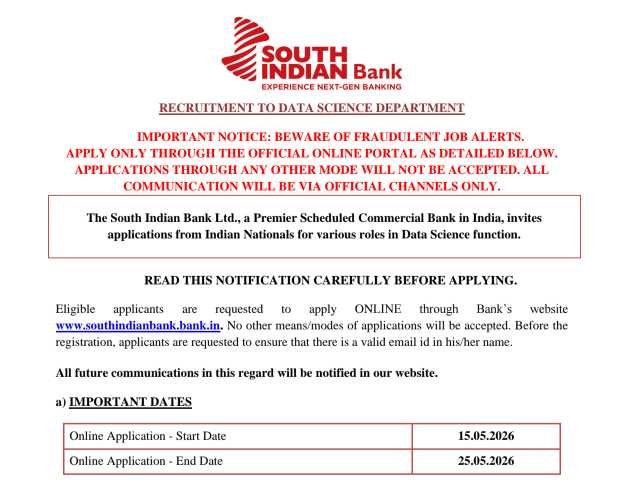
The South Indian Bank has officially released a recruitment notification for various positions in its Data Science Department. Candidates looking for opportunities in the banking technology and analytics sector now have a great chance to work with one of India’s leading private sector banks. The recruitment drive is aimed at hiring talented professionals for the roles of Junior Data Analyst, SQL Developer, and BI Developer under Scale I and Scale II categories.

This latest notification has generated significant interest among IT graduates, data analytics professionals, software developers, and candidates with experience in business intelligence and database management. The bank has invited online applications from eligible Indian nationals through its official website. Interested candidates are advised to carefully read all eligibility conditions, age criteria, educational qualifications, work experience requirements, and application procedures before applying.

According to the official notification, the online application process started on May 15, 2026, and the last date to apply online is May 25, 2026.

In this detailed article, you will find complete information regarding South Indian Bank Data Science Recruitment 2026 including eligibility criteria, vacancy details, salary structure, age relaxation, selection process, application process, important dates, required documents, career growth opportunities, exam preparation strategies, and much more.


About South Indian Bank

South Indian Bank is one of India’s leading scheduled commercial banks with a strong presence across the country. Founded in 1929, the bank has steadily grown into a trusted financial institution known for innovation, customer service, and digital transformation.

The bank has embraced advanced technologies such as artificial intelligence, machine learning, business intelligence, cloud computing, and data analytics to improve operational efficiency and customer experience. The latest recruitment drive for the Data Science Department reflects the bank’s commitment to strengthening its digital ecosystem.

Working with South Indian Bank offers professionals exposure to modern banking technologies, enterprise-level data systems, and analytical frameworks that drive financial decision-making.


South Indian Bank Data Science Recruitment 2026 Overview

Here is a quick overview of the recruitment process:

Particulars Details
Organization Name South Indian Bank
Department Data Science Department
Post Names Junior Data Analyst / SQL Developer / BI Developer
Scale Scale I / Scale II
Application Mode Online
Application Start Date May 15, 2026
Last Date to Apply May 25, 2026
Application Fee Nil
Job Location Anywhere in India
Official Website www.southindianbank.bank.in

The official notification clearly states that applications through any mode other than the online portal will not be accepted.


Important Dates

Candidates should remember the following important dates related to the recruitment process:

Event Date
Notification Release Date May 2026
Online Application Start Date 15 May 2026
Online Application End Date 25 May 2026
Interview Date To Be Announced
Final Selection Result To Be Announced

The bank has advised candidates not to wait until the last date because heavy internet traffic near the closing date may affect application submission.


Vacancy Details

South Indian Bank is recruiting candidates for the following positions:

  • Junior Data Analyst
  • SQL Developer
  • BI Developer

These roles fall under Scale I and Scale II categories.

The recruitment aims to strengthen the bank’s data science and analytics operations, enabling improved decision-making, data management, customer insights, and digital banking services.


Educational Qualification

Candidates applying for the recruitment must possess any of the following qualifications from a recognized university or institution:

  • B.Tech
  • B.E
  • MCA
  • M.Sc (IT/CS)
  • BCA
  • B.Sc (IT/CS/CA)

Applicants must have secured a minimum of 50% marks in their qualifying examination.

The educational qualifications indicate that the bank is seeking technically skilled professionals with expertise in software development, data handling, analytics, and database systems.


Work Experience Requirement

The official notification specifies that candidates must have:

  • Minimum 2 years of experience in Data Analytics, Business Intelligence, or IT
  • At least 2 years of experience in SQL Development


This requirement highlights the importance of hands-on technical expertise. Candidates with professional experience in SQL databases, data visualization, ETL tools, analytics platforms, and reporting systems are likely to have an advantage during the selection process.


Age Limit

The maximum age limit prescribed by the bank is:

  • Not more than 35 years

The notification also states that:

  • SC/ST candidates will receive a relaxation of 5 years in the upper age limit.

Candidates are advised to keep valid proof of age and category certificates ready during the recruitment process.


Salary Structure

Selected candidates will receive attractive salary packages under the IBA-approved pay scale for Scale I, II, and III officers. The salary package includes:

  • Basic Pay
  • Dearness Allowance (DA)
  • House Rent Allowance (HRA)
  • Special Allowance
  • Other Bank Allowances
  • Performance Linked Incentives


The banking sector is known for offering stable income, career growth, and excellent employee benefits. Data science professionals recruited under this notification can expect competitive compensation along with opportunities for advancement.


Job Responsibilities

Although the notification briefly mentions the job roles, candidates selected for these positions are expected to perform duties such as:

Junior Data Analyst

  • Analyzing large datasets
  • Generating reports and dashboards
  • Identifying business trends
  • Assisting management with data-driven decisions
  • Data cleansing and preprocessing

SQL Developer

  • Writing optimized SQL queries
  • Managing relational databases
  • Database performance tuning
  • ETL process support
  • Handling stored procedures and triggers

BI Developer

  • Designing business intelligence dashboards
  • Developing data visualization systems
  • Creating analytical reports
  • Integrating multiple data sources
  • Supporting enterprise analytics solutions

These roles are critical for modern banking operations where data plays a key role in customer engagement, fraud detection, credit analysis, and operational efficiency.


Mode of Selection

The selection process includes:

  • Shortlisting of candidates
  • Preliminary Interview and/or Personal Interview

Only shortlisted candidates will be invited for the recruitment process.

The bank also reserves the right to modify the selection process depending on the number of applications received.

Important points regarding selection:

  • Mere eligibility does not guarantee selection
  • Final selection depends on bank discretion
  • Decisions regarding eligibility and selection will be final

Application Fee

One of the most attractive features of this recruitment drive is that:

  • There is no application fee


Candidates can apply online without paying any registration charges.


How to Apply Online

Candidates must apply online through the official website of South Indian Bank.

The application process includes the following steps:

Step 1: Visit Official Website

Go to the official website of South Indian Bank.

Step 2: Open Careers Section

Navigate to the “Careers” page.

Step 3: Read Notification Carefully

Read all instructions, eligibility conditions, and requirements carefully.

Step 4: Register Online

Enter basic details such as:

  • Name
  • Email ID
  • Mobile Number
  • Educational Details
  • Work Experience

Step 5: Upload Documents

Upload:

  • Passport-size photograph
  • Signature
  • Resume in PDF format

Step 6: Verify Details

Double-check all entered information because modifications after submission are not allowed.

Step 7: Submit Application

Submit the application successfully.

Step 8: Save Application Reference ID

Keep the generated Application Reference ID for future use.


Photograph Upload Guidelines

The notification provides detailed instructions regarding photograph uploads.

Candidates should ensure:

  • Recent passport-size color photograph
  • White background
  • No caps or dark glasses
  • Resolution: 378 x 437 pixels
  • File size not exceeding 50 KB


Failure to follow the specifications may result in rejection of the application.


Signature Upload Guidelines

Candidates must upload signatures according to the prescribed guidelines:

  • Signature on white paper using black ink pen
  • Resolution: 140 x 110 pixels
  • File size below 50 KB


Resume Upload Instructions

Applicants must upload their resume in:

  • PDF format
  • File size not exceeding 1 MB


Candidates should ensure that resumes are updated with relevant technical skills, projects, certifications, and work experience.


Documents Required

Candidates should keep the following documents ready before applying:

  • Educational certificates
  • Experience certificates
  • Age proof
  • Category certificate (if applicable)
  • Passport-size photograph
  • Signature scan
  • Updated resume
  • Valid email ID
  • Mobile number

Important General Conditions

The notification contains several important conditions that applicants must follow.

Multiple Applications Not Allowed

Candidates making multiple registrations for the same role will be disqualified.

Willingness to Serve Anywhere in India

Applicants should be willing to serve anywhere in India.

Medical Fitness

Final appointment will be subject to:

  • Medical fitness
  • Background verification
  • Police clearance
  • CIBIL/Credit history check


False Information

Providing false information may lead to cancellation of candidature or termination after appointment.


Why This Recruitment is Important

The banking industry is rapidly adopting digital technologies. Data science and analytics are becoming central to banking operations including:

  • Fraud detection
  • Customer behavior analysis
  • Loan risk assessment
  • Personalized banking
  • Cybersecurity monitoring
  • Financial forecasting

South Indian Bank’s recruitment reflects the increasing demand for data professionals in the financial sector.


Career Opportunities in Banking Data Science

Data science has emerged as one of the most promising career fields in India. Professionals working in banking analytics gain expertise in:

  • Big data processing
  • Predictive analytics
  • Financial modeling
  • Database optimization
  • Artificial intelligence applications
  • Customer analytics

Working in a reputed bank offers exposure to enterprise-scale data systems and financial technologies.


Skills Required for Success

Candidates aspiring for these positions should possess skills such as:

Technical Skills

  • SQL
  • Database management
  • Data visualization
  • Power BI
  • Tableau
  • Python
  • Excel
  • ETL processes

Analytical Skills

  • Problem-solving
  • Statistical analysis
  • Trend identification
  • Business reporting

Soft Skills

  • Communication
  • Team collaboration
  • Time management
  • Decision-making

Interview Preparation Tips

Candidates shortlisted for interviews should prepare thoroughly.

Revise SQL Concepts

Focus on:

  • Joins
  • Stored procedures
  • Functions
  • Query optimization
  • Triggers
  • Indexing

Learn BI Tools

Prepare concepts related to:

  • Power BI
  • Tableau
  • Dashboards
  • Reporting systems

Understand Banking Analytics

Study how data science is used in:

  • Customer relationship management
  • Fraud detection
  • Risk management
  • Credit scoring

Practice HR Questions

Common questions include:

  • Tell us about yourself
  • Why do you want to join South Indian Bank?
  • Describe your work experience
  • Explain a challenging project

Benefits of Working in South Indian Bank

Employees enjoy multiple benefits including:

  • Job security
  • Attractive salary
  • Career growth
  • Banking allowances
  • Performance incentives
  • Professional work environment
  • Training opportunities

The banking sector also provides long-term stability and professional recognition.


Common Mistakes to Avoid During Application

Many candidates lose opportunities due to avoidable errors.

Incorrect Information

Always verify educational details, experience, and personal data.

Improper Uploads

Ensure photographs and signatures meet the required specifications.

Waiting Until Last Date

Heavy traffic may prevent successful submission.

Multiple Registrations

Submitting multiple applications may result in disqualification.


Future Scope of Data Science in Banking

The future of banking will be increasingly driven by:

  • Artificial intelligence
  • Machine learning
  • Real-time analytics
  • Predictive modeling
  • Automation

Banks are investing heavily in data infrastructure and analytical capabilities. Professionals entering this field now can expect strong long-term career growth.


Comparison with Other Banking IT Jobs

Compared to traditional banking roles, data science positions offer:

Feature Data Science Roles Traditional Banking Roles
Technical Exposure High Moderate
Innovation Advanced Limited
Growth Opportunities Rapid Steady
Digital Skills Essential Optional
Industry Demand Very High High

This recruitment is especially attractive for IT professionals seeking stable careers with modern technological exposure.


Tips to Build a Strong Resume

Candidates should tailor resumes specifically for banking data science roles.

Include:

  • SQL projects
  • Data visualization experience
  • Certifications
  • Technical tools
  • Business intelligence projects
  • Internship experience
  • Achievements

Avoid lengthy resumes and focus on relevant technical expertise.


Certifications That Can Help

The following certifications may strengthen a candidate’s profile:

  • Microsoft Power BI Certification
  • Tableau Certification
  • SQL Certification
  • Google Data Analytics Certificate
  • Python for Data Science
  • AWS Data Analytics
  • Oracle SQL Developer Certification

Demand for SQL Developers in Banking

SQL developers are highly valued in banks because they manage critical databases containing customer information, financial transactions, and analytical reports.

Responsibilities include:

  • Database maintenance
  • Query optimization
  • Data extraction
  • Reporting
  • Integration support

The increasing use of digital banking platforms has significantly increased demand for database professionals.


Importance of Business Intelligence in Banking

Business intelligence tools help banks:

  • Track performance metrics
  • Analyze customer behavior
  • Detect fraud patterns
  • Improve operational efficiency
  • Forecast business trends

BI Developers play a vital role in converting raw data into meaningful business insights.


Growth of Digital Banking in India

India’s banking sector has undergone massive digital transformation due to:

  • UPI adoption
  • Mobile banking
  • Internet banking
  • AI-powered services
  • Digital lending platforms

As a result, banks require skilled professionals capable of handling large-scale data ecosystems.


Role of Data Analytics in Modern Banking

Data analytics supports:

  • Credit risk analysis
  • Customer segmentation
  • Marketing campaigns
  • Financial forecasting
  • Fraud prevention
  • Loan recovery analysis

The ability to analyze and interpret data has become a strategic requirement for financial institutions.


Key Highlights from Official Notification

Some important highlights include:

  • No application fee
  • Attractive salary package
  • Scale I/II officer positions
  • Opportunity to work anywhere in India
  • Online application mode only
  • Recruitment for specialized data science roles


Things Candidates Must Remember

Before applying, candidates should remember:

  • Ensure eligibility before registration
  • Keep scanned documents ready
  • Use active email and phone number
  • Save application reference ID
  • Monitor official website regularly for updates

Frequently Asked Questions (FAQs)

What is the last date to apply for South Indian Bank Data Science Recruitment 2026?

The last date to apply online is May 25, 2026.


What posts are available?

The recruitment includes:

  • Junior Data Analyst
  • SQL Developer
  • BI Developer

What is the application fee?

There is no application fee.


What is the maximum age limit?

The maximum age limit is 35 years.


What educational qualifications are required?

Candidates must possess qualifications such as:

  • B.Tech
  • B.E
  • MCA
  • M.Sc
  • BCA
  • B.Sc

with minimum 50% marks.


Is work experience mandatory?

Yes. Minimum 2 years of experience in Data Analytics, Business Intelligence, or IT with SQL Development experience is required.


What is the mode of selection?

Selection will be based on shortlisting and interview.

South Indian Bank Data Science Recruitment 2026 is an excellent opportunity for skilled IT and analytics professionals seeking a rewarding career in the banking sector. The recruitment offers attractive salary packages, professional growth, exposure to advanced banking technologies, and the opportunity to work in a reputed financial institution.

Candidates with expertise in SQL development, business intelligence, and data analytics should not miss this opportunity. Since there is no application fee and the selection process is interview-based, eligible candidates are encouraged to apply as early as possible.

Applicants are advised to read the official notification carefully, ensure eligibility, prepare all required documents, and complete the application process before the deadline.

As banks continue adopting artificial intelligence and advanced analytics, professionals in data science roles are expected to play a crucial role in shaping the future of digital banking in India.


Official PDF Notification

PDF Link: Detailed Notifications Here

JKPSC Junior Statistical Assistant Course Departmental Examination 2026: Complete Guide to Online Application, Eligibility, Important Dates, Fee, Exam Centres and Instructions

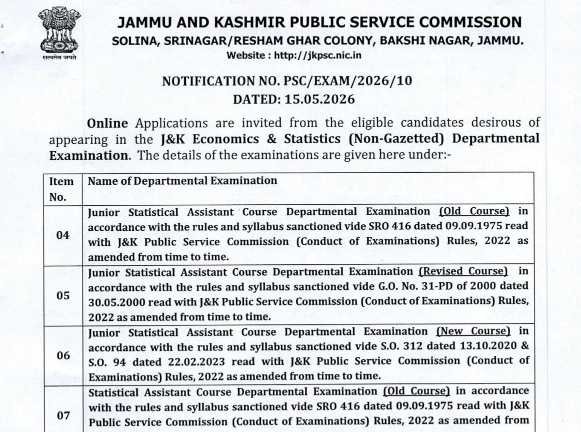
The Jammu and Kashmir Public Service Commission (JKPSC) has officially invited online applications from eligible candidates for the J&K Economics & Statistics (Non-Gazetted) Departmental Examination 2026. The notification, issued under Notification No. PSC/EXAM/2026/10 dated May 15, 2026, provides complete details regarding the Junior Statistical Assistant Course Departmental Examination and Statistical Assistant Course Departmental Examination for various courses including Old Course, Revised Course and New Course.

This departmental examination is a crucial opportunity for employees working under the Economics & Statistics Department in Jammu and Kashmir who wish to qualify for departmental promotions, professional advancement and certification under the prescribed rules and syllabus sanctioned by the government. The notification includes details about examination schedules, online application procedures, fee structure, eligibility requirements, examination centres and mandatory instructions for candidates.

Candidates aspiring to appear in the departmental examination must carefully read all the guidelines and complete the online application process within the stipulated timeline. Since the application process is entirely online, applicants are advised to keep all required documents ready and ensure accuracy while filling the application form.


JKPSC Departmental Examination 2026 Notification Overview

The Jammu and Kashmir Public Service Commission released the notification for departmental examinations under the Economics & Statistics Department for the following categories:

  1. Junior Statistical Assistant Course Departmental Examination (Old Course)
  2. Junior Statistical Assistant Course Departmental Examination (Revised Course)
  3. Junior Statistical Assistant Course Departmental Examination (New Course)
  4. Statistical Assistant Course Departmental Examination (Old Course)
  5. Statistical Assistant Course Departmental Examination (Revised Course)
  6. Statistical Assistant Course Departmental Examination (New Course)

The notification has been issued in accordance with the rules and syllabus sanctioned through various government orders and statutory rules applicable to the department.

The examinations are meant for eligible departmental candidates who fulfil the prescribed conditions under the Economics & Statistics Department of Jammu and Kashmir.


Important Dates for JKPSC Departmental Examination 2026

Candidates must note all important dates mentioned in the official notification to avoid missing deadlines.

Key Dates

Event Date
Date of commencement of online applications 18-05-2026
Last date for submission of online application forms 18-06-2026
Last date for submission of hardcopy along with fee receipt and eligibility certificate 25-06-2026

According to the notification, the online application forms will be available on the official JKPSC website from May 18, 2026.

Candidates are strongly advised not to wait until the final date because heavy traffic on the portal may cause delays or technical issues.


Courses Included in the Departmental Examination

The notification includes both Junior Statistical Assistant and Statistical Assistant departmental examinations under different course structures.

1. Junior Statistical Assistant Course (Old Course)

This examination is conducted according to rules and syllabus sanctioned under SRO 416 dated 09.09.1975 read with JKPSC Conduct of Examinations Rules 2022 as amended from time to time.

2. Junior Statistical Assistant Course (Revised Course)

The revised course examination follows Government Order No. 31-PD of 2000 dated 30.05.2000 and relevant examination rules.

3. Junior Statistical Assistant Course (New Course)

The new course examination follows S.O. 312 dated 13.10.2020 and S.O. 94 dated 22.02.2023 along with JKPSC examination rules.

4. Statistical Assistant Course (Old Course)

Conducted under the old syllabus sanctioned vide SRO 416 dated 09.09.1975.

5. Statistical Assistant Course (Revised Course)

This examination follows Government Order No. 31-PD of 2000.

6. Statistical Assistant Course (New Course)

Conducted under S.O. 312 dated 13.10.2020 and S.O. 94 dated 22.02.2023.


Eligibility Criteria for JKPSC Departmental Examination 2026

The notification clearly states that only eligible candidates can apply for the examination. Candidates must ensure that they satisfy all eligibility conditions before submitting the online application form.

The eligibility certificate must be duly recorded by the Director General, Economics & Statistics before submission to JKPSC.

Applicants who fail to produce eligibility certification or provide incorrect information may face rejection of their candidature.


Application Mode and Official Website

The application process is strictly online. No offline mode or manual application form will be accepted by JKPSC.

Candidates need to apply through the official JKPSC website:

Official Website

https://jkpsc.nic.in

As per the notification, no other means or mode of application shall be entertained.


JKPSC Departmental Examination Fee 2026

Candidates are required to pay an examination fee after successful submission of the online application form.

Examination Fee

  • Rs. 400 per paper

The fee must be paid through online mode only under the “Submitted Applications” menu available in the candidate’s JKPSC account.

Candidates should carefully verify the payment status after completing the transaction.


Examination Centres for JKPSC Departmental Examination 2026

The departmental examination will be conducted at the following centres:

  • Srinagar
  • Jammu
  • Leh

According to the notification, the allotment of examination centres shall remain entirely at the discretion of JKPSC.

Candidates are required to mention their preferred examination centre while filling the online application form.


Step-by-Step Process to Apply Online

The notification contains detailed instructions for online application submission. Candidates should carefully follow each step.

Step 1: Visit Official JKPSC Website

Go to the JKPSC official portal and access the One Time Registration (OTR) section.

Step 2: Complete One Time Registration

New candidates need to create an OTR profile by providing:

  • Personal details
  • Contact information
  • Educational qualifications
  • Service details
  • Uploading required documents

Existing users can directly log in using their credentials.

Step 3: Upload Photograph and Signature

Candidates must upload:

  • Recent passport-size colour photograph
  • Signature image

The notification states that the photograph should not be older than January 1, 2026.

Image Size Requirements

  • Photograph and signature size should be between 10 KB to 20 KB
  • Accepted format: .jpeg or .jpg only

How to Select Examination Post

After completing OTR, candidates must:

  1. Click on “Show Jobs”
  2. Select the advertisement month
  3. Choose the respective departmental examination
  4. Click on “Apply”

An instruction page will appear and candidates should read all instructions carefully before final submission.


Important Instructions Before Final Submission

Before clicking the submit button, candidates should verify all details carefully.

The notification clearly mentions:

  • Once submitted, the online application form cannot be edited
  • Incorrect information may lead to rejection
  • Candidates should review every field carefully

After successful submission, candidates can print the application form for future reference.


Fee Payment Instructions

Candidates must ensure that:

  • Fee payment is completed online only
  • Payment status is reflected successfully
  • Application status shows successful submission

If the payment status remains pending or under processing, candidates are advised to immediately contact JKPSC.

The commission also instructed candidates using external payment gateways to ensure that the amount is credited to the official JKPSC account.


Submission of Hardcopy and Documents

After online submission, candidates must submit:

  1. Hardcopy of application form
  2. Online fee receipt
  3. Eligibility certificate

The documents should be submitted through registered or speed post to:

  • JKPSC Office, Resham Ghar Colony, Bakshi Nagar, Jammu or
  • JKPSC Office, Solina, Srinagar

The last date for submission of hardcopy documents is June 25, 2026.


Why This Departmental Examination is Important

The Junior Statistical Assistant and Statistical Assistant departmental examinations are significant for employees in the Economics & Statistics Department because they:

  • Enhance departmental qualifications
  • Help in career progression
  • Improve promotion prospects
  • Strengthen technical knowledge in statistical work
  • Ensure compliance with departmental service requirements

Departmental examinations also improve administrative efficiency by ensuring that employees possess updated knowledge and professional competency.


Understanding the Old, Revised and New Course Structure

The inclusion of multiple course structures ensures that employees governed under different service rules and appointment periods can appear according to applicable syllabi.

Old Course

Applicable for employees governed under earlier service rules and syllabus frameworks.

Revised Course

Introduced through government revisions aimed at updating departmental training.

New Course

Aligned with modern statistical and administrative requirements under recent government orders.

The new course structure reflects contemporary governance needs and updated departmental standards.


Common Mistakes Candidates Should Avoid

Many candidates lose opportunities because of avoidable mistakes during the application process. Here are some important points to remember:

1. Incorrect Photograph Upload

Ensure photograph dimensions and size meet prescribed requirements.

2. Incomplete OTR Profile

Fill all educational and service details properly.

3. Wrong Examination Selection

Carefully choose the correct course category.

4. Delay in Fee Payment

Complete fee payment well before deadline.

5. Missing Hardcopy Submission

Online application alone is not sufficient. Hardcopy documents must also be submitted.

6. Incorrect Eligibility Certificate

Get proper attestation and certification from the competent authority.


Misconduct Rules and Candidate Responsibilities

JKPSC has issued strict warnings regarding misconduct and submission of false information.

Candidates found guilty of the following may face serious consequences:

  • Furnishing false information
  • Submitting fabricated documents
  • Impersonation
  • Tampering with certificates
  • Using unfair means during examination
  • Misbehaving in examination halls
  • Harassing examination staff

Such candidates may face:

  • Debarment from examinations
  • Criminal prosecution
  • Disqualification from future selections
  • Government employment restrictions

The notification strongly advises candidates not to alter any official documents.


Role of the Economics & Statistics Department

The Economics & Statistics Department plays a major role in planning, data collection, policy analysis and developmental monitoring in Jammu and Kashmir.

Statistical assistants and junior statistical assistants contribute significantly in:

  • Data analysis
  • Government surveys
  • Economic planning
  • Statistical reporting
  • Policy evaluation
  • Developmental indicators monitoring

Departmental examinations help maintain professional standards and improve technical expertise among employees.


Importance of Accurate Statistical Administration

Statistics form the backbone of governance and developmental planning. Accurate data helps the government in:

  • Poverty assessment
  • Employment planning
  • Budget allocation
  • Agricultural surveys
  • Census operations
  • Economic forecasting
  • Public welfare schemes

Qualified statistical personnel ensure reliability and efficiency in these processes.


Tips to Prepare for the Departmental Examination

Candidates preparing for the departmental examination should adopt a structured approach.

Understand the Syllabus

Study the applicable syllabus for old, revised or new course.

Practice Previous Papers

Solving earlier question papers improves confidence and time management.

Focus on Statistical Concepts

Strengthen concepts related to:

  • Statistical methods
  • Data interpretation
  • Sampling
  • Administrative procedures

Improve Writing Skills

Departmental examinations may include descriptive and analytical answers.

Maintain Consistency

Regular study and revision are essential for success.


Digital Transformation in JKPSC Application Process

The online application system reflects the government’s move towards digital governance and transparency.

Benefits of the online system include:

  • Faster processing
  • Reduced paperwork
  • Transparent application tracking
  • Improved accessibility
  • Easier fee payment
  • Efficient communication

The OTR system also simplifies future applications for candidates.


Final Advice for Candidates

Candidates should not treat the departmental examination as a routine process. It is an important professional milestone that can positively impact long-term career growth.

Applicants should:

  • Read the notification carefully
  • Submit applications early
  • Preserve fee receipts
  • Verify eligibility
  • Keep copies of documents
  • Monitor official JKPSC updates regularly

Timely preparation and careful application submission can help candidates avoid unnecessary complications.

The JKPSC Junior Statistical Assistant Course Departmental Examination 2026 offers an important opportunity for eligible employees of the Economics & Statistics Department to enhance their qualifications and career prospects. The Jammu and Kashmir Public Service Commission has outlined a transparent online application process along with detailed instructions for candidates.

Applicants must carefully follow the guidelines related to eligibility, fee payment, examination centre selection, document submission and online registration. Since the examination process includes strict scrutiny and misconduct regulations, candidates should ensure complete accuracy while submitting applications.

The examination not only supports professional advancement but also contributes to improving the efficiency and quality of statistical administration in Jammu and Kashmir. Candidates are therefore advised to complete the application process well before the deadline and begin focused preparation for the departmental examination.

The official notification was issued by JKPSC under Notification No. PSC/EXAM/2026/10 dated May 15, 2026.


Official PDF Notification

PDF Link: https://jkpsc.nic.in/Pdf/Downloader1.ashx?nid=17870&type=n

CBSE Makes Three Languages Mandatory for Classes 9 and 10 From July 1, 2026: Full Details Explained

0

The Central Board of Secondary Education has introduced a major reform in the secondary school curriculum by making the study of three languages compulsory for students of Classes 9 and 10 from July 1, 2026. The move is part of the implementation of the National Education Policy (NEP) 2020 and the National Curriculum Framework for School Education (NCF-SE) 2023.

According to the latest CBSE circular, students studying in Classes 9 and 10 during the 2026–27 academic session must now study three languages identified as R1, R2, and R3. Importantly, at least two of these languages must be native Indian languages.

The decision marks one of the biggest curriculum changes in recent years and is expected to significantly influence language learning, school teaching patterns, and board examination structures across India.


What Is the New CBSE Three-Language Policy?

Under the revised language policy, all students entering Class 9 from July 1, 2026, will have to study three languages compulsorily. The three languages will be categorized as:

  • R1 (Language 1)
  • R2 (Language 2)
  • R3 (Language 3)

CBSE has clarified that:

  • At least two languages must be Indian languages
  • Students may choose a foreign language only if the remaining two are Indian languages
  • Schools must ensure proper implementation of multilingual education under NEP 2020

This new policy aligns with the broader goal of promoting multilingualism and strengthening Indian languages in school education.


Why Has CBSE Introduced This Change?

The reform is directly linked to the implementation of the National Education Policy (NEP) 2020, which emphasizes:

  • Multilingual education
  • Promotion of regional and Indian languages
  • Cognitive development through language diversity
  • Flexibility in language learning

The National Curriculum Framework for School Education (NCF-SE) 2023 also recommends that students should continue learning three languages up to the secondary stage.

CBSE stated that the revised scheme was introduced after reviewing the newly released NCERT curriculum for Classes 9 and 10 for the 2026–27 session.


Two Indian Languages Now Mandatory

One of the biggest highlights of the policy is that students must study at least two Indian languages.

This means:

  • English can still be studied
  • Hindi can be selected
  • Regional languages such as Kashmiri, Dogri, Tamil, Telugu, Bengali, Marathi, Urdu, Punjabi, Malayalam and others can be chosen
  • Foreign languages like French, German, Japanese, Spanish, or Russian can only be selected as the third language if two Indian languages are already being studied

The move is aimed at preserving linguistic diversity and encouraging students to remain connected with Indian culture and regional identities.


Will There Be a Board Exam for the Third Language?

CBSE has clarified that there will be no Class 10 board examination for the third language (R3) for now.

The third language will instead be:

  • Assessed internally by schools
  • Evaluated through school-level examinations and assessments
  • Included in the curriculum but excluded from external board examination structure

This announcement has brought relief to many students and parents concerned about additional board exam pressure.

However, students will still need to successfully complete the third language requirement as part of their academic progression.


What Are R1, R2 and R3?

The revised CBSE framework uses three categories for languages:

Language Category Meaning
R1 Primary language studied by the student
R2 Second language chosen at a different proficiency level
R3 Third compulsory language introduced under NEP

CBSE has also clarified that:

  • The same language cannot be repeated at multiple levels
  • R1 and R2 must be different languages
  • Schools must provide language choices according to available resources

What Languages Can Students Choose?

Students will have a broad list of language options available under the revised curriculum.

Indian Languages

Students may choose from:

  • Hindi
  • Urdu
  • Kashmiri
  • Dogri
  • Punjabi
  • Bengali
  • Marathi
  • Tamil
  • Telugu
  • Kannada
  • Malayalam
  • Gujarati
  • Assamese
  • Sanskrit
  • Konkani
  • Maithili
  • Santali
  • Manipuri
  • Bodo
  • Nepali
  • Sindhi
  • Odia and more

CBSE has expanded language offerings to include all 22 scheduled Indian languages.

Foreign Languages

Students may also opt for:

  • French
  • German
  • Japanese
  • Russian
  • Spanish
  • Korean
  • Arabic
  • Persian

But only under the condition that two Indian languages are already included in the student’s language combination.


Transitional Arrangements for Schools

Since the academic session 2026–27 has already started in many schools, CBSE has announced transitional arrangements for implementation.

These include:

  • Temporary textbook support
  • Interim teacher-sharing models
  • Flexible arrangements for schools lacking language teachers
  • Gradual adaptation of syllabus and assessments

Schools have also been asked to finalize their language offerings and implementation plans quickly to avoid confusion among students.


Impact on Students

The new policy will significantly affect students in several ways.

Positive Impacts

  • Better multilingual skills
  • Stronger understanding of Indian languages and culture
  • Enhanced communication abilities
  • Cognitive benefits associated with multilingual learning
  • Wider academic flexibility

Challenges

  • Additional language workload
  • Difficulty in schools with limited language teachers
  • Concerns from students already managing heavy academic schedules
  • Rural and smaller schools may face infrastructure challenges

Despite these concerns, CBSE believes the policy will strengthen educational quality in the long term.


Impact on Schools and Teachers

Schools across India will now need to:

  • Hire additional language teachers
  • Offer more Indian language options
  • Restructure timetables
  • Introduce multilingual learning support
  • Conduct internal assessments for R3

Teacher shortages remain a major concern, especially in remote areas. CBSE has acknowledged this issue and suggested interim arrangements until schools can fully adapt.


What About Existing Students?

The revised rule primarily applies to students entering Class 9 from July 1, 2026.

CBSE has indicated that:

  • Current batches may continue under transitional norms
  • Schools will gradually shift toward complete implementation
  • Full integration of the three-language system will continue in phases

Earlier reports had suggested a phased rollout beginning from Class 6 and extending to Class 10 by 2030–31.


Is English Still Compulsory?

There has been confusion regarding the status of English under the new language policy.

CBSE has not removed English from the curriculum. Instead:

  • English can continue as one of the three languages
  • Students must additionally study at least one more Indian language
  • Foreign languages are treated separately under the revised framework

Therefore, English remains important, but the policy now places stronger emphasis on Indian languages as well.


What NEP 2020 Says About Language Learning

The National Education Policy 2020 strongly supports multilingualism.

The policy states that:

  • Children learn concepts better in multiple languages
  • Mother tongue and regional language education should be encouraged
  • Students should be exposed to Indian linguistic diversity
  • Language learning helps improve cognitive development and cultural awareness

The CBSE policy is essentially an institutional implementation of these recommendations.


Concerns Raised by Parents and Experts

Several education experts and parents have expressed mixed reactions.

Supporters Say:

  • It promotes Indian languages
  • It strengthens cultural identity
  • It improves cognitive flexibility
  • It supports holistic education

Critics Say:

  • Students already face academic burden
  • Schools lack trained teachers
  • Sudden implementation may create confusion
  • Urban schools may adapt faster than rural institutions

Some experts have also requested more clarity regarding:

  • Internal assessment formats
  • Textbook availability
  • Teacher recruitment plans
  • Board examination patterns after 2030

Future of the Three-Language Formula

CBSE is expected to gradually expand the implementation of the policy in coming years.

Future possibilities include:

  • Standardized R3 assessments
  • Inclusion of vocational and interdisciplinary language modules
  • More digital learning resources
  • Integration with AI-based multilingual education systems

By 2030–31, the board may fully implement the three-language framework across all secondary classes under NEP guidelines.


Key Highlights of the New CBSE Language Policy

  • Three languages compulsory for Classes 9 and 10 from July 1, 2026
  • At least two languages must be Indian languages
  • No Class 10 board exam for the third language
  • Foreign languages allowed only alongside two Indian languages
  • Policy aligned with NEP 2020 and NCF-SE 2023
  • Schools to implement transitional arrangements
  • Internal assessment for R3 language
  • Expanded list of Indian language options

The new CBSE three-language policy marks a historic transformation in India’s secondary education system. By making three languages compulsory for Classes 9 and 10, the board aims to promote multilingualism, preserve Indian linguistic heritage, and align school education with the broader vision of NEP 2020.

While the move has generated debate regarding implementation challenges and academic pressure, it also opens opportunities for students to develop stronger communication skills and deeper cultural understanding.

As schools prepare for the July 1, 2026 rollout, students, parents, and educators will closely watch how effectively the new system is implemented across the country.

For the official report and updates, visit and .

Indian Army TES 56 Recruitment 2026: Apply Online for 90 Lieutenant Posts, Eligibility, Selection Process and Complete Details

0

The Indian Army has officially announced the Indian Army TES 56 Recruitment 2026 notification for candidates aspiring to join the armed forces as commissioned officers through the Technical Entry Scheme (TES). The TES-56 course is scheduled to commence in January 2027 and offers an excellent opportunity for unmarried male candidates who have completed their 10+2 education with Physics, Chemistry, and Mathematics (PCM).

Under this recruitment drive, the Indian Army will fill 90 vacancies for Lieutenant posts through the 10+2 Technical Entry Scheme. Candidates who appeared in JEE Main 2026 and meet the eligibility requirements can apply online through the official Indian Army website.

The Technical Entry Scheme is one of the most prestigious officer-entry routes in the Indian Army. It allows young aspirants to become commissioned officers without appearing in a written entrance examination like NDA or CDS. Selection is based on JEE Main scores, followed by the SSB interview and medical examination.

In this detailed article, candidates will find complete information regarding Indian Army TES 56 Recruitment 2026, including eligibility criteria, age limit, educational qualifications, application process, important dates, selection procedure, salary structure, training details, and preparation tips.


What is Indian Army TES Entry?

The Technical Entry Scheme (TES) is a direct entry route into the Indian Army for students who have completed Class 12 with science subjects. Candidates selected through TES undergo technical and military training before being commissioned as Lieutenants in the Indian Army.

The TES entry is specifically designed for candidates interested in engineering and military leadership. Selected cadets receive engineering training along with military education and leadership development.

Unlike other Army entries, there is no written examination conducted separately for TES. Candidates are shortlisted on the basis of JEE Main performance and academic records.


Indian Army TES 56 Recruitment 2026 Overview

Particulars Details
Organization Indian Army
Entry Scheme Technical Entry Scheme (TES-56)
Course Commencement January 2027
Total Vacancies 90
Post Name Lieutenant
Application Mode Online
Selection Process Shortlisting, SSB Interview, Medical Examination
Official Website
Training Type Permanent Commission


Indian Army TES 56 Recruitment 2026 Important Dates

Candidates must keep track of all important events related to the recruitment process.

Event Date
Notification Release Date May 2026
Online Application Start Date 13 May 2026
Last Date to Apply Online 12 June 2026
SSB Interview Dates To be Announced
TES 56 Course Begins January 2027


Total Vacancies in Indian Army TES 56

The Indian Army has announced a total of 90 vacancies for the TES-56 course.

Post Vacancies
Lieutenant (TES-56) 90

The number of vacancies is provisional and may change depending on organizational requirements.


Eligibility Criteria for Indian Army TES 56 Recruitment 2026

Candidates must fulfill all eligibility conditions before applying online.

Nationality

A candidate must be:

  • A citizen of India, or
  • A subject of Nepal, or
  • A person of Indian origin who migrated from specified countries with the intention of permanently settling in India.

Educational Qualification

Candidates applying for TES-56 must satisfy the following academic requirements:

  • Must have passed 10+2 examination or equivalent.
  • Must have studied Physics, Chemistry, and Mathematics (PCM).
  • Should have secured at least 60% aggregate marks in PCM subjects.
  • Must have appeared in JEE Main 2026.

The JEE Main score is mandatory for shortlisting candidates for SSB interviews.


Age Limit for TES 56 Recruitment

Candidates must fall within the prescribed age bracket.

Criteria Details
Minimum Age 16½ Years
Maximum Age 19½ Years

Candidates should be born between 1 July 2007 and 1 July 2010 (both dates inclusive).


Marital Status

Only unmarried male candidates are eligible to apply for Indian Army TES 56 Recruitment 2026.

Marriage during training is not permitted.


Indian Army TES 56 Selection Process

The selection process for TES-56 involves multiple stages designed to evaluate the candidate’s academic excellence, leadership qualities, and medical fitness.

1. Shortlisting of Applications

Candidates are shortlisted based on:

  • JEE Main 2026 performance
  • Academic records
  • Eligibility fulfillment

Only shortlisted candidates are called for the SSB Interview.


2. SSB Interview

The Services Selection Board (SSB) interview is conducted in two stages.

Stage I

  • Officer Intelligence Rating Test
  • Picture Perception and Discussion Test

Candidates who fail Stage I are sent back the same day.

Stage II

Candidates clearing Stage I undergo:

  • Psychological Tests
  • Group Testing Officer Tasks
  • Personal Interview
  • Conference

The SSB process usually lasts five days.


3. Medical Examination

Candidates recommended by the SSB undergo a detailed medical examination at military hospitals.


4. Final Merit List

The final merit list is prepared based on:

  • SSB performance
  • Medical fitness
  • Availability of vacancies


Training Details for TES 56

Selected candidates undergo four years of training, including military and engineering education.

Training Structure

Training Phase Duration
Basic Military Training 1 Year
Technical Training 3 Years

Cadets receive engineering education and military leadership training simultaneously.

Training is conducted at prestigious military institutions such as:

  • Cadets Training Wing (CTW)
  • Indian Military Academy (IMA), Dehradun


Degree Awarded

After successful completion of training, cadets are awarded:

  • Engineering Degree
  • Permanent Commission in the Indian Army

Candidates are commissioned as Lieutenants.


Salary and Pay Scale

The salary structure for TES officers is highly attractive.

Rank Pay Level
Lieutenant Level 10

Basic Pay

₹56,100 per month during training (stipend after certain phases).

In addition to basic salary, officers receive:

  • Military Service Pay
  • Dearness Allowance
  • High Altitude Allowance
  • Uniform Allowance
  • Free medical facilities
  • Ration benefits
  • Travel concessions

The annual CTC may range between ₹17 lakh to ₹18 lakh depending on postings and allowances.


How to Apply for Indian Army TES 56 Recruitment 2026

Candidates can apply online through the official Indian Army recruitment portal.

Step-by-Step Application Process

  1. Visit the official website:
  2. Click on “Officer Entry Apply/Login”.
  3. Register yourself if you are a new user.
  4. Login using your credentials.
  5. Select “TES-56 Entry”.
  6. Fill in all required details carefully.
  7. Upload documents, photographs, and signatures.
  8. Verify all information before final submission.
  9. Submit the application form.
  10. Download and print the application form for future reference.


Documents Required for TES 56 Application

Candidates should keep the following documents ready:

  • Class 10 certificate
  • Class 12 marksheet
  • JEE Main 2026 details
  • Passport-size photograph
  • Signature
  • Aadhaar card or valid ID proof

Application Fee

There is no application fee for any category.

Category Fee
General Nil
OBC Nil
SC/ST Nil


Why Choose TES Entry in Indian Army?

TES is one of the best career opportunities for science students who wish to serve the nation while pursuing engineering education.

Key Benefits

  • Permanent Commission
  • Engineering Degree
  • Prestigious Officer Rank
  • Attractive Salary
  • Job Security
  • Leadership Development
  • Adventure and Respect
  • World-Class Training

Difference Between NDA and TES Entry

Feature TES NDA
Entry Type Technical General
Written Exam No Separate Exam UPSC NDA Exam
Basis of Selection JEE Main NDA Written Exam
Educational Requirement PCM Mandatory Any Stream
Training Focus Engineering + Military General Military

Preparation Tips for TES 56 Candidates

Focus on JEE Main

Since shortlisting depends heavily on JEE Main scores, candidates should prepare seriously for:

  • Physics
  • Chemistry
  • Mathematics

Improve Communication Skills

SSB interviews assess:

  • Confidence
  • Leadership
  • Decision-making
  • Teamwork

Candidates should regularly practice group discussions and interviews.


Maintain Physical Fitness

Physical fitness is important for military life.

Recommended activities include:

  • Running
  • Push-ups
  • Swimming
  • Outdoor sports

Stay Updated on Current Affairs

Candidates should read newspapers and follow national and international developments regularly.


Career Growth After Joining Indian Army Through TES

Officers commissioned through TES enjoy excellent promotion opportunities.

Rank Structure

  • Lieutenant
  • Captain
  • Major
  • Lieutenant Colonel
  • Colonel
  • Brigadier
  • Major General
  • Lieutenant General
  • General

Career growth depends on performance, service duration, and examinations.


Medical Standards for TES Entry

Candidates should meet prescribed medical standards.

Important Medical Requirements

  • Good mental and physical health
  • No chronic disease
  • Normal vision standards
  • Fit BMI
  • No permanent body deformities

Candidates should carefully read official medical guidelines before applying.


Frequently Asked Questions (FAQs)

What is the last date to apply for Indian Army TES 56 Recruitment 2026?

The last date to apply online is 12 June 2026.


How many vacancies are available in TES 56?

There are 90 vacancies for Lieutenant posts.


Is JEE Main mandatory for TES 56?

Yes, appearing in JEE Main 2026 is mandatory.


Is there any written examination for TES entry?

No separate written examination is conducted for TES recruitment.


Can girls apply for TES 56 Recruitment?

The current TES-56 notification is for unmarried male candidates only.


What is the duration of TES training?

The total training duration is four years.

The Indian Army TES 56 Recruitment 2026 presents a golden opportunity for young science students who dream of serving the nation as Army officers. With 90 vacancies for Lieutenant posts, this entry scheme offers engineering education, military training, leadership exposure, and a respected career in the Indian Army.

Candidates who meet the eligibility requirements should apply before the deadline and start preparing seriously for the SSB interview process. Since selection is highly competitive, strong JEE Main performance and personality development are crucial.

For the latest updates and application process, candidates should regularly visit the official Indian Army website.